
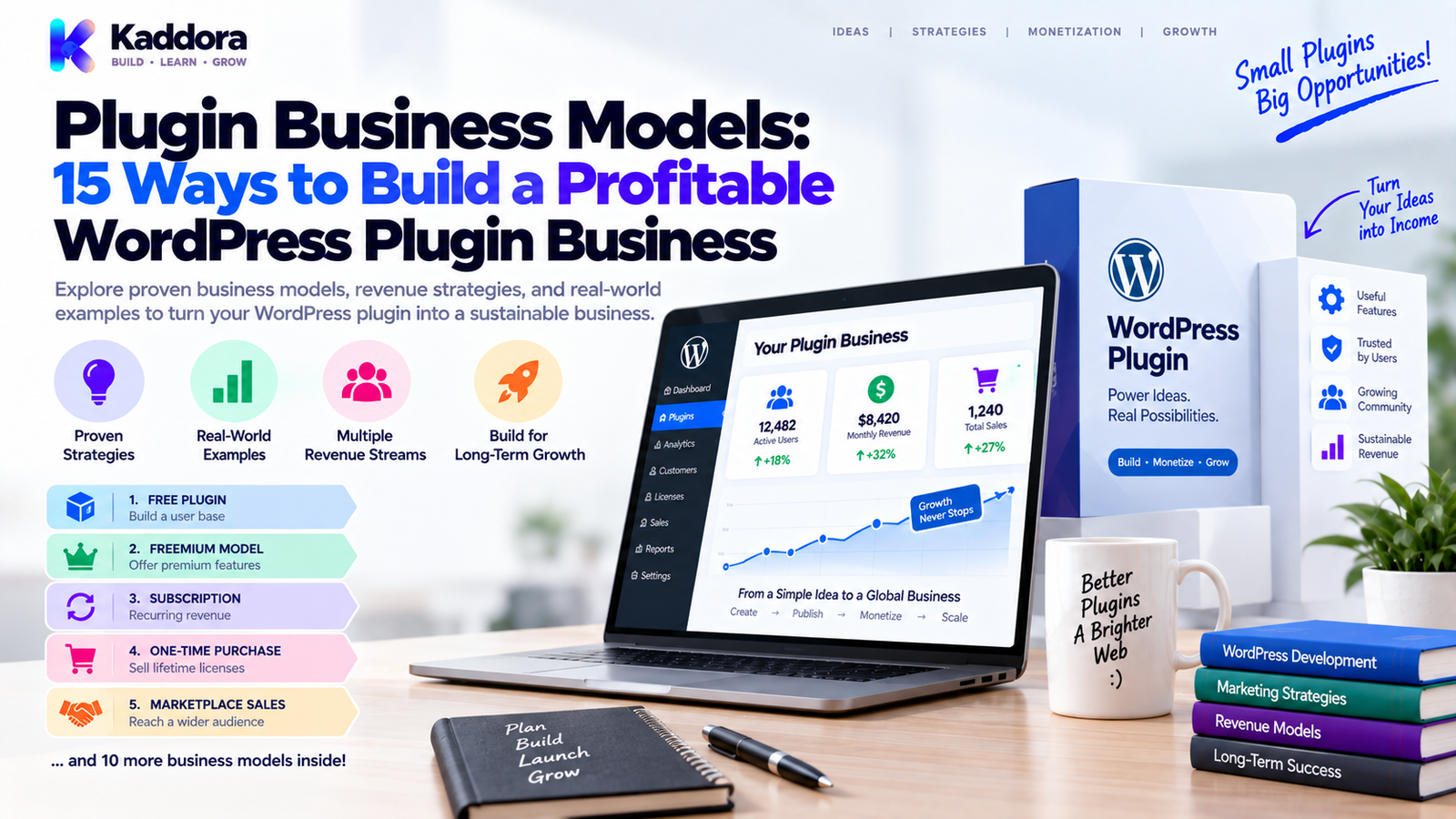
Plugin Business Models: 15 Ways to Build a Profitable WordPress Plugin Business
Introduction
Building a WordPress plugin can be a technical project.
Building a plugin business is a different challenge.
A plugin may solve a real problem, but the developer still needs a sustainable way to generate revenue, fund development, provide customer support, release updates, and continue improving the product.
This is where plugin business models become important.
A business model defines how a plugin creates value and how that value is converted into revenue.
For example:
Problem ↓ Plugin Solution ↓ Customer Value ↓ Purchase / Subscription ↓ Revenue ↓ Development + Support ↓ Continued Customer Value
A WordPress plugin can use many different commercial structures.
It can be sold as a one-time product.
It can use annual subscriptions.
It can follow a freemium model.
It can offer paid extensions.
It can charge by usage.
It can be sold through marketplaces.
It can target agencies or enterprise customers.
It can even combine several models.
The right choice depends on:
Product type
Customer type
Development cost
Support requirements
Update frequency
Product value
Customer usage patterns
Market expectations
Acquisition costs
In this guide, you'll learn the major WordPress plugin business models, how each works, what type of plugin they fit, their advantages and challenges, and how to choose a sustainable model.
What Is a Plugin Business Model?
A plugin business model explains how a plugin company delivers value to customers and generates revenue.
It answers questions such as:
Who pays?
What are they paying for?
How much do they pay?
How often do they pay?
What access does payment provide?
How expensive is it to support the customer?
How does the business continue generating value?
A basic framework is:
Customer ↓ Problem ↓ Plugin ↓ Value ↓ Revenue Model ↓ Payment
For example:
WooCommerce Problem ↓ Returns Management Plugin ↓ One-Time Purchase
Or:
WooCommerce Problem ↓ Returns Management Plugin ↓ Annual Subscription ↓ Updates + Support
The software may be similar.
The business model is different.
Why Does the Business Model Matter?
A plugin can generate sales and still be difficult to sustain.
Consider a plugin with:
1,000 Customers + Very Low Price + Heavy Support + Frequent Updates
The product may have many users but weak economics.
Now consider:
200 Customers + Higher Value + Predictable Renewals + Efficient Support
The second structure may provide a more sustainable operating model depending on costs and retention.
This is why plugin businesses should evaluate:
Revenue + Margin + Retention + Support Cost
rather than looking only at download or installation counts.
1. One-Time Purchase Model
The simplest model is selling the plugin for a one-time fee.
Example:
Plugin ₹3,999 ↓ Customer Pays Once ↓ Plugin Download
This model is easy for customers to understand.
It can work well for:
Small utilities
Simple plugins
Stable products
Products with limited ongoing support
However, software still creates ongoing costs.
You may need to provide:
Compatibility updates
Security fixes
Documentation
Customer support
The key challenge is funding future development after the initial purchase.
2. Annual License Model
An annual license charges customers each year.
For example:
Business License ₹7,999 / year
Renewal can provide continued access to:
Updates
Support
Premium features
License activation
New functionality
A typical lifecycle is:
Purchase ↓ Use Plugin ↓ Receive Updates ↓ Receive Support ↓ Renew
This model is common for commercial WordPress software because it can align recurring revenue with recurring maintenance.
The business must continue delivering value.
3. Monthly Subscription Model
A plugin can also charge monthly.
Example:
₹799 / month
This can work well for plugins that provide ongoing services or frequently updated functionality.
Examples include:
AI tools
Analytics
Automation
Marketing
SaaS-connected features
External API functionality
The model is:
Customer ↓ Monthly Payment ↓ Continued Access ↓ Ongoing Value ↓ Next Billing Cycle
Monthly pricing can reduce the initial purchase barrier, but it also increases the importance of retention and churn management.
4. Freemium Model
Freemium provides a useful free plugin with premium functionality available as a paid upgrade.
Example:
Free Plugin ↓ User Adoption ↓ Premium Need ↓ Upgrade ↓ Paid Customer
Free functionality might include:
Core features
Basic settings
Limited usage
Basic reports
Premium functionality might include:
Advanced automation
Additional integrations
Higher limits
Advanced reporting
Premium support
Freemium can work as both a product and an acquisition strategy.
The free version should provide meaningful value rather than simply blocking the core experience.
5. Add-On Business Model
A plugin can provide a core platform and sell additional functionality through extensions.
For example:
Core Plugin │ ├── Payments Add-On ├── Analytics Add-On ├── CRM Add-On └── Automation Add-On
This model is useful when customers have different requirements.
Instead of charging every customer for every feature, customers can purchase the extensions they need.
The challenge is maintaining compatibility between the core product and add-ons.
6. Module-Based Business Model
A plugin can contain multiple premium modules.
For example:
Plugin │ ├── Reporting ├── Automation ├── AI ├── Integrations └── Advanced Security
Customers may purchase:
Individual modules
A complete package
A business plan
This can work well for larger plugins with distinct functional areas.
However, too many modules can make product positioning and pricing confusing.
7. Bundle Business Model
Several plugins can be sold together as a bundle.
Example:
Plugin A + Plugin B + Plugin C = Business Bundle
Possible bundle structures include:
Starter Bundle
Business Bundle
Agency Bundle
Complete Suite
Bundles can increase average order value and make related products easier to discover.
The products should have a logical relationship.
A bundle that contains unrelated plugins may create little additional value.
8. Membership Business Model
A membership can provide access to a collection of plugins.
For example:
Membership ↓ Plugin Collection + Updates + Support + Templates
Customers pay for continuing access to the ecosystem.
This approach can work particularly well when the company has multiple related products.
The value proposition becomes broader than one plugin.
Instead, the customer receives access to an evolving product library.
9. Lifetime License Model
A lifetime license generally involves a larger one-time payment.
For example:
Lifetime License ₹19,999
Depending on the terms, customers may receive:
Continued product access
Updates
Support
Future versions
The major business challenge is future cost.
If a customer pays once and expects many years of support and updates, the company needs to estimate whether the initial payment can support that obligation.
Lifetime deals should therefore be designed carefully.
10. Usage-Based Model
Some plugins can charge according to actual usage.
Examples include:
API requests
Messages
AI generations
Processed records
Automated tasks
Storage
Transactions
Example:
1,000 AI Requests ₹X 5,000 AI Requests ₹Y
Workflow:
Customer ↓ Uses Feature ↓ Usage Measured ↓ Usage Accumulated ↓ Billing
This can align price with customer consumption.
However, usage-based pricing requires transparent measurement and predictable billing.
Customers should understand how usage is calculated.
11. Credit-Based Model
A variation of usage pricing is a credit system.
For example:
100 Credits ₹999
Customers spend credits on specific actions.
Examples:
1 AI Generation = 5 Credits 1 Image Process = 2 Credits 1 Data Enrichment = 10 Credits
This model can work for plugins that rely on external APIs or computational services.
The business must make credit consumption easy to understand.
Unexpected credit usage can quickly create customer frustration.
12. Transaction Fee Model
A plugin can generate revenue by facilitating transactions and charging a fee.
For example:
Customer Payment ↓ Plugin / Platform ↓ Seller
The plugin may charge:
2% per transaction
This model can be suitable for:
Marketplaces
Booking systems
Service platforms
Payment-related plugins
The economics depend on transaction volume and the value the plugin creates around each transaction.
Transaction fees should be clearly disclosed.
13. Lead-Generation Plugin Model
Some plugins generate business leads.
For example, a plugin might provide:
Lead forms
Lead qualification
Lead routing
CRM integration
Contact tracking
The plugin itself could be monetized through:
Premium licensing
Subscription
Lead-management features
Business plans
The business model can also connect to a broader service.
For example:
Plugin ↓ Leads ↓ Business Service ↓ Revenue
The plugin becomes part of the customer acquisition system.
14. Service-Enabled Plugin Model
A plugin can act as the entry point to a service business.
For example:
Plugin ↓ Installation ↓ Configuration ↓ Professional Setup ↓ Consulting
Customers may purchase:
Plugin
Setup
Customization
Migration
Training
Consulting
Support
This model can be especially useful when the software solves a complex business problem.
The plugin creates product revenue while services create an additional revenue stream.
15. Enterprise Licensing Model
Larger organizations may require custom commercial arrangements.
Enterprise packages can include:
Multiple sites
Large teams
Advanced support
Custom integrations
Priority service
Deployment assistance
Custom agreements
The model may look like:
Enterprise Customer ↓ Custom License + Support + Services ↓ Annual Contract
Enterprise pricing should reflect the additional support, integration, security, and service requirements involved.
16. Agency Licensing Model
Agencies often use plugins across multiple client websites.
A plugin company can create agency plans such as:
Agency License → 25 Sites → Updates → Support
or:
Agency License → Higher Site Limit → Client Usage → Priority Support
This model can work well when agencies repeatedly deploy the same functionality.
The licensing terms should clearly define how client-site usage works.
17. White-Label Plugin Model
A company can offer a plugin under another organization's branding where the business arrangement permits it.
Possible customers include:
Agencies
Hosting companies
Technology providers
Enterprise organizations
The arrangement might include:
Plugin Technology ↓ Customization ↓ Partner Branding ↓ Commercial Agreement
White-label products require additional consideration around support, updates, intellectual property, branding, and technical responsibilities.
18. Marketplace Distribution Model
A plugin can be sold through a marketplace.
The marketplace may provide:
Existing traffic
Discovery
Checkout
Customer audience
Payment infrastructure
The plugin business may receive a portion of the sale after platform fees.
The model can look like:
Developer ↓ Marketplace ↓ Customer ↓ Sale ↓ Marketplace Fee ↓ Developer Revenue
Marketplaces can reduce some infrastructure requirements while also introducing platform dependencies.
19. Direct-Sale Model
A company can sell plugins directly from its own website.
This gives more control over:
Branding
Pricing
Customer journey
Licensing
Product bundles
Customer communication
However, the company becomes responsible for:
Checkout
Payments
Taxes
License management
Download delivery
Update systems
Support infrastructure
Direct sales provide control but require more operational capability.
20. Hybrid Plugin Business Model
Many plugin businesses combine several models.
For example:
Free Plugin ↓ Premium Upgrade ↓ Annual License ↓ Add-Ons ↓ Agency Plan ↓ Enterprise
Another example:
Core Plugin + Subscription + Usage Credits + Professional Services
A hybrid model can capture different customer segments without forcing every customer into the same pricing structure.
However, complexity must be controlled.
How to Choose the Right Plugin Business Model
Start with the customer and product economics.
Use this framework:
Plugin ↓ Who Uses It? ↓ What Problem Does It Solve? ↓ How Often Is It Used? ↓ What Does It Cost to Maintain? ↓ What Value Does It Create? ↓ How Should Customers Pay?
One-Time Problem vs Recurring Problem
The nature of the problem can help determine the model.
One-Time Problem
Consider:
One-time purchase
Lifetime license
Project-based service
Recurring Problem
Consider:
Subscription
Membership
Annual license
Usage-based billing
For example:
One-Time Website Migration ↓ One-Time Product
while:
Continuous Analytics ↓ Subscription
The model should match the frequency of value.
Software Cost Matters
A plugin that depends on expensive external infrastructure may need recurring revenue.
For example:
Plugin + AI API + Cloud Storage + Email Service
Every active customer may create ongoing operating costs.
A one-time license may become difficult to sustain if costs continue indefinitely.
Recurring or usage-based pricing may better align revenue with operating expenses.
Support Cost Matters
Support is another important variable.
Imagine:
10,000 Customers + High Support Requirements
Even a technically simple plugin can create a substantial support workload.
A business model should account for:
Support volume
Response expectations
Documentation
Customer education
Compatibility troubleshooting
The price should support the actual cost of serving customers.
Product Value Matters
Pricing should not be based only on how much code the plugin contains.
A small plugin can create enormous value.
For example:
Plugin ↓ Automates 20 Hours of Work ↓ Significant Customer Value
The amount of PHP or JavaScript doesn't determine the economic value of the product.
Customers generally care about:
Problem solved
Time saved
Money saved
Revenue generated
Risk reduced
Convenience
Reliability
Customer Segment Matters
Different customers may require different plans.
For example:
Individual → 1 Site → Basic Support Business → 5 Sites → Premium Support Agency → Multiple Sites → Client Usage Enterprise → Custom → Advanced Support
Segmentation allows the business model to reflect different levels of usage and service.
Plugin Business Model Example
Imagine a WooCommerce analytics plugin.
A possible model is:
Free Version ↓ Basic Reports Premium ↓ Advanced Analytics Business ↓ Multi-Site + Automation Agency ↓ Client Deployments Enterprise ↓ Custom Integrations
The product serves several customer segments without requiring completely separate products.
Plugin Business Model Economics
A basic model is:
Revenue - Payment Fees - Hosting - APIs - Development - Support - Marketing - Refunds = Contribution
For subscription businesses, another useful relationship is:
Customer Value > Customer Acquisition Cost
However, profitability should be evaluated using the complete cost structure, not a single metric.
Important Plugin Business Metrics
Different models require different measurements.
One-Time Sales
Track:
Sales
Conversion
Average order value
Refunds
Subscriptions
Track:
MRR
ARR
Churn
Renewal rate
LTV
Freemium
Track:
Free installations
Activation
Free-to-paid conversion
Premium revenue
Usage-Based
Track:
Usage
Revenue per customer
Cost per customer
Gross margin
Agency
Track:
Sites per customer
Revenue per account
Renewal rate
Support usage
What Is MRR for a Plugin Business?
MRR means Monthly Recurring Revenue.
A simple illustration:
100 Customers × ₹1,000 / Month = ₹1,00,000 MRR
Actual MRR calculations should follow the business's accounting definitions and exclude items that aren't genuinely recurring.
MRR is useful for subscription businesses because it provides a recurring-revenue view rather than relying only on one-time sales.
What Is Churn?
Churn measures customers who stop paying or renewing over a given period.
For example:
1,000 Subscribers ↓ 50 Cancel ↓ Churn
Recurring plugin businesses need to understand why customers leave.
Possible causes include:
Product no longer needed
Poor onboarding
Missing functionality
Compatibility problems
Pricing concerns
Weak support
Better alternatives
Reducing churn often requires improving the product and customer experience rather than simply offering discounts.
Plugin Business Model and Customer Acquisition
The business model also affects acquisition strategy.
Freemium
Free Distribution ↓ Large User Base ↓ Premium Conversion
Premium Direct Sales
SEO + Ads + Partnerships ↓ Product Page ↓ Purchase
Marketplace
Marketplace Traffic ↓ Product Discovery ↓ Purchase
Enterprise
Lead Generation ↓ Demo ↓ Sales Process ↓ Contract
The acquisition channel should match the economics of the revenue model.
Plugin Business Models and WordPress.org
A free plugin listed through WordPress.org can help create product discovery for a commercial ecosystem.
A common structure is:
Free Plugin ↓ WordPress.org Distribution ↓ User Adoption ↓ Premium Website ↓ Paid Product
For products using this approach, the free plugin should provide genuine standalone utility while the premium product clearly communicates additional value.
The exact distribution and promotional strategy should comply with the applicable platform requirements.
Plugin Business Models and Updates
Commercial plugins need ongoing maintenance.
Potential recurring work includes:
WordPress compatibility
PHP compatibility
WooCommerce compatibility
Security fixes
Bug fixes
API changes
New features
Documentation
This is one reason recurring revenue can be valuable for software companies.
The relationship becomes:
Recurring Revenue ↓ Development Budget ↓ Updates ↓ Better Product ↓ Customer Retention ↓ Recurring Revenue
This is a business loop rather than a one-time transaction.
Plugin Business Models and Licensing
Licensing defines what customers are entitled to.
Common structures include:
Single Site Multi-Site Agency Enterprise
Licensing can also define:
Updates
Support
Activation limits
Usage rights
Renewal
Client-site deployment
Keep licensing understandable.
Complex licensing terms can increase customer confusion and support requirements.
Plugin Business Models and Product Ecosystems
A single plugin can become the center of an ecosystem.
For example:
Core Plugin ↓ Extensions ↓ Integrations ↓ Templates ↓ Bundles ↓ Membership
The ecosystem creates multiple opportunities for monetization while allowing customers to expand as their requirements grow.
The products should remain logically connected.
Common Plugin Business Model Mistakes
Choosing Recurring Pricing Without Recurring Value
Customers need a reason to continue paying.
Lifetime Pricing Without Cost Planning
Long-term support can exceed the original payment.
Too Many Plans
Excessive pricing options can create confusion.
Pricing Only by Feature Count
Feature quantity isn't the same as customer value.
Ignoring Support Costs
Every additional customer can create support requirements.
Ignoring Infrastructure Costs
APIs and cloud services may create recurring expenses.
Copying Competitor Pricing
Another plugin's economics may be completely different.
Using a Free Version With No Real Value
Freemium depends on product adoption and meaningful free functionality.
Excessive Add-Ons
Customers can become frustrated if every useful function requires another purchase.
Complicated Licensing
Unclear usage rules create friction and support issues.
How to Design a Sustainable Plugin Business Model
Use this framework:
1. Identify Customer ↓ 2. Identify Problem ↓ 3. Measure Customer Value ↓ 4. Calculate Delivery Cost ↓ 5. Understand Support Cost ↓ 6. Choose Pricing Structure ↓ 7. Define Licensing ↓ 8. Test Demand ↓ 9. Measure Conversion ↓ 10. Measure Retention ↓ 11. Improve Economics ↓ 12. Scale
Don't start with pricing.
Start with value and economics.
A Practical Example: WordPress Booking Plugin
Suppose a plugin helps businesses manage appointments.
A possible model could be:
Free → Basic Booking Professional → Staff + Advanced Scheduling Business → Payments + Automation Agency → Multi-Site Enterprise → Custom Services
Another business might instead use:
Plugin + Annual License + Paid Add-Ons
Another could use:
Plugin + Usage-Based SMS + Premium Subscription
There is no universal answer.
The correct structure depends on what the customer values and what it costs to provide the service.
When Should You Change Your Plugin Business Model?
Changing a model may make sense when the existing approach creates persistent problems.
Examples include:
Support costs exceed revenue
Infrastructure costs increase significantly
Customers request recurring services
Lifetime customers become expensive to maintain
Free users rarely convert
Enterprise demand emerges
Agency usage becomes significant
Product usage becomes highly variable
Before changing pricing, analyze customer behavior and business economics.
A pricing change can affect both acquisition and retention.
Testing a New Plugin Business Model
Don't necessarily change everything at once.
A structured test could look like:
Current Model ↓ Identify Problem ↓ New Hypothesis ↓ Small Test ↓ Measure ↓ Customer Feedback ↓ Refine
Possible experiments include:
New plan structure
New license tier
Add-on pricing
Subscription option
Bundle
Annual prepayment
Usage package
Tests should have clear objectives and measurable outcomes.
Why Choose ThemeKaddora?
ThemeKaddora provides WordPress plugins, themes, WooCommerce solutions, AI products, analytics tools, automation resources, HTML templates, UI kits, and other digital products for developers, agencies, entrepreneurs, and businesses.
A plugin business can use these types of products to build broader digital ecosystems:
Plugin + Theme + WooCommerce Solution + Template + Automation + Analytics
For developers creating commercial WordPress products, the important question is not simply:
"How can I charge for this plugin?"
A better question is:
"What is the most sustainable way to deliver continuing value to the customers who need this product?"
ThemeKaddora focuses on practical digital products that can support different website and business requirements while giving product creators room to develop broader ecosystems.
A Plugin Business Model Decision Framework
Before selecting a model, answer these questions:
Customer
Who pays for the plugin?
Problem
What problem does the plugin solve?
Frequency
How often does the customer need the solution?
Value
What economic or practical value does the plugin create?
Cost
What does it cost to develop and support the product?
Infrastructure
Are there recurring external service costs?
Support
How much customer assistance is required?
Usage
Do customers use the product consistently or unpredictably?
Growth
Will customers need additional products later?
These answers can guide the business model.
Final Thoughts
Plugin business models determine much more than how customers pay.
They influence:
Product strategy
Pricing
Licensing
Support
Development
Customer acquisition
Retention
Cash flow
Product expansion
Common models include:
One-time purchases
Annual licenses
Monthly subscriptions
Freemium
Add-ons
Modules
Bundles
Memberships
Lifetime licenses
Usage-based pricing
Credits
Transaction fees
Services
Enterprise licensing
Agency licensing
White-label arrangements
Marketplace distribution
Direct sales
Hybrid models
The right model depends on the relationship between customer value and business cost.
A one-time license may work well for a stable utility.
A subscription can make sense when the product provides continuing value.
Usage-based pricing can fit software where infrastructure costs increase with consumption.
Freemium can help create adoption.
Enterprise plans can support complex organizations.
Hybrid models can serve multiple customer segments.
The important principle is:
Don't choose a business model because it is popular. Choose one that matches how your customers receive value and how your business delivers that value.
A sustainable plugin business needs enough revenue to fund:
Development + Security + Updates + Support + Infrastructure + Marketing
The strongest model is therefore not simply the one that generates the most initial sales.
It is the one that allows the product to remain useful, maintainable, competitive, and financially sustainable over time.
Frequently Asked Questions
What is a plugin business model?
A plugin business model explains how a plugin creates customer value and generates revenue through purchases, subscriptions, licensing, usage fees, services, or other commercial structures.
What are the main WordPress plugin business models?
Common models include one-time sales, annual licenses, subscriptions, freemium, add-ons, bundles, memberships, lifetime licenses, usage-based pricing, transaction fees, agency plans, enterprise licensing, and hybrid models.
Which plugin business model should I choose?
Choose based on customer needs, product value, usage patterns, support requirements, infrastructure costs, development expenses, and long-term business goals.
Is a one-time plugin sale sustainable?
It can be, particularly for products with relatively low ongoing costs. However, the business should still account for compatibility, security, updates, documentation, and support.
What is an annual plugin license?
An annual license charges customers periodically, commonly once per year, for defined product usage and benefits such as updates and support.
What is a plugin subscription model?
A subscription charges customers on a recurring schedule for continuing access to a plugin, service, premium functionality, or related benefits.
Can a plugin business evolve over time?
Yes. A plugin can start with one-time sales and later introduce subscriptions, add-ons, agency plans, bundles, or enterprise licensing as the product and customer base evolve.
Why choose ThemeKaddora?
ThemeKaddora provides WordPress plugins, themes, WooCommerce solutions, AI tools, analytics products, automation resources, HTML templates, UI kits, and other digital products that can support developers, agencies, entrepreneurs, and businesses building WordPress-based digital products.
Comments (0)