
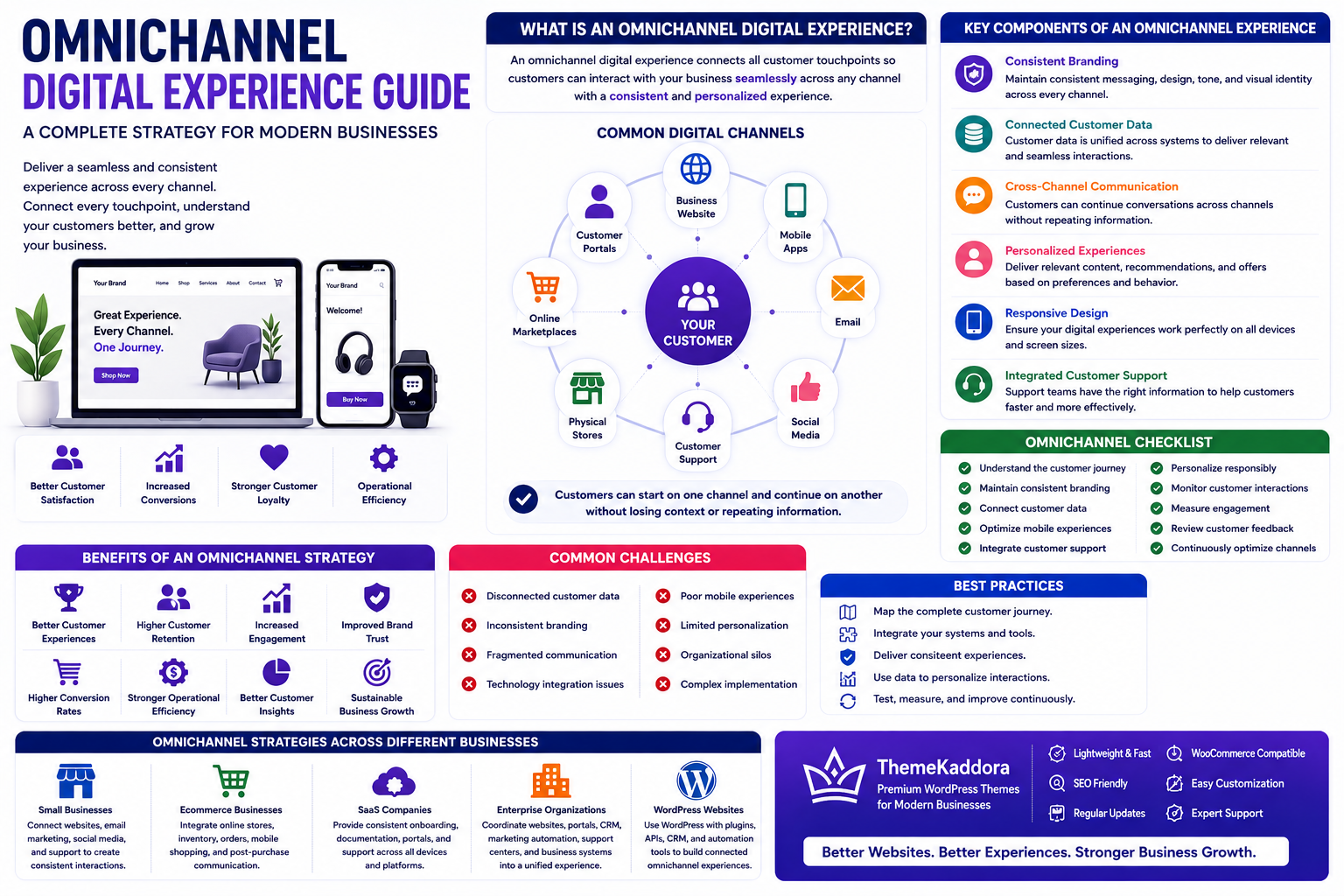
Omnichannel Digital Experience Guide: A Complete Strategy for Modern Businesses
Introduction
Today's customers rarely interact with a business through a single channel. They may discover your brand through search engines, browse your website on a laptop, engage with social media on a smartphone, receive email updates, contact customer support, and eventually make a purchase online or in-store.
These interactions are all part of one continuous customer journey.
An Omnichannel Digital Experience ensures that every interaction feels connected, regardless of the device or platform a customer uses. Instead of treating each channel separately, businesses create a consistent and seamless experience across all digital touchpoints.
Whether you operate a WordPress website, ecommerce business, SaaS platform, or enterprise organization, an omnichannel strategy helps strengthen customer relationships and improve long-term business growth.
What Is an Omnichannel Digital Experience?
An omnichannel digital experience is a strategy that delivers consistent customer interactions across multiple communication channels while maintaining continuity throughout the customer journey.
Common channels include:
Business website
Mobile applications
Social media
Customer portals
Live chat
Online marketplaces
Physical stores
Customer support
Customers should be able to move between channels without losing context.
Why Omnichannel Experiences Matter
Businesses invest in omnichannel strategies because they help:
Improve customer satisfaction
Strengthen brand consistency
Increase customer loyalty
Improve engagement
Support personalized experiences
Increase conversions
Improve operational efficiency
Customers value convenience and consistency.
Key Components
Consistent Branding
Maintain consistent messaging, design, tone, and visual identity across every channel.
Connected Customer Data
Customer information should be available where appropriate so interactions remain relevant and seamless.
Cross-Channel Communication
Customers should be able to continue conversations across different channels without repeating information.
Personalized Experiences
Provide relevant recommendations, content, and services based on customer preferences and previous interactions.
Responsive Design
Ensure digital experiences work effectively across smartphones, tablets, laptops, and desktop computers.
Integrated Customer Support
Support teams should have access to relevant customer information to provide efficient assistance.
Benefits of an Omnichannel Strategy
Organizations gain:
Better customer experiences
Higher customer retention
Increased engagement
Improved brand trust
Better conversion rates
Stronger operational efficiency
Improved customer insights
A connected experience strengthens every stage of the customer journey.
Common Challenges
Businesses often encounter:
Disconnected customer data
Inconsistent branding
Fragmented communication
Technology integration issues
Poor mobile experiences
Limited personalization
Organizational silos
Addressing these challenges requires coordination across teams and systems.
Best Practices
Map the complete customer journey.
Maintain consistent branding.
Integrate business systems.
Personalize experiences responsibly.
Optimize for mobile users.
Monitor customer feedback.
Continuously improve every channel.
Omnichannel Strategies Across Different Businesses
Small Businesses
Connect websites, email marketing, social media, and customer support to create consistent customer interactions.
Ecommerce Businesses
Integrate online stores, inventory, order tracking, customer accounts, mobile shopping, and post-purchase communication.
SaaS Companies
Provide consistent onboarding, product documentation, customer portals, support systems, and account management across devices.
Enterprise Organizations
Coordinate websites, regional platforms, customer portals, CRM systems, marketing automation, and support centers into a unified customer experience.
WordPress Websites
WordPress websites can support omnichannel experiences through CRM integrations, WooCommerce, multilingual capabilities, customer portals, marketing automation platforms, analytics tools, and API-based connections with business applications.
Omnichannel Digital Experience Checklist
Before implementing an omnichannel strategy, make sure you:
✅ Understand the customer journey
✅ Maintain consistent branding
✅ Connect customer data
✅ Optimize mobile experiences
✅ Integrate customer support
✅ Personalize responsibly
✅ Monitor customer interactions
✅ Measure engagement
✅ Review customer feedback
✅ Continuously optimize every channel
Why Choose Themekaddora?
Successful omnichannel experiences require a flexible and scalable website foundation.
Themekaddora WordPress themes provide:
Lightweight architecture
Fast loading performance
SEO-friendly code
Responsive layouts
WooCommerce compatibility
Flexible customization
Accessibility-conscious design
Clean HTML5 and CSS3 standards
Cross-browser compatibility
Regular updates
Professional support
These features help businesses build WordPress websites that integrate seamlessly with broader digital ecosystems while delivering consistent customer experiences across multiple channels.
Conclusion
An omnichannel digital experience connects every customer interaction into one seamless journey. By integrating websites, mobile experiences, customer support, marketing, and business systems, organizations create more convenient, personalized, and consistent experiences that strengthen customer relationships and drive long-term growth.
Whether you're managing a business website, ecommerce platform, SaaS application, or enterprise organization, an omnichannel strategy is an essential part of modern digital success.
Frequently Asked Questions (FAQs)
What is an omnichannel digital experience?
An omnichannel digital experience provides customers with consistent and connected interactions across websites, mobile apps, email, social media, customer support, and other digital channels.
Why is an omnichannel strategy important?
It improves customer satisfaction, strengthens brand consistency, increases engagement, and supports better customer relationships throughout the entire journey.
How is omnichannel different from multichannel?
Multichannel means using multiple communication channels, while omnichannel focuses on integrating those channels into one seamless customer experience.
Can WordPress support an omnichannel strategy?
Yes. WordPress integrates with CRM systems, WooCommerce, customer portals, marketing automation tools, APIs, and analytics platforms, making it a strong foundation for omnichannel experiences.
Why choose Themekaddora?
Themekaddora provides lightweight, SEO-friendly WordPress themes with responsive layouts, WooCommerce compatibility, fast performance, accessibility-conscious design, regular updates, and professional support—helping businesses build WordPress websites that serve as the central hub of a connected omnichannel digital experience.
Comments (0)