
Introduction
Email newsletters remain a valuable way for businesses, bloggers, ecommerce stores, and content creators to maintain relationships with their audiences.
A newsletter can announce new products, share useful articles, promote special offers, communicate company updates, and bring subscribers back to a website. However, managing the process involves more than writing an email and clicking Send.
Website owners need to create attractive email layouts, manage subscriber lists, build signup forms, schedule campaigns, automate welcome messages, track engagement, and maintain responsible subscription practices.
Using separate tools for these activities can make email marketing difficult to manage. Templates may be scattered across different systems, subscriber information may require manual transfers, and recurring campaigns may need to be recreated repeatedly.
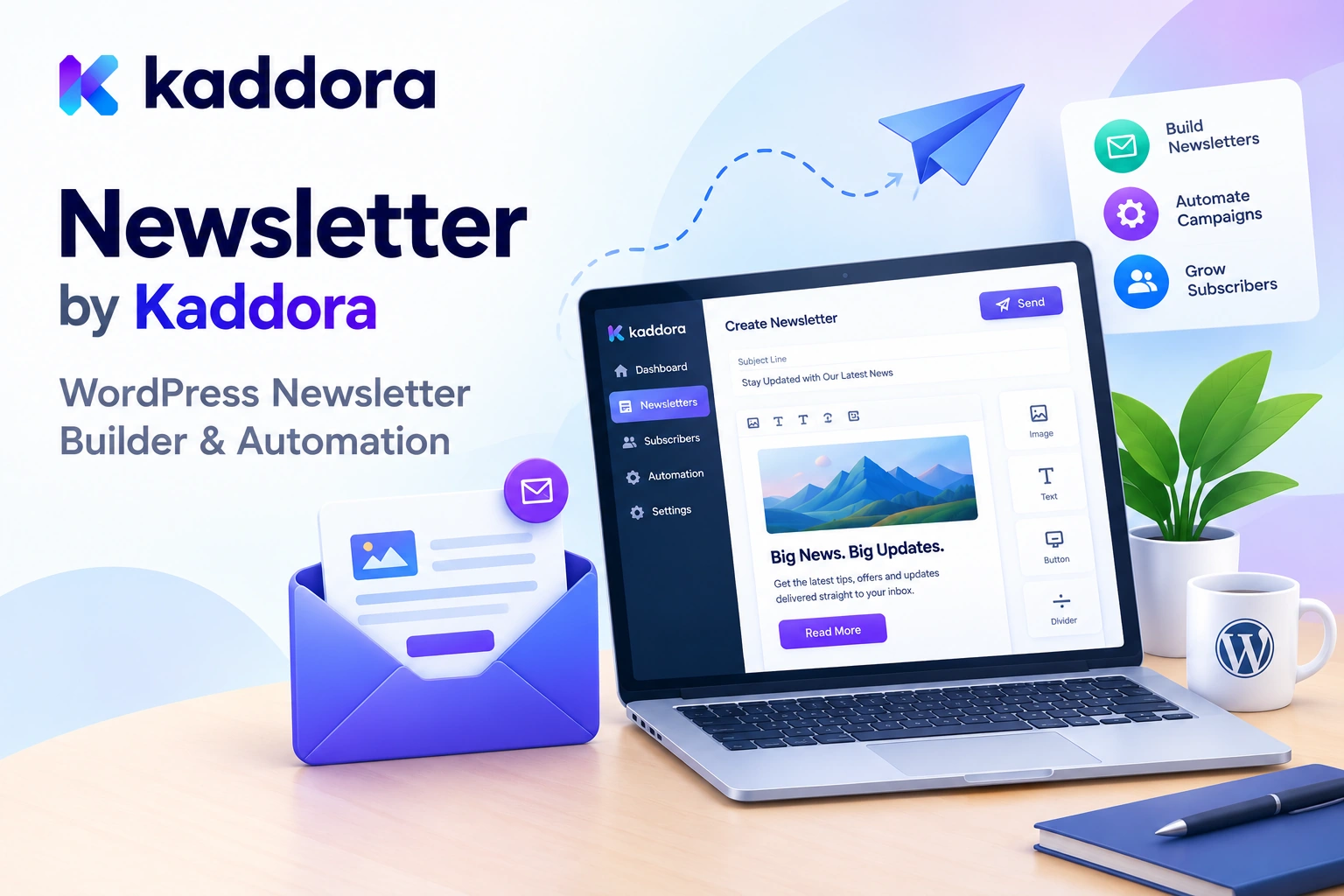
Newsletter by Kaddora – WordPress Newsletter Builder & Automation Plugin is designed to bring these activities together inside the WordPress dashboard.
With its visual drag-and-drop email builder, 70+ newsletter templates, subscriber management, campaign scheduling, email automation, signup forms, WooCommerce integration, and campaign analytics, the plugin provides a structured environment for creating and managing WordPress newsletters.
In this guide, we'll explore its features, practical use cases, setup process, and best practices for building an effective newsletter marketing workflow.
What Is Newsletter by Kaddora?
Newsletter by Kaddora is a WordPress newsletter and email marketing plugin that helps website owners create, manage, and automate email campaigns without manually building every newsletter from HTML.
The plugin combines newsletter design, subscriber management, signup forms, campaign scheduling, automation, email tracking, and reporting in one WordPress-oriented interface.
According to the official Newsletter by Kaddora product listing, its advertised features include:
Drag-and-drop newsletter builder
70+ customizable newsletter templates
Reusable email designs
Desktop, tablet, and mobile previews
Subscriber management and CSV import/export
Newsletter signup forms
Double opt-in and unsubscribe handling
Campaign creation and scheduling
Batch email queue
Automated email sequences
Welcome emails and follow-up campaigns
New post notifications and weekly digests
WooCommerce email marketing integration
Supported form plugin integrations
Open and click tracking
Campaign analytics
JSON template import and export
These capabilities are intended to help businesses organize newsletter creation and delivery from their existing WordPress environment.
Why Do WordPress Websites Need a Newsletter Plugin?
A website can attract visitors through search engines, social media, referrals, and advertising. However, a visitor may leave without making a purchase, exploring other articles, or returning later.
A newsletter provides a way to maintain communication with people who choose to subscribe.
For example, a business may share useful information with subscribers before promoting a service. A blog can notify readers about newly published articles. A WooCommerce store can announce product launches and relevant offers.
Without a structured newsletter workflow, these activities can become repetitive and difficult to maintain.
Common challenges include:
Time-consuming design: Creating every email from scratch takes unnecessary effort.
Disorganized subscribers: Contact lists may be difficult to import, update, segment, or maintain.
Missed opportunities: New subscribers may not receive a timely welcome message.
Inconsistent campaigns: Recurring newsletters may use different layouts and branding.
Manual follow-ups: Businesses repeatedly prepare messages that could be scheduled or automated.
Limited visibility: Without campaign analytics, it can be difficult to understand whether subscribers interact with newsletter content.
Newsletter by Kaddora is designed to address these challenges by combining the main newsletter workflow inside WordPress.
Key Features of Newsletter by Kaddora
1. Drag-and-Drop Newsletter Builder
Creating a professional newsletter often requires a combination of text, images, headings, buttons, and carefully arranged sections.
Newsletter by Kaddora includes a visual drag-and-drop email builder that allows users to assemble newsletter layouts without manually writing complex HTML.
The advertised content blocks include:
Headings and text
Images
Buttons
Hero sections
Product sections
Multiple-column layouts
Coupons
Statistics
Quotes
Video blocks
Lists
Dividers and spacers
Social media footers
Users can also customize properties such as typography, colors, alignment, links, images, spacing, padding, margins, and section widths.
For example, a product announcement email might use a hero image, a headline, a short description, product details, a call-to-action button, and a branded footer.
A visual editor makes these elements easier to arrange and customize while maintaining a consistent design.
2. More Than 70 Newsletter Templates
Starting with a blank email can be time-consuming, especially when creating campaigns regularly.
Newsletter by Kaddora advertises a library of 70+ responsive newsletter templates for different business and communication needs.
The listed template categories include:
Welcome emails
Weekly newsletters
Business announcements
Product launches
Ecommerce campaigns
Promotional offers
Coupon emails
Holiday newsletters
Educational newsletters
SaaS updates
Event announcements
Customer communications
Lead nurturing campaigns
Product recommendations
These templates provide starting points that can be adapted to a company's branding and message.
For example, a blogger could customize a weekly newsletter template to feature recent articles, while an ecommerce store might use a product-oriented layout for a new collection announcement.
Templates save design time, but they should still be reviewed for content accuracy, brand consistency, and mobile readability.
3. Reusable Newsletter Templates
Businesses frequently send similar types of email.
A weekly newsletter, monthly update, welcome message, or promotional campaign may follow a consistent structure even when the content changes.
Newsletter by Kaddora supports saving newsletter designs for reuse.
This can help maintain consistency across recurring campaigns and reduce repeated layout work.
For example:
Create Newsletter Design ↓ Customize Brand Elements ↓ Save the Template ↓ Reuse for Future Campaigns ↓ Update Content ↓ Preview and Send
Reusable designs are particularly helpful for teams that publish newsletters on a regular schedule.
Keep reusable templates flexible enough to accommodate changing content without making every email look identical.
4. Responsive Email Preview
Subscribers may read emails on desktop computers, tablets, and smartphones.
A layout that looks balanced on a large screen may become difficult to navigate on a smaller display if text, images, or buttons are not arranged appropriately.
Newsletter by Kaddora includes responsive preview functionality with desktop, tablet, and mobile viewing modes.
This allows users to inspect their campaign layout before sending it.
During review, check:
Heading and paragraph readability
Image sizing
Button visibility
Link accessibility
Column arrangement
Content spacing
Footer information
Responsive previews are useful, but email clients render HTML differently. Send test emails and check them in the actual email clients used by your audience whenever practical.
5. Newsletter Preview, Test Emails, and Editing Controls
A newsletter should be reviewed before it reaches the entire subscriber list.
The plugin includes newsletter preview, test-email functionality, and Undo/Redo editing controls.
Previewing helps users check content, images, links, buttons, and formatting. A test email provides an additional opportunity to inspect the message as it appears in a mailbox.
A reliable review process can look like this:
Prepare Newsletter ↓ Preview Design ↓ Check Content and Links ↓ Send Test Email ↓ Review on Desktop and Mobile ↓ Schedule or Send Campaign
Undo and Redo controls also help users recover from accidental design changes while editing.
Make sure the subject line, sender identity, images, call-to-action links, and any promotional details are correct before launching the campaign.
6. Subscriber Management
An effective newsletter strategy depends on maintaining an organized subscriber database.
Newsletter by Kaddora includes subscriber management features that allow administrators to add subscribers, view and update contact information, remove records, import and export lists, and track subscription status.
This creates a central place to manage newsletter contacts instead of maintaining separate lists for each campaign.
For example, a business could maintain newsletter contacts collected through website signup forms and use the appropriate subscribed audience for future campaigns.
Subscriber management should prioritize permission and data quality. Only import contacts when the business has an appropriate basis to email them, and remove or suppress contacts according to their subscription preferences and applicable requirements.
7. CSV Subscriber Import and Export
Businesses moving from another newsletter platform may already have an existing contact list.
Newsletter by Kaddora supports CSV subscriber import and export, providing a way to move supported contact information into or out of the plugin.
A typical import workflow involves preparing a clean CSV file, matching the relevant fields, importing the records, and checking the resulting subscriber data.
Export functionality can help with permitted backups and data management.
Before importing a list, remove invalid or duplicate addresses where appropriate and preserve subscription status information. Importing an email address should not automatically be treated as proof of marketing consent.
8. Newsletter Signup Forms
A subscriber list needs a way to grow through voluntary signups.
Newsletter by Kaddora includes signup forms that can be embedded into supported WordPress pages, posts, landing pages, widgets, or content areas.
These forms can be used for:
Blog subscriptions
Product updates
Promotional newsletters
Business announcements
Event updates
Educational content
Special offers
For example, a blog might display a signup form at the end of a useful article, inviting readers to receive future updates.
Keep the value proposition clear. Explain what subscribers can expect, how frequently you plan to send emails, and where they can review your privacy information.
Avoid making subscription consent ambiguous or hiding it inside unrelated form submissions.
9. Double Opt-In and Unsubscribe Management
Responsible newsletter management requires more than collecting email addresses.
The plugin includes double opt-in functionality and built-in unsubscribe handling.
With double opt-in, subscribers are asked to confirm their email address before becoming fully subscribed. This can help reduce accidental subscriptions and improve list quality.
Unsubscribe functionality allows recipients to stop receiving newsletter communications through the available workflow.
These features support better subscription management, although email compliance depends on the full configuration and the applicable laws and provider rules.
Maintain accurate consent records where required, honor opt-out requests promptly, and ensure that unsubscribed contacts are not inadvertently reintroduced through imports or automation.
10. Email Campaign Creation and Scheduling
Newsletter by Kaddora provides campaign management controls that include creating drafts, editing and duplicating campaigns, sending, scheduling, pausing, resuming, resending, and deleting campaigns.
This supports a more organized campaign lifecycle.
For example, a business preparing a product launch can design its campaign in advance and schedule delivery rather than preparing the entire message immediately before the launch.
A typical process is:
Choose Audience ↓ Create Campaign ↓ Design Newsletter ↓ Review and Test ↓ Schedule or Send ↓ Track Available Results
Scheduling allows teams to plan campaigns in advance, coordinate communication, and reduce last-minute work.
Confirm that WordPress scheduling and background processing are functioning correctly. Scheduled delivery depends on the site's configuration and execution environment.
11. Batch Email Queue
Sending a campaign to a large list can create significant email processing activity.
Newsletter by Kaddora includes a batch email queue designed to process campaigns in a more controlled manner rather than attempting to send every message simultaneously.
This approach can help organize larger sending workloads through the configured WordPress mail delivery system.
Batch processing does not automatically guarantee deliverability or bypass provider sending limits. The appropriate approach depends on the email volume, hosting configuration, and available mail transport.
For larger campaigns, configure a suitable SMTP service or transactional email provider and review its sending policies before scheduling delivery.
12. Email Marketing Automation
Automation helps businesses send relevant messages when a particular subscription or content event occurs.
Newsletter by Kaddora includes email automation capabilities with configurable workflows and ready-to-configure presets.
The advertised automation possibilities include:
Welcome email automation
New subscriber sequences
Follow-up emails
New post notifications
Weekly digest campaigns
WooCommerce customer welcome campaigns
Customer onboarding
Educational sequences
Product announcements
Promotional follow-ups
Custom email workflows
For example, a new subscriber can receive a welcome message explaining what the newsletter covers, followed by useful content based on the publication schedule.
Automation can reduce repetitive manual work, but workflows should be tested to avoid duplicate messages, incorrect timing, or communication that ignores subscriber preferences.
13. One-Click Automation Presets and Custom Workflows
Setting up automation from scratch may be difficult for users who are new to email marketing.
Newsletter by Kaddora includes predefined automation presets that can be configured and adapted to a business's needs.
These presets can provide a starting point for welcome messages and other repeatable workflows.
The plugin also lists custom email automation functionality, allowing users to build workflows suited to their newsletter strategy.
Start with one clearly defined automation, test the trigger and outcome, and only then add more steps or conditions.
14. WordPress and WooCommerce Integration
Newsletter by Kaddora is designed to operate inside WordPress and includes supported subscriber-capture workflows involving WordPress users and popular form plugins.
The listed form integrations include Contact Form 7, WPForms, and Fluent Forms.
The plugin also provides WooCommerce integration for customer welcome campaigns, store newsletters, new product announcements, promotional offers, discount campaigns, and customer updates.
WooCommerce is required only when using the plugin's WooCommerce-related features.
When connecting forms or ecommerce workflows to newsletter subscriptions, ensure that the purpose of the subscription is clear and that marketing consent is handled appropriately. A purchase or contact-form submission should not automatically be interpreted as consent to unrelated promotional email.
15. Open Tracking, Click Tracking, and Email Analytics
Campaign reporting helps businesses understand how subscribers interact with newsletter content.
Newsletter by Kaddora includes analytics and tracking functionality for campaign activity, opens, clicks, subscriber activity, and engagement.
Click tracking can help identify which links attract interest, while available open statistics can provide a limited view of engagement.
For example, a newsletter with multiple article links may help a publisher understand which topics receive more clicks.
Open tracking is not a perfect measure of readership because email clients may block, proxy, or prefetch tracking resources. Click statistics can also be influenced by automated link checking or security tools.
Use these metrics as indicators rather than absolute measurements of human engagement. Combine them with website visits, conversions, subscriber growth, and other relevant data when evaluating campaign performance.
16. JSON Import and Export
The plugin supports importing and exporting newsletter designs using JSON.
This can help users back up supported templates, reuse layouts, transfer designs between websites, and standardize campaign creation across projects.
For example, an agency managing multiple WordPress sites may want to reuse a consistent newsletter layout while changing the brand assets and content for each client.
Check exported designs before reusing them. Confirm that images, links, buttons, and content references work correctly in the destination environment.
How to Install and Configure Newsletter by Kaddora
Step 1: Prepare Your WordPress Website
Confirm that your WordPress installation meets the requirements documented for the plugin version you downloaded.
The product listing specifies a compatible PHP environment, working WordPress email configuration, JavaScript enabled for the visual builder, and functioning WordPress scheduling for campaigns and automation. HTTPS is recommended for production sites.
If you plan to use WooCommerce-related features, install and configure WooCommerce separately.
Step 2: Install the Plugin
From your WordPress dashboard:
Navigate to Plugins → Add New Plugin → Upload Plugin.
Select the downloaded Newsletter by Kaddora ZIP file.
Click Install Now.
Activate the plugin.
Open Newsletter by Kaddora from the administration menu.
Follow the documentation supplied with your plugin version.
Step 3: Configure Email Delivery
Review the general email and sender settings before sending newsletters.
The product documentation recommends a working WordPress email configuration and SMTP setup for more reliable delivery.
Configure an appropriate sending method and verify sender identity and domain authentication where applicable.
Step 4: Import or Add Subscribers
Add eligible subscribers manually or import a properly prepared CSV file.
Review contact fields, subscription status, and consent information. Remove invalid or inappropriate records before using the list for campaigns.
Step 5: Create a Newsletter
Choose a predesigned template or start from a blank design.
Use the drag-and-drop builder to add text, images, headings, buttons, product sections, and other supported components.
Customize the layout to match your branding and newsletter objective.
Step 6: Preview and Test the Email
Review the newsletter using the available preview modes.
Send a test email to yourself or your team and verify the subject line, content, links, images, buttons, and layout.
Step 7: Schedule a Campaign or Build Automation
Send the newsletter immediately or schedule it for an appropriate time.
Alternatively, configure a welcome sequence, follow-up campaign, or another supported automation workflow.
Test the automation with controlled subscriber records before using it for your entire mailing list.
Step 8: Review Analytics
After a campaign is sent, examine the available activity and engagement reports.
Use the results to understand what may need improvement, but account for the limitations of email open tracking and automated link checking.
Best Practices for Effective Newsletter Marketing
Define a clear purpose. Each newsletter should provide a useful update, resource, announcement, or offer.
Build a permission-based subscriber list. Collect contacts through appropriate signup workflows and keep their subscription status accurate.
Keep branding consistent. Reusable templates can help maintain a professional appearance across campaigns.
Write meaningful subject lines. Communicate what the message contains without misleading recipients.
Optimize for mobile. Review newsletter layouts on different screen sizes and email clients.
Send test emails. Check links, images, buttons, subject lines, and formatting before sending to the full list.
Configure email delivery properly. Use an appropriate mail transport, verify sender authentication, and monitor delivery problems.
Use automation responsibly. Check triggers and conditions to prevent duplicate or irrelevant messages.
Honor unsubscribes. Ensure contacts who opt out are not accidentally added back to active campaigns.
Measure useful results. Review clicks, subscriber growth, website activity, conversions, and other relevant metrics rather than relying only on opens.
Protect subscriber information. Restrict access, use secure storage, and follow relevant privacy and email marketing requirements.
Common Newsletter Marketing Mistakes to Avoid
1. Sending Emails Without Testing
A broken link or poorly formatted email can undermine the campaign.
Better approach: Preview the newsletter and send a test email before launch.
2. Importing Contacts Without Reviewing Permission
An old or purchased email list may contain invalid addresses or contacts who have not agreed to receive your marketing.
Better approach: Import only contacts you have an appropriate basis to email and preserve relevant subscription status information.
3. Overusing Promotional Messages
A newsletter that always asks subscribers to buy something may offer little long-term value.
Better approach: Balance promotional content with useful information and relevant updates.
4. Ignoring Email Deliverability
A campaign being processed by WordPress does not guarantee that it reaches the recipient's inbox.
Better approach: Configure authenticated email delivery, respect sending limits, and review available delivery information.
5. Building Complex Automations Too Early
Multiple triggers and follow-ups can create unexpected behavior if they have not been tested.
Better approach: Begin with a simple workflow, verify its behavior, and expand gradually.
6. Misinterpreting Analytics
Open rates may be affected by email privacy features, while clicks may include automated security checks.
Better approach: Treat tracking metrics as indicators and evaluate them alongside other business outcomes.
Who Can Benefit From Newsletter by Kaddora?
Newsletter by Kaddora may be useful for:
Bloggers and publishers
Small and growing businesses
WooCommerce stores
Digital marketing agencies
SaaS companies
Restaurants and cafes
Educational websites
Coaches and consultants
Content creators
Marketing teams
WordPress developers
The best fit depends on your subscriber volume, sending requirements, content strategy, email delivery setup, and the features available in your installed version.
Why Choose Kaddora?
Kaddora focuses on practical WordPress products designed to help website owners manage digital workflows more efficiently.
Newsletter by Kaddora brings newsletter creation, subscriber management, signup forms, campaign scheduling, email automation, WooCommerce integration, and analytics into one WordPress-oriented environment.
The visual drag-and-drop builder, template library, saved designs, test-email functionality, and subscriber import/export tools are intended to make recurring newsletter production more organized.
For businesses, these features can help streamline communication with subscribers. For agencies and developers, reusable templates and supported integrations can provide a foundation for managing newsletter workflows across projects.
The objective is not simply to send more emails. It is to help businesses create useful newsletters, maintain a responsible subscriber list, automate appropriate follow-ups, and learn from campaign results.
Conclusion
Newsletter marketing can help WordPress businesses maintain communication with their audiences, share useful content, announce products, and develop customer relationships.
Newsletter by Kaddora – WordPress Newsletter Builder & Automation Plugin is designed to simplify this process through a drag-and-drop email builder, 70+ templates, subscriber management, CSV import/export, signup forms, double opt-in, unsubscribe handling, campaign scheduling, batch email processing, automation workflows, WooCommerce integration, and email analytics.
Whether you run a blog, online store, business website, or content-driven publication, the plugin provides a centralized environment for managing supported newsletter activities.
Start by organizing a permission-based subscriber list, creating a reusable newsletter design, testing email delivery, and building one simple automation. Then review campaign performance and refine your approach based on meaningful results.
A successful newsletter strategy combines useful content, reliable delivery, responsible subscriber management, and consistent communication. With an organized WordPress workflow, these activities become easier to maintain as your audience grows.
Frequently Asked Questions
What is Newsletter by Kaddora?
Newsletter by Kaddora is a WordPress newsletter builder and automation plugin designed to support visual email creation, subscriber management, campaign scheduling, signup forms, automated email sequences, and campaign analytics.
How many newsletter templates are included?
The product listing advertises more than 70 newsletter templates for welcomes, promotions, ecommerce, product launches, business updates, educational content, and other campaign types.
Can I import an existing subscriber list?
Yes. The plugin supports CSV subscriber import and export. Make sure imported contacts have appropriate subscription permissions and that their status information is preserved.
Does Newsletter by Kaddora support automated email sequences?
Yes. Its listed automation possibilities include welcome emails, follow-ups, new subscriber automation, new post notifications, weekly digests, WooCommerce customer welcome campaigns, and custom workflows.
Can I schedule newsletters?
Yes. Campaign scheduling is listed as a feature, along with campaign creation, drafts, duplication, pausing, resuming, resending, and deletion.
Does the plugin support double opt-in and unsubscribe management?
Yes. Double opt-in and built-in unsubscribe handling are listed features intended to help manage subscriptions responsibly.
Which form plugins are supported?
The product listing identifies Contact Form 7, WPForms, and Fluent Forms for supported subscriber-capture workflows. Check the current documentation for integration requirements and limitations.
Does the plugin track email opens and clicks?
Yes. Open tracking, click tracking, and newsletter analytics are listed features. Email client privacy protections and automated link checks can affect tracking accuracy, so interpret these metrics carefully.
Is an SMTP plugin recommended?
Yes. The product documentation recommends a working WordPress email configuration and SMTP setup for improved delivery reliability. Proper domain authentication and sending-provider configuration are also important.
Does the plugin guarantee that emails reach the inbox?
No. Inbox placement depends on the email provider, sender reputation, domain authentication, recipient policies, message content, and other factors. The plugin helps manage newsletter workflows, but delivery should be tested and monitored.
Why choose ThemeKaddora?
ThemeKaddora provides a marketplace for WordPress themes, plugins, and website templates. Website owners, bloggers, marketers, agencies, and developers can explore its catalog to find tools that match their technical requirements and communication goals.
Comments (0)