
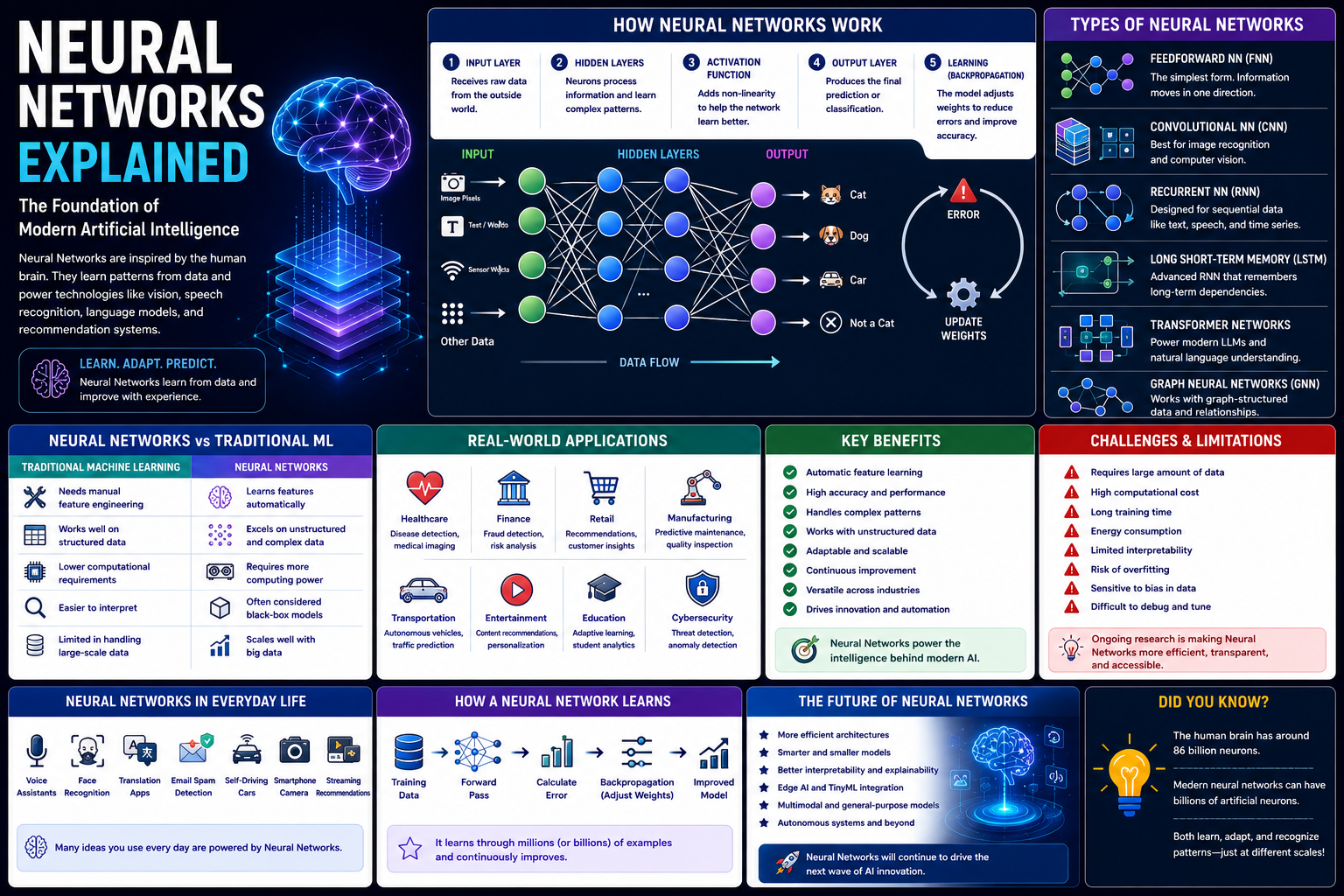
Neural Networks Explained: The Foundation of Modern Artificial Intelligence
Introduction
Artificial Intelligence has advanced rapidly over the past decade, enabling machines to recognize images, understand language, generate content, recommend products, detect fraud, and even drive autonomous vehicles. At the heart of many of these breakthroughs lies one powerful technology:
Neural Networks.
Inspired by the structure of the human brain, neural networks are mathematical models designed to recognize patterns, learn from data, and make intelligent predictions. They form the foundation of modern Deep Learning and power technologies such as Large Language Models (LLMs), Computer Vision, Speech Recognition, Recommendation Systems, and Generative AI.
From virtual assistants to medical diagnostics, neural networks are driving innovation across virtually every industry.
What Are Neural Networks?
A Neural Network is a machine learning model made up of interconnected nodes called neurons that process information in layers.
Instead of following fixed programming rules, neural networks learn patterns from data by adjusting the strength of connections between neurons.
A basic neural network consists of:
Input Layer
Hidden Layers
Output Layer
Weighted Connections
Activation Functions
These components work together to transform raw data into meaningful predictions.
Why Neural Networks Matter
Traditional programming relies on explicit instructions.
Neural networks learn patterns automatically, making them capable of solving problems that are difficult to define using traditional algorithms.
Neural networks enable AI to:
Recognize faces
Translate languages
Detect diseases
Generate text
Recommend products
Understand speech
Drive autonomous vehicles
Predict business trends
Their ability to improve through training makes them one of the most powerful AI technologies available today.
How Neural Networks Work
Most neural networks follow a structured learning process.
1. Input Layer
The network receives data.
Examples include:
Images
Text
Audio
Sensor data
Financial records
2. Hidden Layers
Hidden layers analyze patterns using weighted mathematical operations.
As data passes through multiple hidden layers, the network gradually learns increasingly complex features.
3. Activation Functions
Activation functions determine whether a neuron should pass information to the next layer.
Common examples include:
ReLU
Sigmoid
Tanh
Softmax
4. Output Layer
The network produces a prediction.
Examples include:
Cat or dog classification
Fraud detected
Positive sentiment
Next word prediction
Disease diagnosis
5. Backpropagation
Errors are measured and the network updates its weights to improve future predictions.
Repeated training gradually increases model accuracy.
Core Components of Neural Networks
Every neural network includes several key elements.
Neurons
Basic computational units that process information.
Weights
Determine the importance of each connection.
Bias
Helps adjust neuron outputs for better learning.
Activation Functions
Introduce non-linearity into the model.
Loss Function
Measures prediction error.
Optimizer
Updates model parameters to minimize errors.
Types of Neural Networks
Different problems require different architectures.
Feedforward Neural Networks (FNN)
Basic architecture for classification and prediction tasks.
Convolutional Neural Networks (CNN)
Designed for image recognition and computer vision.
Recurrent Neural Networks (RNN)
Handle sequential data such as speech and text.
Long Short-Term Memory (LSTM)
An improved RNN architecture for long-term sequence learning.
Transformer Networks
Power modern Large Language Models and Generative AI.
Graph Neural Networks (GNN)
Analyze relationships within graph-structured data.
Neural Networks vs Traditional Machine Learning
Traditional Machine Learning
Neural Networks
Often requires manual feature engineering
Learns features automatically
Simpler models
Multi-layer architectures
Performs well on structured data
Excels on complex and unstructured data
Easier to interpret
Often considered black-box models
Lower computational requirements
Requires greater computing power
Neural networks excel in tasks involving images, language, speech, and large-scale data.
Real-World Applications
Neural networks power AI across many industries.
Healthcare
Disease detection
Medical imaging
Drug discovery
Finance
Fraud detection
Credit scoring
Market forecasting
Retail
Personalized recommendations
Demand forecasting
Customer analytics
Manufacturing
Predictive maintenance
Quality inspection
Robotics
Transportation
Autonomous vehicles
Traffic prediction
Route optimization
Entertainment
Streaming recommendations
Content generation
Music personalization
Benefits of Neural Networks
Neural networks provide many advantages.
Benefits include:
Automatic feature learning
High predictive accuracy
Scalability
Pattern recognition
Adaptability
Support for unstructured data
Continuous improvement through training
Versatility across industries
These strengths make neural networks the backbone of modern AI.
Challenges and Limitations
Despite their capabilities, neural networks have limitations.
These include:
Large training datasets
High computational costs
Long training times
Energy consumption
Limited explainability
Risk of overfitting
Model bias
Difficult debugging
Researchers continue improving neural network efficiency and transparency.
Neural Networks in Everyday Life
Many everyday technologies rely on neural networks.
Examples include:
Voice assistants
AI chatbots
Face recognition
Recommendation systems
Translation apps
Spam detection
Smart cameras
Self-driving vehicles
Neural networks work behind the scenes in countless AI-powered products.
Future of Neural Networks
Future developments include:
Smaller and more efficient architectures
Energy-efficient AI chips
Explainable neural networks
Multimodal neural systems
Autonomous AI agents
Brain-inspired computing
Quantum neural networks
Continual learning models
Neural networks will continue driving the next generation of intelligent systems.
Common Misconceptions
Several myths surround neural networks.
Common misconceptions include:
Neural networks think like humans.
More layers always mean better performance.
Neural networks replace all machine learning models.
Neural networks learn instantly.
They never make mistakes.
In reality, neural networks are powerful statistical models that require quality data, careful training, and continuous evaluation.
Final Thoughts
Neural Networks form the foundation of today's most advanced Artificial Intelligence systems. By learning complex patterns from data, they enable machines to recognize images, understand language, generate content, make predictions, and automate decision-making across countless industries.
As computing power, algorithms, and data continue evolving, neural networks will remain at the heart of AI innovation, driving smarter, faster, and more capable intelligent systems for years to come.
Frequently Asked Questions
What is a Neural Network?
A Neural Network is a machine learning model inspired by the human brain that learns patterns from data to make predictions or decisions.
Why are Neural Networks important?
They power many modern AI systems, including image recognition, language models, recommendation engines, and autonomous technologies.
What is the difference between Neural Networks and Deep Learning?
Deep Learning uses neural networks with many hidden layers, while simpler neural networks may contain only one or a few hidden layers.
Where are Neural Networks used?
Healthcare, finance, manufacturing, transportation, retail, education, entertainment, cybersecurity, and many other industries.
Are Neural Networks the same as Artificial Intelligence?
No. Neural Networks are one technology within the broader field of Artificial Intelligence.
Comments (0)