
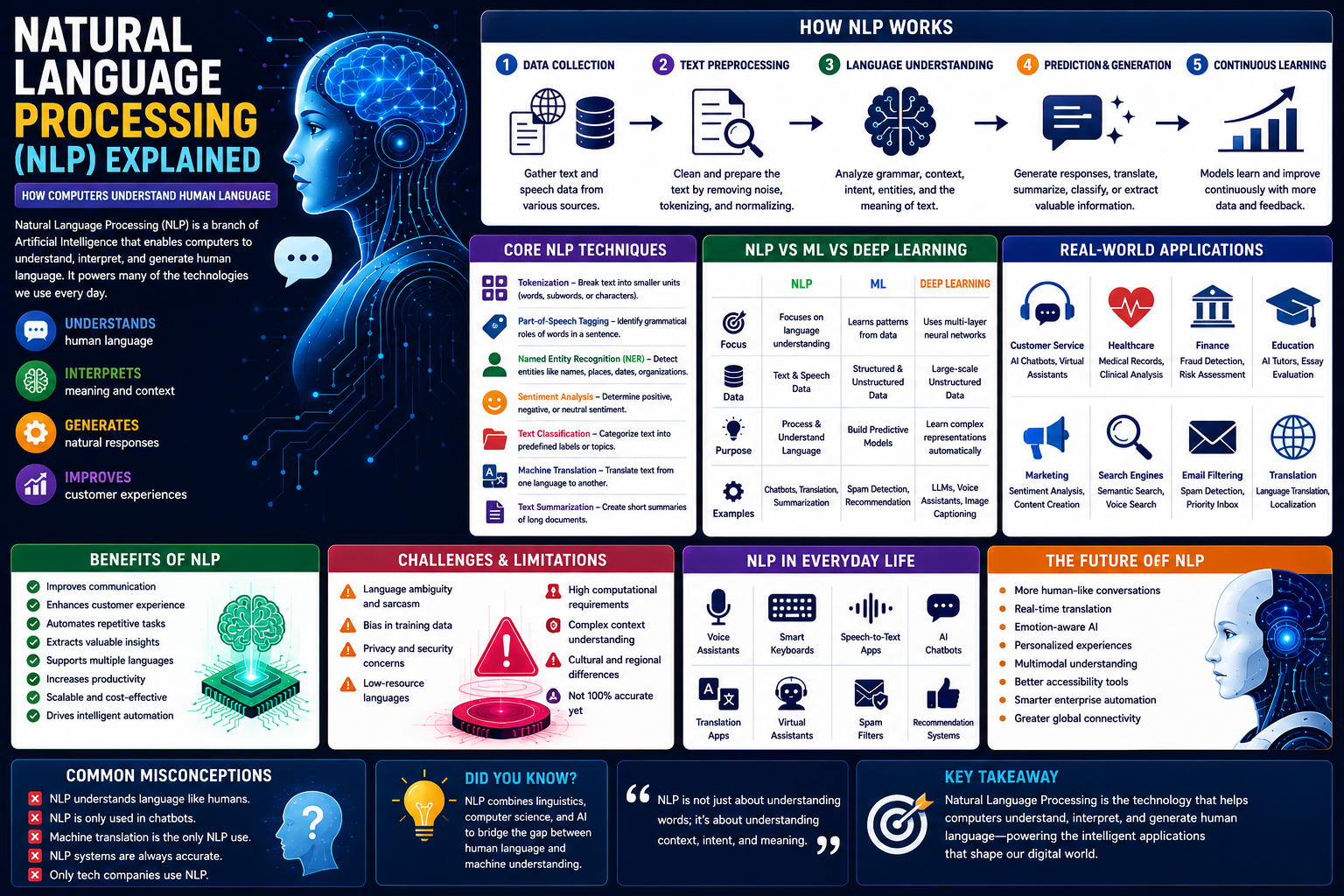
Natural Language Processing (NLP) Explained: How Computers Understand Human Language
Introduction
Natural Language Processing (NLP) is one of the fastest-growing fields within Artificial Intelligence (AI). It enables computers to understand, interpret, analyze, and generate human language in ways that are increasingly natural and accurate. Every day, billions of people interact with NLP-powered technologies through search engines, virtual assistants, translation services, AI chatbots, recommendation systems, email filtering, and customer support platforms.
Unlike traditional software that simply processes commands, NLP allows machines to recognize meaning, identify context, understand intent, and communicate using natural language. This capability has transformed industries ranging from healthcare and education to finance, marketing, cybersecurity, and eCommerce.
As organizations continue generating enormous amounts of text and speech data, Natural Language Processing has become essential for improving communication, automating workflows, and delivering more personalized digital experiences.
What Is Natural Language Processing?
Natural Language Processing is a branch of Artificial Intelligence that combines computer science, linguistics, machine learning, and deep learning to enable computers to process human language.
Rather than simply recognizing words, NLP systems attempt to understand:
Sentence structure
Grammar
Context
Meaning
Intent
Emotions
Relationships between words
Conversation history
Modern NLP allows AI systems to communicate with people in ways that feel increasingly conversational and intelligent.
Natural Language Processing is commonly used for:
AI chatbots
Voice assistants
Search engines
Machine translation
Text summarization
Sentiment analysis
Email spam detection
Speech recognition
How Natural Language Processing Works
Although NLP systems vary in complexity, most follow a structured workflow.
1. Data Collection
Large amounts of language data are gathered from multiple sources.
Examples include:
Books
Websites
Research papers
Emails
Customer conversations
Social media
Audio recordings
Documents
Large and diverse datasets improve language understanding.
2. Text Preprocessing
Before language can be analyzed, raw text must be cleaned and organized.
Common preprocessing tasks include:
Tokenization
Lowercasing
Removing punctuation
Stop-word removal
Lemmatization
Stemming
Text normalization
This prepares data for more accurate processing.
3. Language Understanding
The NLP model examines the processed text to identify important linguistic features.
It analyzes:
Word meaning
Sentence structure
Named entities
Context
Intent
Relationships between words
Modern transformer models perform these tasks with remarkable accuracy.
4. Prediction and Response Generation
Once language has been interpreted, the system performs the requested task.
Depending on the application, NLP may:
Answer questions
Translate languages
Generate text
Summarize documents
Classify information
Detect emotions
Extract important entities
5. Continuous Learning
Modern NLP systems continue improving through:
Larger datasets
Fine-tuning
Human feedback
Reinforcement learning
Model optimization
Continuous learning enables more accurate and natural interactions over time.
Core NLP Techniques
Natural Language Processing includes several important techniques.
Tokenization
Breaks sentences into smaller units such as words or subwords.
Part-of-Speech Tagging
Identifies grammatical roles such as nouns, verbs, adjectives, and adverbs.
Named Entity Recognition (NER)
Recognizes names of people, organizations, locations, dates, currencies, and products.
Sentiment Analysis
Determines whether text expresses positive, negative, or neutral opinions.
Text Classification
Automatically categorizes documents into predefined topics.
Machine Translation
Converts text from one language into another.
Text Summarization
Creates concise summaries while preserving the most important information.
Natural Language Processing vs Machine Learning vs Deep Learning
Although closely related, these technologies serve different purposes.
Natural Language Processing
Machine Learning
Deep Learning
Focuses on language understanding
Learns patterns from data
Uses multi-layer neural networks
Processes text and speech
Broad AI learning technique
Powers modern NLP models
Uses linguistic knowledge
Builds predictive models
Learns language automatically
Modern NLP applications commonly combine Machine Learning and Deep Learning.
Real-World Applications of Natural Language Processing
Natural Language Processing supports innovation across many industries.
Customer Service
AI chatbots
Virtual assistants
Automated ticket handling
Healthcare
Medical documentation
Clinical note analysis
Patient communication
Finance
Fraud monitoring
Financial document analysis
Risk assessment
Education
AI tutors
Language learning
Essay evaluation
Marketing
Customer sentiment analysis
Social media monitoring
Content recommendations
Search Engines
Semantic search
Voice search
Personalized search results
Benefits of Natural Language Processing
Natural Language Processing offers numerous advantages.
Benefits include:
Faster communication
Better customer experiences
Improved automation
Accurate language translation
Personalized recommendations
Faster document processing
Better decision-making
Scalable AI solutions
Organizations increasingly rely on NLP to improve efficiency and customer satisfaction.
Challenges and Limitations
Despite its capabilities, NLP still faces several challenges.
These include:
Language ambiguity
Sarcasm detection
Cultural differences
Bias in training data
Privacy concerns
Limited understanding of context
High computational requirements
Low-resource languages
Ongoing research continues improving these limitations.
Natural Language Processing in Everyday Life
Most people already use NLP every day.
Examples include:
Search engines
Voice assistants
Email spam filters
Translation applications
Smart keyboards
AI chatbots
Speech-to-text software
Customer support systems
NLP has become a fundamental technology behind modern digital communication.
Future of Natural Language Processing
The future of NLP includes exciting advancements such as:
Human-like conversations
Better multilingual communication
Real-time translation
Emotion-aware AI
Personalized assistants
Advanced knowledge retrieval
Enterprise automation
Improved accessibility technologies
As Artificial Intelligence continues evolving, NLP will remain one of its most important technologies.
Common Misconceptions
Several myths exist about Natural Language Processing.
Common misconceptions include:
NLP understands language exactly like humans.
NLP is only used in chatbots.
Machine translation is the only NLP application.
NLP systems never make mistakes.
Only technology companies use NLP.
In reality, NLP powers a wide variety of applications across nearly every industry.
Final Thoughts
Natural Language Processing has become one of the most transformative technologies in Artificial Intelligence. Its ability to understand human language enables smarter search engines, intelligent virtual assistants, AI chatbots, translation services, automated document analysis, and countless other applications that improve daily life.
As AI continues advancing, Natural Language Processing will play an even greater role in making technology more accessible, conversational, and intelligent. Understanding NLP provides valuable insight into how modern AI systems communicate with people and why language remains at the center of the next generation of intelligent applications.
Frequently Asked Questions
What is Natural Language Processing?
Natural Language Processing is a branch of Artificial Intelligence that enables computers to understand, analyze, and generate human language.
Is NLP part of Artificial Intelligence?
Yes. NLP is one of the core fields within Artificial Intelligence.
Does NLP use Machine Learning?
Yes. Modern NLP systems commonly use both Machine Learning and Deep Learning techniques.
What industries use NLP?
Healthcare, education, finance, retail, legal services, customer support, cybersecurity, marketing, and many others.
Why is Natural Language Processing important?
NLP enables natural communication between humans and computers while improving automation, accessibility, productivity, and information analysis.
Comments (0)