
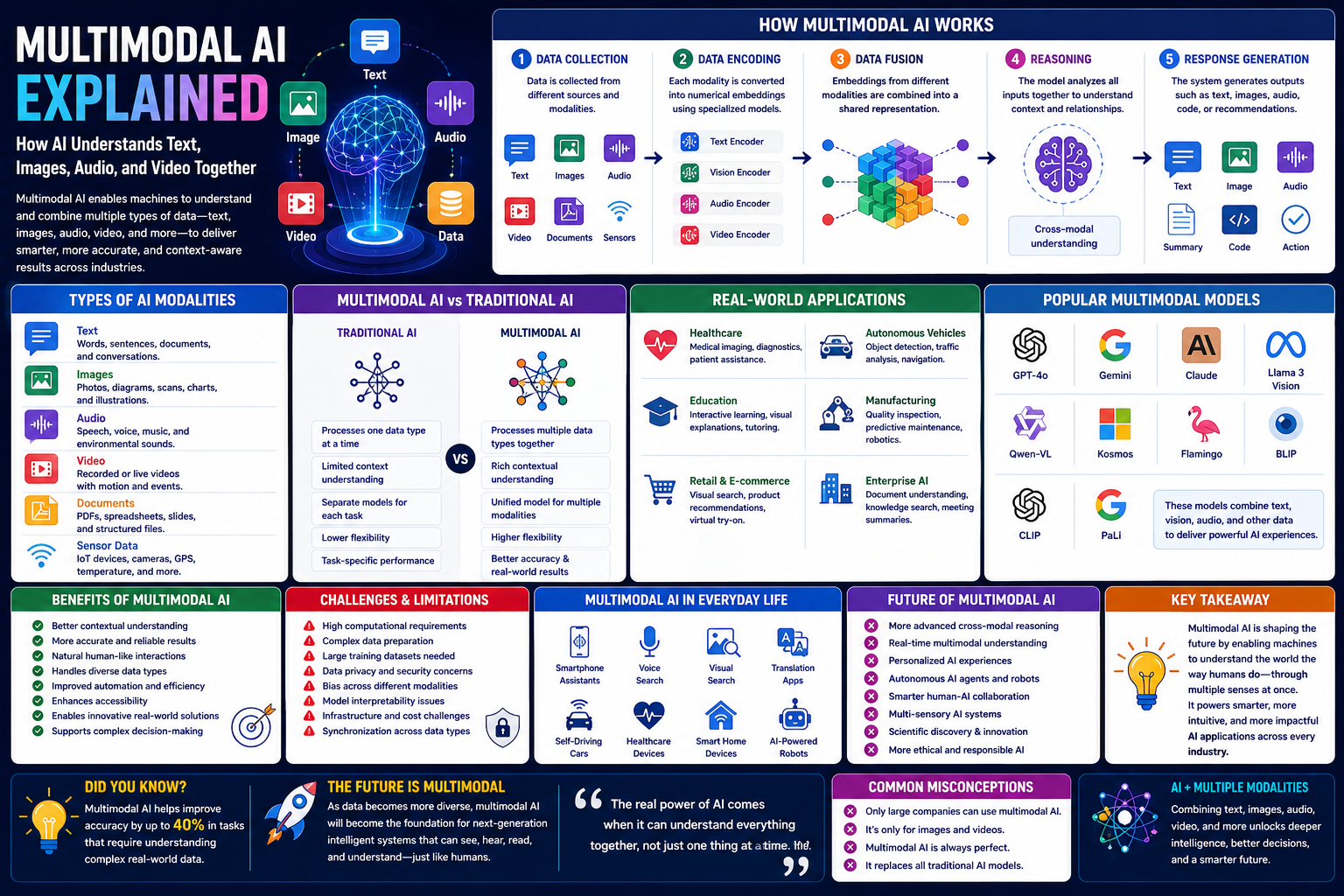
Multimodal AI Explained: How Artificial Intelligence Understands Text, Images, Audio, and Video Together
Introduction
Artificial Intelligence has traditionally focused on processing a single type of information at a time. Some AI systems analyze text, others recognize images, while separate models process speech or video.
Modern AI has evolved beyond these limitations through Multimodal AI.
Multimodal AI enables computers to understand and combine multiple types of information simultaneously—including text, images, audio, video, and even sensor data. Instead of analyzing each format separately, multimodal systems learn relationships between different data types to produce richer, more accurate, and context-aware results.
This technology powers today's most advanced AI assistants, autonomous vehicles, medical diagnostic systems, intelligent robots, document understanding platforms, and next-generation search engines.
As Generative AI continues advancing, Multimodal AI is becoming one of the defining technologies shaping the future of intelligent systems.
What Is Multimodal AI?
Multimodal AI is a branch of Artificial Intelligence that processes and understands multiple forms of data within a single system.
Rather than relying only on text or images, multimodal models combine information from different sources to better understand context and meaning.
Multimodal AI can process:
Text
Images
Audio
Video
Documents
Charts
Speech
Sensor data
By combining multiple modalities, AI can make more informed decisions and generate more accurate responses.
How Multimodal AI Works
Most multimodal AI systems follow a structured workflow.
1. Data Collection
Information is collected from different sources.
Examples include:
Images
Text documents
Voice recordings
Videos
PDFs
Medical scans
Camera feeds
IoT sensors
2. Data Encoding
Each data type is converted into embeddings using specialized AI models.
Examples include:
Text encoders
Vision encoders
Audio encoders
Video encoders
Each encoder transforms information into numerical representations.
3. Data Fusion
The system combines embeddings from multiple modalities into a shared representation.
This allows the AI to understand relationships across different types of information.
4. Reasoning
The model analyzes all available information together.
For example, it may:
Read a document
Interpret an accompanying chart
Analyze an attached image
Listen to spoken instructions
before producing a response.
5. Response Generation
The AI generates outputs that may include:
Text
Images
Audio
Summaries
Code
Reports
Recommendations
Types of AI Modalities
Multimodal AI supports several types of information.
Text
Articles, emails, documents, and conversations.
Images
Photos, diagrams, medical scans, and illustrations.
Audio
Speech, music, environmental sounds, and voice commands.
Video
Recorded footage, surveillance, educational videos, and live streams.
Documents
PDFs, spreadsheets, presentations, invoices, and reports.
Sensor Data
GPS, temperature, industrial equipment, robotics, and IoT devices.
Multimodal AI vs Traditional AI
Traditional AI
Multimodal AI
Processes one data type
Processes multiple data types
Limited context
Rich contextual understanding
Separate models
Unified AI system
Task-specific
Cross-modal reasoning
Lower flexibility
More intelligent decision-making
Multimodal AI enables more natural interactions between humans and machines.
Popular Multimodal Models
Several advanced AI models support multimodal capabilities.
Examples include:
GPT-4o
Gemini
Claude
Llama Vision
Qwen-VL
Kosmos
Flamingo
BLIP
CLIP
PaLI
Each model offers different strengths depending on the use case.
Real-World Applications
Multimodal AI is transforming industries worldwide.
Healthcare
Medical image interpretation
Clinical documentation
Patient assistance
Education
Interactive tutoring
Visual learning
Accessibility tools
Manufacturing
Quality inspection
Predictive maintenance
Robotics
Retail
Visual product search
Smart recommendations
Customer support
Transportation
Autonomous driving
Traffic monitoring
Driver assistance
Enterprise AI
Document analysis
Business intelligence
Meeting summarization
Knowledge management
Benefits of Multimodal AI
Multimodal AI offers many advantages.
Benefits include:
Better contextual understanding
Higher AI accuracy
More natural interactions
Faster decision-making
Improved accessibility
Enhanced automation
Better personalization
Smarter enterprise workflows
Organizations increasingly adopt multimodal AI to improve productivity and customer experiences.
Challenges and Limitations
Despite its strengths, multimodal AI faces challenges.
These include:
High computational requirements
Complex model training
Data synchronization
Privacy concerns
Large infrastructure costs
Bias across modalities
Security risks
Explainability challenges
Continuous research continues addressing these limitations.
Multimodal AI in Everyday Life
Many everyday technologies already rely on multimodal AI.
Examples include:
AI assistants
Smartphone cameras
Visual search
Voice assistants
Self-driving vehicles
Smart home devices
Translation tools
Healthcare diagnostics
Multimodal AI is becoming increasingly integrated into daily life.
Future of Multimodal AI
Future developments include:
Fully autonomous AI assistants
Human-like conversations
Smarter robotics
AI-powered scientific discovery
Advanced healthcare systems
Personalized education
Enterprise AI copilots
Real-time multimodal reasoning
Multimodal AI is expected to become the standard architecture for future intelligent systems.
Common Misconceptions
Several myths surround multimodal AI.
Common misconceptions include:
Multimodal AI only works with images.
It replaces all specialized AI models.
It understands every type of data perfectly.
Only large companies can use multimodal AI.
Multimodal AI eliminates AI errors.
In reality, multimodal AI expands AI capabilities but still depends on high-quality data, robust models, and responsible implementation.
Final Thoughts
Multimodal AI represents one of the biggest advances in Artificial Intelligence by enabling machines to understand the world through multiple forms of information simultaneously. From intelligent assistants and healthcare diagnostics to autonomous vehicles and enterprise automation, multimodal systems are expanding what AI can achieve.
As AI technology continues evolving, understanding Multimodal AI will become increasingly valuable for developers, businesses, researchers, educators, and anyone interested in the future of intelligent systems.
Frequently Asked Questions
What is Multimodal AI?
Multimodal AI is Artificial Intelligence that processes multiple types of information—such as text, images, audio, and video—within a single model.
Why is Multimodal AI important?
It enables richer understanding, more accurate reasoning, and more natural human-computer interactions.
Does Multimodal AI use Large Language Models?
Many modern multimodal systems combine Large Language Models with vision, speech, and other specialized models.
Where is Multimodal AI used?
Healthcare, education, finance, manufacturing, transportation, retail, research, robotics, and enterprise automation.
Is Multimodal AI the future of AI?
Many experts believe multimodal systems will become the standard approach because they can understand the world more similarly to humans.
Comments (0)