
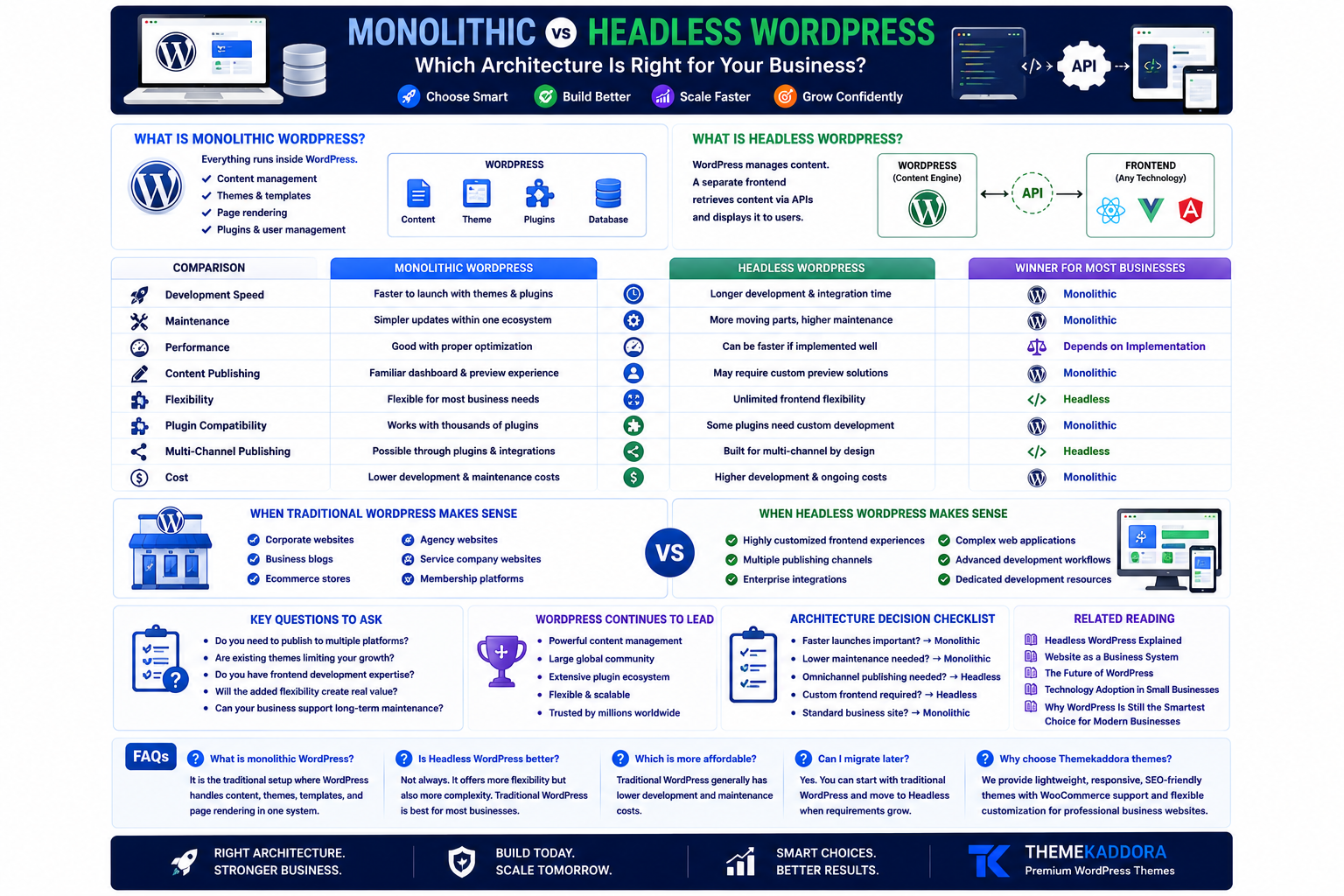
Monolithic vs Headless WordPress: Which Architecture Is Right for Your Business?
Introduction
When businesses choose WordPress, one of the biggest architectural decisions they may face is whether to use a traditional (monolithic) setup or adopt a headless approach.
For many organizations, this question appears after they begin scaling their digital presence.
Perhaps the company wants to launch a mobile app, integrate multiple digital platforms, improve frontend flexibility, or deliver content across several channels.
At first glance, Headless WordPress often seems like the obvious upgrade.
But architecture should never be selected simply because it is modern or popular.
The right choice depends on your business objectives, technical resources, customer experience goals, and long-term maintenance strategy.
This guide compares Monolithic and Headless WordPress to help you make an informed decision.
Understanding Monolithic WordPress
A monolithic WordPress website combines everything in one platform.
WordPress handles:
Content management
Themes
Templates
Rendering pages
Plugins
User management
The frontend and backend work together as one application.
This is how millions of WordPress websites operate today.
Understanding Headless WordPress
Headless WordPress separates content management from presentation.
WordPress manages content.
A separate frontend application—built with modern frameworks or technologies—retrieves content using APIs and presents it to visitors.
This creates greater flexibility but also introduces additional complexity.
Comparing the Two Approaches
Development Speed
Monolithic WordPress
Businesses can launch quickly using existing themes, plugins, and templates.
Development focuses primarily on customization rather than rebuilding common functionality.
Headless WordPress
Projects usually require more planning, frontend development, API integration, testing, and deployment.
Initial development often takes longer.
Maintenance
Monolithic
Updates are generally simpler because themes, plugins, and WordPress operate within one ecosystem.
Headless
Maintenance includes:
WordPress updates
Frontend framework updates
API compatibility
Multiple deployment environments
More moving parts require additional expertise.
Performance
Performance depends more on implementation than architecture.
A poorly optimized Headless website can perform worse than a well-optimized traditional WordPress website.
Businesses should prioritize:
Efficient hosting
Image optimization
Caching
Code quality
Asset delivery
Architecture alone does not guarantee speed.
Content Publishing Experience
Content creators often prefer traditional WordPress because previewing and publishing workflows are familiar.
Headless implementations may require custom preview solutions depending on the frontend architecture.
Flexibility
Headless architecture offers greater freedom for developers.
Traditional WordPress offers faster implementation for common business requirements.
Choose flexibility only when your business truly benefits from it.
Plugin Compatibility
Traditional WordPress benefits from thousands of plugins that work directly with themes.
Some plugins designed for frontend functionality may require additional development in Headless environments.
Always evaluate compatibility before migrating.
Multi-Channel Publishing
One of Headless WordPress's strongest advantages is publishing content across multiple channels.
Examples include:
Websites
Mobile apps
Smart displays
Customer portals
Digital kiosks
Traditional WordPress can support integrations as well, but Headless is often more flexible for large-scale omnichannel projects.
Cost Considerations
Traditional WordPress typically requires:
Lower development costs
Faster deployment
Simpler maintenance
Headless WordPress usually involves:
Higher development investment
Specialized expertise
Additional infrastructure
Ongoing technical maintenance
Evaluate total cost of ownership—not just launch costs.
When Traditional WordPress Makes Sense
Choose traditional WordPress if your business needs:
Corporate websites
Business blogs
Ecommerce stores
Agency websites
Service company websites
Membership platforms
Most organizations fit comfortably within this category.
When Headless WordPress Makes Sense
Headless becomes attractive when you need:
Highly customized frontend experiences
Multiple publishing channels
Enterprise integrations
Complex web applications
Advanced development workflows
These projects often justify additional investment.
Decision Framework
Ask these questions:
Are existing WordPress themes limiting business growth?
Do multiple platforms require shared content?
Does your team have frontend development expertise?
Will additional flexibility create measurable value?
Can the business support long-term maintenance?
Business strategy should guide architecture.
Why WordPress Continues to Lead
Regardless of architecture, WordPress remains one of the world's most flexible content management platforms.
Its strengths include:
Mature publishing workflows
Large community
Extensive ecosystem
Long-term scalability
Strong customization capabilities
Businesses can choose the architecture that best matches their goals while continuing to benefit from WordPress itself.
Why Choose Themekaddora?
For the majority of business websites, traditional WordPress offers the ideal balance of flexibility, performance, and simplicity.
Themekaddora WordPress themes are designed to maximize those strengths through:
Lightweight architecture
Responsive layouts
SEO-friendly code
WooCommerce compatibility
Fast loading performance
Flexible customization
Clean HTML5 and CSS3 standards
Cross-browser compatibility
Regular updates
Professional support
Whether you're launching a startup, agency website, ecommerce store, or corporate platform, Themekaddora helps you build a professional website without unnecessary complexity.
Architecture Comparison Checklist
Traditional WordPress is best if you need:
✅ Faster launches
✅ Lower maintenance
✅ Broad plugin compatibility
✅ Standard business functionality
Consider Headless WordPress if you require:
✅ Omnichannel publishing
✅ Custom frontend applications
✅ Enterprise integrations
✅ Dedicated development resources
Related Reading
Continue learning with:
Headless WordPress Explained
Website as a Business System
The Future of WordPress
Technology Adoption in Small Businesses
Why WordPress Is Still the Smartest Choice for Modern Businesses
These articles provide a comprehensive understanding of how WordPress supports modern digital businesses.
Conclusion
There is no universal winner between Monolithic and Headless WordPress.
Each architecture serves different business needs.
Traditional WordPress remains the most practical solution for the majority of organizations because it delivers flexibility, speed, and ease of management.
Headless WordPress offers additional possibilities for enterprises and organizations with complex digital ecosystems, but those benefits come with greater technical responsibility.
By understanding your goals before selecting an architecture, you can build a WordPress website that supports sustainable growth while avoiding unnecessary complexity.
Frequently Asked Questions (FAQs)
What is a monolithic WordPress website?
A monolithic WordPress website combines content management, themes, templates, and page rendering within a single WordPress application.
Is Headless WordPress better than traditional WordPress?
Not necessarily. Headless WordPress offers greater flexibility but also introduces additional complexity. Traditional WordPress remains the best choice for most business websites.
Which architecture is more affordable?
Traditional WordPress generally has lower development and maintenance costs compared to Headless WordPress.
Can I migrate from traditional WordPress to Headless later?
Yes. Many businesses begin with traditional WordPress and transition to a Headless architecture only when their requirements justify the additional investment.
Why choose Themekaddora WordPress themes?
Themekaddora themes provide responsive layouts, lightweight performance, SEO-friendly code, WooCommerce compatibility, and flexible customization—making them an ideal foundation for modern traditional WordPress websites.
Comments (0)