
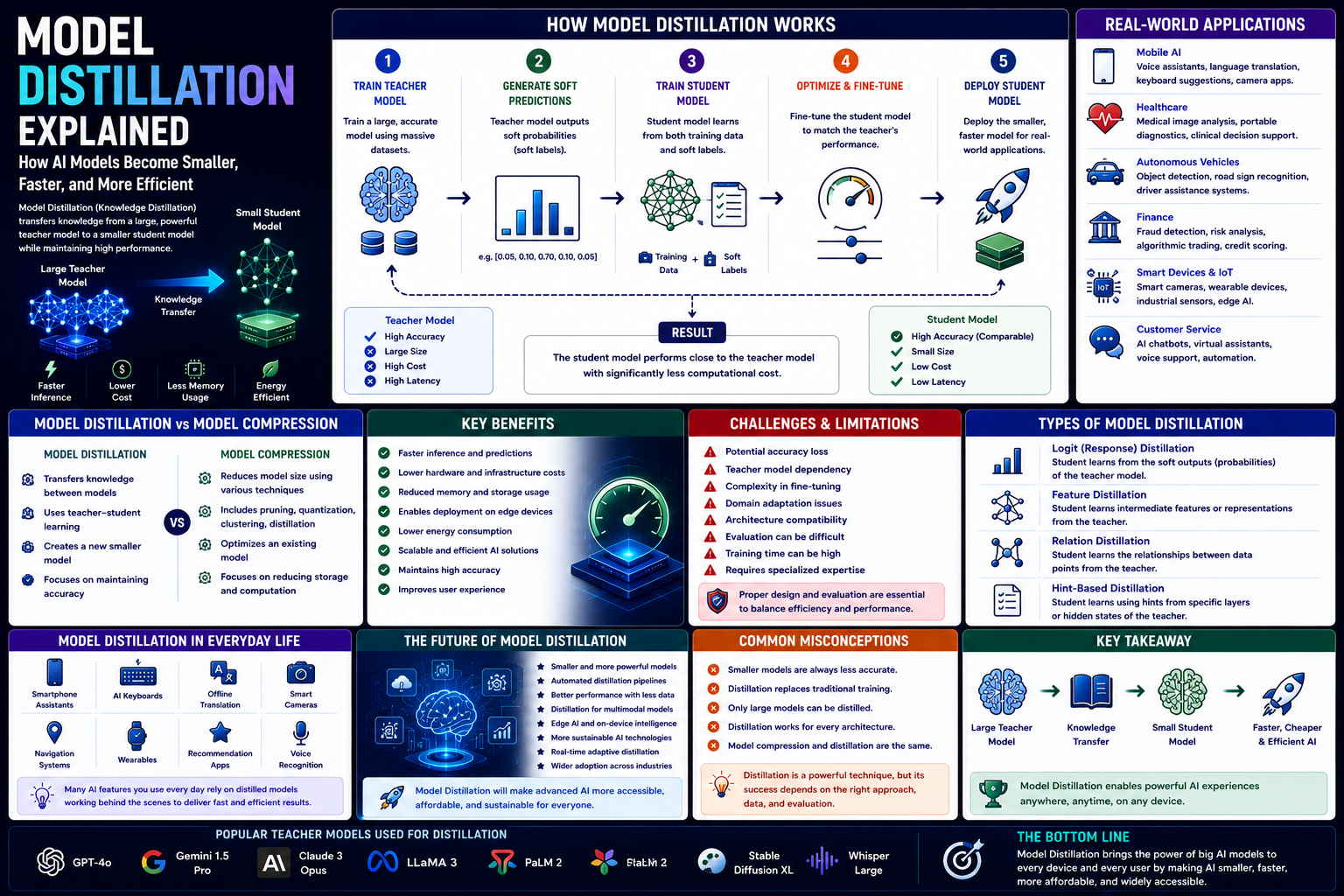
Model Distillation Explained: How AI Models Become Smaller, Faster, and More Efficient
Introduction
Modern Artificial Intelligence models have become incredibly powerful, but they have also become extremely large. Some advanced foundation models contain billions of parameters and require expensive hardware, significant energy consumption, and large amounts of memory to operate efficiently.
While these models deliver exceptional performance, deploying them on smartphones, laptops, IoT devices, autonomous systems, and enterprise applications can be difficult.
Model Distillation, also known as Knowledge Distillation, solves this challenge by transferring knowledge from a large AI model into a much smaller model while maintaining most of its accuracy and capabilities.
This technique enables developers to build lightweight AI systems that run faster, consume fewer resources, and remain highly effective across many real-world applications.
What Is Model Distillation?
Model Distillation is a machine learning technique where a large, highly capable AI model (called the Teacher Model) trains a smaller AI model (called the Student Model) to perform similar tasks.
Instead of learning directly from raw training data alone, the student model learns from the predictions and behavior of the teacher model.
This process allows smaller models to achieve impressive performance while requiring significantly fewer computing resources.
Why Model Distillation Matters
Large AI models are expensive to deploy.
Model Distillation helps organizations:
Reduce infrastructure costs
Improve inference speed
Lower memory usage
Deploy AI on edge devices
Reduce energy consumption
Improve scalability
Enable mobile AI
Accelerate real-time inference
It makes advanced AI practical for a much wider range of applications.
How Model Distillation Works
Most knowledge distillation workflows follow several stages.
1. Train the Teacher Model
A large, highly accurate AI model is trained using extensive datasets.
2. Generate Soft Predictions
The teacher produces probability distributions instead of simple correct-or-incorrect labels.
These "soft labels" provide richer learning signals.
3. Train the Student Model
The smaller model learns from both:
Original training data
Teacher model predictions
4. Optimize Performance
Developers fine-tune the student model to balance:
Accuracy
Speed
Memory usage
Energy efficiency
5. Deploy the Student Model
The lightweight model is deployed in production environments such as mobile apps, cloud services, robotics, or embedded systems.
Core Components of Model Distillation
Several elements contribute to successful distillation.
Teacher Model
Large pretrained model providing knowledge.
Student Model
Smaller model designed for efficient deployment.
Soft Labels
Probability-based outputs that improve learning.
Loss Function
Measures differences between teacher and student predictions.
Fine-Tuning
Optimizes the student model after distillation.
Evaluation
Measures performance, latency, accuracy, and resource usage.
Model Distillation vs Model Compression
Model Distillation
Model Compression
Transfers knowledge between models
Reduces model size using various techniques
Uses teacher-student learning
Includes pruning, quantization, and distillation
Often improves efficiency while retaining accuracy
Focuses on reducing storage and computation
Creates a new smaller model
Optimizes an existing model
Knowledge Distillation is one important approach within the broader field of model compression.
Real-World Applications
Model Distillation powers many AI solutions.
Mobile AI
Offline assistants
Camera enhancement
Translation apps
Healthcare
Medical image analysis
Portable diagnostic devices
Clinical decision support
Autonomous Vehicles
Object detection
Road sign recognition
Driver assistance
Customer Service
Lightweight AI chatbots
Virtual assistants
Voice support
Finance
Fraud detection
Risk analysis
Mobile banking AI
Edge Computing
Smart cameras
IoT devices
Industrial sensors
Benefits of Model Distillation
Organizations gain significant advantages.
Benefits include:
Faster inference
Lower hardware costs
Reduced memory requirements
Improved scalability
Better mobile performance
Lower energy consumption
Easier deployment
Wider AI accessibility
Distillation allows advanced AI to operate efficiently on resource-constrained devices.
Challenges and Limitations
Despite its advantages, Model Distillation presents challenges.
These include:
Accuracy loss
Teacher model dependency
Fine-tuning complexity
Domain adaptation issues
Architecture compatibility
Evaluation difficulty
Training time
Specialized expertise
Careful optimization is necessary to balance efficiency and performance.
Model Distillation in Everyday Life
Many consumer technologies already rely on distilled AI models.
Examples include:
Smartphone voice assistants
AI keyboards
Offline translation
Smart cameras
Facial recognition
AI-powered wearables
Recommendation engines
Navigation systems
Users benefit from faster AI without realizing that smaller models are working behind the scenes.
Future of Model Distillation
Future developments include:
Automated distillation pipelines
Distillation for multimodal models
Smaller foundation models
Edge AI optimization
Enterprise AI deployment
Energy-efficient AI systems
Real-time adaptive models
Sustainable AI computing
Model Distillation will remain a key technology for making powerful AI more accessible and affordable.
Common Misconceptions
Several myths surround Model Distillation.
Common misconceptions include:
Smaller models are always less accurate.
Distillation replaces model training.
Only Large Language Models use distillation.
Distillation works for every AI architecture.
Model Distillation eliminates the need for optimization.
In reality, distillation is one of several techniques used to create efficient AI while maintaining strong performance.
Final Thoughts
Model Distillation has become one of the most important techniques in modern Artificial Intelligence by making advanced AI models practical for real-world deployment. By transferring knowledge from powerful teacher models to efficient student models, organizations can deliver fast, scalable, and cost-effective AI solutions across cloud platforms, mobile devices, and edge computing environments.
As AI models continue to grow in size and complexity, Model Distillation will play a crucial role in ensuring that intelligent technologies remain efficient, accessible, and sustainable for businesses and users worldwide.
Frequently Asked Questions
What is Model Distillation?
Model Distillation is a machine learning technique where a smaller student model learns from a larger teacher model to achieve similar performance with fewer computational resources.
Why is Model Distillation important?
It reduces model size, lowers costs, improves inference speed, and enables AI deployment on mobile devices, edge systems, and resource-constrained environments.
What is the difference between Model Distillation and Model Compression?
Model Distillation transfers knowledge from one model to another, while Model Compression is a broader category that includes pruning, quantization, and distillation.
Which industries use Model Distillation?
Healthcare, finance, robotics, autonomous vehicles, cybersecurity, manufacturing, telecommunications, retail, and consumer electronics.
Does Model Distillation reduce AI accuracy?
Some accuracy loss is possible, but well-designed student models often retain most of the teacher model's performance while being much faster and smaller.
Comments (0)