
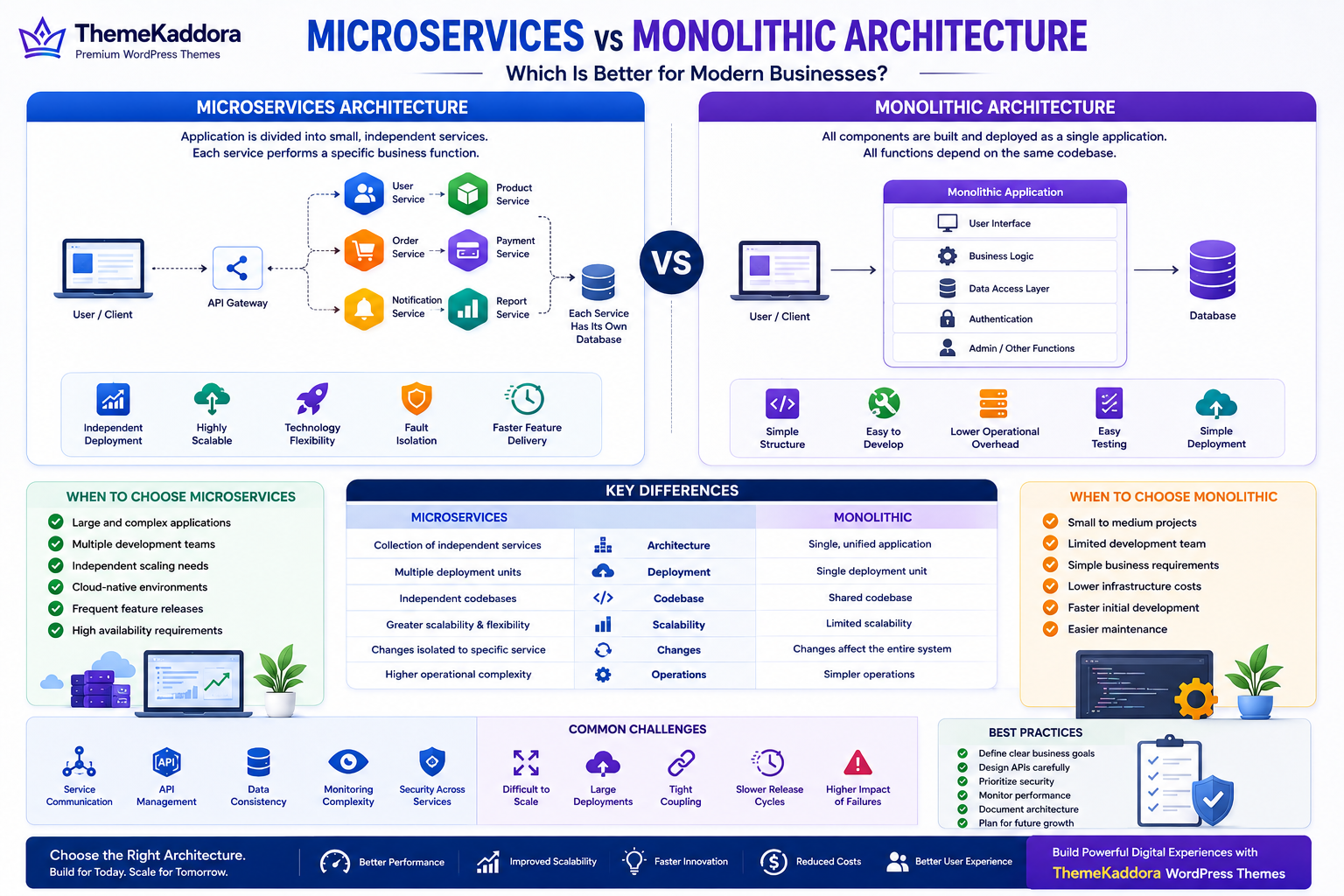
Microservices vs Monolithic Architecture: Which Is Better for Modern Businesses?
Introduction
Every digital product is built on an underlying software architecture. Whether it's an ecommerce platform, SaaS application, enterprise portal, or , architectural decisions affect scalability, maintenance, performance, and WordPress-powered ecosystem
For many years, monolithic architecture was the standard approach to software development. As businesses expanded and digital services became more complex, microservices architecture emerged as an alternative designed to improve flexibility and scalability.
Neither architecture is universally better. The right choice depends on your business objectives, technical resources, operational complexity, and long-term growth plans.
Understanding the differences between these two architectural approaches helps organizations make informed technology decisions.
What Is Monolithic Architecture?
A monolithic application is built as a single, unified system where all major components operate together.
Typically, a monolithic application includes:
User interface
Business logic
Database access
Authentication
Administrative functions
These components are developed, deployed, and maintained as one application.
What Are Microservices?
Microservices architecture divides an application into smaller, independent services.
Each service focuses on a specific business capability, such as:
User authentication
Product catalog
Payment processing
Customer accounts
Notifications
Reporting
These services communicate through APIs and can be developed, deployed, and updated independently.
Key Differences
Monolithic Architecture:
Single application
One deployment unit
Shared codebase
Easier initial development
Simpler operations for smaller projects
Changes affect the entire application
Microservices Architecture:
Collection of independent services
Multiple deployment units
Independent codebases
Greater architectural flexibility
Better scalability for large systems
Individual services can be updated independently
Why Businesses Choose Monolithic Architecture
Organizations may choose monolithic applications because they:
Simplify initial development
Reduce infrastructure complexity
Lower operational overhead
Require fewer deployment processes
Work well for smaller applications
Are easier for small development teams to manage
For many business websites and internal applications, a monolithic architecture remains a practical choice.
Why Businesses Choose Microservices
Organizations adopt microservices to:
Scale individual services independently
Support larger development teams
Accelerate feature delivery
Improve fault isolation
Increase technology flexibility
Support cloud-native architectures
Enable continuous deployment
Microservices are commonly used for large digital platforms and enterprise applications.
Benefits of Monolithic Architecture
A monolithic approach offers:
Simpler project structure
Faster initial development
Easier testing for smaller applications
Lower hosting complexity
Straightforward deployment
Simplified debugging
Many startups successfully begin with monolithic applications before expanding.
Benefits of Microservices
Microservices help businesses:
Improve scalability
Increase development agility
Reduce deployment risks
Improve system resilience
Support API-first development
Enable independent technology choices
Simplify continuous delivery
This flexibility becomes increasingly valuable as applications grow.
Common Challenges
Monolithic Challenges
Difficult to scale individual components
Larger deployments
Tightly coupled systems
Slower release cycles
Greater impact from application-wide failures
Microservices Challenges
Higher operational complexity
API management
Distributed system monitoring
Service communication
Security across multiple services
More complex infrastructure
Microservices require strong governance and operational maturity.
Best Practices
Start with business requirements.
Avoid unnecessary complexity.
Design scalable APIs.
Monitor application performance.
Document architecture decisions.
Secure every service.
Review architecture regularly.
Choosing the Right Architecture
Small Businesses
Monolithic applications often provide sufficient functionality while keeping development and maintenance simpler.
Ecommerce Businesses
Growing ecommerce platforms may gradually adopt microservices for inventory, payments, search, and customer accounts as operational complexity increases.
SaaS Companies
Many SaaS platforms benefit from microservices because they support rapid feature development and scalable cloud deployments.
Enterprise Organizations
Large enterprises frequently adopt microservices to support multiple business units, global operations, and complex digital ecosystems.
WordPress Websites
Most WordPress websites use a monolithic architecture, where content management and presentation operate together. However, larger organizations may combine WordPress with microservices and APIs to extend functionality, integrate enterprise systems, or support headless implementations.
Architecture Selection Checklist
Before choosing an architecture, make sure you:
✅ Define business objectives
✅ Evaluate scalability requirements
✅ Assess technical expertise
✅ Consider long-term maintenance
✅ Plan security requirements
✅ Design API integrations
✅ Monitor system performance
✅ Document architecture decisions
✅ Review infrastructure costs
✅ Plan for future growth
Why Choose Themekaddora?
A reliable website foundation should support both current and future business needs.
Themekaddora WordPress themes provide:
Lightweight architecture
Fast loading performance
SEO-friendly code
Responsive layouts
WooCommerce compatibility
Flexible customization
Accessibility-conscious design
Clean HTML5 and CSS3 standards
Cross-browser compatibility
Regular updates
Professional support
Whether your business uses a traditional WordPress website or integrates with modern API-driven systems, Themekaddora themes provide a dependable platform for professional digital experiences.
Conclusion
Microservices and monolithic architecture each offer distinct advantages. Monolithic applications remain an excellent choice for many business websites and smaller software projects because of their simplicity and lower operational complexity. Microservices become increasingly valuable for organizations requiring greater scalability, flexibility, and independent service deployment.
Selecting the right architecture depends on your business goals, technical capabilities, and long-term digital strategy rather than following technology trends alone.
Frequently Asked Questions (FAQs)
What is the difference between microservices and monolithic architecture?
Monolithic architecture builds an application as a single system, while microservices divide it into independent services that communicate through APIs.
Which architecture is better?
Neither is universally better. The right choice depends on application complexity, business requirements, team size, scalability needs, and long-term objectives.
Are microservices always more scalable?
Microservices make it easier to scale individual services independently, but they also introduce greater operational complexity.
Does WordPress use monolithic architecture?
Yes. Standard WordPress installations primarily follow a monolithic architecture, although they can integrate with APIs, headless frontends, and microservices where appropriate.
Why choose Themekaddora?
Themekaddora provides lightweight, SEO-friendly WordPress themes with responsive layouts, WooCommerce compatibility, fast performance, accessibility-conscious design, regular updates, and professional support—helping businesses build scalable WordPress websites that adapt to evolving digital architectures.
Comments (0)