
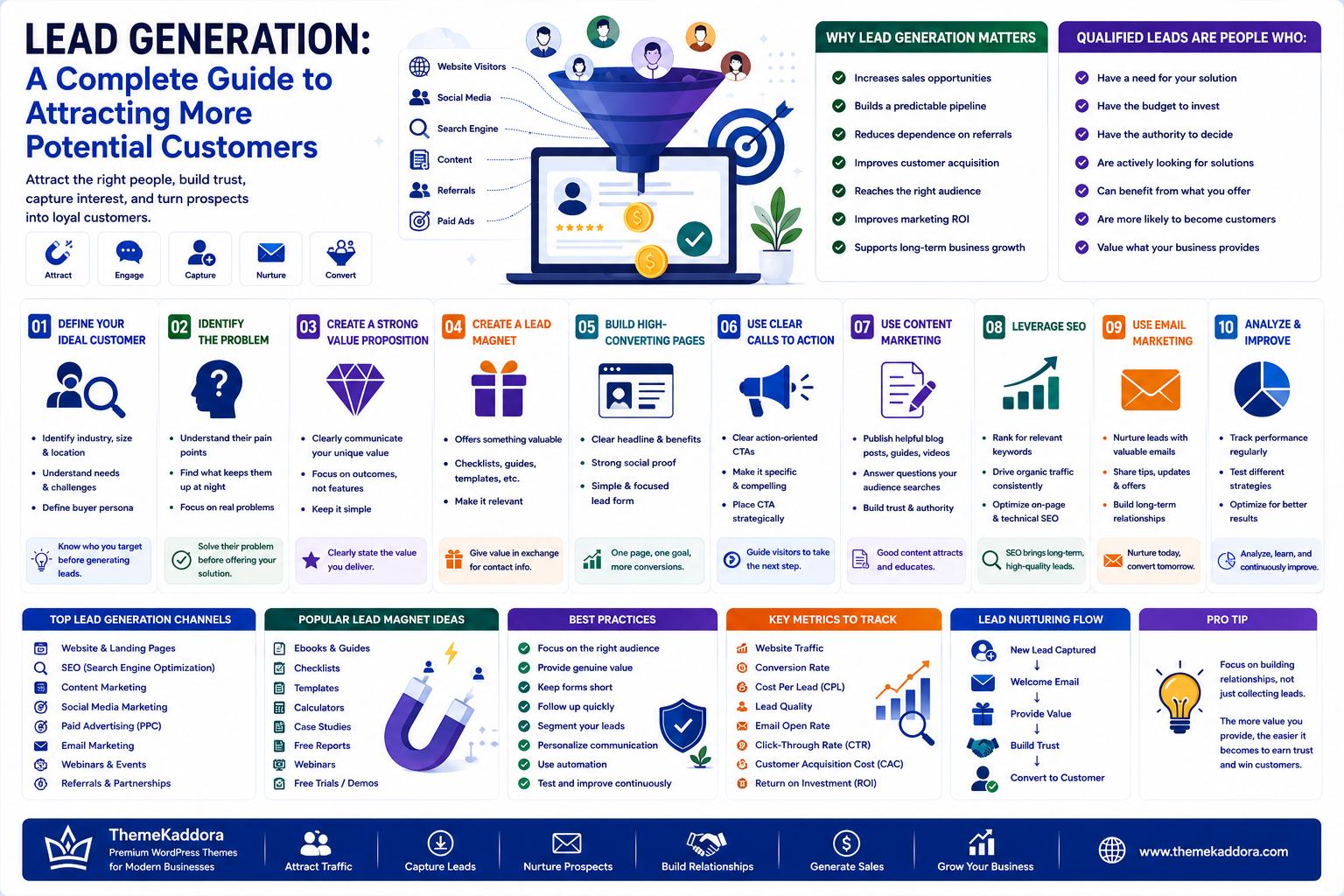
Lead Generation: A Complete Guide to Attracting More Potential Customers
Introduction
Every business needs customers to grow.
However, before someone becomes a customer, they usually go through several stages. They may discover a business, visit its website, read its content, compare alternatives, ask questions, and eventually decide whether to make a purchase.
The process of attracting people who may eventually become customers is known as lead generation.
A strong lead generation strategy helps businesses create a predictable flow of potential customers instead of relying entirely on random inquiries or referrals.
Lead generation can be particularly valuable for:
B2B businesses
Agencies
Consultants
SaaS companies
Service providers
Local businesses
Professional firms
eCommerce businesses
In this guide, you'll learn what lead generation is, how to attract qualified prospects, which channels can generate leads, and how to turn those leads into paying customers.
What Is Lead Generation?
Lead generation is the process of attracting and identifying people who have shown interest in a company's products or services.
A lead might:
Submit a contact form
Request a quote
Book a consultation
Download a resource
Subscribe to a newsletter
Start a free trial
Request a demo
Send a business inquiry
The goal is to move potential customers from initial awareness toward a meaningful sales conversation or purchase.
Why Lead Generation Matters
Without a consistent source of prospects, sales teams may struggle to maintain predictable revenue.
Effective lead generation can help businesses:
Increase sales opportunities
Reduce dependence on referrals
Build a predictable pipeline
Reach specific audiences
Improve customer acquisition
Support business growth
Measure marketing performance
The objective is not simply to generate as many leads as possible.
It is to generate relevant, qualified leads.
1. Define Your Ideal Customer
Before generating leads, understand who you want to attract.
Define characteristics such as:
Industry
Business size
Location
Job role
Budget
Needs
Challenges
Buying authority
For example:
Instead of targeting:
"All businesses."
A company might target:
"Small eCommerce businesses that need help automating repetitive sales and customer-management processes."
A specific audience makes messaging much easier.
2. Identify Your Customer's Problem
People rarely search for a product simply because it exists.
They search for solutions to problems.
For example:
Problem: Sales teams forget to follow up with leads.
Potential solution: Automated CRM follow-up workflows.
Or:
Problem: Website visitors leave without making contact.
Potential solution: Better landing pages, offers, and lead capture systems.
Identify the problem before promoting the solution.
3. Create a Strong Value Proposition
A value proposition explains why someone should choose your business.
A useful structure is:
We help [audience] achieve [outcome] without [major pain point].
For example:
"We help small businesses automate repetitive operations so their teams can spend more time growing revenue."
Keep the message simple and specific.
4. Create a Lead Magnet
A lead magnet is something valuable offered in exchange for contact information.
Examples include:
Checklists
Templates
Guides
Reports
Calculators
Case studies
Free audits
Webinars
Educational resources
The lead magnet should solve a small but meaningful problem for your target audience.
5. Build High-Converting Landing Pages
A landing page should focus on one primary objective.
A strong landing page can include:
Clear headline
Problem statement
Value proposition
Benefits
Supporting evidence
Testimonials
Relevant visuals
Call to action
Lead capture form
Avoid distracting visitors with unnecessary navigation or competing offers.
6. Use Clear Calls to Action
Visitors should know what to do next.
Examples include:
Get a Free Consultation
Request a Quote
Download the Guide
Book a Demo
Start Free Trial
Get the Checklist
Request an Audit
Use action-oriented language that clearly communicates the next step.
7. Use Content Marketing
Educational content can attract potential customers who are researching problems.
Create:
Blog posts
Tutorials
Videos
Guides
Case studies
Webinars
Reports
For example, a CRM company might publish:
"How to Stop Losing Sales Leads Through Poor Follow-Up."
The content attracts people experiencing the problem the company solves.
8. Use Search Engine Optimization
SEO can generate leads continuously by helping your content appear in relevant searches.
Focus on:
Search intent
Keyword research
Helpful content
Technical SEO
Internal linking
Page speed
Structured content
Create pages around problems, services, comparisons, and questions your potential customers actually search for.
9. Use Social Media Strategically
Social platforms can help businesses reach potential customers and build trust.
Share:
Educational content
Industry insights
Case studies
Customer results
Short tutorials
Common mistakes
Practical advice
Avoid turning every post into a direct sales advertisement.
Useful content can create interest before the sales conversation begins.
10. Use Email Marketing
Email can nurture prospects who are not ready to buy immediately.
A lead-nurturing sequence might include:
Email 1: Welcome
Email 2: Helpful educational content
Email 3: Common problem and solution
Email 4: Case study
Email 5: Offer or consultation
The exact sequence should depend on the business and customer journey.
11. Use Referral Marketing
Existing customers can become an important source of new leads.
Encourage satisfied customers to recommend your business to others.
Referral strategies can include:
Referral programs
Partner introductions
Customer advocacy
Testimonials
Case studies
Trust from an existing customer can make referrals particularly valuable.
12. Build Strategic Partnerships
Partner with businesses that serve a similar audience without directly competing with you.
For example:
A web development company might partner with:
SEO consultants
Branding agencies
Marketing firms
IT providers
Business consultants
Partnerships can create mutually beneficial lead opportunities.
13. Use Webinars and Online Events
Webinars allow businesses to demonstrate expertise while interacting directly with potential customers.
A webinar could cover:
Industry challenges
Practical solutions
New technologies
Case studies
How-to tutorials
End with a relevant next step rather than an aggressive sales pitch.
14. Offer Free Consultations Carefully
Free consultations can help prospects understand how your business can help.
However, define the scope clearly.
A consultation might include:
Problem discussion
Initial assessment
Recommendations
Possible next steps
Avoid providing an entire paid project during a free consultation.
15. Use Lead Qualification
Not every lead has the same value.
Qualify leads based on factors such as:
Need
Budget
Authority
Timeline
Business fit
This helps sales teams prioritize prospects who are more likely to become customers.
16. Separate Marketing-Qualified and Sales-Qualified Leads
A Marketing-Qualified Lead (MQL) has shown meaningful interest but may not yet be ready to speak with sales.
A Sales-Qualified Lead (SQL) has stronger buying intent and is appropriate for direct sales follow-up.
Defining these stages helps marketing and sales teams coordinate better.
17. Respond Quickly
Lead response time can affect conversion opportunities.
When someone requests:
A quote
Demo
Consultation
Contact
Trial
Create a process for responding promptly.
Automation can acknowledge the inquiry immediately while a team member handles the actual conversation.
18. Use CRM Software
A CRM helps businesses organize leads and track sales activity.
Useful CRM capabilities include:
Contact management
Lead tracking
Follow-up reminders
Sales pipelines
Email integration
Task management
Reporting
Customer history
A centralized CRM reduces the chance of leads being forgotten.
19. Automate Lead Follow-Up
Many leads are lost because nobody follows up consistently.
Automation can handle:
Reminder emails
Task creation
Lead assignment
Follow-up notifications
Appointment reminders
Lead scoring
Status updates
Automation should support human sales conversations rather than replace them entirely.
20. Track Lead Sources
Understand where your leads come from.
Track sources such as:
Google search
Social media
Referrals
Paid advertising
Webinars
Partnerships
Direct traffic
This helps businesses invest more effectively in channels that generate qualified opportunities.
21. Measure Lead Generation Metrics
Important metrics include:
Number of leads
Qualified leads
Conversion rate
Cost per lead
Lead-to-customer rate
Customer acquisition cost
Sales cycle length
Revenue per lead
Do not judge a channel only by lead volume.
A channel generating fewer but higher-quality leads may be more valuable.
22. Improve Lead Quality
If marketing generates many leads but sales struggles to close them, investigate the problem.
Possible causes include:
Incorrect audience
Weak targeting
Misleading messaging
Poor qualification
Unclear offer
Low-intent traffic
Marketing and sales should regularly review lead quality together.
23. Test Different Offers
Different prospects respond to different offers.
Test:
Free consultations
Free audits
Checklists
Demonstrations
Trials
Discounts
Educational webinars
Measure results rather than assuming which offer will perform best.
24. Improve Lead Conversion
Generating leads is only the beginning.
Improve conversion by:
Responding quickly
Understanding customer needs
Providing relevant information
Following up consistently
Handling objections
Demonstrating value
Making purchasing easy
The sales process should feel helpful rather than forced.
25. Build Trust Before Asking for the Sale
People are more likely to engage with businesses they trust.
Build credibility through:
Testimonials
Reviews
Case studies
Certifications where relevant
Educational content
Transparent pricing where appropriate
Demonstrable expertise
Trust can reduce uncertainty during the buying process.
Common Lead Generation Mistakes
Targeting Everyone
Broad targeting often produces weak leads.
Focusing Only on Lead Volume
More leads do not necessarily mean more revenue.
Using Weak Offers
People need a reason to provide their information.
Poor Follow-Up
Good leads can become lost opportunities without timely communication.
No Lead Qualification
Sales teams may waste time on prospects who are not a good fit.
Overusing Sales Messages
Constant promotion can reduce trust and engagement.
Not Tracking Lead Sources
Without attribution, it becomes difficult to understand which channels work.
Lead Generation Checklist
Strategy
Define ideal customer
Identify customer problems
Create value proposition
Define lead qualification criteria
Lead Capture
Create lead magnet
Build landing pages
Add clear CTAs
Simplify forms
Marketing
Publish content
Optimize for search
Use social media
Build email campaigns
Develop partnerships
Sales
Respond quickly
Qualify leads
Track follow-ups
Use CRM
Measure conversion
Optimization
Track lead sources
Test offers
Improve landing pages
Review lead quality
Calculate acquisition costs
How Technology Improves Lead Generation
Modern businesses can connect marketing and sales into a single workflow.
For example:
Visitor → Landing Page → Lead Form → CRM → Lead Qualification → Follow-Up → Sales Opportunity → Customer
Technology can automate many parts of this process.
Useful capabilities include:
CRM automation
Lead scoring
Email automation
Appointment scheduling
Analytics
Chatbots
Marketing automation
Sales dashboards
The objective is to make lead management more consistent without removing the human element from important customer conversations.
Why Choose ThemeKaddora?
At ThemeKaddora, we believe businesses can generate better opportunities by combining strong marketing strategies with efficient digital systems.
Modern businesses can use technology for:
CRM management
Lead tracking
Marketing automation
Landing pages
Analytics
Customer communication
Sales workflows
Business automation
The goal is to help businesses spend less time managing disconnected processes and more time converting qualified opportunities into long-term customers.
Conclusion
Lead generation is one of the foundations of sustainable business growth.
However, successful lead generation is not simply about collecting contact information.
It is about attracting the right people, solving relevant problems, building trust, and creating a clear path from initial interest to purchase.
Start by defining your ideal customer.
Understand their problems.
Create useful offers and content.
Build effective landing pages.
Capture and qualify leads.
Follow up consistently.
Then use CRM and automation technology to manage the process efficiently.
The strongest lead generation systems connect marketing, sales, technology, and customer experience into one continuous process.
When businesses focus on lead quality rather than lead quantity, they can build healthier sales pipelines and create more predictable opportunities for long-term growth.
Frequently Asked Questions
1. What is lead generation?
Lead generation is the process of attracting potential customers and encouraging them to express interest in a business, product, or service.
2. What is a qualified lead?
A qualified lead is a prospect who meets defined criteria indicating that they may be a good fit and have meaningful buying potential.
3. How can small businesses generate leads?
Small businesses can use SEO, content marketing, referrals, social media, email marketing, partnerships, networking, webinars, and targeted outreach.
4. What is a lead magnet?
A lead magnet is a useful resource offered in exchange for contact information, such as a guide, checklist, template, or report.
5. Why is lead qualification important?
Qualification helps businesses prioritize prospects who have stronger needs, fit, authority, budget, or buying intent.
6. What is lead nurturing?
Lead nurturing involves communicating with prospects over time to build trust and move them toward a purchasing decision.
7. What is a CRM?
A Customer Relationship Management system helps businesses organize customer and prospect information, sales activities, follow-ups, and relationships.
8. How quickly should businesses respond to leads?
Businesses should establish a response process that is as timely as practical for their customers and sales model. Automated acknowledgments can help ensure prospects know their inquiry was received.
9. How do you measure lead generation success?
Track qualified leads, conversion rate, cost per lead, lead-to-customer rate, acquisition cost, sales cycle, and revenue generated.
10. What is the biggest lead generation mistake?
Focusing on the number of leads rather than whether those leads are relevant, qualified, and capable of becoming profitable customers.
Comments (0)