
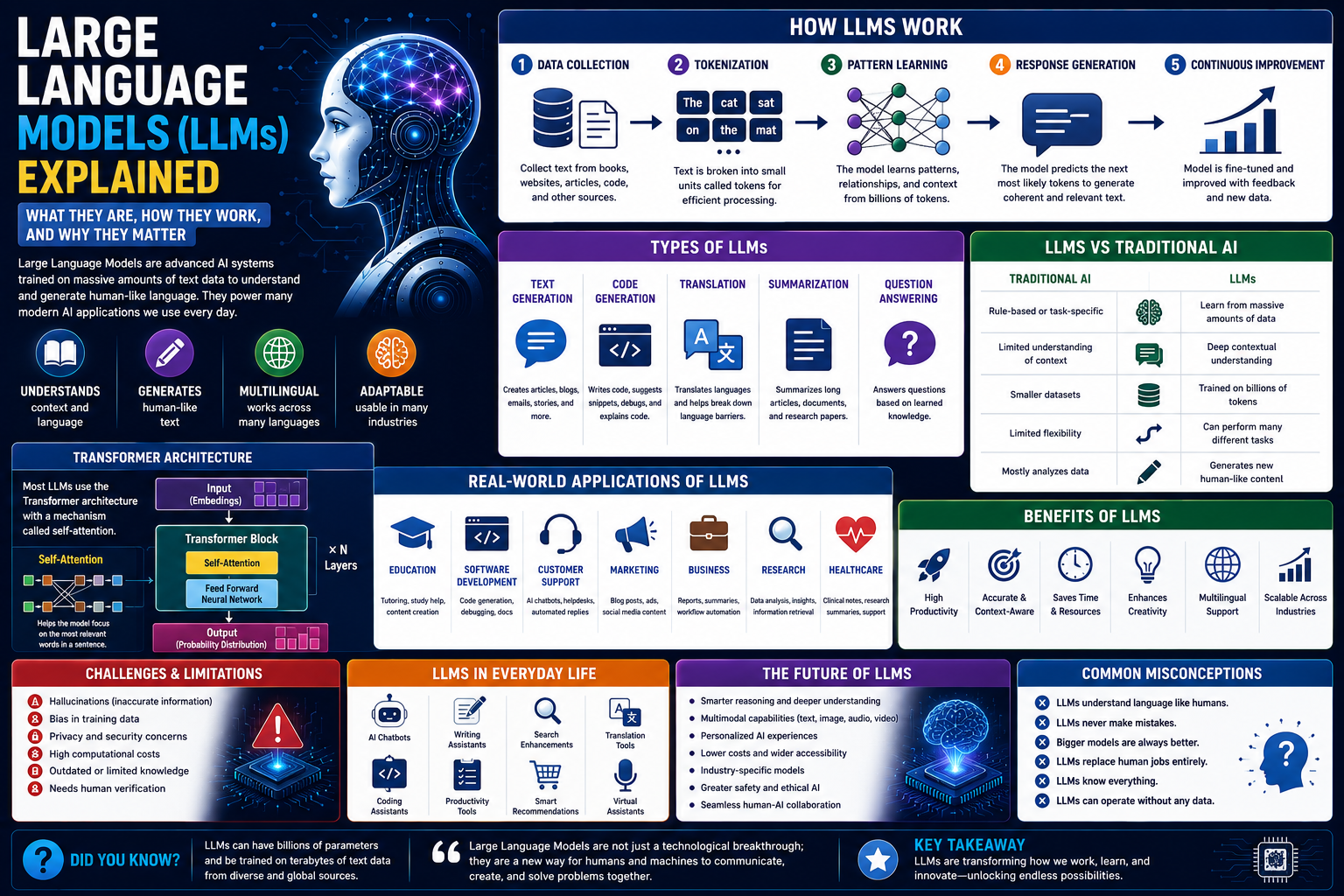
Large Language Models (LLMs) Explained: What They Are, How They Work, and Why They Matter
Introduction
Large Language Models (LLMs) are among the most significant breakthroughs in Artificial Intelligence. They power many of today's AI tools, enabling computers to understand, generate, summarize, translate, and analyze human language with remarkable fluency.
From AI chatbots and virtual assistants to coding assistants, search engines, customer support systems, and educational platforms, LLMs are transforming how people interact with technology.
Modern LLMs are trained on enormous collections of text, allowing them to recognize language patterns, answer questions, generate content, and assist users across countless tasks.
Understanding how Large Language Models work helps explain many of today's most advanced AI applications.
What Are Large Language Models?
Large Language Models are advanced Artificial Intelligence systems trained to understand and generate natural language.
Unlike traditional software that follows predefined rules, LLMs predict the most likely sequence of words based on patterns learned during training.
LLMs can perform tasks such as:
Writing articles
Answering questions
Translating languages
Summarizing documents
Generating computer code
Explaining technical concepts
Brainstorming ideas
Assisting with research
Their flexibility makes them useful across many industries.
How LLMs Work
Although highly sophisticated, most LLMs follow a similar workflow.
1. Massive Data Collection
Models are trained using enormous collections of text from books, articles, websites, research papers, technical documentation, and other licensed or publicly available sources.
2. Tokenization
Instead of processing complete sentences, text is divided into smaller units called tokens.
Tokens may represent:
Words
Parts of words
Characters
Punctuation
Tokenization allows the model to process language efficiently.
3. Pattern Learning
During training, the model analyzes billions of word relationships to understand:
Grammar
Context
Sentence structure
Writing styles
Facts
Reasoning patterns
The objective is to predict the next most likely token.
4. Response Generation
When a user enters a prompt, the model predicts one token at a time until it forms a complete response.
This process happens extremely quickly, producing fluent and context-aware text.
5. Fine-Tuning
Many LLMs undergo additional fine-tuning to improve performance for specific industries or tasks such as healthcare, law, education, finance, or programming.
Transformer Architecture Explained
Most modern LLMs are based on the Transformer architecture introduced in 2017.
Transformers use a mechanism called self-attention, which allows the model to determine which words in a sentence are most relevant to one another.
Key advantages include:
Better understanding of context
Faster training
Improved scalability
Stronger language generation
Efficient parallel processing
The Transformer architecture made today's powerful LLMs possible.
Training Large Language Models
Training an LLM is a complex process involving:
Massive datasets
High-performance GPUs and TPUs
Billions of model parameters
Weeks or months of computation
Continuous evaluation
Model optimization
After pretraining, models may receive additional instruction tuning and reinforcement learning to improve helpfulness and reliability.
Popular Applications of LLMs
Large Language Models are used in many fields.
Education
Personalized tutoring
Lesson planning
Study assistance
Software Development
Code generation
Debugging
Documentation
Customer Support
AI chatbots
Help desks
Automated responses
Marketing
Blog writing
Email campaigns
SEO content
Social media posts
Healthcare
Clinical documentation
Medical research support
Knowledge retrieval
Business
Report generation
Workflow automation
Document summarization
Internal knowledge assistants
Benefits of Large Language Models
LLMs provide many advantages.
Benefits include:
Faster content creation
Improved productivity
Natural conversations
Multilingual capabilities
Knowledge assistance
Coding support
Better customer service
Workflow automation
Organizations increasingly integrate LLMs into daily operations.
Challenges and Limitations
Despite their capabilities, LLMs have important limitations.
Challenges include:
Hallucinated responses
Outdated knowledge
Bias in outputs
Privacy concerns
High computational costs
Limited reasoning in some domains
Security risks
Need for human verification
Responsible use remains essential.
LLMs in Everyday Life
Many people already interact with LLMs every day.
Examples include:
AI chat assistants
Writing assistants
Coding assistants
Search experiences
Translation tools
Customer service bots
Productivity applications
Educational platforms
As AI adoption grows, LLMs will become even more integrated into everyday work.
Future of Large Language Models
Future developments are expected to include:
More accurate reasoning
Better multilingual communication
Multimodal understanding
Personalized AI assistants
Lower computational costs
Industry-specific AI models
Improved safety mechanisms
Greater business integration
LLMs are expected to become a foundational technology for future AI systems.
Common Misconceptions
Common myths include:
LLMs understand language exactly like humans.
LLMs never make mistakes.
Bigger models are always better.
LLMs replace all professionals.
LLMs know everything.
In reality, LLMs are statistical prediction systems that require careful human oversight.
Final Thoughts
Large Language Models have fundamentally changed how humans interact with computers. Their ability to understand context, generate natural language, assist with problem-solving, and automate knowledge-based work is reshaping industries worldwide.
As AI continues to advance, understanding LLMs will become increasingly valuable for students, developers, businesses, educators, and professionals who want to make informed use of modern artificial intelligence.
Frequently Asked Questions
What is a Large Language Model?
A Large Language Model is an AI system trained on enormous amounts of text to understand and generate natural language.
What is the Transformer architecture?
Transformer is a neural network architecture that uses self-attention to understand relationships between words more effectively.
Are LLMs the same as Generative AI?
LLMs are one type of Generative AI focused primarily on text and language-related tasks.
Where are LLMs used?
Education, healthcare, finance, customer support, marketing, software development, research, and many other industries.
Why are Large Language Models important?
They enable natural communication between humans and computers while supporting automation, knowledge discovery, creativity, and productivity.
Comments (0)