
Introduction
Getting visitors to a website is only one part of running a successful online store. The next challenge is helping those visitors find relevant products, understand their value, and complete their purchases.
A WooCommerce store may receive regular traffic but still experience low conversions because product pages are unclear, recommendations are irrelevant, calls to action are weak, or shoppers struggle to discover suitable products.
This is where conversion optimization becomes important.
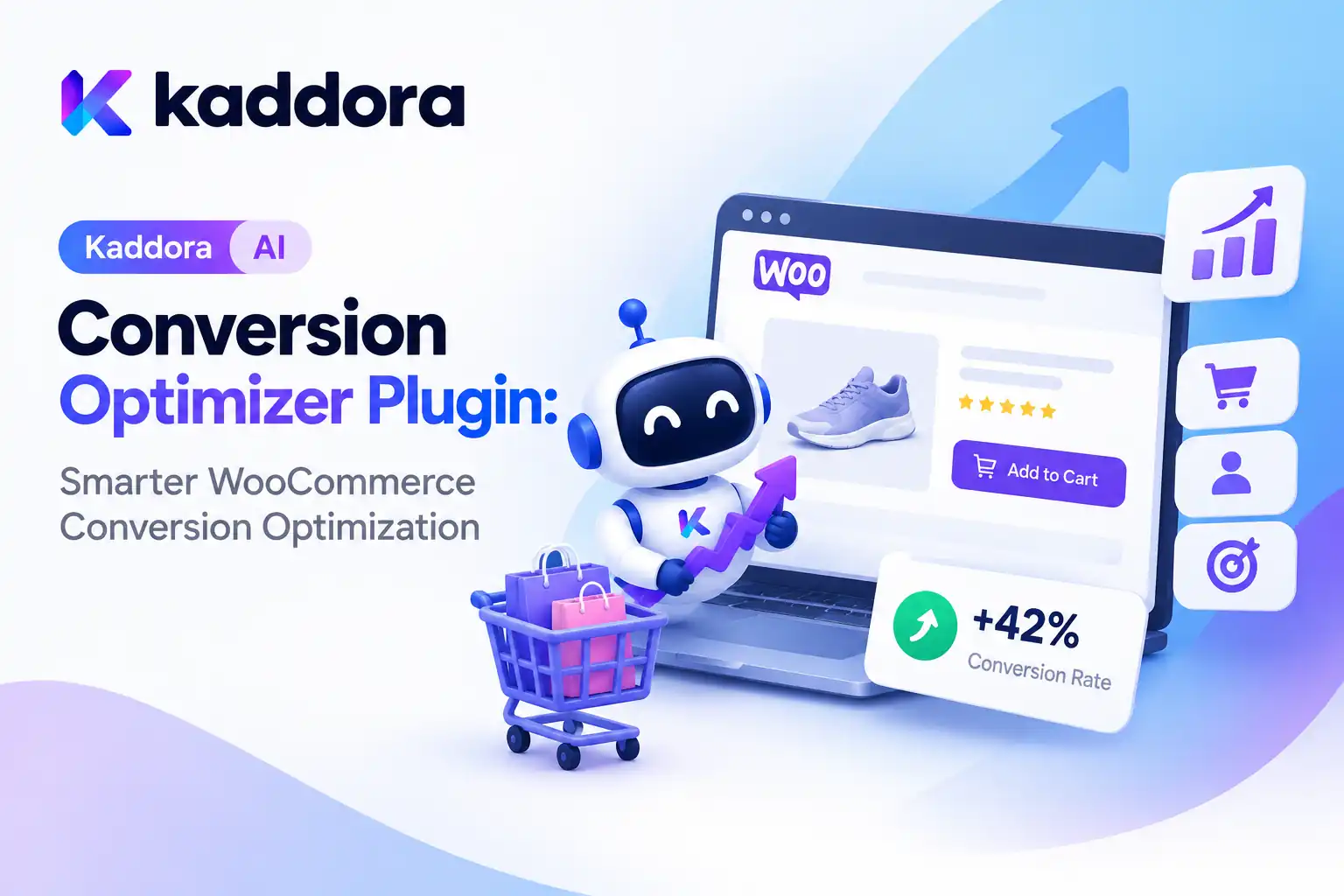
Kaddora AI Conversion Optimizer Plugin is designed to help WordPress and WooCommerce store owners improve shopping experiences through AI-powered insights, personalized product recommendations, content optimization, and conversion analytics.
Instead of relying entirely on manual guesswork, store owners can use optimization insights to identify opportunities, improve product discovery, and make more informed decisions about their customer experience.
In this guide, we'll explore how AI-powered conversion optimization works, the capabilities offered by Kaddora AI Conversion Optimizer, practical WooCommerce use cases, and best practices for building a more effective online shopping journey.
What Is the Kaddora AI Conversion Optimizer Plugin?
Kaddora AI Conversion Optimizer is an AI-powered plugin for WordPress and WooCommerce designed to support conversion-focused improvements across the shopping experience.
Its intended capabilities include AI-driven customer behavior analysis, personalized product recommendations, content improvement suggestions, dynamic optimization, and conversion performance reporting.
The plugin is designed to help store owners work on several areas of the customer journey:
Product discovery: Help shoppers explore relevant products.
Personalization: Present recommendations based on available customer interests and browsing behavior.
Content optimization: Identify opportunities to improve product descriptions, messaging, and calls to action.
Cross-selling and upselling: Suggest related or complementary products.
Performance insights: Review recommendation engagement, product interactions, and conversion-related metrics.
Explore the Kaddora AI Conversion Optimizer Plugin for its product details and available purchase options.
Why Does Conversion Optimization Matter for WooCommerce?
Conversion optimization is the process of improving a website so that more visitors complete a desired action. In an ecommerce store, that action is often a purchase, although it may also be adding a product to the cart, subscribing to a newsletter, or beginning checkout.
Consider a typical shopping journey:
Visitor Arrives ↓ Browses Products ↓ Views Product Details ↓ Adds Product to Cart ↓ Completes Checkout
A shopper can leave at any stage. Confusing descriptions, irrelevant recommendations, unclear product benefits, unexpected costs, and difficult checkout experiences can create friction.
Conversion optimization helps identify and address these problems.
AI can support this process by analyzing available data, suggesting improvements, and helping store owners make the shopping journey more relevant. However, results depend on factors such as traffic quality, product selection, pricing, website usability, and the changes implemented.
Key Features of Kaddora AI Conversion Optimizer
1. AI-Powered Conversion Insights
Understanding visitor behavior is an important starting point for improving an online store.
Kaddora AI Conversion Optimizer is designed to provide AI-driven insights and automated recommendations that help store owners identify potential opportunities for improvement.
These insights can support questions such as:
Which parts of the product experience may need improvement?
Could shoppers benefit from more relevant recommendations?
Are product descriptions communicating value clearly?
Which product interactions should be reviewed?
What conversion improvements should the store prioritize?
AI-generated recommendations should be treated as decision-support tools. Store owners should evaluate them against their actual business objectives and available performance data.
2. Personalized Product Recommendations
Product recommendations can help visitors discover items that match their interests.
For example, someone browsing a laptop may also be interested in a laptop bag, mouse, or compatible accessory. A shopper exploring skincare products may want to see related products from the same category.
Relevant recommendations can make product discovery easier and encourage shoppers to explore more of the catalog.
Kaddora AI Conversion Optimizer is designed to support recommendation scenarios such as:
Related products
Personalized suggestions
Frequently bought together recommendations
Cross-selling opportunities
Upselling opportunities
Recently viewed product experiences
The usefulness of these recommendations depends on product data, the available behavioral signals, and how the recommendations are configured.
3. Intelligent Content Optimization
Product content helps customers understand what they are buying.
A product page with vague descriptions or generic messaging may leave important questions unanswered. Conversion-focused content should explain the product's benefits, important specifications, use cases, and differentiating features.
The plugin is designed to support content optimization through suggestions for product descriptions, conversion-focused messaging, calls to action, and engagement improvements.
For example, instead of relying on a generic description such as:
This is a high-quality backpack suitable for everyday use.
A more informative description might explain its capacity, compartments, materials, carrying comfort, and intended uses—provided those details are accurate.
AI can help improve structure and clarity, but factual claims should always be checked against verified product information.
4. Cross-Selling and Upselling Opportunities
Cross-selling and upselling can help customers discover additional value when the suggestions are relevant.
Cross-selling recommends complementary products. For example, a camera shopper might be interested in a memory card or camera bag.
Upselling presents an alternative that offers additional features or value. For example, a shopper considering a basic model might compare it with a premium model that better fits their needs.
Kaddora AI Conversion Optimizer is designed to support these recommendation strategies alongside related product and frequently bought together suggestions.
The goal should be to help customers make informed choices—not overwhelm them with unnecessary offers.
5. Conversion Analytics and Reporting
Optimization works best when changes can be evaluated.
The plugin's listed analytics capabilities include conversion tracking, recommendation performance, click analysis, product interaction reporting, visitor insights, and sales optimization reports.
These insights can help store owners review how shoppers interact with product recommendations and conversion-focused elements.
For meaningful analysis, define the metric before making changes. For example:
Metric
What It Helps You Understand
Product click-through rate
Whether shoppers engage with recommendations
Add-to-cart rate
How often product views lead to cart additions
Checkout completion rate
How effectively shoppers finish checkout
Conversion rate
The proportion of visitors or sessions that complete a purchase, based on the chosen definition
Average order value
The average revenue per order
Revenue per visitor
How much revenue is generated relative to visitor volume
Use consistent measurement definitions and compare equivalent periods. A change in one metric does not automatically establish that the overall business has improved.
6. WooCommerce-Focused Integration
Conversion improvements should fit naturally into the shopping experience.
Kaddora AI Conversion Optimizer is designed for WooCommerce use cases involving product pages, shop pages, category pages, cart pages, checkout experiences, customer accounts, and product archives.
The exact placement and behavior of individual optimization elements may depend on plugin configuration, the active theme, WooCommerce settings, and other installed extensions.
Test changes on the actual storefront to make sure recommendations and content remain clear, usable, and consistent across devices.
7. Configuration and Developer Extensibility
The product listing describes an administrator dashboard with configuration controls, along with support for WordPress and WooCommerce hooks and filters for custom integrations.
This can be useful for store owners who want a manageable setup process and developers who need to align conversion-related functionality with an existing WooCommerce workflow.
Before deploying the plugin on a production store, review the current documentation, compatibility requirements, and available settings.
How to Use AI Conversion Optimization in a WooCommerce Store
A practical optimization workflow can be organized into a few steps.
Step 1: Identify the Conversion Goal
Decide what you want to improve before enabling optimization features.
Examples include:
Helping shoppers discover relevant products
Improving product-page engagement
Encouraging appropriate complementary purchases
Reducing friction in the buying journey
Improving the clarity of product content
Avoid trying to improve every metric at the same time.
Step 2: Review Your Product Data
AI recommendations are more useful when the underlying catalog is accurate.
Review product titles, descriptions, categories, attributes, images, prices, and stock status. Remove outdated information and ensure that important product details are available.
Incorrect product data can lead to irrelevant recommendations or misleading content suggestions.
Step 3: Configure Relevant Optimization Options
Install and activate the plugin, then open its settings in the WordPress dashboard.
Configure the available optimization and recommendation options according to your store's needs. Review how the features interact with the current WooCommerce theme and product templates.
Step 4: Review Recommendations and Content Suggestions
Use AI-generated recommendations as starting points for improvement.
Check whether suggested products are relevant, whether content accurately describes the product, and whether calls to action are clear. Review any proposed changes before applying them to important storefront pages.
Step 5: Measure Performance
Establish a baseline before changing product recommendations or page content.
Track suitable metrics over a meaningful period, accounting for traffic changes, campaigns, discounts, seasonality, and other factors that may influence performance.
Where practical, use controlled A/B tests rather than assuming that a change caused an improvement simply because performance increased afterward.
Step 6: Refine the Experience
Keep the changes that demonstrate useful results and reconsider those that do not. Conversion optimization is an ongoing process of testing, measuring, and improving the customer journey.
Practical Use Cases
Fashion and Apparel Stores
Fashion stores can use related product recommendations to help shoppers discover matching accessories, alternative styles, and complementary items. Product descriptions can also be reviewed for clarity about materials, fit, care instructions, and available variations.
Electronics Stores
Electronics stores can benefit from clearer product specifications and relevant accessory suggestions. Compatibility must be verified so that customers are not shown items that do not work with their selected products.
Beauty and Personal Care Stores
Relevant recommendations can help customers explore complementary products and suitable product categories. Suggestions should be based on verified product information rather than unsupported claims about results or suitability.
Furniture Stores
Furniture shoppers often compare materials, sizes, styles, and functional features. Better-organized product content and related-item discovery can help them evaluate products more efficiently.
Digital Product Stores
Stores selling digital products can improve how they present product benefits, explain included deliverables, and recommend relevant products or packages.
Best Practices for Better Conversion Optimization
Prioritize relevance over volume. More recommendations do not necessarily create a better shopping experience. Show products that make sense in context.
Keep product claims accurate. AI should not invent specifications, compatibility details, discounts, testimonials, or guarantees.
Make the next step clear. Calls to action should explain what the shopper can do next without misleading language or unnecessary pressure.
Optimize for mobile. Check whether recommendation sections and calls to action are easy to use on smaller screens.
Protect checkout usability. Avoid adding unnecessary interface elements or distractions to an already sensitive step in the purchase journey.
Measure meaningful outcomes. Clicks can indicate engagement, but they do not always translate into completed purchases or profitable orders.
Respect customer privacy. Review what data is collected, how it is used, and whether external AI services process any information. Configure tracking and data processing in accordance with applicable privacy requirements.
Test changes carefully. Change one major element at a time when practical, and retain a way to reverse changes that do not work well.
Common Conversion Optimization Mistakes
Optimizing Without a Clear Goal
A store may change banners, product descriptions, and recommendation layouts without deciding what success looks like. Define the target metric first.
Showing Irrelevant Recommendations
Random or poorly matched products can distract visitors. Relevance should take priority over the number of items displayed.
Trusting AI Without Review
AI-generated text or recommendations can be inaccurate. Verify factual details, prices, stock, compatibility, and other important product information.
Ignoring Mobile Visitors
An optimization element that works on desktop may take up too much space on mobile. Test the full journey across devices.
Making Too Many Changes at Once
When several elements change simultaneously, it becomes harder to determine which change affected the results. Use a structured testing process.
Expecting Guaranteed Results
No plugin can guarantee a specific conversion rate or revenue increase. Outcomes depend on the store, audience, product-market fit, implementation, and measurement.
Who Can Benefit From Kaddora AI Conversion Optimizer?
The plugin may be useful for:
WooCommerce store owners seeking a more structured optimization process
Online retailers with broad product catalogs
Businesses exploring personalized product discovery
Store managers reviewing product engagement and recommendation performance
Marketing teams looking for AI-assisted content and conversion insights
Developers integrating conversion-focused capabilities into WooCommerce stores
The best fit depends on the store's current challenges, available data, and the features supported by the plugin version being used.
Why Choose Kaddora?
Kaddora focuses on practical WordPress and WooCommerce solutions for businesses that want to improve how their websites serve customers.
Kaddora AI Conversion Optimizer is designed to bring together AI-powered optimization insights, product recommendations, content suggestions, WooCommerce integration, and conversion-related analytics in one plugin experience.
For store owners, this can provide a structured starting point for identifying opportunities and reviewing shopping journeys. For developers, the listed integration hooks and filters can help support custom workflows where compatible.
The objective is not to rely on AI alone. It is to combine AI-assisted insights with accurate product data, a usable storefront, appropriate measurement, and informed business decisions.
Conclusion
Conversion optimization is an ongoing process of understanding customers, removing friction, and improving the shopping experience.
The Kaddora AI Conversion Optimizer Plugin is designed to support this process for WordPress and WooCommerce stores through personalized product recommendations, cross-selling and upselling opportunities, content optimization suggestions, and conversion analytics.
Store owners can use these capabilities to review product discovery, improve messaging, and make more informed decisions about their storefront. The strongest results still depend on relevant products, accurate information, a smooth checkout experience, and consistent measurement.
Start with one clearly defined goal, review the available plugin settings, measure the baseline, and evaluate each change carefully. Used thoughtfully, AI-powered conversion optimization can become a useful part of a broader ecommerce improvement strategy.
Frequently Asked Questions
What is the Kaddora AI Conversion Optimizer Plugin?
It is an AI-powered WordPress and WooCommerce plugin designed to support conversion optimization through product recommendations, AI-generated insights, content improvement suggestions, and conversion-related analytics.
Can Kaddora AI Conversion Optimizer help with product recommendations?
The plugin is designed to support personalized recommendations, related products, frequently bought together suggestions, cross-selling, upselling, and recently viewed product experiences. Review the available settings in your installed version to understand which options you can configure.
Does the plugin work with WooCommerce?
Yes. It is marketed for WordPress and WooCommerce stores, with use cases across product, shop, category, cart, checkout, customer account, and product archive pages. Confirm compatibility with your current theme and installed extensions before deployment.
Can AI conversion optimization guarantee more sales?
No. AI can support product discovery, content improvements, and data analysis, but it cannot guarantee a particular conversion rate or revenue increase. Results depend on the store, traffic, product data, implementation, and testing.
Can the plugin improve product descriptions?
The listed capabilities include AI-powered product description enhancement and conversion-focused content suggestions. Review generated text for accuracy and ensure that it reflects verified product information before publishing it.
Does Kaddora AI Conversion Optimizer include analytics?
The product listing describes analytics features such as conversion tracking, recommendation performance, click analysis, product interaction reports, visitor insights, and sales optimization reports. Check the current plugin documentation for the exact reports and configuration options available.
Is technical knowledge required to use the plugin?
The product is described as having a user-friendly configuration interface intended to simplify setup. The amount of work required can still depend on your store setup, theme, integrations, and optimization goals.
Why choose ThemeKaddora?
ThemeKaddora provides a marketplace for WordPress themes, plugins, and website templates. Store owners and developers can explore its catalog to find tools that match their website requirements, compatibility needs, and business goals.
Comments (0)