
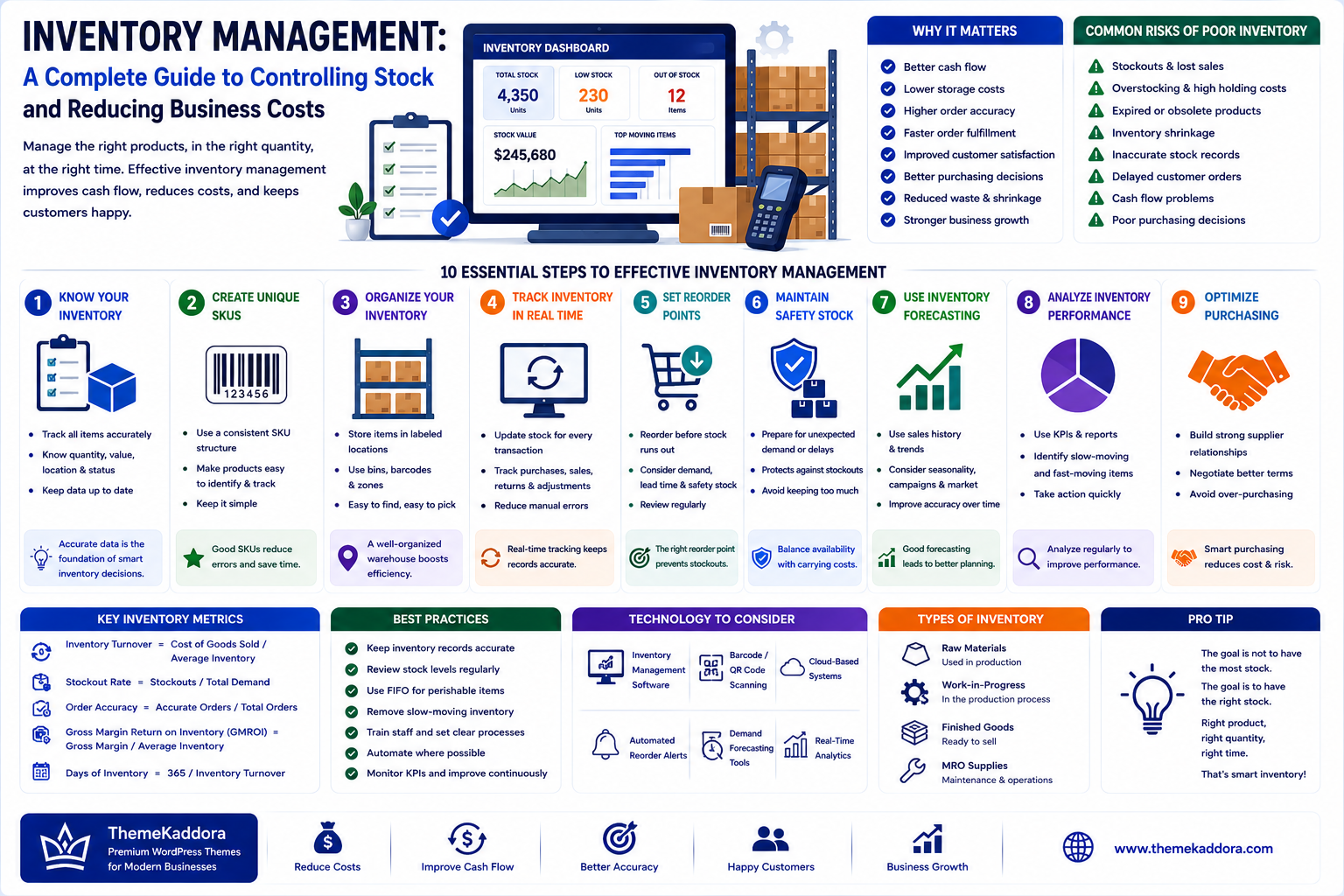
Inventory Management: A Complete Guide to Controlling Stock and Reducing Business Costs
Introduction
Inventory is one of the most important assets for many businesses.
Whether you operate a retail store, eCommerce business, manufacturing company, restaurant, wholesale operation, or distribution business, having the right products available at the right time is essential.
Too little inventory can result in stockouts, delayed orders, and unhappy customers.
Too much inventory can tie up cash, increase storage costs, create waste, and leave businesses holding products that are difficult to sell.
This makes inventory management a critical part of business operations.
Effective inventory management helps businesses understand what they have, what they need, when they need it, and how quickly products are moving.
In this guide, you'll learn how inventory management works, why it matters, which strategies businesses can use, and how technology can improve inventory accuracy and efficiency.
What Is Inventory Management?
Inventory management is the process of purchasing, storing, tracking, organizing, and controlling products or materials used by a business.
It covers the entire inventory lifecycle:
Purchase → Receive → Store → Track → Sell or Use → Reorder
Depending on the business, inventory may include:
Finished products
Raw materials
Components
Packaging
Spare parts
Work-in-progress items
Maintenance supplies
The objective is to maintain enough inventory to meet demand without unnecessarily tying up business capital.
Why Inventory Management Matters
Poor inventory management can create problems across the entire organization.
Common issues include:
Stockouts
Overstocking
Expired products
Inventory shrinkage
Excess storage costs
Cash flow problems
Delayed customer orders
Inaccurate stock records
Poor purchasing decisions
A strong inventory process helps businesses reduce these risks.
Benefits can include:
Better cash flow
Lower storage costs
Higher order accuracy
Faster fulfillment
Improved customer satisfaction
Better purchasing decisions
Reduced waste
1. Know Your Inventory
The first step toward better inventory management is knowing exactly what you have.
Maintain accurate information about:
Product names
SKUs
Quantities
Locations
Purchase costs
Selling prices
Suppliers
Reorder levels
Product status
Without accurate inventory data, forecasting and purchasing decisions become difficult.
2. Create Unique SKUs
A Stock Keeping Unit, or SKU, is a unique identifier assigned to a product or product variation.
For example:
TSH-BLU-M-001
could represent:
TSH = T-shirt
BLU = Blue
M = Medium
001 = Product number
A consistent SKU system makes products easier to identify and track.
Avoid creating unnecessarily complicated SKU structures.
3. Organize Your Inventory
Physical organization is just as important as digital tracking.
Store products in clearly identified locations.
Use:
Shelving
Bins
Labels
Barcodes
QR codes
Warehouse zones
Employees should be able to locate products quickly.
A well-organized warehouse can reduce picking errors and save significant time.
4. Track Inventory in Real Time
Whenever inventory enters or leaves the business, update the inventory record.
Track:
Purchases
Sales
Returns
Transfers
Damaged goods
Adjustments
Stock usage
Real-time or near-real-time tracking helps prevent discrepancies between physical inventory and recorded inventory.
5. Set Reorder Points
A reorder point determines when a product should be reordered.
For example:
If a business normally sells 10 units per day and suppliers require several days to deliver, inventory should be replenished before stock reaches zero.
The exact reorder point should consider:
Average demand
Supplier lead time
Demand variability
Safety stock
Seasonal changes
Avoid using the same reorder threshold for every product.
6. Maintain Safety Stock
Safety stock is additional inventory maintained to protect against unexpected demand or supply delays.
It can help businesses handle:
Sudden increases in demand
Supplier delays
Transportation problems
Forecasting errors
Seasonal fluctuations
However, excessive safety stock defeats the purpose of inventory optimization.
The goal is to balance availability with carrying costs.
7. Use Inventory Forecasting
Inventory forecasting estimates future product demand.
Forecasting can use:
Historical sales
Seasonal trends
Marketing campaigns
Market conditions
Product launches
Customer behavior
Supplier lead times
Accurate forecasting can reduce both stockouts and unnecessary purchases.
8. Analyze Product Demand
Not every product deserves the same inventory strategy.
Some products may sell every day.
Others may sell only occasionally.
Classify products based on:
Sales volume
Revenue contribution
Profitability
Demand consistency
Business importance
High-demand products usually require closer monitoring.
9. Use ABC Inventory Analysis
ABC analysis categorizes inventory according to importance.
A Items
High-value or strategically important products requiring close monitoring.
B Items
Moderately important products requiring regular management.
C Items
Lower-value products that can usually be managed with simpler controls.
This allows businesses to focus their attention where it has the greatest financial impact.
10. Monitor Inventory Turnover
Inventory turnover measures how frequently inventory is sold or consumed during a period.
A higher turnover can indicate strong product movement, although the ideal level depends on the business.
Very low turnover may indicate:
Weak demand
Overstocking
Poor purchasing decisions
Outdated products
Analyze turnover by product category rather than relying only on one overall number.
11. Reduce Dead Stock
Dead stock refers to inventory that is no longer selling or being used.
It can occur because of:
Changing customer preferences
Product replacement
Seasonal demand
Poor purchasing decisions
Product damage
Businesses can address dead stock through:
Discounts
Bundling
Promotions
Supplier returns where possible
Alternative sales channels
Preventing dead stock is usually better than trying to recover its value later.
12. Manage Perishable Inventory
Businesses selling food, medicine, cosmetics, or other time-sensitive products need additional controls.
Use appropriate methods such as:
FIFO — First In, First Out
Older inventory is used or sold first.
For products with expiration dates, businesses may also prioritize items based on their earliest expiry.
Proper stock rotation helps reduce waste.
13. Improve Supplier Management
Inventory performance depends heavily on suppliers.
Track supplier performance using:
Delivery times
Order accuracy
Product quality
Pricing
Minimum order quantities
Reliability
If one supplier repeatedly causes delays, consider alternative suppliers or contingency plans.
14. Negotiate Better Purchasing Terms
Strong supplier relationships can sometimes provide opportunities for:
Better pricing
Flexible payment terms
Smaller minimum orders
Faster delivery
Bulk discounts
However, lower purchase prices should not automatically justify buying excessive quantities.
The total inventory cost matters more than the unit price alone.
15. Conduct Regular Stock Counts
Physical stock counts help identify discrepancies.
Common approaches include:
Full Physical Count
The entire inventory is counted at once.
Cycle Counting
Different products are counted regularly according to an established schedule.
Cycle counting can reduce disruption while helping maintain inventory accuracy.
16. Investigate Inventory Shrinkage
Inventory shrinkage occurs when recorded inventory is greater than the physical inventory available.
Potential causes include:
Theft
Damage
Data-entry errors
Incorrect shipments
Returns not recorded correctly
Administrative mistakes
Investigate recurring discrepancies rather than simply adjusting the numbers.
17. Improve Warehouse Layout
Warehouse layout can directly affect productivity.
Frequently picked products should generally be easy to access.
Consider:
Product velocity
Product size
Weight
Picking frequency
Safety
Storage requirements
An efficient layout can reduce unnecessary employee movement.
18. Standardize Receiving Procedures
Inventory accuracy begins when products arrive.
A receiving process should verify:
Quantity
Product identity
Condition
Purchase order
Supplier documentation
Do not automatically add products to available stock before confirming what was actually received.
19. Standardize Picking and Packing
Incorrect shipments can increase costs and damage customer relationships.
Create clear procedures for:
Picking
Verification
Packing
Labeling
Shipping
Barcode scanning can help reduce manual errors where appropriate.
20. Track Inventory Across Locations
Businesses operating multiple warehouses, stores, or fulfillment centers need centralized visibility.
Track:
Location
Available quantity
Reserved stock
Incoming stock
Transferred stock
This allows businesses to identify where inventory is available before placing unnecessary new orders.
21. Connect Inventory With Sales Data
Inventory decisions become more effective when connected with actual sales activity.
For example:
Marketing campaign → Increased demand → Faster inventory movement → Reorder requirement
Sales, purchasing, and inventory teams should work from consistent information.
22. Automate Inventory Management
Technology can automate many inventory tasks.
Examples include:
Automatic stock updates
Low-stock alerts
Purchase order generation
Barcode scanning
Inventory reports
Stock synchronization
Supplier notifications
Sales forecasting
Automation reduces manual data entry and helps employees focus on higher-value work.
23. Use Inventory Dashboards
A centralized dashboard can provide visibility into important information.
Monitor:
Current stock
Low-stock products
Overstock
Fast-moving products
Slow-moving products
Inventory value
Purchase orders
Supplier performance
Decision-makers can use this information to respond quickly.
24. Calculate Inventory Carrying Costs
Inventory costs more than its purchase price.
Carrying costs can include:
Storage
Insurance
Handling
Damage
Obsolescence
Financing costs
Warehouse labor
Understanding these costs helps businesses determine how much inventory they can realistically afford to hold.
25. Create an Inventory Policy
A written inventory policy can standardize decision-making.
It may define:
Reorder procedures
Stock count frequency
Approval requirements
Supplier selection
Returns
Damaged goods
Stock adjustments
Inventory reporting
Clear policies reduce confusion and improve accountability.
Common Inventory Management Mistakes
Ordering Based Only on Intuition
Historical data and demand patterns are usually more reliable than assumptions alone.
Ignoring Slow-Moving Products
Slow-moving inventory can quietly consume cash and storage space.
Poor Record Keeping
Inaccurate records make every inventory decision harder.
Overbuying for Discounts
A cheaper unit price does not help if products remain unsold.
No Backup Suppliers
Supplier disruptions can quickly create stock shortages.
Ignoring Inventory Shrinkage
Repeated discrepancies should be investigated.
Using Too Many Manual Processes
Manual spreadsheets and disconnected systems can increase errors as the business grows.
Inventory Management Checklist
Inventory Setup
Create SKUs
Organize storage locations
Record supplier information
Define product categories
Stock Control
Track inventory movement
Set reorder points
Maintain appropriate safety stock
Conduct stock counts
Purchasing
Analyze demand
Evaluate suppliers
Monitor lead times
Review purchasing costs
Warehouse
Optimize layout
Standardize receiving
Improve picking
Verify packing
Analytics
Monitor turnover
Identify dead stock
Track inventory value
Analyze demand
Technology
Automate stock updates
Use barcode systems where appropriate
Create inventory dashboards
Connect inventory with sales data
How Technology Can Improve Inventory Management
Modern inventory systems can connect multiple business processes.
For example:
Sale → Inventory Update → Low-Stock Alert → Purchase Order → Supplier → Receiving → Stock Update
This reduces the need for manual coordination.
Businesses can also connect inventory with:
Accounting
CRM
eCommerce
ERP
Purchasing
Warehouse management
Analytics
Integrated systems provide a more complete view of business operations.
Why Choose ThemeKaddora?
At ThemeKaddora, we believe businesses can improve operational efficiency by connecting their digital systems.
Modern businesses can use technology to support:
Inventory tracking
Sales management
Purchasing
Reporting
Automation
Business analytics
eCommerce operations
The objective is to reduce repetitive work, improve visibility, and help decision-makers act on accurate information.
Conclusion
Effective inventory management is not simply about counting products.
It is about maintaining the right inventory at the right time while controlling the costs associated with purchasing, storage, handling, and fulfillment.
Start by establishing accurate inventory records.
Then create clear SKUs, organize storage, monitor stock movement, establish reorder points, forecast demand, evaluate suppliers, and conduct regular inventory counts.
As the business grows, use automation and integrated systems to reduce manual work and improve visibility.
The ultimate goal is simple:
Have enough inventory to serve customers without unnecessarily tying up business capital.
Businesses that manage inventory effectively can improve cash flow, reduce waste, increase operational efficiency, and create a more reliable customer experience.
Frequently Asked Questions
1. What is inventory management?
Inventory management is the process of purchasing, storing, tracking, controlling, and replenishing products or materials used by a business.
2. Why is inventory management important?
It helps businesses avoid stockouts, reduce overstocking, control costs, improve cash flow, and fulfill customer orders more efficiently.
3. What is a reorder point?
A reorder point is the inventory level at which a business should initiate a new purchase to avoid running out of stock.
4. What is safety stock?
Safety stock is additional inventory maintained to protect against unexpected demand increases or supplier delays.
5. What is inventory turnover?
Inventory turnover measures how frequently inventory is sold or consumed during a specific period.
6. What is ABC inventory analysis?
ABC analysis categorizes inventory according to its relative importance or value so businesses can prioritize management efforts.
7. How can businesses reduce dead stock?
Businesses can improve forecasting, avoid excessive purchasing, use promotions, bundle products, and review slow-moving inventory regularly.
8. How does technology improve inventory management?
Technology can automate stock tracking, alerts, purchasing workflows, reporting, forecasting, and synchronization across business systems.
9. How often should inventory be counted?
The appropriate frequency depends on the business. Some companies use regular cycle counting, while others conduct full physical counts periodically.
10. What is the biggest inventory management mistake?
One of the biggest mistakes is making purchasing decisions without accurate inventory and demand data.
Comments (0)