
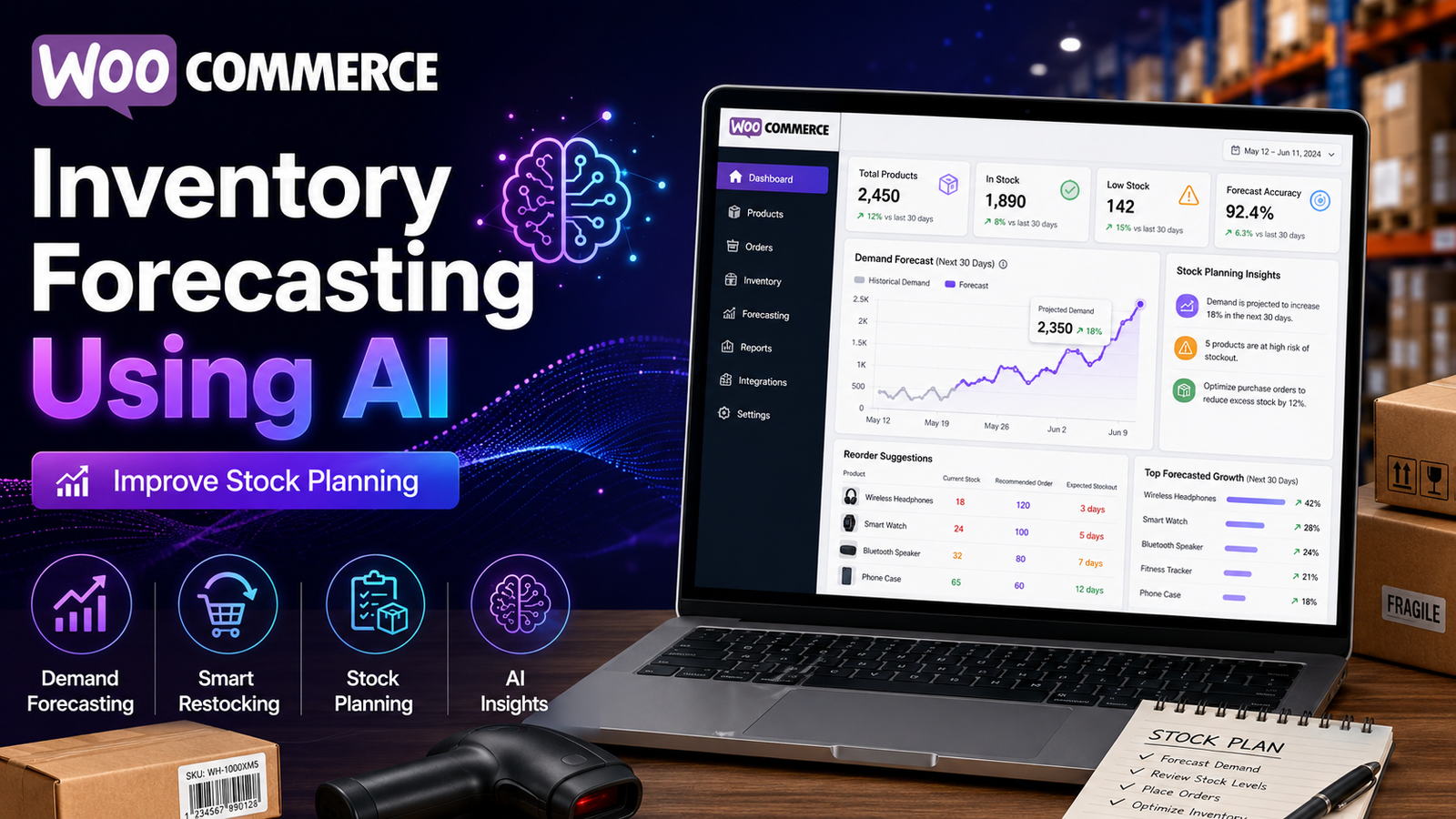
Inventory Forecasting Using AI
One of the biggest challenges for every eCommerce business is knowing how much inventory to keep in stock. Order too much, and you increase storage costs while tying up cash in unsold products. Order too little, and you risk stockouts, lost sales, and dissatisfied customers.
Traditional inventory forecasting often relies on spreadsheets or historical sales reports. While these methods can be useful, they may not adapt quickly to changing customer behavior, seasonal demand, or market trends.
Artificial Intelligence (AI) improves inventory forecasting by analyzing large amounts of historical and real-time business data to identify patterns that support smarter inventory planning.
In this guide, you'll learn how AI inventory forecasting works, its benefits, best practices, and how WooCommerce businesses can use it to improve inventory management.
Quick Answer
What is inventory forecasting using AI?
Inventory forecasting using AI is the process of using artificial intelligence to analyze sales history, inventory movement, seasonal demand, customer purchasing patterns, and other business data to estimate future inventory requirements and support more informed purchasing decisions.
Why Inventory Forecasting Matters
Poor forecasting can lead to costly inventory problems.
Accurate forecasting helps businesses:
Reduce stockouts
Avoid overstocking
Improve cash flow
Increase inventory turnover
Improve customer satisfaction
Plan purchasing more efficiently
Support business growth
Instead of reacting after inventory problems occur, forecasting helps businesses prepare in advance.
How AI Improves Inventory Forecasting
Unlike manual forecasting, AI can analyze multiple variables simultaneously.
These may include:
Historical sales
Seasonal buying patterns
Product popularity
Customer purchasing behavior
Inventory turnover
Stock availability
Promotional campaigns
Historical demand fluctuations
By evaluating these data points together, AI can generate forecasting recommendations that help businesses make better inventory decisions.
Benefits of AI Inventory Forecasting
Better Demand Prediction
AI helps estimate future demand by identifying historical sales trends and recurring purchasing patterns.
Reduced Stockouts
Forecasting allows businesses to replenish inventory before products become unavailable.
Lower Inventory Costs
Ordering more accurately helps reduce excess inventory and unnecessary storage expenses.
Improved Purchasing Decisions
Inventory recommendations support more efficient supplier ordering and purchasing schedules.
Higher Customer Satisfaction
Maintaining product availability improves the shopping experience and reduces missed sales opportunities.
Faster Decision-Making
AI processes large datasets much faster than manual spreadsheet analysis, allowing teams to respond more quickly to changing conditions.
Factors That Influence AI Forecasting
Several types of business data contribute to more reliable forecasting.
Historical Sales Data
Past sales performance helps establish long-term demand patterns.
Seasonal Trends
Products often experience recurring peaks during holidays, festivals, or promotional events.
Product Lifecycle
New products, growing products, and mature products typically require different inventory strategies.
Inventory Turnover
Fast-moving products generally require more frequent replenishment than slower-moving inventory.
Promotional Activity
Marketing campaigns and discounts can significantly influence short-term demand.
Best Practices for AI Inventory Forecasting
Maintain Accurate Inventory Records
Forecasting is only as reliable as the underlying inventory data.
Review Forecasts Regularly
Customer demand changes over time, so forecasting should be monitored continuously rather than treated as a one-time task.
Monitor Fast-Selling Products
Frequently review products with high sales volume to ensure forecast recommendations remain appropriate.
Compare Forecasts with Actual Sales
Evaluate forecast accuracy regularly to improve future planning.
Consider Supplier Lead Times
Even accurate forecasts must account for supplier delivery schedules to avoid shortages.
Common Forecasting Mistakes
Avoid these common issues:
❌ Relying only on last month's sales
❌ Ignoring seasonal demand
❌ Failing to update inventory records
❌ Overstocking "just in case"
❌ Ignoring inventory turnover trends
❌ Assuming AI predictions are always perfect
AI provides valuable guidance, but successful inventory planning still requires human review and business experience.
How Kaddora WooCommerce Inventory Management Helps
Growing WooCommerce businesses need more than basic stock tracking—they need visibility into inventory performance and planning.
Kaddora WooCommerce Inventory Management Plugin helps store owners organize inventory information through centralized dashboards, reporting, and inventory insights that support better planning.
Key Features
Centralized inventory dashboard
Real-time inventory tracking
Inventory performance reports
Product movement analysis
Low-stock monitoring
SKU management
Bulk inventory updates
WooCommerce integration
By combining inventory visibility with reporting tools, the plugin helps businesses make more informed inventory decisions.
AI Inventory Forecasting Checklist
✅ Keep inventory records accurate
✅ Monitor sales trends
✅ Review inventory reports weekly
✅ Track seasonal demand
✅ Analyze inventory turnover
✅ Compare forecasts with actual sales
✅ Review supplier lead times
✅ Adjust purchasing plans regularly
Frequently Asked Questions
What is AI inventory forecasting?
AI inventory forecasting uses artificial intelligence to analyze inventory and sales data in order to estimate future product demand and support inventory planning.
Can AI predict inventory demand accurately?
AI can identify patterns and generate demand forecasts using historical and operational data. However, forecasts are estimates and should be reviewed alongside business knowledge and market conditions.
Does AI help reduce stockouts?
Yes. By identifying demand trends and inventory risks earlier, AI can help businesses replenish inventory before shortages occur.
Is AI forecasting useful for small businesses?
Yes. Even small WooCommerce stores can benefit from data-driven forecasting as they grow their product catalog and sales volume.
Which WooCommerce plugin supports AI-driven inventory insights?
Businesses seeking centralized inventory dashboards, reporting, stock monitoring, and intelligent inventory analysis can evaluate Kaddora WooCommerce Inventory Management Plugin.
Final Thoughts
Inventory forecasting has evolved beyond spreadsheets and manual calculations. AI enables businesses to analyze more data, recognize demand patterns, and make inventory decisions with greater confidence.
For WooCommerce store owners, combining AI-supported forecasting with disciplined inventory management can reduce costs, improve product availability, and create a smoother shopping experience for customers.
If you're looking to strengthen your inventory planning process, Kaddora WooCommerce Inventory Management Plugin provides centralized inventory management, real-time monitoring, and actionable reporting to support smarter stock decisions.
Comments (0)