
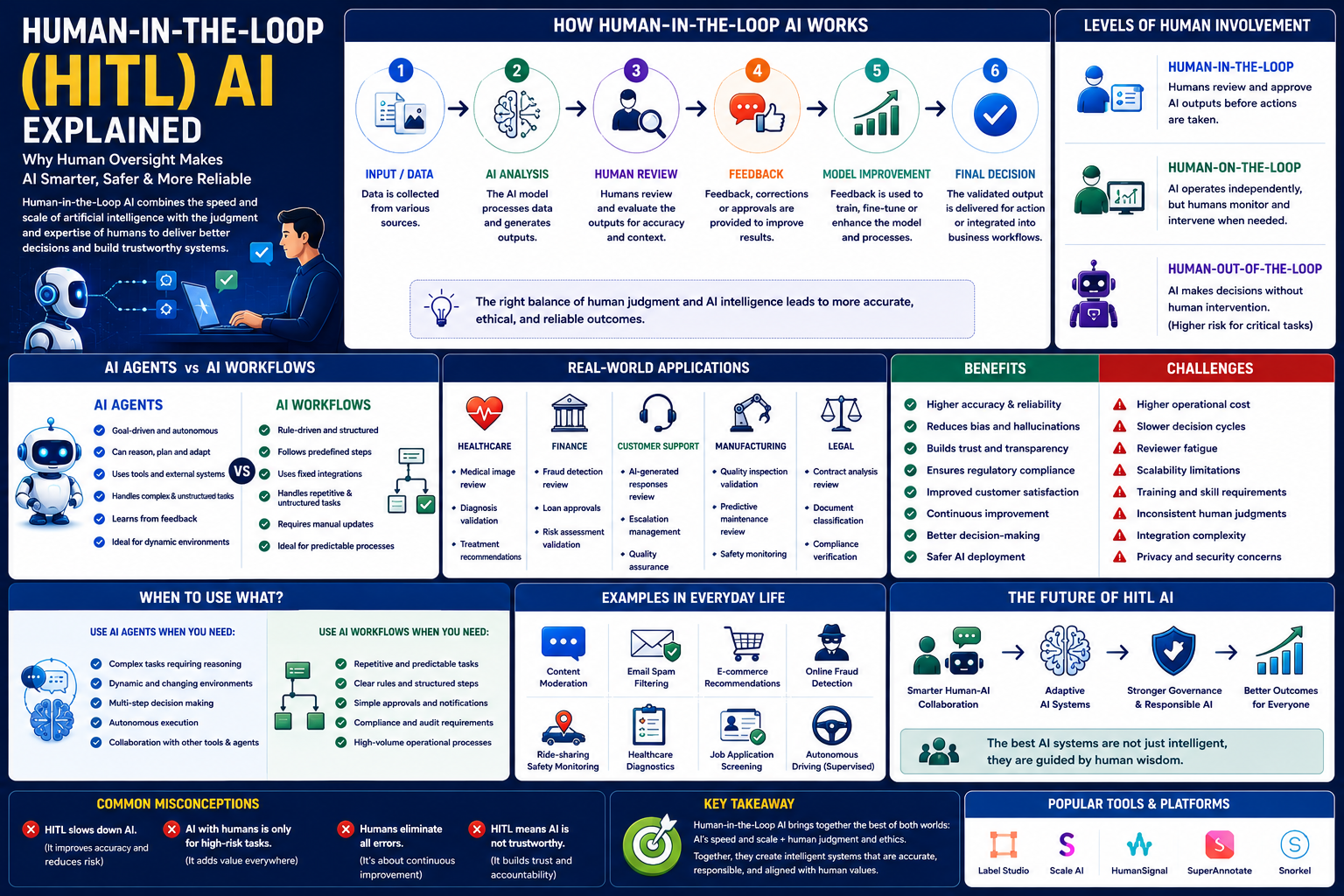
Human-in-the-Loop (HITL) AI Explained: Why Human Oversight Makes Artificial Intelligence Smarter and Safer
Introduction
Artificial Intelligence can analyze data, automate decisions, generate content, and solve complex problems faster than ever before. However, AI systems are not perfect. They may misunderstand context, produce inaccurate results, reinforce biases, or make decisions that require ethical judgment.
This is where Human-in-the-Loop (HITL) AI becomes essential.
Human-in-the-Loop AI combines the speed and scalability of machine intelligence with the experience, judgment, and oversight of human experts. Instead of allowing AI to operate independently in every situation, humans review, validate, correct, or approve important decisions.
From healthcare and finance to autonomous vehicles and customer service, HITL AI helps organizations build more reliable, transparent, and responsible AI systems.
What Is Human-in-the-Loop AI?
Human-in-the-Loop (HITL) AI is an approach in which people participate in one or more stages of an AI system's lifecycle to improve accuracy, quality, safety, or decision-making.
Human involvement may include:
Reviewing AI outputs
Correcting mistakes
Approving recommendations
Labeling training data
Monitoring AI performance
Providing feedback
Handling complex cases
Ensuring regulatory compliance
Rather than replacing people, HITL AI enables effective collaboration between humans and intelligent systems.
Why Human-in-the-Loop AI Matters
Human oversight helps organizations:
Improve AI accuracy
Reduce hallucinations
Detect bias
Build trust
Meet compliance requirements
Improve customer experiences
Support ethical AI
Continuously improve AI models
HITL is especially important in high-risk applications where mistakes can have significant consequences.
How Human-in-the-Loop AI Works
Most HITL systems follow a structured workflow.
1. Data Collection
AI receives data such as text, images, documents, audio, or sensor information.
2. AI Analysis
The model processes the data and generates predictions or recommendations.
3. Human Review
People review outputs that require validation or expert judgment.
4. Feedback
Corrections and comments are provided to improve future performance.
5. Model Improvement
Feedback is incorporated into future model updates or operational processes.
6. Final Decision
The approved result is delivered to users or integrated into business workflows.
Levels of Human Involvement
Organizations can choose different levels of oversight.
Human-in-the-Loop
Humans review important AI decisions before execution.
Human-on-the-Loop
AI operates autonomously while humans monitor performance and intervene when needed.
Human-out-of-the-Loop
AI makes decisions without human intervention.
The appropriate level depends on the application's risk, regulations, and business requirements.
Human-in-the-Loop AI vs Fully Autonomous AI
Human-in-the-Loop AI
Fully Autonomous AI
Human oversight
No human review
Better accountability
Higher autonomy
Lower risk
Faster execution
Supports ethical decisions
Limited human intervention
Ideal for critical applications
Ideal for repetitive low-risk tasks
Many enterprises use a hybrid approach that balances automation with human expertise.
Real-World Applications
Human-in-the-Loop AI supports many industries.
Healthcare
Medical diagnosis review
Radiology image validation
Treatment planning
Finance
Fraud investigation
Loan approvals
Compliance monitoring
Legal
Contract review
Document analysis
Regulatory compliance
Customer Support
AI-generated responses
Escalation management
Quality assurance
Manufacturing
Quality inspection
Predictive maintenance validation
Safety monitoring
Autonomous Vehicles
Remote supervision
Safety intervention
Driving assistance
Benefits of Human-in-the-Loop AI
Organizations gain many advantages.
Benefits include:
Higher accuracy
Improved trust
Reduced bias
Better compliance
Enhanced transparency
Continuous learning
Improved customer satisfaction
Safer AI deployment
Human oversight ensures AI remains aligned with business objectives and ethical standards.
Challenges and Limitations
Despite its advantages, HITL AI introduces challenges.
These include:
Increased operational costs
Slower decision-making
Reviewer fatigue
Scalability limitations
Training requirements
Inconsistent human judgments
Integration complexity
Privacy considerations
Effective governance helps organizations balance automation and human involvement.
Human-in-the-Loop AI in Everyday Life
Many familiar services already rely on HITL AI.
Examples include:
Content moderation
Fraud detection
Customer support
Medical imaging
Recruitment screening
Identity verification
Autonomous driving assistance
Online marketplace reviews
In many cases, AI handles routine tasks while humans resolve exceptions.
Future of Human-in-the-Loop AI
Future developments include:
Smarter human-AI collaboration
Adaptive review systems
AI-assisted decision support
Explainable AI integration
Enterprise AI governance platforms
Personalized oversight
Regulatory AI frameworks
Safer autonomous systems
Human expertise will remain an essential part of responsible AI deployment.
Common Misconceptions
Several myths surround Human-in-the-Loop AI.
Common misconceptions include:
Human oversight slows AI unnecessarily.
HITL means AI is unreliable.
Every AI system requires constant human review.
Human reviewers eliminate every error.
Fully autonomous AI is always better.
In reality, the level of human involvement should match the application's goals, risks, and regulatory requirements.
Final Thoughts
Human-in-the-Loop AI represents a balanced approach to artificial intelligence, combining machine efficiency with human judgment. By integrating expert oversight into AI systems, organizations can improve accuracy, reduce risks, build trust, and ensure responsible decision-making.
As AI continues to expand into critical industries, Human-in-the-Loop AI will remain a key strategy for creating intelligent systems that are not only powerful but also safe, transparent, and aligned with human values.
Frequently Asked Questions
What is Human-in-the-Loop AI?
Human-in-the-Loop AI is an approach where humans participate in reviewing, validating, or improving AI decisions to increase accuracy, safety, and accountability.
Why is Human-in-the-Loop AI important?
It improves trust, reduces errors, supports compliance, and helps organizations deploy AI responsibly.
Which industries use Human-in-the-Loop AI?
Healthcare, finance, legal, manufacturing, retail, transportation, education, cybersecurity, and customer service all benefit from HITL AI.
Does Human-in-the-Loop AI replace automation?
No. It combines automation with human expertise, allowing AI to handle routine tasks while people oversee critical decisions.
Is Human-in-the-Loop AI required for every AI system?
Not always. Low-risk tasks may operate autonomously, while high-risk applications often require human oversight.
Comments (0)