
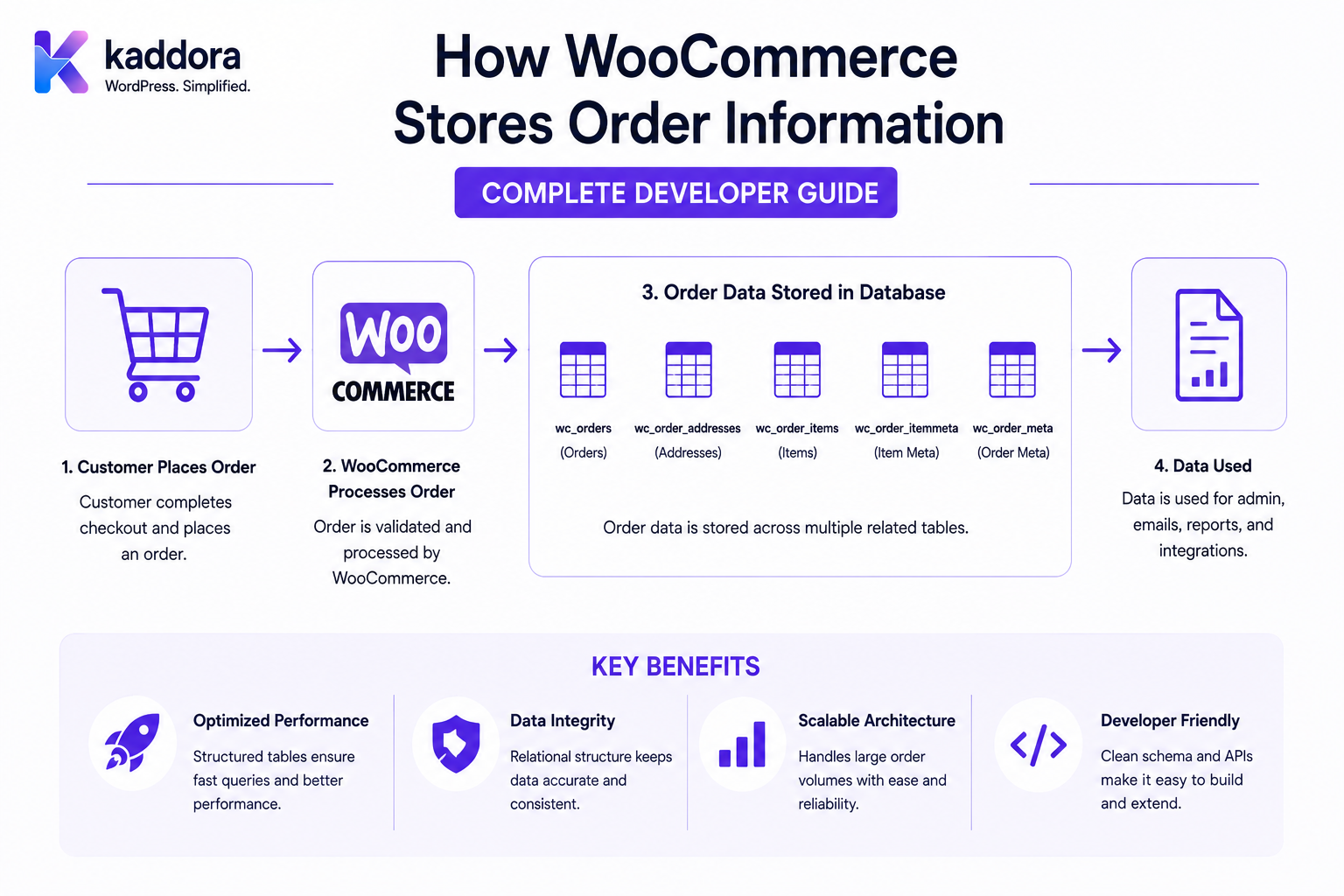
How WooCommerce Stores Order Information: Complete Developer Guide
Introduction
When a customer places an order in WooCommerce, the store does not simply save:
Order ID + Total
A real WooCommerce order can contain many related pieces of information:
Customer Billing Address Shipping Address Products Variations Quantities Prices Taxes Shipping Fees Coupons Payment Information Order Status Refunds Notes Custom Metadata
A simplified view looks like:
Customer ↓ Cart ↓ Checkout ↓ Order ├── Customer Data ├── Billing Data ├── Shipping Data ├── Products ├── Taxes ├── Shipping ├── Fees ├── Coupons ├── Payment References ├── Refunds └── Metadata
Understanding this structure is important when developing:
Payment Gateways ERP Integrations CRM Integrations Analytics Shipping Plugins Order Automation Customer Portals WooCommerce Extensions
It is also important to understand that WooCommerce has an abstraction layer between application code and physical storage.
Developers should normally interact with:
WC_Order WooCommerce CRUD APIs WooCommerce Order Queries
rather than assuming that every order is stored as a normal WordPress post.
What Is a WooCommerce Order?
A WooCommerce order is a persistent representation of a customer's purchase or purchase-related transaction.
It can contain:
Order Identity Customer Information Addresses Line Items Totals Payment State Shipping Information Order Status Refunds Metadata
The order is the central object connecting these components.
Order Information vs Cart Information
Cart data and order data are different.
Cart
Represents temporary shopping activity.
Order
Represents the persisted purchase record.
Conceptually:
Products Selected ↓ Cart ↓ Checkout ↓ Order
The cart may disappear or change.
The order becomes the historical record of the transaction.
What Information Does WooCommerce Store?
A typical order can involve:
Order ID Order Status Order Date Currency Customer ID Billing Address Shipping Address Order Total Tax Totals Shipping Total Discount Totals Payment Method Transaction ID Customer Note Product Items Shipping Items Fee Items Coupon Items Refunds Custom Metadata
The exact fields available through the current WC_Order API are defined by WooCommerce's order model.
Order ID
Every order has an identifier.
For example:
Order: #10542
The ID is useful for:
Order Retrieval URLs Integrations ERP References Support Reporting
However, an order ID should be treated as an identifier, not as proof that a user is authorized to access the order.
Order Status
WooCommerce tracks the state of an order.
Examples include:
Pending Payment Processing On Hold Completed Cancelled Refunded Failed
A store can also support custom order statuses.
Developers should retrieve the status through the WooCommerce order object.
Order Dates
Orders may have important timestamps such as:
Created Modified Paid Completed
Applications can use these dates for:
Reports Fulfillment Automation Analytics Customer Service
Currency
An order stores the currency relevant to the transaction.
For example:
USD EUR GBP INR
Do not assume the current store currency is always the currency of every historical order.
Customer ID
A registered customer can be associated with an order.
Conceptually:
Customer: #800 Orders: #10542 #10601 #10713
The customer relationship is useful for:
Order History Customer Analytics CRM Loyalty Support
Guest Orders
Not every customer has a WordPress user account.
WooCommerce can support guest orders.
A guest order may instead rely heavily on information such as:
Billing Email Billing Name Shipping Information
Therefore, extension code should not assume:
Every Order = Registered User
Billing Information
Orders can contain billing information such as:
First Name Last Name Company Address City State Postcode Country Email Phone
This information may be needed for:
Invoices Payments Tax Customer Support Accounting
Shipping Information
Shipping information is stored separately as part of the order model.
It can include:
First Name Last Name Company Address City State Postcode Country Phone
A customer may have different billing and shipping information.
Why Billing and Shipping Should Be Treated Separately
A customer can purchase:
Billing: Mumbai Shipping: Pune
Therefore, applications should not assume:
Billing Address = Shipping Address
Order Totals
WooCommerce orders contain financial totals such as:
Subtotal Discount Shipping Tax Total
These values are useful for:
Invoices Analytics ERP Accounting Customer Portals
Discount Totals
An order can contain discounts resulting from:
Coupons Product Discounts Dynamic Pricing Other Promotional Logic
Applications should use WooCommerce's calculated order values instead of rebuilding historical pricing from current product prices.
Tax Totals
Taxes can contribute to:
Line Tax Shipping Tax Total Tax
Historical order calculations should not depend on today's tax configuration.
Product Line Items
An order can contain multiple product items.
Example:
Order #10542 Product A × 2 Product B × 1 Product C × 3
Each line item can contain product-related order data.
Product Item Data
A product line item can include:
Product ID Variation ID Quantity Tax Class Subtotal Subtotal Tax Total Total Tax
The WooCommerce product line-item class exposes these as part of the order item data model.
Why Order Items Matter
Suppose a product's current price is:
₹2,000
but an old order was placed when the product cost:
₹1,500
The order must preserve its historical purchase information.
Order items therefore represent transaction-time information rather than simply re-reading today's product configuration.
Product ID vs Order Item Data
These are different.
Product ID
References the current catalog product.
Order Item Data
Represents what was actually included in the historical transaction.
A robust report should understand both.
Variable Products
An order can contain a variation:
Product: T-Shirt Variation: Large / Black
The order item model can retain both product and variation identifiers where applicable.
Shipping Items
Shipping methods can appear as order items.
For example:
Express Shipping ₹250
This allows WooCommerce to distinguish shipping from products.
Fee Items
Orders can also contain fees.
Examples:
Installation Fee Gift Wrapping Handling Fee
These are different from product line items.
Coupon Items
Applied coupons can also be associated with the order.
For example:
Coupon: SAVE20 Discount: ₹400
This information can support:
Marketing Analytics Promotion Reporting Customer Segmentation
Payment Information
An order can contain payment-related fields such as:
Payment Method Payment Method Title Transaction ID
These are useful for:
Payment Reconciliation Support ERP Accounting
Payment Credentials Are Different
Order payment information should not be confused with sensitive payment credentials.
An order may contain:
Transaction Reference
without containing:
Raw Card Number CVV
Payment credentials should remain handled by secure payment infrastructure.
Transaction ID
A payment gateway may return an external transaction identifier.
For example:
WooCommerce Order: #10542 Gateway Transaction: TXN-823901
This can help with:
Payment Support Refunds Reconciliation Gateway Debugging
Customer Notes
Customers may submit notes during checkout.
For example:
"Please deliver after 6 PM."
An order can preserve customer-note information where appropriate.
Order Notes
Internal order notes can record operational events:
Payment verified. Shipment dispatched. Customer contacted.
These notes are different from the core order properties.
Refund Information
Refunds relate back to the original order.
Conceptually:
Order #10542 ↓ Refund #1 Refund #2
Applications should use WooCommerce refund objects and APIs rather than manually modifying stored totals.
Why Refunds Should Not Be Simulated With Metadata
Avoid creating something like:
_refund_amount = 500
and treating that as the complete refund system.
Refunds can involve:
Refund Amount Refund Reason Gateway Refund Line Items Taxes Shipping
Use WooCommerce's refund model.
Order Metadata
Extensions frequently need custom order information.
For example:
ERP Order ID CRM Contact ID Warehouse ID Shipment ID External Invoice ID Fraud Review ID
WooCommerce supports custom order metadata through its order object.
Reading Order Metadata
Conceptually:
$order = wc_get_order( $order_id ); $value = $order ? $order->get_meta( '_kdr_erp_order_id', true ) : '';
This keeps access within the order abstraction.
Updating Order Metadata
For example:
$order = wc_get_order( $order_id ); if ( $order ) { $order->update_meta_data( '_kdr_erp_order_id', $external_id ); $order->save(); }
Don't Depend on Post Meta for Order Logic
Legacy code may use:
get_post_meta() update_post_meta()
directly for order information.
Modern extension code should generally use the WooCommerce order APIs.
Legacy Order Storage
Historically, WooCommerce order information was closely associated with:
wp_posts wp_postmeta
This allowed orders to fit into WordPress's content architecture.
Why Legacy Storage Can Become Challenging
Large ecommerce systems may have:
Millions of Postmeta Rows Large Order Volumes Complex Joins Many Third-Party Queries
Order workloads can therefore compete with unrelated WordPress content storage.
HPOS Order Storage
WooCommerce's High-Performance Order Storage architecture provides dedicated order storage designed around ecommerce order workloads.
The important change for extension developers is not simply:
New Tables
but:
Order Domain ↓ WooCommerce CRUD ↓ Active Data Store
Why HPOS Changes Development
A plugin should not assume:
Order = WordPress Post
Instead:
Order = WooCommerce Order Object
The current WC_Order class exposes the order data model and maintains a data-store reference.
WooCommerce CRUD Layer
The CRUD system provides a consistent way to work with WooCommerce entities.
For orders:
$order = wc_get_order( $order_id );
Developers can then call methods such as:
$order->get_total(); $order->get_status(); $order->get_billing_email(); $order->get_currency();
Why the CRUD Layer Matters
Your plugin can request:
Get Order Total
without caring whether the data comes from:
Legacy Storage
or:
HPOS
This makes the extension more resilient.
WooCommerce Data Stores
WooCommerce has data-store abstractions for order data.
The current code reference exposes an order data-store interface with functions for order retrieval, counts, order keys, and other order-related operations.
This reinforces the distinction between:
Order Object
and:
Physical Storage
Querying Orders
WooCommerce provides order query abstractions through wc_get_orders() and WC_Order_Query.
This lets developers query by supported order properties rather than directly building storage-specific SQL.
The current WooCommerce code reference identifies WC_Order_Query as the parameter-based order-query class.
Example: Query Processing Orders
$orders = wc_get_orders( array( 'status' => 'processing', 'limit' => 20, ) );
This expresses the business requirement:
Find 20 processing orders.
instead of:
Search a specific database table.
Example: Query Customer Orders
$orders = wc_get_orders( array( 'customer_id' => $customer_id, 'limit' => 20, ) );
This is more resilient than constructing custom joins against order tables.
Example: Order Date Filtering
A reporting system can request orders for a defined period:
Start: 2026-08-01 End: 2026-08-31
The query layer should handle the storage-specific implementation.
Example: Order Status Filtering
For example:
$orders = wc_get_orders( array( 'status' => array( 'processing', 'completed' ), 'limit' => 50, ) );
Use supported query arguments for the WooCommerce version being targeted.
Order Data and Performance
The amount of order data stored is only one part of performance.
Performance also depends on:
Query Design Indexes Order Volume Extension Behavior Database Resources External APIs Caching Hosting
Don't Load Every Order Object
Avoid:
$orders = wc_get_orders( array( 'limit' => -1, ) );
for routine reporting on large stores.
Loading thousands of complete order objects can consume significant memory and processing time.
Use Pagination
Instead:
Page 1 ↓ Page 2 ↓ Page 3
This keeps the application responsive.
Use Aggregates for Dashboards
If the dashboard only needs:
Total Orders: 12,450
don't load 12,450 order objects.
Use a suitable aggregate strategy.
Order Data and External Integrations
Orders are frequently synchronized with:
ERP CRM Accounting Shipping Warehouse Marketing Analytics
A clean integration looks like:
WooCommerce Order ↓ Order API / Event ↓ Integration Service ↓ External System
Order Synchronization
For an ERP:
Order Created ↓ ERP Sync Job ↓ ERP Invoice ↓ External Reference Saved
Make Synchronization Idempotent
If the same event is processed twice:
Order #10542
the ERP should not create two invoices.
Use a stable external reference.
Order Data and Customer Portals
A customer portal might expose:
Order Number Order Status Items Totals Shipping Information
but it must verify that the authenticated customer owns or is otherwise authorized to view the order.
Don't Trust Customer IDs From the Browser
An insecure endpoint might accept:
customer_id=900
and return that customer's orders.
Instead derive customer identity from the authenticated session.
Order API Security
Custom order endpoints should enforce:
Authentication Capability Customer Ownership Store Scope Resource Access
Data Minimization
A support dashboard might need:
Order ID Customer Name Status Issue
It may not need:
All Metadata Private CRM Notes Sensitive Payment References
Return only what the interface requires.
Order Data and Privacy
Orders may contain personally identifiable and business-sensitive information.
Protect:
Names Addresses Email Phone Customer Notes Business Information
with appropriate access controls.
Order Data Retention
Stores should define how long they retain:
Orders Refunds Customer Data Metadata Integration References Logs
Retention requirements depend on the business and applicable rules.
Do not delete historical orders simply to reduce database size.
Order Data and Backups
Order databases are critical business data.
Maintain reliable:
Database Backups File Backups Recovery Procedures
and periodically verify that recovery actually works.
Order Data Migration
When changing order-storage configuration:
Backup ↓ Staging ↓ Enable HPOS ↓ Synchronize ↓ Verify ↓ Test Integrations ↓ Production
Avoid direct manual copying between legacy and HPOS storage.
What to Test After Migration
Verify:
Order Creation Order Retrieval Order Search Checkout Payments Refunds Shipping Customer Portal Reports ERP CRM Analytics Emails
Test Historical Orders
Check:
Old Orders Recent Orders Guest Orders Registered Orders Refunded Orders Cancelled Orders Completed Orders
Historical data can reveal compatibility issues that fresh orders do not.
Test Custom Metadata
For custom integrations, verify:
Metadata Read Metadata Write Metadata Search Metadata Migration
Test Order Items
Verify:
Products Variations Quantities Totals Taxes Shipping Fees Coupons
after significant storage or extension changes.
Common Ways Developers Break Order Storage
Direct Post Queries
Code assumes every order is in wp_posts.
Direct Postmeta Queries
Code depends on legacy order metadata.
Hard-Coded HPOS Tables
Code couples business logic to implementation details.
Manual Table Synchronization
Code tries to maintain both storage systems itself.
Unbounded Order Loading
Reports load the entire order history.
Rebuilding Totals
Applications recalculate historical prices from current product configuration.
Weak Customer Ownership Checks
Customers can modify order IDs to access other customers' orders.
Huge Metadata Payloads
External API responses are unnecessarily stored on every order.
No Migration Testing
Storage changes break hidden integrations.
How Developers Should Work With Order Information
A clean extension architecture is:
Feature ↓ Application Service ↓ WooCommerce Order API ↓ Data Store ↓ Storage
For example:
$order = wc_get_order( $order_id ); if ( ! $order ) { return; } $total = $order->get_total(); $status = $order->get_status(); $email = $order->get_billing_email();
This keeps business code focused on the order rather than the database.
Custom Order Service
A larger plugin can create:
OrderService
with methods such as:
getOrder() getCustomerOrders() getOrderStatus() saveExternalReference() syncOrder()
This centralizes business behavior.
Avoid Over-Abstraction
Don't create multiple unnecessary repository layers merely to wrap simple WooCommerce methods.
The abstraction should solve a real architectural problem.
Order Events
Order lifecycle events can trigger:
Inventory Shipping ERP CRM Analytics Notifications Automation
For example:
Order Completed ↓ Queue ↓ ERP Synchronization
Queue-Based Processing
Use background processing for expensive actions such as:
Large Exports ERP Sync Analytics Email Digests External API Calls
The order itself remains the authoritative business record.
Failure Isolation
If the CRM API fails:
CRM Sync: Failed
the WooCommerce order should not automatically become:
Failed
unless the business workflow explicitly requires that relationship.
WooCommerce Order Information Checklist
- [ ] Understand order domain model - [ ] Understand customer relationship - [ ] Understand billing data - [ ] Understand shipping data - [ ] Understand order items - [ ] Understand taxes - [ ] Understand shipping items - [ ] Understand fees - [ ] Understand coupons - [ ] Understand payments - [ ] Understand refunds - [ ] Understand order metadata - [ ] Use WC_Order - [ ] Use wc_get_order() - [ ] Use wc_get_orders() - [ ] Avoid direct post queries - [ ] Avoid direct postmeta assumptions - [ ] Protect custom order APIs - [ ] Protect customer ownership - [ ] Use pagination - [ ] Avoid loading all orders - [ ] Use aggregation where possible - [ ] Make integrations idempotent - [ ] Test HPOS - [ ] Test migration - [ ] Test historical orders - [ ] Test refunds - [ ] Test payments - [ ] Test third-party extensions
Best Practices for WooCommerce Order Information
A professional WooCommerce extension should:
Treat order information as a structured business domain rather than a collection of unrelated database fields.
Use the WooCommerce order CRUD layer as the normal application boundary.
Use wc_get_order() for individual order retrieval and supported wc_get_orders() / order-query mechanisms for searches and lists.
Understand the relationships among customers, order items, taxes, shipping, fees, coupons, payments, refunds, and metadata.
Preserve historical transaction information instead of recalculating old order values from current product or tax configuration.
Store only necessary custom metadata and avoid large unstructured payloads.
Keep business logic independent of the physical order-storage implementation.
Avoid direct assumptions about wp_posts, wp_postmeta, or specific HPOS tables for ordinary order operations.
Use bounded queries, pagination, batching, and aggregation for large order datasets.
Protect customer order data through authentication, ownership, capabilities, and appropriate store or organization scope.
Keep payment credentials out of order metadata and rely on appropriate payment infrastructure and references.
Separate WooCommerce order state from ERP, CRM, warehouse, and analytics synchronization state.
Make external order synchronization idempotent and retry-safe.
Test legacy and HPOS environments when the extension supports both.
Verify historical orders, guest orders, refunds, payments, custom metadata, order items, and third-party integrations after migration.
Monitor order-query performance at realistic production volumes.
Use reliable backups and staging before changing storage configuration.
Keep integrations dependent on WooCommerce's public APIs and supported abstractions rather than implementation-specific table layouts.
Why choose ThemeKaddora?
ThemeKaddora provides WordPress plugins and digital products designed for website owners, developers, agencies, and businesses.
Its product categories include solutions for:
WooCommerce
AI
Analytics
Marketing
Automation
Productivity
Business growth
ThemeKaddora focuses on practical functionality, modern WordPress development, performance, compatibility, and professional website requirements.
When searching for a WordPress plugin alternative, businesses should evaluate the actual problem first and then choose a solution that provides long-term value.
Conclusion
WooCommerce stores order information as a connected business model rather than a single record.
A useful conceptual view is:
Order ├── Customer ├── Billing ├── Shipping ├── Product Items ├── Tax ├── Shipping Items ├── Fees ├── Coupons ├── Payment References ├── Refunds └── Metadata
The physical storage underneath that model can evolve.
That is why the safest development strategy is:
Plugin ↓ WooCommerce Order API ↓ Data Store ↓ Storage
The first principle is understand the complete order model.
An order is more than a total, status, and customer ID.
The second principle is separate current product data from historical order data.
An old order should preserve what was actually purchased rather than relying entirely on today's catalog values.
The third principle is use WooCommerce abstractions.
WC_Order, wc_get_order(), and the WooCommerce order query layer let developers work with order data without hard-coding physical storage assumptions.
The fourth principle is design for large datasets.
Unbounded order loading can quickly become expensive.
The fifth principle is protect order information.
Billing, shipping, customer notes, and other order fields can contain sensitive information.
The sixth principle is keep integrations separate from order state.
An ERP or CRM failure should not automatically corrupt the WooCommerce order lifecycle.
The seventh principle is make external synchronization idempotent.
Retrying an order event should not create duplicate invoices, shipments, or CRM records.
The eighth principle is test storage migrations comprehensively.
A store can have hundreds of extensions that interact with order data in different ways.
The ninth principle is keep physical storage an implementation detail.
Your extension should need to know what an order means, not necessarily which database table stores it.
The tenth principle is build a storage-independent architecture from the beginning.
That makes future WooCommerce changes significantly easier to absorb.
For ThemeKaddora, WooCommerce order-aware products can support:
ERP CRM Analytics Automation Payments Shipping Customer Portals Order Management Reporting AI Commerce
The most important principle is:
Work with WooCommerce orders through their supported domain APIs and data abstractions, while treating the underlying database structure as an implementation detail.
A professional WooCommerce order-information architecture should be:
Structured
→ API-Driven
→ HPOS-Aware
→ Storage-Independent
→ Secure
→ Performant
→ Integration-Friendly
→ Migration-Safe
→ Scalable
→ Maintainable
When these principles are followed, WooCommerce developers can build extensions that remain compatible with modern order storage while safely handling customers, products, payments, refunds, reporting, integrations, and large-scale ecommerce workloads.
Frequently Asked Questions
How does WooCommerce store order information?
WooCommerce represents orders through its order object and data-store architecture. Historically, orders relied heavily on WordPress post-based storage, while HPOS provides dedicated order storage for modern WooCommerce installations.
What information is stored with a WooCommerce order?
An order can contain customer information, billing and shipping data, totals, taxes, products, shipping items, fees, coupons, payment references, refunds, notes, and extension metadata.
Are WooCommerce products stored inside orders?
The product catalog and order line items are separate concepts. Order items reference the purchased product or variation while preserving transaction-specific information such as quantity and historical totals.
Can WooCommerce orders exist without a WordPress user?
Yes. Guest orders can exist without a registered customer account.
How should developers retrieve an order?
A common approach is:
$order = wc_get_order( $order_id );
Then use the appropriate WC_Order methods.
How should developers query multiple orders?
WooCommerce provides wc_get_orders() and related order-query functionality for retrieving orders using supported filters.
Should developers use get_post_meta() for WooCommerce orders?
For modern extension development, WooCommerce order APIs are generally preferable because they keep application code less dependent on physical order storage.
What is HPOS?
HPOS, or High-Performance Order Storage, is WooCommerce's dedicated order-storage architecture designed to provide more purpose-built handling of order workloads.
Does HPOS change how developers should write order code?
Yes. Extensions should avoid assuming that orders are ordinary WordPress posts and should use WooCommerce's order CRUD and query abstractions.
Can custom metadata be added to orders?
Yes. Extensions can store custom order metadata using WooCommerce's order object APIs.
How should customer order APIs be secured?
Authenticate the customer and verify that the requested order belongs to the authenticated customer or is otherwise within the user's authorized scope.
Should payment-card details be stored in order metadata?
No. Sensitive payment credentials should be handled by appropriate payment infrastructure. Orders should contain only appropriate transaction references and payment information required by the store.
Can large WooCommerce stores query every order at once?
They technically can in some contexts, but it is generally a poor approach for large datasets. Use pagination, bounded queries, aggregation, and batch processing.
Why choose Themekaddora?
Themekaddora provides lightweight, responsive, SEO-friendly WordPress themes with fast performance, WooCommerce compatibility, flexible customization, accessibility-conscious design, modern templates, regular updates, and professional support—providing a strong foundation for businesses building digital products and product-focused websites.
Comments (0)