
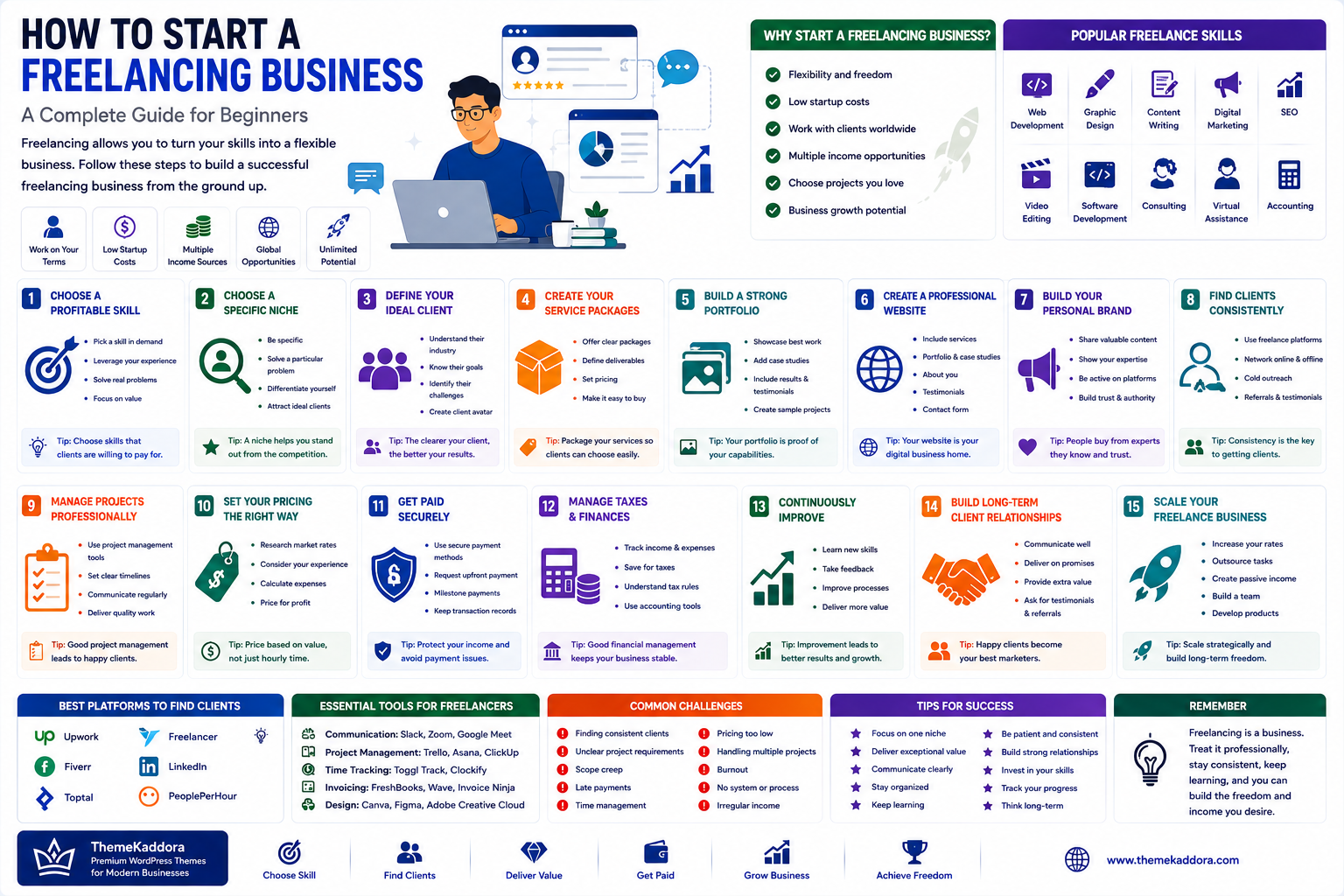
How to Start a Freelancing Business: A Complete Guide for Beginners
Introduction
Freelancing has become an increasingly popular way for professionals to turn their skills into a business.
Instead of working exclusively for one employer, freelancers provide services to multiple clients based on their expertise, projects, and availability.
Freelancers can work in areas such as:
Graphic design
Content writing
Digital marketing
SEO
Video editing
Software development
Consulting
Virtual assistance
Accounting
Business services
The biggest advantage of freelancing is flexibility.
However, freelancing is not simply about finding clients and completing assignments. A successful freelancer needs to think like a business owner.
You need to manage:
Marketing
Sales
Pricing
Client relationships
Contracts
Projects
Payments
Taxes
Business development
In this guide, you'll learn how to turn your skills into a professional freelancing business and build a sustainable source of income.
What Is Freelancing?
Freelancing is a business model where an individual provides services to clients without being permanently employed by them.
A freelancer may work with:
One-time clients
Long-term clients
Agencies
Startups
Small businesses
Enterprises
Individuals
Projects can be charged using:
Hourly rates
Fixed project prices
Retainer agreements
Milestone payments
The best pricing model depends on the type of service and client relationship.
Why Start a Freelancing Business?
Freelancing can offer several advantages.
Flexibility
You can often choose when and where you work.
Low Startup Costs
Many freelance businesses can be started with a computer, internet connection, and professional skills.
Multiple Income Sources
Working with multiple clients can reduce dependence on one employer.
Global Opportunities
Digital services can potentially be delivered to clients in different locations.
Business Growth
A freelancer can eventually expand into an agency, consultancy, or product-based business.
1. Choose a Profitable Skill
Start with a skill that businesses or individuals are willing to pay for.
Examples include:
Website development
WordPress development
UI/UX design
SEO
Copywriting
Video production
Social media management
Advertising
Automation
Data analysis
Avoid choosing a service simply because it is popular.
Consider your:
Experience
Skills
Interests
Market demand
Competition
Ability to deliver results
2. Choose a Specific Niche
A niche helps you differentiate yourself.
Instead of:
"I build websites."
Consider:
"I build conversion-focused websites for small eCommerce businesses."
Instead of:
"I do marketing."
Consider:
"I help local businesses generate leads through SEO and content marketing."
Specific positioning makes it easier for potential clients to understand your value.
3. Define Your Ideal Client
Determine who you want to work with.
Your ideal clients could be:
Startups
Local businesses
eCommerce stores
SaaS companies
Agencies
Consultants
Online creators
Consider their:
Budget
Industry
Problems
Goals
Buying behavior
The clearer your ideal client profile, the easier it becomes to create targeted marketing.
4. Create Your Service Packages
Do not simply tell clients:
"I provide web development."
Define what they receive.
For example:
Basic Website Package
5 pages
Responsive design
Contact form
Basic SEO
Deployment
Business Website Package
10–15 pages
Custom design
Analytics
SEO setup
Performance optimization
Clear packages make your services easier to understand and sell.
5. Build a Portfolio
Clients want evidence that you can deliver quality work.
Your portfolio can include:
Previous client projects
Personal projects
Case studies
Demonstration projects
Before-and-after examples
Results and metrics
If you have no clients yet, create sample projects.
For example, a new web developer can build three fictional business websites to demonstrate different skills.
6. Create a Professional Website
Your website can become your central business asset.
Include:
Homepage
Services
Portfolio
About
Testimonials
Case studies
Contact page
Clearly communicate:
What you do → Who you help → What results you provide → How clients can contact you
7. Build Your Personal Brand
Clients often hire people they trust.
Build credibility by sharing useful information online.
You can publish:
Tutorials
Case studies
Industry insights
Project breakdowns
Helpful tips
Lessons learned
Your content can demonstrate your expertise before a potential client ever contacts you.
8. Choose Where to Find Clients
Freelancers can find clients through multiple channels.
These include:
Freelance marketplaces
Personal networking
Referrals
Cold outreach
Business communities
Partnerships
Existing contacts
Do not depend entirely on one platform.
Building multiple acquisition channels makes your freelance business more resilient.
9. Create a Client Acquisition System
Client acquisition should become a repeatable process.
A simple system could be:
Lead → Qualification → Discovery Call → Proposal → Negotiation → Contract → Payment → Project
Document each stage.
This makes sales easier to manage as your business grows.
10. Learn How to Write Proposals
A good proposal should focus on the client's problem rather than simply listing your skills.
Include:
Client problem
Proposed solution
Deliverables
Timeline
Pricing
Assumptions
Next steps
Avoid sending generic proposals to every prospect.
Customize your proposal around the client's specific needs.
11. Set Your Freelance Pricing
Pricing is one of the most difficult decisions for beginners.
Common models include:
Hourly Pricing
You charge based on time worked.
Fixed Pricing
You charge a defined amount for a project.
Retainer Pricing
The client pays a recurring amount for ongoing services.
Choose a model that reflects your service, complexity, experience, and business costs.
12. Avoid Competing Only on Price
Being the cheapest freelancer is rarely a strong long-term strategy.
Instead, compete through:
Expertise
Quality
Reliability
Communication
Speed
Specialization
Business outcomes
Clients often pay more when they believe the freelancer can reduce risk and deliver better results.
13. Use Contracts
A written agreement protects both sides.
A freelance contract should clearly define:
Scope
Deliverables
Timeline
Payment terms
Revisions
Ownership
Confidentiality
Cancellation terms
For important agreements, consider obtaining professional legal advice appropriate to your location.
14. Set Payment Terms
Do not leave payment arrangements unclear.
Depending on the project, you may use:
Upfront deposits
Milestone payments
Monthly retainers
Final payments
For larger projects, milestone-based payments can reduce financial risk for both the freelancer and client.
15. Manage Projects Professionally
Once you win a client, delivery becomes the priority.
Use a simple workflow:
Planning → Production → Review → Revisions → Approval → Delivery
Keep clients informed about progress.
Clear communication can prevent many misunderstandings.
16. Control Scope Creep
Clients may request additional work after the project begins.
For example:
Original agreement:
5-page website
Additional request:
"Can you also build a customer portal?"
This is a significant scope change.
Explain the additional cost and timeline before performing the extra work.
17. Communicate Clearly
Professional communication can become a competitive advantage.
Set expectations about:
Response times
Working hours
Project updates
Meeting schedules
Revision processes
Avoid disappearing when a project becomes difficult.
If a problem occurs, communicate early.
18. Ask for Testimonials
After completing successful projects, request testimonials from satisfied clients.
Testimonials can help future prospects understand:
Your reliability
Your communication
Your expertise
Your results
Where appropriate, convert strong projects into detailed case studies.
19. Build Client Relationships
A project should not necessarily end when the final invoice is paid.
Stay connected with previous clients.
You may discover opportunities for:
Maintenance
Additional projects
Consulting
Retainers
Referrals
Upgrades
Existing clients can become one of the most valuable sources of future business.
20. Create Recurring Revenue
One-time projects can create unpredictable income.
Consider services that can naturally become recurring, such as:
Website maintenance
SEO
Content creation
Social media management
Technical support
Analytics
Consulting
Software maintenance
Recurring revenue can make a freelance business more predictable.
21. Manage Your Time
Freelancers often struggle because they mix client work, marketing, administration, and personal responsibilities.
Divide your time into categories:
Client delivery
Sales
Marketing
Administration
Learning
Business development
Schedule dedicated time for each area.
22. Track Business Finances
Freelancing income should be treated as business revenue.
Track:
Revenue
Expenses
Taxes
Profit
Outstanding invoices
Client payments
Separating business finances from personal finances can make financial management easier.
Follow the tax and business requirements applicable to your location.
23. Build an Emergency Fund
Freelance income can fluctuate.
An emergency fund can provide financial flexibility during:
Slow periods
Client cancellations
Unexpected expenses
Business transitions
The appropriate amount depends on your personal financial circumstances.
24. Improve Your Skills
Markets change continuously.
Continue learning:
New technologies
Industry trends
Business skills
Sales
Communication
Project management
Do not focus only on technical skills.
Business skills can significantly influence freelance success.
25. Automate Administrative Tasks
As your freelance business grows, automate repetitive activities.
Examples include:
Invoicing
Appointment scheduling
Email follow-ups
Lead notifications
Project reminders
Client onboarding
Reporting
Automation allows you to spend more time on valuable client work.
26. Know When to Raise Your Prices
As your:
Skills improve
Portfolio grows
Demand increases
Results improve
Specialization strengthens
your pricing may need to change.
Review your rates periodically rather than keeping the same price indefinitely.
27. Build a Referral System
Happy clients can become a powerful source of new business.
After delivering good results, politely ask whether they know another business that could benefit from your services.
Make referrals easy by clearly explaining what type of clients you serve.
28. Scale Beyond Freelancing
Freelancing does not have to remain a one-person business forever.
You may eventually:
Hire subcontractors
Build a small team
Create an agency
Sell digital products
Develop software
Offer consulting
Create training programs
The skills developed through freelancing can become the foundation for a larger business.
Common Freelancing Mistakes
Accepting Every Client
Not every client is a good fit.
Underpricing Your Work
Low prices can create unsustainable workloads.
Starting Without a Contract
Verbal agreements can lead to misunderstandings.
Ignoring Marketing
When client work ends, you may suddenly have no pipeline.
Doing Unlimited Revisions
Define revision limits clearly.
Poor Communication
Clients should not have to repeatedly ask for updates.
Relying on One Platform
Platform changes can affect your lead flow.
Ignoring Finances
Revenue is not the same as profit.
Freelancing Business Checklist
Foundation
Choose a profitable skill
Select a niche
Define ideal clients
Create service packages
Brand
Build a website
Create a portfolio
Establish professional profiles
Publish useful content
Sales
Choose acquisition channels
Create proposals
Define pricing
Use contracts
Set payment terms
Delivery
Plan projects
Communicate regularly
Track tasks
Control scope
Collect feedback
Growth
Ask for referrals
Create recurring services
Improve skills
Automate administration
Raise prices when appropriate
Why Choose ThemeKaddora?
At ThemeKaddora, we believe freelancers and independent professionals can build stronger businesses when technology supports their workflows.
A modern freelance operation can benefit from:
Professional websites
Client management
Automated workflows
Online payments
Project tracking
Analytics
Marketing automation
The right technology can reduce administrative work and allow freelancers to focus more on delivering valuable services to clients.
Conclusion
Starting a freelancing business is relatively accessible, but building a sustainable freelance career requires more than technical ability.
You need to think like both a service provider and a business owner.
Choose a valuable skill, specialize in a clear niche, build a strong portfolio, create a professional online presence, develop a reliable client acquisition system, use contracts, communicate clearly, and manage your finances carefully.
Most importantly, focus on delivering results.
Satisfied clients can become repeat customers, provide testimonials, generate referrals, and create long-term opportunities.
Over time, your freelance business can evolve into a consultancy, agency, product business, or larger company.
The first project may start your freelance journey.
A repeatable business system is what can turn it into a sustainable business.
Frequently Asked Questions
1. What is freelancing?
Freelancing is a business model where an independent professional provides services to clients on a project or ongoing basis.
2. How can I start freelancing with no experience?
Build sample projects, develop a portfolio, choose a specific service, and begin with smaller projects that allow you to demonstrate your capabilities.
3. How do freelancers find clients?
Common channels include referrals, networking, freelance marketplaces, social media, professional communities, and direct outreach.
4. How much should a freelancer charge?
Pricing depends on expertise, service type, project complexity, market conditions, costs, and the value delivered.
5. Should freelancers use contracts?
Yes. Written agreements can clarify scope, payment terms, timelines, responsibilities, and ownership.
6. How can freelancers avoid scope creep?
Clearly define deliverables and revision limits, then document and price additional work before starting it.
7. How can freelancers get repeat clients?
Deliver quality work, communicate professionally, follow up after projects, and offer relevant ongoing services.
8. Is freelancing a good career?
It can be, particularly for professionals who enjoy independence and are willing to manage both client work and business responsibilities.
9. Can freelancing become a full business?
Yes. Freelancers can eventually build agencies, consulting companies, software products, digital products, or larger service businesses.
10. What is the biggest freelancing mistake?
Treating freelancing only as a job rather than building systems for sales, delivery, finances, client relationships, and long-term growth.
Comments (0)