
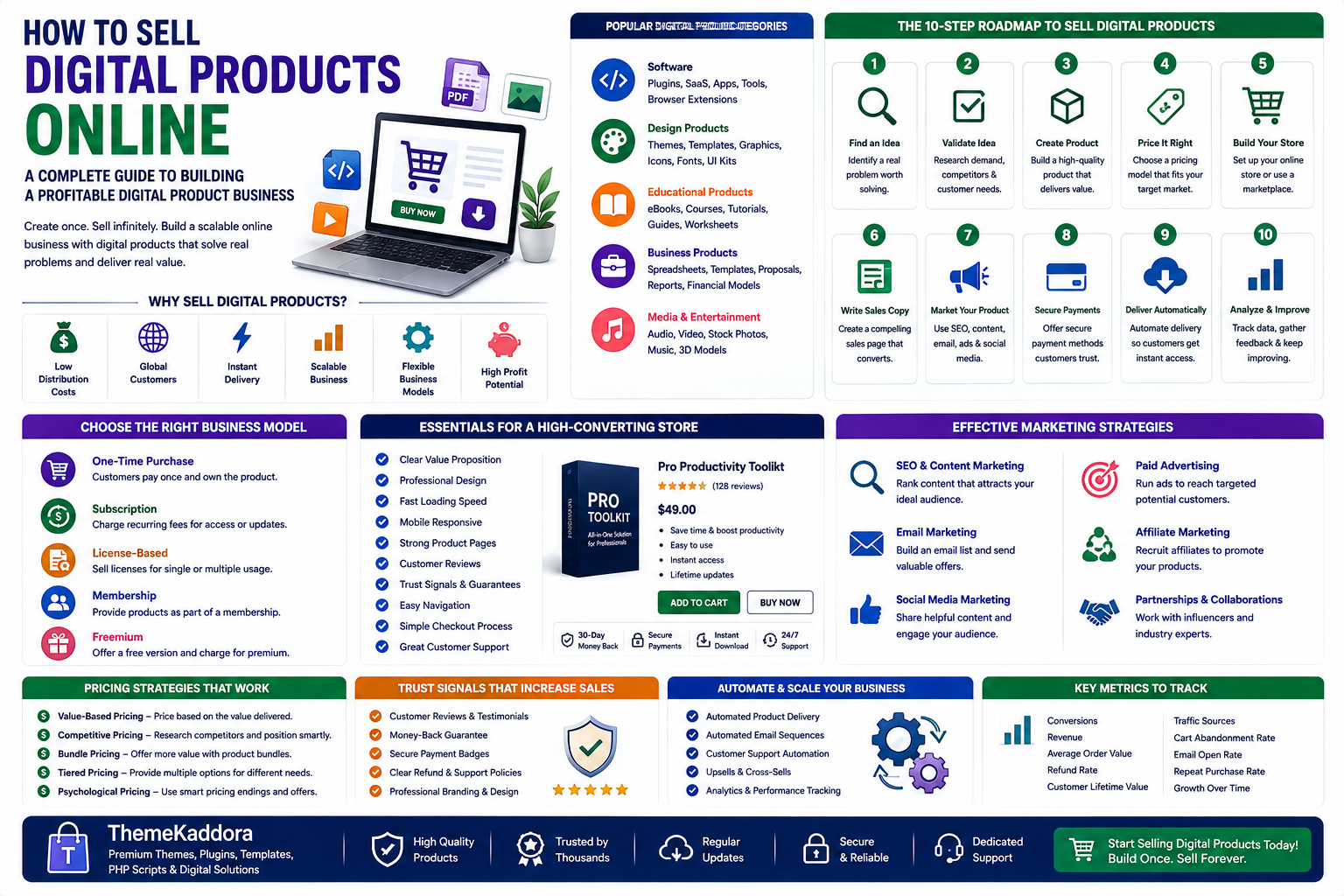
How to Sell Digital Products Online: A Complete Guide to Building a Profitable Digital Product Business
Introduction
The internet has created a powerful opportunity for entrepreneurs to build businesses around products that can be created once and delivered to customers repeatedly.
Unlike physical products, digital products don't require warehouses, packaging, or traditional shipping.
Customers can often receive their purchases immediately after payment.
Digital products can include:
Plugins
Website templates
SaaS products
AI tools
eBooks
Online courses
Graphics
UI kits
Software
Business templates
Design assets
Digital documents
Audio and video files
This makes digital products attractive to developers, designers, agencies, educators, creators, and entrepreneurs.
However, creating a digital product is only one part of building a successful business.
You also need to identify demand, define your target customer, price the product correctly, create a strong sales page, market the product, provide support, and continuously improve the customer experience.
In this guide, you'll learn how to sell digital products online and build a sustainable digital-product business.
1. What Are Digital Products?
Digital products are goods that are created, distributed, and consumed electronically.
Unlike physical products, they generally don't require physical inventory.
Examples include:
Software
WordPress plugins
Desktop applications
SaaS products
Browser extensions
Design Products
Website templates
Graphics
Icons
Fonts
UI kits
Presentation templates
Educational Products
eBooks
Courses
Tutorials
Guides
Worksheets
Business Products
Spreadsheets
Business templates
Marketing templates
Proposal templates
Financial models
The best digital products usually solve a specific problem.
2. Why Sell Digital Products?
Digital products offer several advantages.
Low Distribution Costs
Once a product is created, delivering another copy usually costs relatively little compared with manufacturing and shipping physical goods.
Global Customers
Digital products can potentially be sold to customers around the world.
Instant Delivery
Customers can often access their purchases immediately after payment.
Scalable Distribution
A digital product can potentially serve many customers without requiring proportional increases in physical inventory.
Flexible Business Models
You can sell products through:
One-time purchases
Subscriptions
Licenses
Memberships
Bundles
Usage-based pricing
However, digital products still require ongoing development, marketing, support, infrastructure, and customer service.
3. Find a Profitable Digital Product Idea
One of the biggest mistakes entrepreneurs make is creating a product before validating demand.
Start with a problem.
Ask:
What problems do people frequently experience?
What tasks are difficult or repetitive?
What existing solutions are expensive?
What products receive frequent complaints?
What could be made simpler?
What workflow could be automated?
Potential product ideas include:
Business automation templates
Industry-specific software
AI productivity tools
Website templates
Marketing resources
eCommerce plugins
Reporting dashboards
Financial templates
The strongest ideas solve clear problems for specific audiences.
4. Validate Your Product Idea
Before investing months in development, validate the idea.
You can research demand through:
Search engine queries
Online communities
Customer reviews
Competitor analysis
Social media discussions
Product marketplaces
Surveys
Interviews
Landing pages
Look for evidence that people already spend money trying to solve the problem.
Existing competition isn't necessarily bad.
It can demonstrate that demand exists.
The opportunity may be to offer:
Better usability
Better support
Better pricing
Better performance
Better design
Better specialization
5. Choose Your Target Audience
Avoid trying to sell a product to everyone.
Define a specific customer.
For example:
Instead of:
"Accounting software for everyone."
consider:
"Simple accounting software for small creative agencies."
A specific audience makes it easier to create:
Marketing messages
Product features
Landing pages
Tutorials
Pricing
Customer support
The clearer your audience, the easier it becomes to communicate your product's value.
6. Build a Minimum Viable Product
You don't need to create every possible feature before launching.
Start with the core problem.
A minimum viable product should:
Solve the primary problem
Be usable
Deliver measurable value
Allow customers to provide feedback
For example, instead of creating a massive business-management platform with dozens of modules, start with one workflow that solves an important problem extremely well.
Then expand based on customer feedback.
7. Create Different Product Types
A digital business doesn't have to sell only one product.
You can build a product ecosystem.
For example:
Entry Product
A low-cost template or small tool.
Core Product
A premium plugin, software product, or course.
Subscription
Ongoing access to advanced functionality.
Premium Product
Enterprise features, advanced support, or specialized functionality.
This allows customers to enter at different price points.
8. Choose the Right Pricing Model
Pricing can significantly influence sales and profitability.
Common digital-product pricing models include:
One-Time Purchase
Customers pay once for permanent access or a specific license.
Subscription
Customers pay monthly or annually.
Lifetime License
Customers pay once for extended access under defined licensing terms.
Freemium
A basic version is free while advanced functionality requires payment.
Usage-Based
Customers pay according to consumption.
Bundle Pricing
Multiple products are sold together at a combined price.
The best model depends on product type, ongoing costs, customer expectations, and the value provided.
9. Build a High-Converting Product Page
Your product page should answer the customer's most important questions.
Include:
Product name
Clear value proposition
Product screenshots
Features
Benefits
Pricing
Compatibility
Requirements
Documentation
Support information
Update policy
License details
Refund policy
FAQs
Clear call to action
Don't make customers search for essential information.
Transparency builds trust.
10. Use Product Demonstrations
Digital products can be difficult to evaluate before purchase.
Demonstrations reduce uncertainty.
Use:
Screenshots
Videos
Live demos
Interactive previews
Tutorials
Before-and-after examples
For software products, showing the actual interface is particularly valuable.
Customers want to understand what they're buying before they pay.
11. Create a Strong Sales Funnel
A digital product business can use a simple funnel:
Content → Landing Page → Product Education → Offer → Purchase → Onboarding → Repeat Purchase
Different customers may enter at different stages.
For example:
A visitor might discover your business through a Google search.
They read an educational article.
They discover your product.
They visit the product page.
They compare alternatives.
They purchase.
Then an email sequence helps them successfully use the product.
This entire journey can be optimized.
12. Use SEO to Attract Customers
Search engine optimization can provide long-term traffic.
Create content around problems your target customers search for.
For example, if you sell a WooCommerce analytics product, publish content about:
WooCommerce analytics
Sales reporting
eCommerce metrics
Revenue tracking
Customer behavior
Store performance
Educational content can attract people before they're ready to purchase.
The key is matching content with search intent.
13. Use Email Marketing
Email marketing helps turn visitors into long-term customers.
Build email sequences for:
Welcome messages
Product education
New product announcements
Abandoned carts
Tutorials
Cross-selling
Upselling
Renewal reminders
Customer feedback
Email becomes particularly valuable after the first purchase.
A customer who has already trusted your business may be more likely to purchase another relevant product.
14. Create Product Bundles
Bundles can increase perceived value and Average Order Value.
For example:
Website Starter Bundle
could include:
WordPress theme
Plugin
Templates
Documentation
Another example:
Business Automation Bundle
could include:
CRM tools
Reporting templates
Automation workflows
AI productivity tools
Bundles should be logical and easy to understand.
15. Offer Excellent Customer Support
Digital products may not require shipping, but customers still need support.
Provide:
Documentation
Tutorials
FAQs
Knowledge bases
Support tickets
Email assistance
Video guides
Good support can become a competitive advantage.
Customers aren't only buying a product.
They're buying confidence that they can successfully use it.
16. Automate Digital Product Delivery
Automation can reduce administrative work.
After payment, systems can automatically:
Confirm the order.
Generate access information.
Deliver the product.
Send the receipt.
Provide documentation.
Add the customer to appropriate communication workflows.
Automation allows you to serve more customers without manually processing every purchase.
17. Protect Your Digital Products
Digital products can be copied or distributed without authorization.
Depending on the product, protection methods may include:
License keys
Account-based access
Download limits
Subscription validation
Secure customer dashboards
Access expiration
Software activation systems
Protection should balance security with a convenient customer experience.
Overly aggressive protection can frustrate legitimate customers.
18. Track Important Metrics
Digital-product businesses should monitor:
Website traffic
Conversion rate
Revenue
Average Order Value
Customer acquisition cost
Refund rate
Repeat purchase rate
Customer lifetime value
Product usage
Subscription churn
Analytics helps identify which products and marketing channels actually generate results.
19. Build a Product Ecosystem
Long-term growth can come from building related products.
For example:
WordPress Theme → WooCommerce Plugin → AI Plugin → Analytics Tool → SaaS Platform
Each product can introduce customers to another solution.
This creates opportunities for:
Cross-selling
Upselling
Bundling
Subscriptions
Customer retention
The ecosystem approach can increase customer lifetime value while strengthening your brand.
20. Continuously Improve Your Products
Launching a product isn't the end.
Collect customer feedback and improve:
Features
Performance
Documentation
User interface
Compatibility
Security
Pricing
Customer support
Monitor reviews and support requests to identify recurring problems.
A product that improves over time can remain competitive for much longer.
Common Digital Product Business Mistakes
Creating Products Without Demand
A technically impressive product can still fail if customers don't need it.
Competing Only on Price
Low pricing isn't always a competitive advantage.
Focus on value.
Poor Documentation
Customers need clear instructions to use digital products successfully.
Weak Product Pages
If customers don't understand what they're buying, they may not purchase.
Ignoring Support
Poor support can damage customer trust.
Overbuilding Before Validation
Build the core solution first.
Ignoring Security
Protect customer accounts, payments, downloads, and product infrastructure.
Failing to Update Products
Software products require ongoing maintenance.
Why Choose ThemeKaddora?
ThemeKaddora is a digital marketplace focused on practical digital products and solutions for website owners, developers, agencies, freelancers, entrepreneurs, and online businesses.
ThemeKaddora's ecosystem can include:
WordPress themes
WordPress plugins
WooCommerce solutions
SaaS products
AI-powered tools
Business automation solutions
Website templates
Digital assets
Conclusion
Selling digital products online can create a scalable business model, but success requires much more than uploading a product and waiting for sales.
Start with a real problem.
Validate demand.
Understand your target audience.
Build a focused product.
Create a transparent sales page.
Choose an appropriate pricing model.
Use SEO and content marketing to attract potential customers.
Build relationships through email marketing.
Automate product delivery.
Provide excellent support.
Track business metrics.
And continuously improve your products based on real customer feedback.
The strongest digital-product businesses don't simply sell files or software.
They sell solutions to meaningful problems.
ThemeKaddora's digital ecosystem—including WordPress themes, plugins, WooCommerce solutions, SaaS products, AI tools, templates, and business solutions—fits into this growing digital economy by helping users discover practical technology for building and growing online businesses.
Ultimately, the goal is simple:
Create something useful, make it easy to buy, make it easy to use, and continuously improve it.
Frequently Asked Questions
1. What are digital products?
Digital products are goods delivered electronically, including software, plugins, templates, courses, eBooks, graphics, and other downloadable or online resources.
2. What digital products can I sell online?
You can sell software, WordPress themes, plugins, website templates, SaaS products, courses, eBooks, graphics, business templates, AI tools, and many other digital resources.
3. Are digital products profitable?
They can be profitable when they solve a meaningful problem, have clear demand, and are supported by effective pricing, marketing, customer support, and product development.
4. How do I find a digital product idea?
Identify recurring problems within a specific audience and research existing solutions, customer complaints, search demand, and market opportunities.
5. Should I create a digital product before validating demand?
Ideally, validate the problem and customer demand before investing significant time and money in development.
6. What is the best pricing model for digital products?
There is no universal model. One-time purchases, subscriptions, licenses, bundles, freemium plans, and usage-based pricing can all work depending on the product.
7. How can I market digital products?
Use SEO, content marketing, email marketing, social media, partnerships, demonstrations, paid advertising, affiliates, and product marketplaces.
8. How can I protect digital products?
Depending on the product, use licensing systems, account-based access, secure downloads, activation systems, download limits, and appropriate access controls.
9. Why choose ThemeKaddora?
ThemeKaddora provides practical digital products and solutions across WordPress, WooCommerce, SaaS, AI, templates, business automation, and other digital categories for businesses, developers, agencies, freelancers, and entrepreneurs.
10. Can I sell digital products through a marketplace?
Yes, depending on the marketplace's policies and supported product categories. Always review its licensing, seller requirements, payment terms, and product submission rules before listing a product.
Comments (0)