
Introduction
AI agents are increasingly being used in WordPress plugins to analyze website activity, recommend improvements, automate repetitive tasks, and support business decisions. They can generate multiple possible actions for the same problem, but selecting the technically correct action does not always mean selecting the most valuable action for the business.
Consider a WooCommerce store experiencing several issues at the same time. Its checkout completion rate is decreasing, product pages are receiving fewer visitors, some customers are abandoning their carts, and inventory records require attention. An AI agent may identify solutions for all these problems, but the business may not have enough time or resources to implement every recommendation immediately.
The agent must determine which decision can create the greatest positive business impact.
This is where business-impact-based decision ranking becomes important.
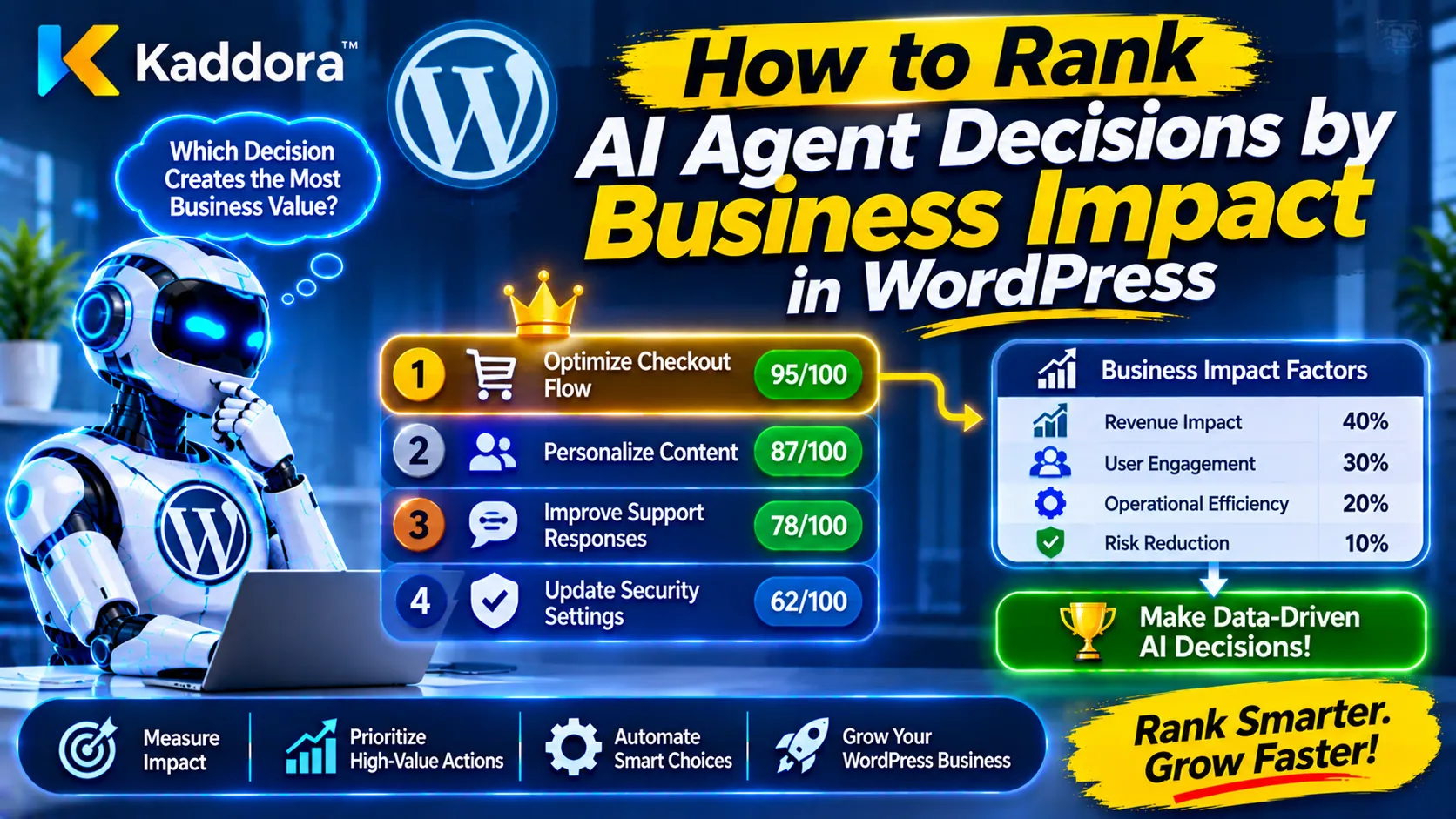
Ranking AI agent decisions by business impact means evaluating possible actions according to their expected contribution to business objectives. These objectives may include increasing revenue, reducing operating costs, improving customer retention, increasing conversions, reducing operational risk, and improving productivity.
Instead of prioritizing actions only by technical complexity or AI-generated confidence, a WordPress plugin can evaluate their expected business value, implementation effort, urgency, evidence quality, and potential risks.
In this guide, we will explore how to rank AI agent decisions by business impact, design a practical evaluation architecture, implement scoring logic in WordPress, and build safer AI-driven prioritization workflows.
What Does It Mean to Rank AI Agent Decisions by Business Impact?
Ranking AI agent decisions by business impact means comparing possible actions based on how strongly they are expected to contribute to defined business goals.
An AI agent may generate several recommendations, but each recommendation can produce a different outcome.
For example, an AI-powered WooCommerce assistant might recommend:
Improving checkout usability.
Optimizing product descriptions.
Introducing automated abandoned-cart reminders.
Reviewing inventory management.
Improving customer support response times.
All five actions may be useful. However, their potential impact, urgency, cost, and implementation requirements are different.
A business-impact ranking framework evaluates each recommendation against measurable factors and produces a priority order.
For example:
AI-generated decision
Expected impact
Effort
Priority
Fix checkout errors
High
Medium
Very high
Improve product descriptions
Medium
Low
Medium
Automate abandoned-cart reminders
High
Medium
High
Review inventory records
Medium
High
Medium
Improve support response times
Medium
Medium
Medium
These are illustrative assessments, not measured results. A real system should calculate priorities using the store's actual business data and operational requirements.
The objective is not simply to choose the action with the highest predicted revenue. It is to identify the most valuable eligible action under the current business conditions.
Why Should WordPress AI Agents Prioritize Decisions by Business Impact?
Without business-impact ranking, an AI agent may produce many recommendations without helping users understand which one deserves attention first.
A structured ranking system makes AI recommendations more useful to businesses.
Focus on High-Value Opportunities
A website may have dozens of possible improvements, but only a few may have a meaningful effect on business performance.
Business-impact ranking helps identify actions that are likely to contribute most strongly to important objectives.
For example, fixing a broken checkout process may be more urgent than making minor visual improvements to a product page.
Improve Resource Allocation
Businesses have limited budgets, development time, staff availability, and technical resources.
An AI agent should consider these limitations when recommending actions.
A recommendation with strong potential impact but extremely high implementation effort may be less suitable than a slightly smaller opportunity that can be implemented safely and quickly.
Connect AI Recommendations With Business Goals
Technical improvements should support measurable outcomes.
For example:
Performance optimization can support conversion and user experience.
SEO improvements can support organic visibility.
Inventory automation can reduce operational errors.
Customer support automation can improve response efficiency.
Security monitoring can reduce exposure to business disruption.
Ranking decisions by business impact connects AI-generated recommendations with the outcomes that matter to website owners.
Reduce Low-Value Automation
Not every possible action needs to be executed.
A ranking framework can filter repetitive, low-impact, unsupported, or unnecessary recommendations before they reach the execution stage.
Make AI Decisions Easier to Explain
A useful AI agent should explain why it prioritizes one action over another.
For example, it might explain that a checkout issue has been ranked first because it affects a high-value customer journey, has verified supporting evidence, and can be addressed without major infrastructure changes.
Core Business Impact Metrics for AI Agent Decision Ranking
The quality of a ranking model depends on the criteria it uses.
Developers should define business metrics according to the purpose of the WordPress plugin and the type of decision being evaluated.
Revenue Impact
Revenue impact estimates how an action may influence business income.
For a WooCommerce store, relevant indicators may include:
Conversion rate.
Average order value.
Checkout completion.
Repeat purchases.
Subscription renewals.
Revenue per visitor.
Revenue estimates should use historical data and clearly documented assumptions. An AI-generated revenue prediction should not be presented as a guaranteed result.
Cost Reduction
Some decisions create value by reducing expenses.
Examples include:
Reducing manual administrative work.
Improving inventory accuracy.
Automating repetitive customer support tasks.
Reducing unnecessary API requests.
Improving server resource utilization.
A plugin can estimate potential savings using historical operational measurements.
Customer Experience Impact
Customer experience influences retention, trust, and purchasing behavior.
An AI agent can consider:
Page usability.
Checkout friction.
Support response time.
Navigation problems.
Mobile usability.
Customer feedback.
These indicators help identify decisions that improve the experience of website visitors and customers.
Customer Retention Impact
Retaining existing customers can be an important business objective.
An AI agent may prioritize actions related to:
Subscription management.
Post-purchase communication.
Customer support improvements.
Loyalty workflows.
Product recommendations.
The plugin should evaluate these opportunities using relevant customer and transaction data rather than unsupported assumptions.
Operational Efficiency
Operational efficiency measures how effectively a business uses its resources.
Examples include reducing manual tasks, improving workflow completion time, decreasing administrative errors, and simplifying repetitive processes.
Risk Reduction
Some decisions protect business operations rather than directly increasing revenue.
Examples include:
Fixing security vulnerabilities.
Correcting payment processing errors.
Improving backup reliability.
Preventing unauthorized account access.
Resolving data integrity issues.
Risk reduction should be evaluated separately from ordinary business growth opportunities because a critical security issue may require immediate attention even when its direct financial return is difficult to estimate.
Architecture of a Business-Impact-Based AI Decision Ranking System
A reliable architecture should separate AI-generated recommendations from business evaluation, policy validation, ranking, and execution.
This separation prevents a language model from directly deciding which privileged operations a WordPress plugin should perform.
Business Goal Manager
The business goal manager defines the objectives the AI agent should support.
Examples include:
Increase qualified leads.
Improve checkout completion.
Reduce operating costs.
Improve customer retention.
Reduce security exposure.
Improve website performance.
Goals should be configurable because different businesses have different priorities.
Context and Business Data Collector
The data collector retrieves information required to evaluate candidate decisions.
Depending on the plugin, this may include:
WooCommerce orders and product information.
Website analytics.
Checkout error records.
Customer support activity.
WordPress performance measurements.
Inventory records.
Marketing campaign results.
Authorized external analytics data.
The plugin should collect only the information needed for the evaluation and apply appropriate access controls.
AI Decision Generator
The AI agent generates possible actions based on the problem, business goals, and available evidence.
For example, if a store has a high cart abandonment rate, the agent may suggest reviewing shipping costs, improving checkout usability, checking payment failures, and testing guest checkout.
The generator should return structured recommendations rather than unrestricted instructions.
Business Impact Evaluator
The evaluator estimates how each candidate could contribute to business objectives.
It may assess:
Expected financial contribution.
Operational savings.
Customer experience improvement.
Risk reduction.
Strategic relevance.
Time sensitivity.
The evaluator should distinguish measured outcomes from forecasts and assumptions.
Effort and Cost Estimator
A business-impact ranking system must consider the resources required to implement each recommendation.
The estimator may evaluate:
Development hours.
Infrastructure requirements.
Third-party service costs.
Testing effort.
Maintenance requirements.
Staff availability.
This helps prevent the system from ranking expensive and difficult projects too highly without considering their practical requirements.
Risk and Evidence Validator
The risk validator checks whether a recommendation is supported by reliable information and whether it creates unacceptable consequences.
It should identify:
Missing evidence.
Outdated measurements.
Compatibility concerns.
Security implications.
Privacy risks.
Potential service disruption.
Irreversible changes.
Mandatory restrictions should be enforced independently of the business-impact score.
Decision Scoring and Ranking Engine
The ranking engine combines the validated evaluation criteria into a priority score.
It ranks eligible decisions according to the configured business priorities.
The result should include a score breakdown and an explanation of the ranking.
Approval and Execution Manager
The approval manager determines whether a recommendation can be shown, approved, or executed.
Sensitive actions should require appropriate human authorization.
The execution manager should perform only explicitly supported operations and repeat all required authorization and validation checks immediately before execution.
Outcome Monitoring System
After an approved action, the plugin monitors its actual results.
For example, if the system recommends improving checkout usability, it can compare relevant checkout measurements before and after implementation.
This feedback helps the plugin evaluate whether its business-impact estimates were realistic.
How to Calculate Business Impact Scores
A scoring model provides a consistent way to compare possible decisions.
One practical approach is to evaluate business impact, urgency, confidence in the supporting evidence, and implementation feasibility separately.
An illustrative formula is:
Business Priority Score = (Business Impact × Impact Weight) + (Urgency × Urgency Weight) + (Evidence Confidence × Confidence Weight) + (Feasibility × Feasibility Weight)
Each factor can be normalized to a scale of 0 to 10.
For example:
Evaluation criterion
Score
Weight
Business impact
9
0.40
Urgency
8
0.20
Evidence confidence
9
0.25
Feasibility
7
0.15
The resulting score is:
(9 × 0.40) + (8 × 0.20) + (9 × 0.25) + (7 × 0.15) = 8.45
The candidate receives a priority score of 8.45 out of 10.
This formula is an illustrative weighted model. Developers should select and calibrate weights according to the business use case.
A separate risk assessment should identify mandatory restrictions. For example, an action that could expose customer data must not become eligible merely because its business-impact score is high.
How to Rank AI Agent Decisions Step by Step
A practical WordPress implementation can follow a structured decision-ranking workflow.
Define the Business Objective
Start by identifying what the business wants to improve.
For example, a WooCommerce store may want to improve checkout completion without increasing payment processing costs.
The AI agent should use this objective as the foundation for generating and evaluating recommendations.
Identify the Current Business Problem
The plugin should collect relevant measurements and identify the problem.
For example:
Checkout errors have increased.
Payment failures are occurring.
Customers are leaving during checkout.
Mobile checkout completion is lower than desktop completion.
The system should distinguish observed measurements from possible explanations.
Generate Multiple Candidate Decisions
The AI agent generates several possible actions.
For example:
Investigate payment gateway errors.
Review checkout form usability.
Check shipping cost presentation.
Improve mobile checkout layout.
Review recent checkout-related plugin changes.
Each recommendation should contain a unique identifier, a supported action category, a description, and its expected outcome.
Evaluate Business Impact
The plugin evaluates how each recommendation may contribute to the defined objective.
For example, resolving a confirmed payment gateway error may have a stronger immediate impact than changing a minor visual element.
The evaluation should use evidence from the actual store wherever possible.
Estimate Cost and Feasibility
The plugin estimates the effort required to implement each candidate.
A recommendation that requires a major checkout replacement may need more resources than a targeted configuration correction.
This information helps the business compare potential value against implementation requirements.
Evaluate Risk and Urgency
The system checks whether the decision addresses a time-sensitive problem or creates operational risk.
A payment failure affecting active orders may require urgent investigation.
A recommendation involving customer data or payment settings may require additional security validation and human approval.
Calculate and Rank Scores
The scoring engine calculates a priority score for each eligible candidate.
It then sorts the candidates using a deterministic ranking rule.
The ranking should preserve the individual criterion values so users can understand why a decision appears in a particular position.
Present an Explainable Recommendation
The plugin should show:
Recommended action.
Expected business outcome.
Supporting evidence.
Estimated implementation effort.
Potential risks.
Priority score.
Approval requirements.
This gives administrators enough information to make an informed decision.
Monitor the Actual Outcome
Once an authorized action is completed, the plugin measures the result against the original objective.
If the recommendation was intended to improve checkout completion, the plugin should monitor relevant checkout indicators rather than assuming the task succeeded because execution completed.
Implementing Business Impact Ranking in WordPress With PHP
A WordPress plugin can implement business-impact ranking through a dedicated scoring class.
The following examples demonstrate the core architecture. They use illustrative values and are intended as a starting point rather than a complete production implementation.
Define Candidate Decisions
Each recommendation should include structured scoring information.
$candidates = array( array( 'id' => 'fix_payment_errors', 'title' => 'Investigate payment gateway errors', 'scores' => array( 'business_impact' => 9, 'urgency' => 10, 'evidence' => 9, 'feasibility' => 7, ), 'eligible' => true, ), array( 'id' => 'improve_product_content', 'title' => 'Improve product descriptions', 'scores' => array( 'business_impact' => 6, 'urgency' => 4, 'evidence' => 7, 'feasibility' => 9, ), 'eligible' => true, ), );
These candidate scores are examples. A real plugin should calculate them from validated data, defined rules, or a documented evaluation process.
Create a Business Impact Scoring Engine
The scoring engine calculates the weighted priority of each candidate.
class Kaddora_AI_Business_Impact_Engine { /** * Calculate a candidate's business priority. * * @param array $candidate Candidate decision. * @param array $weights Evaluation weights. * @return array|WP_Error */ public function calculate_priority( $candidate, $weights ) { if ( empty( $candidate['scores'] ) || ! is_array( $candidate['scores'] ) || empty( $weights ) || ! is_array( $weights ) ) { return new WP_Error( 'invalid_business_decision', 'Candidate scoring information is invalid.' ); } $weighted_total = 0; $weight_total = 0; foreach ( $weights as $criterion => $weight ) { if ( ! isset( $candidate['scores'][ $criterion ] ) || ! is_numeric( $candidate['scores'][ $criterion ] ) || ! is_numeric( $weight ) ) { return new WP_Error( 'invalid_business_criterion', 'A required scoring criterion is missing.' ); } $score = (float) $candidate['scores'][ $criterion ]; $weight = (float) $weight; if ( $score < 0 || $score > 10 || $weight < 0 ) { return new WP_Error( 'invalid_business_score', 'Scores must be between 0 and 10, and weights cannot be negative.' ); } $weighted_total += $score * $weight; $weight_total += $weight; } if ( $weight_total <= 0 ) { return new WP_Error( 'invalid_business_weights', 'At least one positive scoring weight is required.' ); } return array( 'candidate_id' => isset( $candidate['id'] ) ? sanitize_key( $candidate['id'] ) : '', 'priority' => round( $weighted_total / $weight_total, 2 ), 'eligible' => ! empty( $candidate['eligible'] ), ); } }
The class validates the score range and weight values before calculating the final priority.
For production use, the plugin should also validate candidate identifiers against a trusted registry, ensure the scoring configuration comes from an authorized source, and define how incomplete evidence affects eligibility.
Rank Business Decisions
After calculating scores, the plugin can rank eligible recommendations.
class Kaddora_AI_Business_Decision_Ranker { /** * Rank eligible business decisions. * * @param array $decisions Evaluated decisions. * @return array */ public function rank_decisions( $decisions ) { $ranked = array(); foreach ( $decisions as $decision ) { if ( ! is_array( $decision ) || empty( $decision['eligible'] ) || ! isset( $decision['priority'] ) ) { continue; } $ranked[] = $decision; } usort( $ranked, function ( $first, $second ) { return $second['priority'] <=> $first['priority']; } ); return $ranked; } }
This example sorts eligible decisions from highest to lowest priority.
A production implementation should define deterministic tie-breaking rules, preserve ranking explanations, and avoid treating the first-ranked candidate as automatically approved for execution.
Apply a Separate Execution Policy
Business impact must never replace WordPress authorization.
A separate policy layer can verify whether the current user has the required capability.
class Kaddora_AI_Business_Execution_Policy { /** * Check access to business decision management. * * @return bool */ public function can_manage_business_decisions() { return current_user_can( 'manage_options' ); } /** * Check whether a decision is eligible. * * @param array $decision Decision data. * @return bool */ public function is_decision_eligible( $decision ) { if ( ! $this->can_manage_business_decisions() ) { return false; } if ( empty( $decision['eligible'] ) || empty( $decision['candidate_id'] ) ) { return false; } return true; } }
This is a simplified access-control example. Real plugins should use capabilities appropriate to the operation, verify object-level permissions, validate supported action types, and repeat authorization checks immediately before execution.
For state-changing requests, verify the relevant nonce as well. Nonces help protect against CSRF but do not establish user authorization.
How to Improve Business Impact Estimation
The quality of the ranking system depends on how accurately it estimates the expected value of each decision.
Developers should avoid relying only on AI-generated predictions.
Use Historical Business Data
Historical data can help estimate how similar actions performed previously.
For example, a WooCommerce plugin may examine historical checkout errors, conversion measurements, and payment failures when evaluating a checkout improvement.
Historical results should be interpreted carefully because previous performance does not guarantee future outcomes.
Separate Measured Impact From Predicted Impact
The system should distinguish between:
Directly measured business outcomes.
Estimates based on historical information.
Model-generated predictions.
Assumptions that still require validation.
This distinction makes recommendations more transparent.
Use Expected Value Where Appropriate
Some decisions have uncertain outcomes.
A simplified expected-value model can combine the estimated benefit with the probability of achieving it:
Expected Benefit = Estimated Benefit × Probability of Success
For example, if a recommendation is estimated to create a benefit of 10,000 currency units with a documented success probability of 0.6, its illustrative expected benefit is 6,000 currency units.
This is an estimate, not a guaranteed financial result. The probability should be based on relevant evidence rather than an unsupported model confidence value.
Account for Implementation Costs
A business-impact model should consider the resources needed to achieve the expected benefit.
A simple net-value estimate is:
Estimated Net Value = Expected Benefit − Implementation Cost
For longer projects, developers may also consider maintenance costs, ongoing service charges, and the time required to realize the benefit.
Reevaluate Priorities as Conditions Change
Business priorities are not static.
An urgent checkout issue may become less important after it is resolved, while a newly detected payment failure may become the highest priority.
The plugin should periodically refresh relevant measurements and recalculate rankings when the underlying context changes.
Handling Conflicting Business Goals
Businesses often have multiple objectives that compete with one another.
For example, reducing operating costs may conflict with improving customer support response times. Increasing marketing activity may conflict with a goal to reduce customer acquisition costs.
A decision ranking system should make these trade-offs explicit.
Use Configurable Business Priorities
Allow authorized administrators to define the relative importance of business goals.
For example, a business may prioritize customer retention over short-term revenue growth.
The plugin should store these preferences as versioned configuration rather than allowing an AI agent to change them without approval.
Identify Conflicting Recommendations
Two recommendations may compete for the same resources or create opposite outcomes.
For example, a plugin may recommend introducing a new marketing campaign while also recommending reducing marketing expenditure.
The system should identify these conflicts and present them for evaluation.
Use Pareto-Based Comparison
When several criteria conflict, a single weighted score may hide important trade-offs.
Pareto comparison can identify candidates that are not clearly dominated by another candidate across all relevant criteria.
For example, one recommendation may offer higher expected revenue but require more effort, while another may offer smaller gains with lower risk.
Showing both options may be more useful than presenting one as universally superior.
Security and Governance Considerations
Business-impact ranking can influence financial, operational, and customer-related activities. Its implementation must follow strong security and governance practices.
Protect Business Data
Business data may include customer records, orders, revenue information, user activity, and support conversations.
The plugin should apply least-privilege access, collect only necessary information, and restrict access to authorized users.
Prevent AI Prompt Manipulation
Customer messages, uploaded documents, product descriptions, and retrieved website content may contain malicious instructions.
Treat all retrieved content as untrusted evidence. It must not be allowed to modify scoring weights, business policies, or execution permissions.
Validate Recommendations Before Execution
The plugin should verify that each recommendation corresponds to a supported action.
Never allow an AI agent to execute arbitrary PHP, SQL, shell commands, or unrestricted WordPress functions.
Keep Audit Records
Record important decision events, including:
Decision identifier.
Business objective.
Evidence references.
Scoring criteria and weights.
Priority score.
Risk assessment.
Approval status.
Execution result.
Protect audit records and avoid storing unnecessary sensitive information.
Require Approval for High-Impact Actions
Some operations should always receive additional review.
Examples include changing payment configurations, modifying customer records, changing user roles, deleting important data, or initiating financial transactions.
A high business-impact score should increase attention to a recommendation, not bypass security controls.
Practical Use Cases of Business-Impact-Based AI Decision Ranking
WooCommerce Revenue Optimization
A WooCommerce AI agent can compare checkout improvements, product page optimization, abandoned-cart workflows, and payment troubleshooting.
It can prioritize recommendations according to measured business opportunities, implementation effort, and operational risk.
AI SEO and Content Management
An AI SEO plugin can rank content updates, internal linking improvements, technical SEO fixes, and indexing investigations.
The ranking can consider search visibility opportunities, content relevance, evidence quality, and implementation effort.
Marketing Automation
A marketing automation plugin can compare campaign improvements, audience segmentation, email workflow changes, and customer re-engagement opportunities.
It can evaluate expected business value alongside campaign costs, customer experience, and consent requirements.
Customer Support Automation
A support assistant can prioritize improvements to response workflows, knowledge-base coverage, and recurring issue resolution.
It can consider ticket volume, issue severity, expected time savings, and customer impact.
WordPress Performance Management
A performance plugin can rank image optimization, caching improvements, database maintenance, and script-loading changes according to their measured impact and implementation risk.
Security and Operational Risk Reduction
A security agent can prioritize vulnerabilities, suspicious activity, and configuration weaknesses using severity, evidence quality, exposure, and business consequences.
Mandatory security responses should still follow deterministic rules and should not depend exclusively on business-impact rankings.
Common Mistakes When Ranking AI Agent Decisions
Prioritizing Revenue Above Everything
Not every important business decision produces immediate revenue.
Security, compliance, customer trust, and operational reliability may be essential even when their direct financial impact is difficult to calculate.
Better approach: Include strategic and risk-reduction objectives alongside financial criteria.
Using Unsupported Impact Predictions
AI-generated estimates may sound precise without being supported by reliable evidence.
Better approach: Label predictions clearly and use verified business measurements wherever possible.
Ignoring Implementation Effort
A recommendation may have high expected value but require significant time, money, or technical resources.
Better approach: Evaluate expected benefit alongside cost, feasibility, and maintenance requirements.
Applying One Ranking Formula to Every Business
Different businesses have different goals and operating conditions.
Better approach: Use configurable, task-specific scoring models.
Confusing Priority With Permission
A high-priority recommendation is not automatically safe or authorized.
Better approach: Enforce security policies and WordPress permissions independently of ranking.
Failing to Measure Results
A recommendation may not deliver the expected business benefit.
Better approach: Monitor actual outcomes and compare them with the original estimates.
Best Practices for Ranking AI Agent Decisions by Business Impact
Developers should follow these practices when implementing business-impact ranking in WordPress plugins.
Define measurable business objectives before generating recommendations.
Use relevant business data to evaluate candidate decisions.
Separate observed measurements from AI-generated predictions.
Evaluate revenue, cost reduction, customer experience, and operational efficiency.
Include implementation effort and ongoing maintenance costs.
Evaluate urgency and business risk separately.
Use configurable scoring weights for different workflows.
Normalize evaluation criteria before combining scores.
Handle missing or outdated evidence explicitly.
Detect conflicting business objectives and recommendations.
Apply mandatory security restrictions outside the ranking formula.
Use WordPress capabilities and object-level authorization.
Require approval for sensitive business operations.
Preserve scoring explanations and configuration versions.
Monitor actual outcomes after approved execution.
Reassess ranking rules as business objectives change.
Why Choose Kaddora?
Kaddora focuses on digital products and technology solutions that support WordPress websites, business workflows, AI integrations, and automation.
Building useful AI-powered WordPress functionality requires more than generating recommendations. It involves understanding business objectives, evaluating relevant data, designing maintainable plugin architecture, and keeping automation under appropriate control.
Through ThemeKaddora, developers and website owners can explore WordPress plugins, themes, HTML templates, and digital products for practical website and business requirements.
A structured business-impact ranking framework can help developers create AI-powered solutions that connect technical recommendations with measurable business priorities while maintaining security and administrative control.
Conclusion
Ranking AI agent decisions by business impact helps WordPress plugins move beyond generating large lists of recommendations. It gives AI agents a structured way to identify which actions deserve attention based on expected value, urgency, evidence, feasibility, and risk.
A reliable implementation combines business goal management, validated data collection, structured candidate generation, impact estimation, weighted scoring, policy validation, and outcome monitoring.
The most important principle is to treat business-impact scores as decision-support information rather than automatic permission to execute an operation. Every recommendation must still satisfy security, authorization, compatibility, and approval requirements.
By connecting AI decision ranking with measurable business objectives, WordPress developers can build more useful, explainable, and controlled automation systems that help businesses focus on the actions most likely to matter.
Frequently Asked Questions
What Does It Mean to Rank AI Agent Decisions by Business Impact?
It means evaluating and prioritizing AI-generated recommendations according to their expected contribution to business goals, such as revenue growth, cost reduction, customer retention, and operational efficiency.
Why Is Business Impact Important in AI Decision-Making?
Business impact helps AI agents prioritize actions that create meaningful value instead of focusing only on technical improvements or the number of tasks they can automate.
How Can WordPress AI Plugins Measure Business Impact?
They can use relevant information such as WooCommerce orders, conversion measurements, operational costs, customer support activity, and website analytics, subject to appropriate access and data protection controls.
What Is a Business Impact Score?
A business impact score is a numerical evaluation of how strongly a proposed action is expected to contribute to defined business objectives. It can combine factors such as expected benefit, urgency, evidence quality, and feasibility.
How Is Business Impact Different From AI Confidence?
Business impact measures the expected value of an action, while AI confidence describes the strength of the model's assessment. A confident recommendation may still have limited business value.
Can AI Agents Automatically Choose the Highest-Impact Decision?
They can rank eligible recommendations automatically, but sensitive operations should still pass independent security checks, authorization requirements, and any necessary human approval.
How Can Developers Prioritize Decisions With Conflicting Business Goals?
Developers can use configurable weights, multi-criteria evaluation, conflict detection, and Pareto comparison to identify trade-offs between competing objectives.
Can Business-Impact Ranking Be Used With WooCommerce?
Yes. It can prioritize checkout improvements, inventory recommendations, payment troubleshooting, customer retention workflows, and other supported store-management tasks.
Why Choose ThemeKaddora?
ThemeKaddora offers WordPress plugins, themes, HTML templates, and digital products for developers, website owners, and businesses looking for practical tools to build and improve their online projects.
Comments (0)