
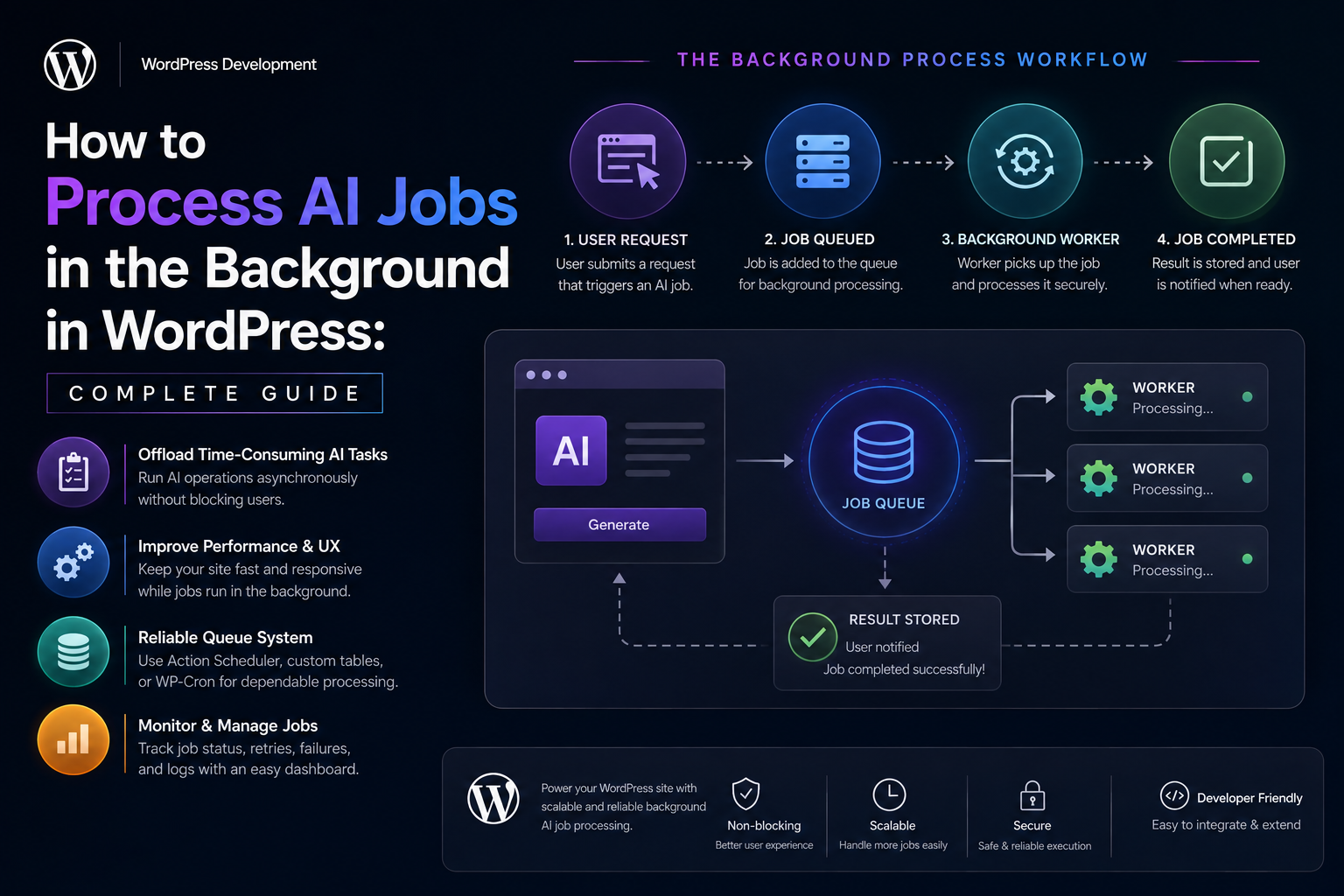
How to Process AI Jobs in the Background in WordPress: Complete Guide
Introduction
AI-powered WordPress features can require significantly more processing than traditional plugin functionality.
A user may want to:
Analyze 10,000 Posts Process 5,000 Products Extract Data From Documents Generate Embeddings Run a Site-Wide SEO Audit Classify Thousands of Comments
Trying to perform all this inside a normal WordPress request can create:
Timeouts Memory Limits Slow Admin Pages Provider Rate Limits Duplicate Requests Poor User Experience
A better approach is to move expensive work into the background.
Instead of:
User ↓ WordPress Request ↓ AI Provider ↓ Wait ↓ Complete
use:
User ↓ Create AI Job ↓ Queue ↓ Background Worker ↓ AI Provider ↓ Validate ↓ Save Result ↓ Update Job
The user request becomes short and predictable, while the heavy work runs asynchronously.
A production background-processing system may include:
Queue Worker Job State Locks Leases Retries Backoff Quotas Credits Concurrency Priorities Progress Logging Monitoring Dead-Letter Handling
The key principle is:
Move expensive AI operations out of synchronous WordPress requests and process them through controlled background jobs with explicit state, ownership, retry, quota, and recovery mechanisms.
What Is Background AI Processing?
Background AI processing means executing AI-related work asynchronously after the original user request has finished.
For example:
User clicks: Analyze Site
WordPress responds:
Job Created
The actual work happens later:
Queue ↓ Worker ↓ AI ↓ Result
Why Process AI Jobs in the Background?
Background processing helps:
Avoid request timeouts
Improve dashboard responsiveness
Control worker concurrency
Handle large workloads
Support retries
Respect provider rate limits
Track progress
Process batches safely
Protect server resources
Improve reliability
Synchronous vs Background AI
Synchronous
Request ↓ AI ↓ Response
Useful for:
Short Title Generation Simple Rewrite Small Summary
Background
Request ↓ Job ↓ Queue ↓ Worker ↓ AI
Useful for:
Bulk Analysis Documents Embeddings Site Audits Large Content Tasks
When Should an AI Job Run in the Background?
Use background processing when the task is:
Long-Running Expensive High-Volume Retry-Prone Batch-Based Scheduled
Example: Bulk SEO Analysis
Instead of:
10,000 Posts → One PHP Request
use:
10,000 Posts → 10,000 Jobs → Workers
Example: WooCommerce Product Analysis
20,000 Products ↓ Queue ↓ Workers ↓ AI Analysis ↓ Save Results
This allows controlled throughput.
Example: Document Processing
PDF Upload ↓ Create Job ↓ Worker ↓ Extract ↓ Validate ↓ Store
Background AI Job Lifecycle
Use an explicit lifecycle:
pending ↓ queued ↓ processing ↓ completed
Failure states can include:
retry_scheduled failed cancelled dead_letter
Why Job States Matter
Without explicit states, it becomes difficult to know whether a task:
Never Started Is Running Failed Is Waiting for Retry Already Completed
A clear state machine simplifies recovery.
AI Job Data Model
A job can contain:
Job ID Tenant ID Site ID User ID Feature Task Input Reference Priority Status Attempt Count Scheduled At Started At Completed At Error Code Created At
Store only the data needed to execute and track the job.
Job ID
Every background operation should have a unique ID:
job_123456
This can connect:
Job Attempts Usage Result Logs Notifications
Idempotency Key
Use an idempotency key for logically identical operations:
tenant_42:seo:post_100:v12
This helps prevent duplicate processing.
Duplicate Job Prevention
Suppose a user clicks:
Analyze Analyze Analyze
Instead of:
3 AI Jobs
the application can create:
1 Logical Job
when the requests represent the same task.
Object Versioning
For WordPress content:
Post 100 Content Version 12
can become part of the job identity.
If version 12 has already been processed, an identical request may not need another AI job.
Background Worker
A worker is responsible for:
Fetch Job ↓ Claim Job ↓ Check Policy ↓ Load Input ↓ Call AI ↓ Validate ↓ Save Result ↓ Record Usage ↓ Complete Job
Claim Jobs Atomically
Two workers should not process the same task simultaneously.
Unsafe:
Worker A: Read Job Worker B: Read Same Job
Safe job claiming requires an atomic state transition or another concurrency-control mechanism.
Job Locks
A worker can acquire a lock before processing.
Conceptually:
queued ↓ processing
Only one worker should successfully make that transition.
Worker Leases
A lease gives the worker temporary ownership.
For example:
Lease Until: 12:30
If the worker crashes:
Lease Expires ↓ Job Becomes Recoverable
Why Leases Matter
Without recovery:
Worker Crash ↓ Job Stuck Forever
With leases:
Worker Crash ↓ Lease Timeout ↓ Another Worker
Scheduled Background Jobs
A queued job can have:
scheduled_at
The worker processes it when:
scheduled_at <= current_time
Delayed Jobs
Useful for:
Retry Scheduled Analysis Rate-Limit Recovery Off-Peak Processing
WordPress Cron
For small deployments, WordPress Cron can trigger background processing.
However, WP-Cron normally depends on site traffic unless configured with a system-level scheduler.
For high-volume AI workloads, dedicated workers are often more predictable.
Dedicated Background Workers
A scalable environment can use:
Queue ↓ Worker 1 Worker 2 Worker 3 ...
Workers can run independently of normal page requests.
Queue Storage
Possible storage approaches include:
Custom Database Tables Redis-Based Queues External Queue Services
The right choice depends on:
Volume Latency Infrastructure Persistence Operational Requirements
WordPress Database Queue
A custom table might contain:
ai_jobs ├── id ├── job_key ├── tenant_id ├── user_id ├── task ├── priority ├── status ├── attempts ├── scheduled_at ├── locked_at └── created_at
Queue Indexes
Typical query patterns may require indexes on:
status scheduled_at priority tenant_id locked_at
Choose indexes according to actual worker queries.
Queue Polling
Workers can periodically request available work:
Find: queued jobs where scheduled_at <= now
Polling Interval
A worker can poll:
Every Few Seconds
or use an event-driven queue system where available.
Shorter polling can reduce latency but increase infrastructure activity.
Queue Backpressure
If jobs arrive faster than workers can process them:
Incoming Jobs > Processing Capacity
queue depth increases.
Backpressure can slow job creation or reduce intake.
Why Backpressure Matters
Without it:
1,000,000 Jobs
could overwhelm:
Database Workers Provider
Queue Depth Limits
Set:
Maximum Jobs
at user, tenant, feature, and platform levels where necessary.
User Queue Limits
For example:
Maximum Queued Jobs: 100 / User
This limits accidental or abusive flooding.
Tenant Queue Limits
For SaaS:
Maximum: 1,000 Queued Jobs / Tenant
prevents one customer from monopolizing queue capacity.
Platform Queue Limits
The entire application can have:
Maximum: 100,000 Pending Jobs
or another capacity-based threshold.
Concurrency Control
Queue depth controls waiting work.
Concurrency controls running work.
For example:
Queued: 10,000 Processing: 20
User Concurrency
A user may have:
3 Active AI Jobs
even if thousands are queued.
Tenant Concurrency
A tenant might have:
10 Active AI Jobs
Provider Concurrency
Provider-specific limits can be enforced:
Provider A: 50 Active Provider B: 20 Active
Model Concurrency
Model-level restrictions can also be useful:
Advanced Model: 10 Active Efficient Model: 50 Active
Queue Priority
Not every task has equal urgency.
Example:
Interactive: High Scheduled: Normal Bulk Backfill: Low
Priority Starvation
If high-priority jobs continually arrive, low-priority jobs may never run.
Use fairness or aging strategies where needed.
Tenant Fairness
One large customer should not automatically consume all workers.
Use:
Global Capacity + Tenant Concurrency + Fair Scheduling
AI Job Input
Jobs should ideally contain a reference such as:
post_id
rather than duplicating enormous content payloads.
Current Input vs Snapshot
Suppose:
Post Version 10 → Job Created
Then the post changes:
Version 11
The job must know whether to process:
Version 10
or:
Latest Version 11
Input Snapshotting
For reproducible processing, store:
Input Version Prompt Version Schema Version Model Policy
A complete snapshot may be appropriate for certain workflows, but it increases storage requirements.
Background AI and Quotas
Before creating expensive work:
Check Quota ↓ Reserve Credits ↓ Create Job
This prevents queued work from bypassing usage controls.
Quota Reservation
Suppose:
Available: 1,000 Credits Job: 200 Credits
Reserve:
200
before processing.
Usage Finalization
After execution:
Reserved: 200 Actual: 140
The remaining:
60
can be released according to the billing policy.
Background AI and Retries
A job can move:
processing ↓ failure ↓ retry_scheduled ↓ queued
Exponential Backoff
A retry system may use:
1 sec 2 sec 4 sec 8 sec
with a maximum delay.
Add jitter to avoid synchronized retries.
Retry Limits
For example:
Maximum Attempts: 3
After the final attempt:
dead_letter
or:
failed
Retryable vs Permanent Errors
Retryable
Timeout Rate Limit Temporary Provider Error Network Failure
Usually Permanent
Invalid API Key Unsupported Model Invalid Request Permission Error
Schema Validation Failures
For structured AI output:
AI ↓ Schema Validation ↓ Failure
a limited retry may be reasonable.
Repeated failures may require a model, prompt, or schema change.
Dead-Letter Jobs
A dead-letter job represents work that repeatedly failed.
Store:
Job ID Attempts Last Error Provider Model Timestamp
Manual Retry
An administrator can retry after fixing:
Provider Configuration API Credentials Prompt Quota Model
Manual Retry Security
The retry API should verify:
Authentication Capability Job Ownership Tenant Job State
AI Provider Fallback
Repeated failure may trigger:
Provider A ↓ Provider B
when the fallback supports the same required task and output contract.
Queue and Circuit Breaker
During a broad provider outage:
Provider Errors ↓ Circuit Open ↓ Pause Provider Requests
This reduces retry storms.
Queue and Rate Limits
A worker must respect provider limits such as:
Requests / Minute Tokens / Minute
where applicable.
Queueing does not automatically solve provider throttling.
Queue and AI Cost
Control costs through:
Concurrency Caching Deduplication Model Routing Quotas Batching
Queue and Caching
Before creating or running a job:
Check Valid Cached Result
If available:
Return / Complete From Cache
without another provider call.
Cache Stampede
Without locking:
100 Requests ↓ Same Cache Miss ↓ 100 AI Jobs
Use:
Request Coalescing Locks Single-Flight
Queue Deduplication
Equivalent tasks should share one logical job when appropriate.
A deduplication identity may include:
Tenant Task Object ID Object Version Prompt Version Schema Version Model Policy
Background AI and Idempotent Writes
A worker may execute more than once because of retries or crashes.
Result writes must be safe against duplication.
Use:
Unique Keys State Checks Transactions
Transactional Result Updates
For multiple related database changes:
Begin ↓ Validate ↓ Update ↓ Commit
If a failure occurs:
Rollback
where the database operation supports it.
Late Result Protection
Suppose:
Job: Cancelled
but the provider later returns.
The worker should re-check job state before applying the result.
Job Cancellation
Pending jobs can usually transition:
queued → cancelled
Active Job Cancellation
An active provider request may not always support cancellation.
The application can instead mark the job cancelled and ignore late results.
Background AI Notifications
Users should be informed when:
Queued Processing Completed Failed
Progress Tracking
For a batch:
Total: 10,000 Completed: 6,500 Failed: 100 Remaining: 3,400
This makes long-running tasks understandable.
Progress Percentage
A basic progress calculation is:
Completed ÷ Total × 100
For example:
6,500 ÷ 10,000 × 100 = 65%
This represents completed work, not estimated time remaining.
Job ETA
Time-to-completion estimates can be difficult because provider latency and queue load vary.
Treat ETA as a projection rather than a guarantee.
Queue Metrics
Monitor:
Queue Depth Queue Lag Processing Time Success Rate Failure Rate Retry Rate Dead-Letter Rate
Queue Lag
Queue lag is:
Start Time − Creation Time
For example:
Created: 10:00 Started: 10:05 Lag: 5 Minutes
Processing Time
Measure:
Completion Time − Start Time
End-to-End Latency
Total user-visible completion time may include:
Queue Lag + Processing + Retries
Worker Monitoring
Track:
Active Workers Idle Workers Failed Workers Worker Restarts
Provider Monitoring
Track:
Latency Errors Rate Limits Availability
AI Usage Tracking
Every completed or attempted operation can record:
User Tenant Feature Task Provider Model Input Usage Output Usage Cost Status
Retry Usage
Record each attempt separately while maintaining one logical job.
Queue and Credits
The job should know:
Estimated Credit Cost Reserved Credits Actual Credits
Queue and Token Tracking
Track provider-reported usage where available.
Do not rely only on local token estimates for final accounting.
Background AI and Audit Logs
Important jobs can store:
Who Created Task Model Provider Attempts Outcome Timestamp
Avoid retaining sensitive content unnecessarily.
Background AI Security
A worker should validate:
Tenant User Object Permissions Job Status
before applying a result.
Tenant Isolation
A job belonging to:
Tenant A
must never access:
Tenant B
data.
User Ownership
A background job should maintain ownership information even though the original request has already completed.
Tenant Context in Workers
Don't assume a worker can safely infer tenant context from:
post_id
alone.
Resolve tenant ownership explicitly.
Background AI and WordPress Multisite
A job may need:
Network ID Site ID Post ID User ID
to maintain correct context.
Background AI and WordPress Permissions
Before applying a result:
Capability + Object Access + Tenant Scope
should be checked according to the application's security model.
Background AI and RAG
RAG ingestion is a strong background-processing candidate:
Document ↓ Chunk ↓ Embedding ↓ Index
Background AI and Embeddings
For large sites:
10,000 Documents ↓ Embedding Jobs ↓ Vector Store
Avoid reprocessing unchanged documents.
Background AI and Document Extraction
A document workflow can be:
Upload ↓ Job ↓ Extraction ↓ Schema Validation ↓ Business Validation ↓ Store
Background AI and WooCommerce
Useful jobs include:
Bulk Product Classification Product Description Generation Review Analysis Recommendation Indexing Catalog Enrichment
Background AI and SEO
Useful jobs include:
Site Audit Metadata Generation Content Classification Internal Linking Analysis
Background AI and AI Chat
Normal chat responses are usually interactive, but long-running operations triggered by chat can move to the background.
For example:
"Analyze my entire catalog."
should become:
Background Job
rather than one enormous synchronous request.
Background AI and Scheduled Automation
Examples:
Nightly SEO Analysis Weekly Product Review Monthly Content Audit
These can create jobs through the same queue infrastructure.
Scheduled Job Deduplication
A scheduler should check whether equivalent work is already:
Queued Processing
before creating another task.
Queue Retention
Completed jobs should not necessarily remain forever.
Define retention for:
Completed Jobs Failed Jobs Dead Letters Logs
Queue Cleanup
A scheduled cleanup can archive or delete expired job metadata.
Do not remove records still needed for billing, audit, or debugging.
Queue Database Growth
Monitor:
Job Rows Usage Events Logs Result Metadata
at scale.
Background AI and Database Optimization
For high-volume workloads:
Indexes Batch Operations Archiving Pagination
can keep queue and usage tables manageable.
API Design for Background Jobs
A WordPress plugin may expose:
POST /ai/jobs GET /ai/jobs/{id} POST /ai/jobs/{id}/cancel POST /ai/jobs/{id}/retry
API Authorization
Every endpoint should validate:
Authentication Capability Tenant Ownership Job State
Job Status API
A user should receive only:
Their Authorized Jobs
or those available to their administrative scope.
Polling vs Push Notifications
Polling
Browser → Check Status
Simple and widely compatible.
Push
Job Complete → Notification
Can provide better real-time UX.
Choose based on application complexity.
WebSockets for Job Updates
A real-time application can publish:
Queued Processing Progress Completed
over a persistent connection.
But WebSocket infrastructure is not required for every WordPress plugin.
Background AI and Webhooks
External systems can create jobs.
Webhook processing should be:
Authenticated Idempotent Tenant-Aware
Duplicate Webhooks
If:
event_123
arrives twice, it should not create duplicate jobs.
Background AI and Payment Events
Payment or subscription events can trigger AI jobs, but financial status itself should remain deterministic and controlled by the payment system.
AI Jobs and Subscription State
A queued job may be created under one plan and execute after the customer changes plan.
Define whether policy is evaluated:
At Job Creation
or:
At Execution
Quota Changes
If a quota decreases while jobs are queued:
Cancel Pause Execute
according to your policy.
Plan Upgrade
After an upgrade:
Basic → Pro
queued jobs can be handled according to the new or original policy.
Plan Downgrade
After a downgrade:
Pro → Basic
define how queued jobs and advanced-model access behave.
Background AI and Emergency Controls
Provide controls to:
Pause Queue Pause Tenant Pause Feature Disable AI
during incidents.
Queue Pause
A platform operator can stop new work from being claimed while allowing current jobs to finish.
AI Kill Switch
A global control can stop provider requests during:
Outage Runaway Cost Security Incident Provider Problem
Tenant-Level Kill Switch
A tenant administrator can pause only its organization's AI processing when supported.
Feature-Level Kill Switch
You may disable:
Document AI
while keeping:
SEO AI
enabled.
Circuit Breaker
If a provider's failure rate becomes excessive:
Healthy ↓ Failures ↓ Open ↓ Pause Calls ↓ Recovery Test ↓ Closed
Background AI Testing
Test:
Single Job Multiple Jobs Concurrent Workers Worker Crash Timeout Rate Limit Retry Fallback Cancellation Duplicate Job
Queue Race Testing
Run two workers against the same job and verify:
One Logical Execution
Worker Crash Testing
Terminate a worker during execution and verify:
Lease Expiration ↓ Recovery
Quota Testing
Test:
Enough Credits Exact Credits Insufficient Credits
under concurrency.
Retry Testing
Simulate:
Timeout 5xx Rate Limit
and verify correct retry behavior.
Permanent Error Testing
Simulate:
Invalid API Key Invalid Model Invalid Request
and confirm the system does not retry forever.
Cancellation Testing
Test:
Cancel Before Start Cancel During Processing Late Provider Response
Batch Testing
Run:
10,000 Jobs
and confirm failed items do not necessarily stop successful work.
Tenant Isolation Testing
Attempt:
Tenant A Job → Tenant B Data
and verify access is rejected.
Progress Testing
Confirm:
0% 25% 50% 75% 100%
are calculated correctly.
Usage Testing
Verify:
Provider Usage + Credits + Cost
remain consistent across retries and fallbacks.
Common Background AI Processing Mistakes
Running Heavy AI in User Requests
This can cause timeouts and poor UX.
No Job State Machine
Failures become difficult to recover.
No Job Ownership
Results may cross user or tenant boundaries.
No Worker Locking
Duplicate processing becomes possible.
No Lease Recovery
Worker crashes can leave jobs stuck.
No Quota Integration
Background jobs can bypass usage restrictions.
No Concurrency Controls
Workers can overwhelm the provider.
No Queue Limits
Users can flood the system.
No Backpressure
Incoming workload can overwhelm infrastructure.
No Deduplication
Equivalent work can create duplicate AI calls.
No Idempotent Writes
Retries can create duplicate records.
No Retry Limits
Temporary failures can become infinite cost loops.
No Dead-Letter State
Repeated failures remain unmanaged.
No Progress Tracking
Large workloads become difficult for users to understand.
No Tenant Isolation
One customer can access another customer's jobs or data.
No Monitoring
Queue problems remain hidden.
No Retention Policy
Completed jobs and logs grow indefinitely.
Background AI Job Checklist
- [ ] Define job types - [ ] Define job states - [ ] Create job ID - [ ] Create idempotency key - [ ] Add deduplication - [ ] Store tenant context - [ ] Store user context - [ ] Store site context - [ ] Define queue priority - [ ] Set queue depth limits - [ ] Set user limits - [ ] Set tenant limits - [ ] Set concurrency limits - [ ] Add provider rate limits - [ ] Add worker locking - [ ] Add worker leases - [ ] Add retry logic - [ ] Add exponential backoff - [ ] Add jitter - [ ] Set max attempts - [ ] Add fallback model - [ ] Add circuit breaker - [ ] Add dead-letter handling - [ ] Add cancellation - [ ] Add progress tracking - [ ] Add quota checks - [ ] Add credit reservation - [ ] Add usage tracking - [ ] Add result validation - [ ] Add idempotent writes - [ ] Add notifications - [ ] Add audit logs - [ ] Add monitoring - [ ] Add retention policy - [ ] Add cleanup - [ ] Test race conditions - [ ] Test worker crashes - [ ] Test retries - [ ] Test cancellation - [ ] Test quotas - [ ] Test tenant isolation
Best Practices for Processing AI Jobs in the WordPress Background
A professional background AI architecture should:
Move expensive, long-running, bulk, scheduled, or retry-prone AI operations outside normal synchronous WordPress requests.
Keep short, predictable interactive AI features synchronous when appropriate.
Give every job a unique identifier and an explicit lifecycle.
Use idempotency keys and deduplication to prevent duplicate logical processing.
Claim jobs atomically so multiple workers cannot process the same job.
Use leases or recoverable locks so crashed workers do not leave tasks permanently stuck.
Store tenant, site, user, feature, and task context explicitly.
Decide whether workers process current source data or a versioned input snapshot.
Apply authentication and authorization when creating jobs and validate ownership again before committing results.
Integrate user, site, tenant, plan, feature, and credit quotas into job creation and execution.
Reserve credits or quota before expensive work when required by the product's accounting model.
Keep queue depth bounded at user, tenant, feature, provider, and platform levels where appropriate.
Control concurrency separately from queue size.
Use priority and fairness so large bulk workloads do not starve important customer tasks.
Respect provider-specific rate limits and use controlled worker throughput.
Retry only transient errors with exponential backoff, jitter, and maximum attempts.
Separate provider errors, validation failures, business failures, authorization failures, and database failures.
Use compatible model or provider fallbacks only when they are likely to recover the task.
Move repeatedly failing jobs to dead-letter or manual-review states rather than retrying indefinitely.
Make result writes idempotent and use transactions for related database changes where appropriate.
Re-check job state before applying late results after cancellation.
Use queues and background workers for document extraction, embeddings, RAG ingestion, bulk WooCommerce analysis, and large SEO operations.
Check valid caches before starting expensive AI work and cache validated results after successful execution.
Deduplicate identical background jobs to reduce unnecessary provider usage.
Track actual provider usage, credits, costs, retries, fallbacks, latency, and outcomes by logical job.
Provide progress reporting for bulk workloads.
Secure job-status, cancellation, retry, and export APIs with server-side authorization and tenant isolation.
Provide operational pause controls, tenant-level controls, feature-level controls, and a global AI kill switch for high-risk incidents.
Monitor queue depth, queue lag, processing time, worker health, provider health, retry rate, dead-letter rate, and AI cost.
Define retention and cleanup policies for completed jobs, failed jobs, logs, and result metadata.
Test concurrency, worker crashes, duplicate events, timeouts, rate limits, retries, fallback, cancellation, quotas, plan changes, and cross-tenant access.
Why choose ThemeKaddora?
ThemeKaddora provides WordPress plugins and digital products designed for website owners, developers, agencies, and businesses.
Its product categories include solutions for:
WooCommerce
AI
Analytics
Marketing
Automation
Productivity
Business growth
ThemeKaddora focuses on practical functionality, modern WordPress development, performance, compatibility, and professional website requirements.
When searching for a WordPress plugin alternative, businesses should evaluate the actual problem first and then choose a solution that provides long-term value.
Conclusion
Processing AI jobs in the WordPress background is essential when AI features move beyond small interactive operations.
A production architecture is:
WordPress Request ↓ Authentication ↓ Authorization ↓ Quota / Credit Check ↓ Create Job ↓ Queue ↓ Worker ↓ AI Provider ↓ Validation ↓ Result Store ↓ Usage Finalization ↓ Notification
The first principle is keep heavy work out of synchronous requests.
Background processing prevents long AI operations from blocking normal WordPress requests.
The second principle is treat jobs as durable state.
Every job should have a clear status, owner, identifier, and recovery path.
The third principle is make execution idempotent.
Workers can crash and jobs can retry, so duplicate execution must not create duplicate application state.
The fourth principle is control concurrency.
A queue alone does not prevent too many AI calls from running simultaneously.
The fifth principle is respect quotas and credits.
Background processing must not become a way to bypass customer usage restrictions.
The sixth principle is design for worker failure.
Leases, locks, and state transitions allow the system to recover from crashed workers.
The seventh principle is separate retry types.
Provider retries, database retries, webhook retries, and job retries solve different failure modes.
The eighth principle is maintain tenant isolation.
Workers must carry and validate the correct user, site, tenant, and object context.
The ninth principle is make workloads observable.
Users need job progress, while operators need queue depth, lag, error, cost, and worker-health metrics.
The tenth principle is build emergency controls.
A production AI platform should be able to pause queues, throttle tenants, disable features, or stop AI processing during incidents.
For ThemeKaddora, background AI infrastructure can support:
Bulk SEO Analysis WooCommerce AI Document Processing Embeddings RAG Ingestion Content Classification AI Moderation Product Enrichment Scheduled AI Tasks AI Cost Controls AI Credits Multi-Tenant AI
The most important principle is:
Treat every expensive AI operation as a durable, tenant-aware background job with explicit ownership, quota checks, concurrency limits, idempotency, retries, monitoring, and recovery rather than as a long-running WordPress request.
A professional WordPress background AI system should be:
Asynchronous
→ Durable
→ Idempotent
→ Recoverable
→ Quota-Aware
→ Concurrency-Controlled
→ Tenant-Safe
→ Observable
→ Cost-Aware
→ Scalable
When these principles are applied, WordPress AI plugins can process large workloads without freezing user requests, overwhelming external providers, duplicating expensive operations, or creating unmanaged background tasks.
Frequently Asked Questions
What is background AI processing in WordPress?
Background AI processing means executing AI work asynchronously after the original WordPress request has completed.
Why should AI jobs run in the background?
Background processing prevents timeouts, improves user experience, supports large workloads, allows retries, and provides better control over concurrency and provider usage.
Which AI tasks should run in the background?
Bulk content analysis, document extraction, embeddings, RAG ingestion, large SEO audits, product classification, catalog enrichment, and scheduled AI workflows are common examples.
Should every AI task be asynchronous?
No. Short, predictable interactive tasks may be better handled synchronously when their resource usage and latency are well bounded.
What is an AI background job?
It is a durable unit of AI work with a unique ID, lifecycle state, owner, execution information, result, and failure state.
Why do jobs need explicit states?
States such as queued, processing, retry scheduled, completed, failed, cancelled, and dead letter make execution and recovery predictable.
What is a worker?
A worker is a background process that retrieves queued jobs, executes them, validates results, and updates job state.
Why is job locking important?
Without locking, two workers may process the same job simultaneously and create duplicate AI requests or duplicate results.
What is a worker lease?
A worker lease provides temporary ownership of a job. If the worker crashes, the lease expires and the job can be recovered.
Why should AI jobs use idempotency keys?
Idempotency prevents repeated submissions or retries of the same logical task from creating unintended duplicate processing.
How do I prevent duplicate background AI jobs?
Use request fingerprints, task identity, object versions, prompt/schema versions, and model context to deduplicate equivalent work.
Why choose Themekaddora?
Themekaddora provides lightweight, responsive, SEO-friendly WordPress themes with fast performance, WooCommerce compatibility, flexible customization, accessibility-conscious design, modern templates, regular updates, and professional support—providing a strong foundation for businesses building digital products and product-focused websites.
Comments (0)