
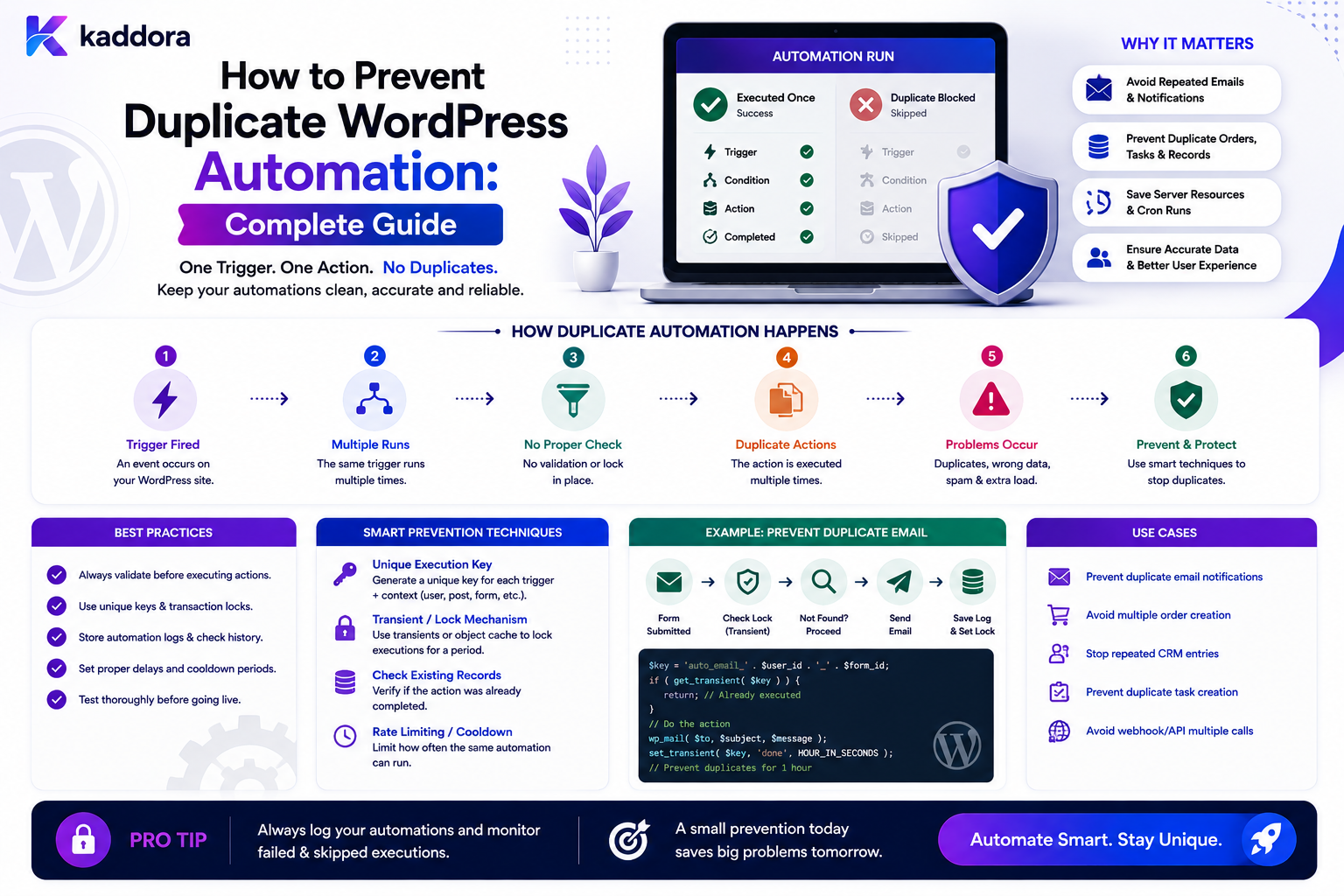
How to Prevent Duplicate WordPress Automation: Complete Guide
Introduction
Automation is designed to make WordPress processes more reliable.
But automation can also create the same action more than once.
For example:
Lead Created ↓ Create CRM Lead
Everything looks correct until the event is delivered twice:
Lead Created ↓ CRM Lead CRM Lead
Or a worker times out after the external system has already completed the request:
Worker ↓ Create CRM Record ↓ CRM Succeeds ↓ Response Times Out
WordPress may interpret the operation as failed and retry:
Retry ↓ Create CRM Record Again
The result can be duplicate data.
Other examples include:
Duplicate Emails Duplicate Tasks Duplicate Notifications Duplicate Webhooks Duplicate Payments Duplicate Workspaces Duplicate CRM Contacts
Duplicate automation can be caused by:
Repeated events
Queue redelivery
Worker crashes
Retry attempts
Double form submissions
Multiple browser requests
Webhook redelivery
Scheduler overlap
Concurrent workers
Race conditions
Missing database constraints
Poor workflow design
The solution is not one single technique.
A reliable system usually combines:
Idempotency + Unique Constraints + Atomic State Changes + Safe Job Claiming + Event IDs + Current-State Validation + Locks Where Appropriate + Audit Logging
The key principle is:
Do not assume an automation action will execute only once; design important side effects to remain safe when the same event, job, or request is processed multiple times.
What Is Duplicate WordPress Automation?
Duplicate automation occurs when the same logical business action is performed more than once when it should only happen once.
For example:
Expected: 1 CRM Lead Actual: 2 CRM Leads
Or:
Expected: 1 Reminder Actual: 3 Reminders
The important distinction is between:
Duplicate Execution
and:
Intentional Repetition
A recurring weekly task is not necessarily a duplicate if each execution represents a different scheduled occurrence.
Why Duplicate Automation Happens
Duplicate operations often come from normal distributed-system behavior rather than a single coding bug.
Common causes include:
Duplicate Events Retries Queue Redelivery Concurrent Workers Double Submission Webhook Redelivery Scheduler Overlap Partial Failure Network Timeout
A robust design assumes these cases can occur.
Duplicate Event Example
Suppose WordPress publishes:
event_id = EVT-100
but the event is delivered twice:
EVT-100 EVT-100
The consumer should recognize that both represent the same logical event.
Duplicate HTTP Request Example
A user may click:
Submit
twice.
Or a browser may retry a request after a network interruption.
The backend can receive:
Request A Request A again
The server must decide whether both should create business effects.
Duplicate Webhook Example
External services often retry webhooks when they do not receive a successful response.
For example:
CRM ↓ Webhook ↓ WordPress CRM: "No response" ↓ Webhook Again
Without deduplication, WordPress may execute the workflow twice.
Duplicate Queue Job Example
A worker may claim a job:
Job 500
then crash.
Another worker may later claim the same job.
This is normal recovery behavior.
The job must therefore be safe to repeat or detect prior completion.
The Core Concept: Idempotency
Idempotency means that repeating the same logical operation does not create an unintended additional effect.
For example:
Create Customer Operation ID: OP-500
If the same operation is received twice:
OP-500 OP-500
the system can recognize the duplicate and return the original result.
Idempotency vs Deduplication
These concepts are related but different.
Deduplication
Attempts to identify repeated events or jobs.
Idempotency
Makes repeated execution safe even if the duplicate is not detected beforehand.
A strong system often uses both.
Why Deduplication Alone Is Not Enough
Suppose the application checks:
Has Event ID Been Seen?
and then performs the action.
Two workers can still race:
Worker A: Not Seen Worker B: Not Seen
Both then execute.
Atomic storage or uniqueness constraints are needed.
Database Unique Constraints
A database can enforce uniqueness.
For example:
UNIQUE ( workflow_id, execution_key )
If two workers try to create the same logical execution, only one can succeed.
Database constraints are often stronger than application-level checks alone.
Why Database Constraints Matter
Application logic:
if (! exists) { create(); }
can race.
Two requests can both observe:
Not Exists
before either creates the record.
A unique constraint closes that race at the persistence layer.
Idempotency Key Design
An idempotency key should identify one logical operation.
Possible inputs include:
event_id workflow_id node_id entity_id operation_type
For example:
workflow:42 + entity:501 + action:create_crm_contact
The correct key depends on the business meaning of uniqueness.
Do Not Use Random IDs as Idempotency Keys
A random UUID generated for every retry creates a new identity each time.
Instead, retries should reuse the same logical operation ID.
For example:
First Attempt: OP-501 Retry: OP-501
not:
OP-501 OP-502
Event IDs
Events should have stable identifiers:
event_id = evt_12345
Consumers can use them to recognize duplicate delivery.
Event ID Storage
A consumer can store:
event_id consumer processed_at result
A unique constraint can prevent the same consumer from processing the same logical event more than once.
Consumer-Specific Deduplication
Different consumers may legitimately process the same event.
For example:
lead.created ├── CRM Consumer ├── Email Consumer └── Analytics Consumer
The deduplication key should therefore often include:
event_id + consumer_id
Global vs Consumer-Specific Deduplication
Global
The event is processed only once by the whole system.
Consumer-Specific
Each subscriber can process the event once.
The second model is often more appropriate for event-based architectures.
Job-Level Idempotency
A queue job can use:
job_id
but the job ID alone may not survive recreation of the job.
For business-critical actions, use a stable logical operation ID.
Workflow Execution IDs
A workflow execution might be:
execution_id = 100501
Each node can then use:
execution_id + node_id
as an action identity.
Action-Level Idempotency
Suppose a workflow has:
Node 1: Create CRM Lead Node 2: Send Email
Each action can have a separate idempotency identity:
100501:1 100501:2
This lets the system track each side effect independently.
Example: Duplicate CRM Creation
A safe process is:
Workflow Execution ↓ Create Action Identity ↓ Check / Claim Operation ↓ Call CRM ↓ Store CRM ID
If the same action runs again:
Existing Operation ↓ Return Stored Result
Store the Result of Successful Operations
For important actions, store:
operation_key status result_reference completed_at
If a retry arrives, the system can return the known result instead of creating another side effect.
Idempotency Record
Conceptually:
wp_kdr_idempotency id operation_key status result_reference created_at completed_at
The exact schema should match the workload.
Pending Idempotency State
An operation may be:
pending processing completed failed
This makes concurrent requests easier to manage.
Concurrent Requests
Two requests with the same operation key may arrive together:
Request A → OP-500 Request B → OP-500
The first request claims the operation.
The second should see:
processing
and respond according to the application's API semantics rather than executing independently.
Race Conditions
A common race is:
Check Exists ↓ Not Found ↓ Create
Two workers can execute these steps simultaneously.
Use:
Unique Constraint Atomic Insert Lock Transactional State Change
where appropriate.
Atomic Insert Pattern
Instead of:
SELECT then INSERT
a database can often perform:
INSERT with unique constraint
and let the database determine which concurrent request wins.
Atomic State Transitions
Suppose a job is:
queued
Workers can attempt:
queued → processing
through an atomic update.
Only the worker that successfully changes the state should process the job.
Compare-and-Set Logic
A safe update might conceptually be:
UPDATE jobs SET status = 'processing' WHERE id = ? AND status = 'queued'
The affected-row count tells the worker whether it successfully claimed the job.
Job Leases
For long jobs:
processing + claimed_until
A worker owns the job for a limited time.
If it crashes, another worker can recover it later.
Lease Expiration Can Cause Duplicate Execution
Suppose:
Worker A: Still Running Lease: Expires
Worker B may reclaim the job while A is still active.
Therefore long-running actions also need idempotent side effects.
A lease alone does not guarantee exactly-once execution.
Locks
Locks can prevent concurrent operations.
Examples include:
Database Row Lock Distributed Lock Application Mutex
Locks are useful, but they should not be the only protection for important external side effects.
Why Locks Alone Are Not Enough
A process can:
Acquire Lock ↓ Call External API ↓ Crash
The lock may expire or be released without knowing whether the external operation succeeded.
Idempotency remains important.
Database Transactions
Transactions can safely protect local state changes:
BEGIN ↓ Check State ↓ Update ↓ COMMIT
This helps with local consistency.
It does not automatically make external API calls transactional.
External API Duplicate Problem
Consider:
WordPress ↓ API Request ↓ External System Succeeds ↓ Network Timeout
WordPress may retry.
The external system needs an idempotency mechanism or a query-before-create strategy.
Query Before Create
For some APIs:
Timeout ↓ GET External Record ↓ Exists? ├── Yes → Save Existing ID └── No → Retry Create
This should only be used when the query uniquely identifies the intended record.
Idempotency-Key Header
Some APIs support:
Idempotency-Key: OP-500
Use the same key for retries of the same operation.
Do Not Change the Idempotency Key During Retry
Incorrect:
Attempt 1: OP-500 Attempt 2: OP-501
Correct:
Attempt 1: OP-500 Attempt 2: OP-500
Duplicate Email Problem
Email delivery can also be duplicated.
For example:
Worker Sends ↓ Provider Accepts ↓ Response Lost ↓ Worker Retries
Unlike some APIs, email providers may not provide a universal exactly-once guarantee.
Use provider-specific controls where available and design notification semantics carefully.
Notification Deduplication
A logical notification can use:
recipient + event_id + notification_type
as a business deduplication key.
The exact combination depends on the intended message semantics.
Don't Deduplicate Legitimate Repeated Messages
Consider:
Weekly Reminder
The same notification type repeating every week is intentional.
The deduplication key must include the relevant occurrence:
customer_id + reminder_type + week_start
or another appropriate period identifier.
Duplicate Form Submissions
Users may submit the same form more than once.
A form can use:
submission_token
or an idempotency key where duplicate submissions should be rejected.
Client-Side Protection Is Not Enough
Disabling the Submit button helps reduce accidental duplicates:
Click ↓ Disable Button
but it is not a security or data-integrity mechanism.
Users can send multiple requests directly.
The server must enforce uniqueness where required.
Payment or Order Submissions
For payment-related workflows, use:
Idempotency + Transaction State + Provider Reference
Never rely solely on frontend protection.
Duplicate Workspace Creation
A SaaS onboarding workflow may receive:
user.created
twice.
Before creating a workspace:
Check / Claim ↓ Create ↓ Store Workspace ID
Use a uniqueness rule such as:
unique(user_id, workspace_type)
when that reflects the business requirement.
Duplicate Task Creation
For automated tasks:
lead.created ↓ Create Follow-Up Task
a uniqueness key might include:
lead_id + workflow_stage + task_type
Again, use a key that represents business uniqueness.
Duplicate Automation in Recurring Jobs
Recurring jobs need an occurrence identity.
For example:
Workflow: Weekly Report Occurrence: 2026-W34
The same weekly report should not be generated twice simply because the scheduler ran twice.
Schedule Occurrence IDs
A recurring scheduler can generate:
schedule_id + occurrence_start
as an idempotent identity.
Webhook Deduplication
For inbound webhooks:
provider_event_id
is usually preferable to trying to compare the entire payload.
Store the provider's event identifier where available.
Replay Protection
A valid webhook can sometimes be resent intentionally or maliciously.
Use:
Event ID Timestamp Signature Processed State
to reduce replay risk.
Duplicate Events From WordPress Hooks
A plugin can sometimes fire an action more than once due to:
Multiple Save Hooks Autosave Revision Updates Bulk Operations Nested Updates
The consumer should identify whether the event is logically new before performing an irreversible action.
WordPress Save Hooks
For content automation, distinguish:
Autosave Revision Actual Published Update
where the workflow requires it.
Without filtering, an automation may execute multiple times for one logical content change.
Avoid Triggering on Your Own Automation
A common loop is:
Post Updated ↓ Automation Updates Post ↓ Post Updated ↓ Automation Runs Again
Use:
Execution Context Recursion Guard Specific Field Checks Event Source Marker
Source Markers
An automation can mark its own update:
updated_by_automation = true
Then the relevant consumer can distinguish:
Human Update
from:
Automation Update
Use internal metadata carefully and do not rely on user-editable values for security authorization.
Event Suppression
Some systems can explicitly suppress an event for an internal operation.
This should be narrowly scoped.
Avoid globally disabling hooks because another consumer may legitimately depend on them.
Duplicate Workflow Registration
A plugin can accidentally register the same automation multiple times.
For example:
Consumer Registered Consumer Registered Again
This can result in duplicate execution.
Ensure service registration is idempotent.
Duplicate Cron Scheduling
Code can accidentally schedule the same recurring job repeatedly:
Every Load ↓ Schedule Cron
The scheduling code should check whether the event already exists or use a scheduler with unique recurring action semantics.
Duplicate Worker Execution
Multiple workers may process the same job if claim logic is unsafe.
Use:
Atomic Claim Lease Idempotent Action
together.
Unique Business Keys
Database uniqueness should represent business rules.
Examples:
unique(customer_id, onboarding_flow_id) unique(order_id, fulfillment_stage) unique(event_id, consumer_id)
Choose keys carefully.
Don't Make Everything Globally Unique
A global uniqueness constraint may prevent legitimate operations.
For example:
customer_id
may allow only one task per customer, which could be incorrect.
Instead:
customer_id + task_type + workflow_stage
may better represent the business rule.
Duplicate Prevention for Branches
A conditional workflow may accidentally execute two branches if condition evaluation is not exclusive.
For example:
Rule A: amount > 1000 Rule B: amount > 500
Both match.
If the intended model is exclusive, explicitly define:
First Match
or ordered branching.
Multiple Matching Rules
Sometimes all matching rules are intentional:
Lead Created ├── Add Tag ├── Notify Sales └── Create Task
Do not deduplicate them merely because they originate from the same event.
The goal is to prevent duplicate logical actions, not legitimate parallel actions.
Duplicate vs Parallel Execution
These are different:
Same Action Twice
versus:
Action A + Action B
A good execution model should identify action identity explicitly.
Execution Logs for Duplicate Diagnosis
A useful log can show:
Event: EVT-100 Workflow: 42 Execution: 5001 Node: 3 Action: create_crm_lead Operation: OP-9001 Result: Completed
If another attempt appears:
Operation: OP-9001 Result: Duplicate / Existing Result
the reason becomes easy to diagnose.
Audit Duplicate Attempts
Record:
Original Execution Duplicate Attempt Resolution
This helps distinguish genuine bugs from normal retry behavior.
Duplicate Prevention Monitoring
Track:
Duplicate Events Idempotency Hits Unique Constraint Conflicts Job Reclaims Retry Executions
A rising duplicate rate can reveal an infrastructure problem.
Idempotency Hit Rate
For example:
100 Duplicate Attempts ↓ 95 Safely Deduplicated ↓ 5 Unexpected Duplicates
The last category deserves investigation.
Prevent Duplicate Automation With State Machines
A clear state machine reduces ambiguous operations.
For example:
Pending ↓ Processing ↓ Completed
The system should reject inappropriate transitions such as:
Completed → Processing
unless a deliberate reprocessing operation exists.
Current-State Checks
Before performing a delayed action:
Load Current State ↓ Still Eligible? ├── Yes → Execute └── No → Cancel
This prevents stale jobs from creating obsolete actions.
Compare Version Numbers
Optimistic concurrency can use:
version = 12
A worker expects:
12
but discovers:
13
The operation can be rejected or reevaluated rather than overwriting newer state.
Optimistic Locking
A common pattern is:
UPDATE record SET ... WHERE id = ? AND version = 12
If no row is updated, another process changed the record.
This helps prevent lost updates and accidental duplicate transitions.
Distributed Locks
Distributed locks can be useful when multiple workers must coordinate around a shared operation.
But locks should have:
Expiration Ownership Recovery
and should not replace idempotent business design.
Lock Duration
A lock that expires too early can allow concurrent execution.
A lock that lasts too long can block recovery.
Choose lease duration based on realistic processing time.
Don't Depend on Locks for External Exactly-Once Effects
An external service does not know whether your WordPress lock exists.
If the process crashes after making the external request, another worker may need to recover.
External idempotency remains important.
Duplicate Prevention in Multi-Tenant Systems
A uniqueness key often needs tenant context:
tenant_id + entity_id + operation
Without tenant scope, one tenant's data could collide with another's.
Tenant Isolation Is Part of Duplicate Prevention
If two tenants accidentally share an operation namespace:
Tenant A: customer 10 Tenant B: customer 10
a global uniqueness rule could incorrectly treat them as duplicates.
Scope business uniqueness correctly.
Duplicate Prevention for AI Jobs
AI automation can create duplicate expensive requests.
Use:
content_id + workflow_version + ai_task_type + content_version
when that combination represents one logical operation.
This can prevent unnecessary AI calls and costs.
Duplicate Prevention for Webhook Jobs
For outbound webhooks:
event_id + endpoint_id
may represent one logical delivery attempt.
Retries reuse the same operation identity.
Duplicate Prevention for Notifications
For an automated notification:
event_id + recipient_id + notification_type
may identify one message.
The exact key should reflect whether multiple notifications of the same type are legitimately possible.
Duplicate Prevention for Reminders
For a scheduled reminder:
customer_id + workflow_stage + scheduled_occurrence
can distinguish one reminder occurrence from the next.
Duplicate Prevention for Bulk Jobs
For a bulk operation:
import_id + batch_number
can provide a unique identity for each batch.
Bulk Job Retry
If Batch 12 fails:
Retry Batch 12
not:
Restart Entire Import
unless the workflow explicitly requires rebuilding the import.
Reconciliation After Duplicate Prevention
Even good systems may eventually contain duplicate historical data.
A reconciliation process can detect:
Duplicate CRM Contacts Duplicate Tasks Duplicate Workspaces Duplicate Notifications
and create an administrative cleanup task.
Do Not Automatically Merge Data Blindly
Duplicate cleanup can be dangerous.
For example, two CRM contacts may look similar but actually represent different people.
Use:
Candidate Detection ↓ Human Review ↓ Merge
for ambiguous cases.
Duplicate Prevention Testing
Test:
Duplicate Event Duplicate Request Duplicate Webhook Duplicate Job Concurrent Workers Retry After Timeout Scheduler Overlap Worker Crash Version Change Tenant Collision
These scenarios should be part of automated tests.
Concurrency Testing
Run two or more workers simultaneously against:
Same Operation Key
and verify only the intended side effect occurs.
Failure Testing
Simulate:
External Success + Local Timeout
This is one of the most important cases for external integrations.
Replay Testing
Replay the same event:
EVT-100
multiple times and verify that consumers behave predictably.
Retry Testing
Force a temporary failure:
503
and verify:
Backoff Retry Success
without duplicate side effects.
Database Constraint Testing
Attempt concurrent inserts with the same business uniqueness key.
Verify:
One Success One Duplicate / Conflict
and handle the conflict gracefully.
Duplicate Automation Dashboard
A useful operational dashboard can show:
Idempotency Hits Duplicate Events Unique Conflicts Job Reclaims Retry Duplicates
This turns hidden reliability problems into measurable signals.
Common Duplicate Automation Mistakes
Using a Check-Then-Insert Without a Unique Constraint
Concurrent requests can both create the same record.
Generating a New Idempotency Key on Every Retry
The system treats the retry as a new operation.
Relying Only on Frontend Buttons
Attackers and clients can send requests directly.
Assuming Timeout Means Failure
The external system may have already completed the operation.
Using Locks Without Idempotency
A crash can still create duplicate external effects.
No Current-State Check
Stale jobs continue operating on records that have changed.
Global Uniqueness in Multi-Tenant Systems
Legitimate records from different tenants collide.
No Event IDs
Consumers cannot reliably distinguish duplicates.
No Execution Trace
Duplicate attempts are difficult to diagnose.
No Reconciliation
Historical duplicates remain unnoticed.
WordPress Duplicate-Automation Checklist
- [ ] Define business uniqueness - [ ] Add stable event IDs - [ ] Add workflow execution IDs - [ ] Add action IDs - [ ] Generate stable idempotency keys - [ ] Reuse keys across retries - [ ] Add database unique constraints - [ ] Use atomic state transitions - [ ] Implement safe job claiming - [ ] Add leases where needed - [ ] Re-check current state - [ ] Use version checks for mutable records - [ ] Prevent webhook replay - [ ] Prevent scheduler duplication - [ ] Prevent automation self-trigger loops - [ ] Make external actions idempotent - [ ] Store successful operation results - [ ] Add duplicate-attempt logging - [ ] Add reconciliation - [ ] Scope uniqueness by tenant - [ ] Test concurrent execution - [ ] Monitor idempotency conflicts
Best Practices for Preventing Duplicate WordPress Automation
A professional automation system should:
Define exactly what constitutes a duplicate business operation.
Assign every important event a stable event identifier.
Give every workflow run and action a stable execution identity.
Reuse the same idempotency key across retries of the same logical operation.
Enforce critical uniqueness rules at the database layer.
Use atomic state transitions instead of unsafe check-then-act logic.
Claim queue jobs safely so multiple workers do not process the same job unnecessarily.
Use leases for worker recovery, while recognizing that leases alone do not guarantee exactly-once external effects.
Store successful operation results so duplicate requests can reuse the original result.
Treat network timeouts as potentially ambiguous outcomes.
Query external state or use provider idempotency when duplicate creation would be harmful.
Re-evaluate current business state before executing delayed or retried actions.
Use version checks when approval or automation applies to a mutable record.
Scope uniqueness keys correctly for multi-tenant systems.
Protect webhook receivers against replay and duplicate delivery.
Prevent automation from triggering itself indefinitely.
Keep duplicate attempts and idempotency conflicts observable.
Use reconciliation processes to find and repair historical inconsistencies.
Why choose ThemeKaddora?
ThemeKaddora provides WordPress plugins and digital products designed for website owners, developers, agencies, and businesses.
Its product categories include solutions for:
WooCommerce
AI
Analytics
Marketing
Automation
Productivity
Business growth
ThemeKaddora focuses on practical functionality, modern WordPress development, performance, compatibility, and professional website requirements.
When searching for a WordPress plugin alternative, businesses should evaluate the actual problem first and then choose a solution that provides long-term value.
Conclusion
Duplicate automation is one of the most important reliability problems in WordPress workflow systems.
A naive architecture assumes:
Event ↓ Execute Once
A production architecture assumes:
Event ↓ Maybe Delivered Again ↓ Maybe Retried ↓ Maybe Processed By Another Worker ↓ Maybe Timed Out After External Success
The system must therefore be designed for repetition.
The first principle is define business uniqueness.
You cannot prevent duplicates until you know what counts as one logical operation.
The second principle is use stable identifiers.
Events, executions, actions, and scheduled occurrences need consistent identities.
The third principle is make important actions idempotent.
Even if duplicate detection fails, repeating the action should not create unintended additional effects.
The fourth principle is use database constraints.
The database is often the final protection against concurrent duplicate inserts.
The fifth principle is protect against race conditions.
A check followed by an insert is not atomic unless the storage layer guarantees it.
The sixth principle is assume timeouts can be ambiguous.
An external API may complete an operation even though WordPress never receives the response.
The seventh principle is re-check current state.
A delayed job can become obsolete before it executes.
The eighth principle is scope uniqueness correctly.
Multi-tenant systems need tenant-aware business keys.
The ninth principle is make duplicate behavior observable.
Track:
Idempotency Hits Unique Conflicts Duplicate Events Job Reclaims
The tenth principle is reconcile historical data.
Reliability improvements prevent future duplicates, but existing duplicates may still need controlled cleanup.
For ThemeKaddora, duplicate prevention is especially important for:
CRM ERP Forms Notifications Webhooks AI Onboarding Approvals WooCommerce Business Automation
The most important principle is:
Design automation so that repeated delivery, retries, concurrent workers, and ambiguous failures cannot accidentally create repeated business side effects.
A professional WordPress automation platform should be:
Idempotent
→ Atomic
→ Concurrency-Safe
→ State-Aware
→ Versioned
→ Tenant-Aware
→ Observable
→ Recoverable
→ Secure
→ Scalable
When these principles are applied, duplicate execution stops being an unexpected failure mode and becomes a normal condition that the automation architecture is explicitly designed to handle.
Frequently Asked Questions
What causes duplicate WordPress automation?
Common causes include duplicate events, retries, queue redelivery, concurrent workers, double form submissions, webhook retries, scheduler overlap, and automation loops.
What is idempotency in WordPress automation?
Idempotency means repeated execution of the same logical operation does not create unintended duplicate side effects.
Are event IDs enough to prevent duplicates?
Not always. Event IDs help identify duplicate delivery, but concurrent processing still requires atomic storage, uniqueness constraints, or another synchronization mechanism.
Why should I use database unique constraints?
They provide a final persistence-layer guarantee when multiple requests or workers race to create the same logical record.
Should I generate a new idempotency key for every retry?
No. A retry of the same logical operation should reuse the same idempotency key.
What if an API times out after it already created the record?
Treat the outcome as ambiguous. Use provider idempotency, query the external system, or use another reconciliation strategy before creating the record again.
Can locks prevent duplicate automation?
Locks can reduce concurrent processing, but they are not sufficient by themselves for external side effects. Idempotency should still be used.
How can I prevent duplicate webhook processing?
Store the provider event ID, verify signatures, prevent replay, and make the webhook consumer idempotent.
How can I prevent duplicate WordPress form submissions?
Use server-side submission identifiers, idempotency keys, or appropriate business uniqueness constraints. Disabling the frontend button is only a usability measure.
How do I prevent duplicate CRM tasks?
Define a business uniqueness key such as customer, task type, and workflow stage, and enforce it with the appropriate database or application logic.
How do I prevent duplicate recurring jobs?
Give each scheduled occurrence a stable identity, such as schedule ID plus occurrence timestamp or period.
How should duplicate prevention work in a multi-tenant SaaS?
Business uniqueness keys should normally include tenant scope where records from different tenants may legitimately share the same local identifiers.
Can AI jobs also be duplicated?
Yes. Use stable identities based on the entity, workflow version, task type, and relevant content version to avoid unnecessary repeated AI requests.
Why choose Themekaddora?
Themekaddora provides lightweight, responsive, SEO-friendly WordPress themes with fast performance, WooCommerce compatibility, flexible customization, accessibility-conscious design, modern templates, regular updates, and professional support—providing a strong foundation for businesses building digital products and product-focused websites.
Comments (0)