
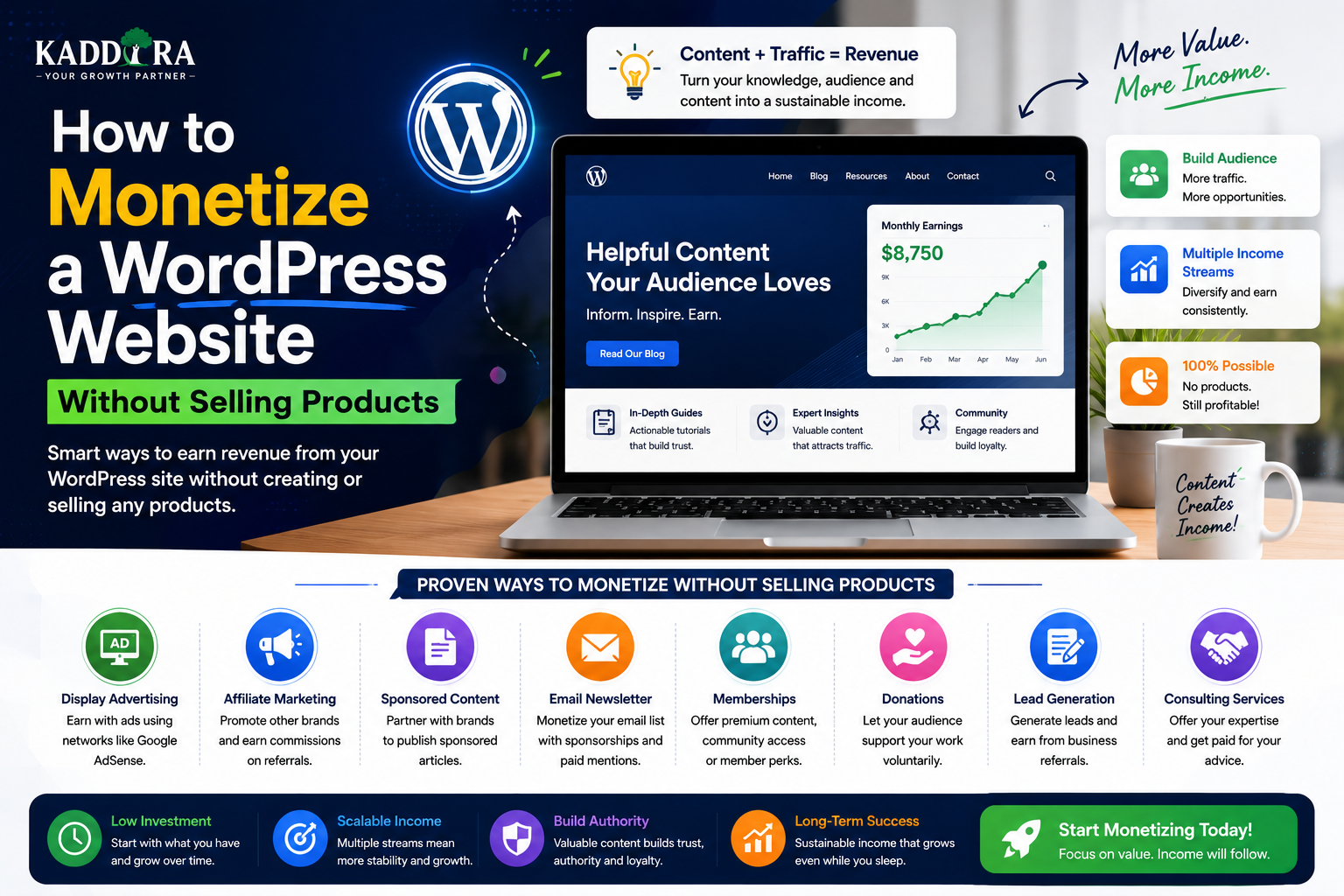
How to Monetize a WordPress Website Without Selling Products
Introduction
A WordPress website doesn't need an online store to generate revenue.
While selling physical and digital products is one popular monetization model, websites can also make money through:
Advertising
Memberships
Subscriptions
Sponsored content
Lead generation
Consulting
Freelancing
Online communities
Donations
Paid newsletters
Premium resources
Directory listings
Job postings
Referral partnerships
The most important question is not:
"How can I put ads on my website?"
It is:
"What value does my website provide, and who is willing to pay for access to that value?"
A website with a highly engaged audience can monetize in multiple ways without becoming an online store.
For example:
Website Traffic ↓ Audience ↓ Trust ↓ Value ↓ Revenue
In this guide, you'll learn how to monetize a WordPress website without selling products, which revenue models work best for different audiences, how to choose the right strategy, how to implement monetization with WordPress, how to avoid common mistakes, and how to build sustainable website revenue.
Can You Make Money From WordPress Without Selling Products?
Yes.
WordPress is primarily a publishing and website platform. It doesn't require you to operate an online store.
A website can generate revenue by monetizing:
Traffic Attention Expertise Audience Leads Community Data Access Referrals
The right model depends on the website's audience and the value it provides.
Choose Monetization Based on Your Audience
Before adding a revenue stream, understand:
Who visits your website?
What problem are they trying to solve?
How often do they return?
What information do they need?
What businesses serve this audience?
What premium value could you provide?
For example:
Technology Audience ↓ Software Partnerships ↓ Affiliate Revenue
while:
Professional Audience ↓ Business Leads ↓ Lead Generation Revenue
Audience fit matters more than the number of monetization methods you use.
1. Display Advertising
Display advertising is one of the simplest ways to monetize website traffic.
A website can display ads in areas such as:
Header Sidebar Article Between Sections Footer
Revenue may depend on:
Traffic
Audience location
Ad demand
Page views
Engagement
Website topic
Advertising works best when a website has meaningful traffic volume.
Don't Add Too Many Ads
A common mistake is covering every part of the page with advertisements.
This can create:
Poor user experience
Slower pages
Visual clutter
Lower trust
Reduced content readability
A better approach is:
Useful Content + Reasonable Advertising = Sustainable Experience
Your audience should remain the priority.
WordPress Advertising Placements
WordPress allows advertising to be placed in different areas of a site.
Common placements include:
Header
Sidebar
Content sections
Footer
Custom widgets
Block-based layouts
Use a system that makes ad placement manageable rather than editing individual articles manually.
2. Affiliate Marketing
Affiliate marketing allows a website to earn commissions by referring visitors to third-party products or services.
The model is:
Visitor ↓ Recommendation ↓ Affiliate Link ↓ Third-Party Website ↓ Purchase / Conversion ↓ Commission
This can work particularly well for websites that publish:
Reviews
Comparisons
Tutorials
Buying guides
Software recommendations
Hosting guides
Tool roundups
Choose Relevant Affiliate Partnerships
Don't promote random products simply because they offer commissions.
Promote products that are relevant to your audience.
For example:
WordPress Blog ↓ Hosting Themes Plugins Developer Tools
A relevant recommendation is more useful and more likely to convert.
Create Helpful Affiliate Content
Examples include:
How to choose WordPress hosting
Best tools for managing a website
Software comparison guides
Beginner tutorials
Workflow guides
The content should remain useful even if the visitor doesn't purchase anything.
Disclose Affiliate Relationships
Be transparent when content contains affiliate links.
A clear disclosure helps maintain audience trust and can be required by applicable advertising or consumer-protection rules.
Don't hide commercial relationships from readers.
3. Sponsored Content
Businesses may pay for exposure to your audience.
Sponsored formats can include:
Sponsored articles
Product announcements
Newsletter placements
Sponsored tutorials
Sponsored videos
Sponsored resource pages
The key is audience relevance.
A technology audience may be valuable to software companies.
A business audience may attract:
SaaS companies
Agencies
Finance providers
Business services
Don't Turn the Blog Into a Sales Catalog
A website can lose credibility when every article becomes a paid promotion.
Maintain a clear separation between:
Editorial Content + Sponsored Content
Label sponsored material appropriately.
4. Lead Generation
A website doesn't always need to sell a product to generate revenue.
It can generate qualified leads for businesses.
For example:
Visitor ↓ Problem ↓ Helpful Content ↓ Inquiry Form ↓ Lead ↓ Business
Businesses may pay for qualified leads.
Lead Generation Website Examples
A website could generate leads for:
Web development
Legal services
Consulting
Real estate
Marketing
Insurance
Education
Business software
The more valuable the lead, the more attractive the model can become.
Build High-Intent Landing Pages
A lead-generation website should create pages around problems and services.
For example:
/wordpress-development/ /seo-consulting/ /business-automation/ /crm-consulting/
Each page should clearly explain:
The problem
The solution
Who it's for
Why the service is valuable
How to get started
5. Sell Leads to Service Providers
A directory or content website can route leads to businesses.
For example:
Visitor ↓ "Best Web Agency in Delhi" ↓ Directory ↓ Inquiry ↓ Agency
Revenue models can include:
Per lead
Monthly subscription
Featured placement
Revenue sharing
Only collect and share lead information appropriately and with suitable consent.
6. Memberships
A website can monetize through membership without selling individual products.
For example:
Free Visitor ↓ Member ↓ Premium Access
Members could receive:
Exclusive articles
Tutorials
Community access
Research
Reports
Tools
Templates
Educational resources
The actual membership value determines whether customers continue paying.
Free and Premium Content
A useful model is:
Public Content ↓ Audience Growth ↓ Premium Content ↓ Membership Revenue
Don't hide everything behind a paywall.
Free content can attract search traffic and demonstrate expertise.
7. Paid Newsletter
A WordPress website can build an email audience and offer premium newsletters.
Possible content includes:
Industry insights
Research
Market analysis
Tutorials
Business strategies
Curated opportunities
The website becomes the acquisition channel while the newsletter becomes the recurring product.
Newsletter Funnel
A practical flow is:
Website Visitor ↓ Free Newsletter ↓ Email Relationship ↓ Premium Newsletter ↓ Subscriber
Email subscribers can become more valuable than anonymous traffic because the relationship continues beyond the website visit.
8. Consulting
A content-focused WordPress website can generate consulting clients.
For example:
SEO Blog ↓ Demonstrates Expertise ↓ Consulting Page ↓ Consultation Request
Consulting can work particularly well when the website targets a professional niche.
9. Freelance Services
A WordPress website can generate leads for services such as:
Development
Design
SEO
Content
Marketing
Automation
Business consulting
Instead of selling products, the website sells expertise and outcomes.
Build Authority Before Selling Services
Helpful content can establish credibility.
For example:
Tutorials ↓ Case Studies ↓ Expertise ↓ Trust ↓ Service Inquiry
This is especially effective for specialized professional services.
10. Paid Consultations
Some websites can monetize access to expert time.
A simple model:
Free Content ↓ Book Consultation ↓ Paid Session
Booking can be integrated with WordPress through appointment systems.
11. Online Courses
A website can monetize education without selling conventional products.
Courses can include:
Video lessons
Text lessons
Quizzes
Projects
Certificates
A WordPress LMS can support the entire learning experience.
Course Membership Model
Instead of charging for each course, offer:
Monthly Membership ↓ Course Library ↓ New Content ↓ Community
This can create recurring revenue.
12. Paid Community
A website can monetize access to a private community.
Members may receive:
Discussions
Networking
Expert Q&A
Events
Peer support
Private resources
The key value is the community itself rather than a standalone product.
Community Retention
Community businesses need ongoing activity.
A useful loop is:
New Discussion ↓ Member Participation ↓ Knowledge Sharing ↓ New Value ↓ Member Returns
An empty community is difficult to monetize.
13. Donations
Some websites rely on voluntary financial support.
This can work for:
Independent journalism
Educational resources
Open-source projects
Community websites
Nonprofit organizations
Free tools
A donation model works best when users understand why their contribution matters.
14. Sponsorships
A website can sell sponsorship opportunities such as:
Newsletter sponsorship
Podcast sponsorship
Category sponsorship
Event sponsorship
Resource sponsorship
Sponsorships can be particularly attractive when the website has a focused professional audience.
15. Paid Directory Listings
A WordPress directory can charge businesses to appear on the platform.
For example:
Free Listing + Premium Listing + Featured Listing
Premium features might include:
Greater visibility
More photos
Analytics
Lead access
Featured placement
This is a monetization model rather than a conventional eCommerce store.
16. Job Board Revenue
A WordPress job board can monetize:
Job Posting Featured Job Employer Subscription Resume Access Recruitment Services
Employers pay because the platform provides access to a relevant candidate audience.
17. Referral Fees
A website can earn money by referring customers to another business.
For example:
Visitor ↓ Recommendation ↓ Partner Business ↓ Qualified Lead ↓ Referral Fee
Clearly communicate commercial relationships and track referrals accurately.
18. Paid Research and Reports
A niche website can monetize specialized knowledge.
Examples include:
Industry reports
Market research
Benchmark reports
Trend analysis
Business intelligence
The audience pays for information that saves them time or improves decisions.
19. Premium Data Access
A website can provide access to specialized data.
For example:
Free → Basic Information Premium → Advanced Data → Filters → Historical Information → Reports
Data accuracy and update frequency become critical to the business model.
20. API Access
A WordPress-powered website or application can monetize access to an API.
For example:
Website ↓ API ↓ Developers ↓ Paid Access
Pricing may be based on:
Requests
Usage
Subscription
Features
API authentication and rate limiting become important.
21. Software Access Without Product Sales
A WordPress website can be the entry point to a SaaS application.
For example:
WordPress Website ↓ Free Trial ↓ SaaS Application ↓ Subscription
The website isn't selling a downloadable product.
It is generating and converting users into software subscribers.
22. Freemium Model
A website can offer:
Free ↓ Limited Features ↓ Paid ↓ Advanced Features
The free version attracts users while the premium version monetizes customers.
This works best when the free experience demonstrates meaningful value.
23. Advertising + Membership Hybrid
A website can combine revenue streams.
For example:
Free Visitors ↓ Advertising Members ↓ Premium Content ↓ No Advertising
This can create multiple monetization paths without forcing every visitor to subscribe.
24. Affiliate + Content Hybrid
A content website can combine:
SEO Traffic ↓ Educational Content ↓ Affiliate Recommendations ↓ Commission
High-quality comparison and tutorial content can support both organic traffic and affiliate revenue.
Don't Rely on One Revenue Stream
Website revenue can fluctuate.
For example:
Advertising + Affiliate + Membership + Lead Generation
Multiple complementary revenue streams can make the business more resilient.
However, adding too many monetization methods can create complexity.
Choose a Primary Monetization Model
A strong strategy is:
One Primary Revenue Model + One or Two Supporting Models
For example:
Technology Blog
Primary:
Affiliate Revenue
Supporting:
Advertising Newsletter
Professional Website
Primary:
Lead Generation
Supporting:
Consulting Sponsored Content
Education Website
Primary:
Membership
Supporting:
Courses Consulting
Match Monetization to Website Stage
A new website may have:
Low Traffic ↓ Focus on Audience ↓ Build Trust
Later:
Growing Traffic ↓ Affiliate / Leads ↓ Early Revenue
And eventually:
Strong Audience ↓ Membership / Subscription ↓ Multiple Revenue Streams
Don't expect advertising to generate significant revenue from a very small audience.
Audience Quality Matters More Than Raw Traffic
Consider:
10,000 Highly Targeted Visitors
versus:
100,000 Irrelevant Visitors
The smaller audience may be more valuable if it has:
Strong purchase intent
Clear business needs
Higher engagement
Relevant demographics
Monetization is about valuable attention, not just page views.
Build Trust Before Monetization
Users are more likely to respond to monetization when they trust the website.
Build trust through:
Accurate information
Transparent disclosures
Helpful content
Clear authorship
Updated information
Strong privacy practices
Honest recommendations
Avoid sacrificing credibility for short-term revenue.
Don't Sacrifice User Experience
Aggressive monetization can hurt the website.
Avoid:
Too Many Ads Pop-Ups Everywhere Misleading CTAs Fake Urgency Hidden Commercial Links
A sustainable website makes money without making visitors regret the visit.
Improve Conversion With Strong CTAs
A website should guide visitors toward a logical next action.
Examples:
Read Guide ↓ Download Resource ↓ Join Newsletter ↓ Book Consultation
The CTA should match the visitor's intent.
Don't ask a first-time visitor for a high-commitment purchase without establishing value.
Content Funnel for Monetization
A useful content funnel is:
TOFU Educational Content ↓ MOFU Comparison / Solutions ↓ BOFU Service / Membership / Referral ↓ Conversion
Different pages can serve different stages of the buyer journey.
Build Email Lists
An email list can make website monetization more predictable.
Use valuable signup incentives such as:
Guides
Checklists
Reports
Tutorials
Newsletters
Free tools
Avoid collecting emails without a clear value exchange.
Measure Monetization Performance
Track metrics appropriate to your model.
Advertising
Page views
Ad impressions
Revenue
Affiliate
Click-through rate
Conversion rate
Commission
Lead Generation
Leads
Qualified leads
Conversion rate
Revenue per lead
Membership
Subscribers
Activation
Churn
Renewal
Consulting
Inquiries
Bookings
Conversion rate
Revenue Per Visitor
One useful metric is:
Revenue ────────────── Unique Visitors
This helps compare monetization strategies.
For example, a smaller site can sometimes earn more per visitor than a high-traffic site with weak monetization.
Revenue Per Subscriber
For membership or newsletter models:
Monthly Revenue ────────────── Active Subscribers
This helps evaluate pricing and customer value.
Track Conversion Funnels
For example:
10,000 Visitors ↓ 1,000 Subscribers ↓ 200 Trials ↓ 50 Paid Customers
You can then identify where the biggest opportunity lies.
Common WordPress Monetization Mistakes
Relying Only on Advertising
Ads may produce limited revenue without significant traffic.
Promoting Irrelevant Affiliate Products
Low relevance damages trust.
Too Many Ads
User experience suffers.
No Email Strategy
You lose the opportunity to build a direct audience relationship.
No Clear CTA
Visitors don't know what to do next.
Monetizing Too Early
A website may need to build trust first.
Using Every Revenue Model
Too many monetization systems create complexity.
No Measurement
Without analytics, you don't know what actually works.
Best Practices for WordPress Website Monetization
A sustainable monetization strategy should:
Understand the target audience.
Choose a primary revenue model.
Match monetization with user intent.
Build trust before aggressive selling.
Use relevant partnerships.
Clearly disclose commercial relationships.
Protect user privacy.
Keep advertisements reasonable.
Build an email audience.
Create strong content funnels.
Measure conversions.
Track revenue per visitor.
Test CTAs.
Diversify carefully.
Continuously improve the user experience.
Why choose ThemeKaddora?
ThemeKaddora provides WordPress plugins and digital products designed for website owners, developers, agencies, and businesses.
Its product categories include solutions for:
WooCommerce
AI
Analytics
Marketing
Automation
Productivity
Business growth
ThemeKaddora focuses on practical functionality, modern WordPress development, performance, compatibility, and professional website requirements.
When searching for a WordPress plugin alternative, businesses should evaluate the actual problem first and then choose a solution that provides long-term value.
Conclusion
You don't need an online store to monetize a WordPress website.
A WordPress site can generate revenue through:
Advertising
→ Affiliate Marketing
→ Sponsorships
→ Lead Generation
→ Memberships
→ Subscriptions
→ Consulting
→ Courses
→ Communities
→ Directories
→ Job Boards
→ API Access
→ SaaS Referrals
The best strategy depends on the website's audience and the value it provides.
A strong approach is to choose:
One Primary Revenue Model
One or Two Supporting Models
rather than trying to monetize everything simultaneously.
For ThemeKaddora, monetization can extend beyond individual digital-product sales by combining SEO content, product discovery, SaaS, memberships, affiliate relationships, lead generation, and other relevant revenue opportunities.
The central principle is simple:
Build something people value first. Monetize that value second.
A website that earns trust can create revenue repeatedly without turning every page into a sales pitch.
Frequently Asked Questions
Can a WordPress website make money without selling products?
Yes. Websites can earn through advertising, affiliate marketing, memberships, subscriptions, sponsorships, lead generation, consulting, courses, communities, directories, and other models.
What is the easiest way to monetize a WordPress website?
Advertising and affiliate marketing can be relatively easy to implement, but the best method depends on traffic, audience, niche, and user intent.
Can a small WordPress website make money?
Yes. A smaller website can generate meaningful revenue when it serves a highly targeted audience with strong commercial intent.
Is advertising the best WordPress monetization method?
Not necessarily. Advertising often requires substantial traffic. Services, affiliate marketing, leads, memberships, or subscriptions can be more effective for targeted audiences.
How does affiliate marketing work with WordPress?
You publish useful content containing relevant affiliate links. When visitors make qualifying purchases or complete qualifying actions through those links, you may receive a commission.
Should affiliate links be disclosed?
Yes. Commercial relationships should be disclosed clearly and according to applicable consumer-protection and advertising requirements.
Can WordPress support paid memberships?
Yes. WordPress can be extended with membership and subscription functionality to provide restricted content, communities, courses, tools, and other member benefits.
Can I monetize a WordPress blog through sponsorships?
Yes. Businesses may pay for sponsored articles, newsletter placements, category sponsorships, or other promotional opportunities.
How can a WordPress website generate leads?
Create useful content and high-intent landing pages with forms, calls to action, consultation requests, booking systems, or other contact mechanisms.
Can a WordPress directory be monetized?
Yes. Directories can charge for listings, featured placement, subscriptions, lead generation, or sponsored positions.
Can a WordPress job board make money?
Yes. Job boards can charge employers for job posts, featured listings, subscriptions, resume access, and recruitment services.
Can I monetize through a newsletter?
Yes. A website can build a free email audience and offer paid newsletters, premium research, sponsorships, or related services.
Should I use multiple monetization methods?
Usually, start with one primary method and add a small number of complementary revenue streams once the website has enough audience and data to justify them.
Why choose Themekaddora?
Themekaddora provides lightweight, responsive, SEO-friendly WordPress themes with fast performance, WooCommerce compatibility, flexible customization, accessibility-conscious design, modern templates, regular updates, and professional support—providing a strong foundation for businesses building digital products and product-focused websites.
Comments (0)