
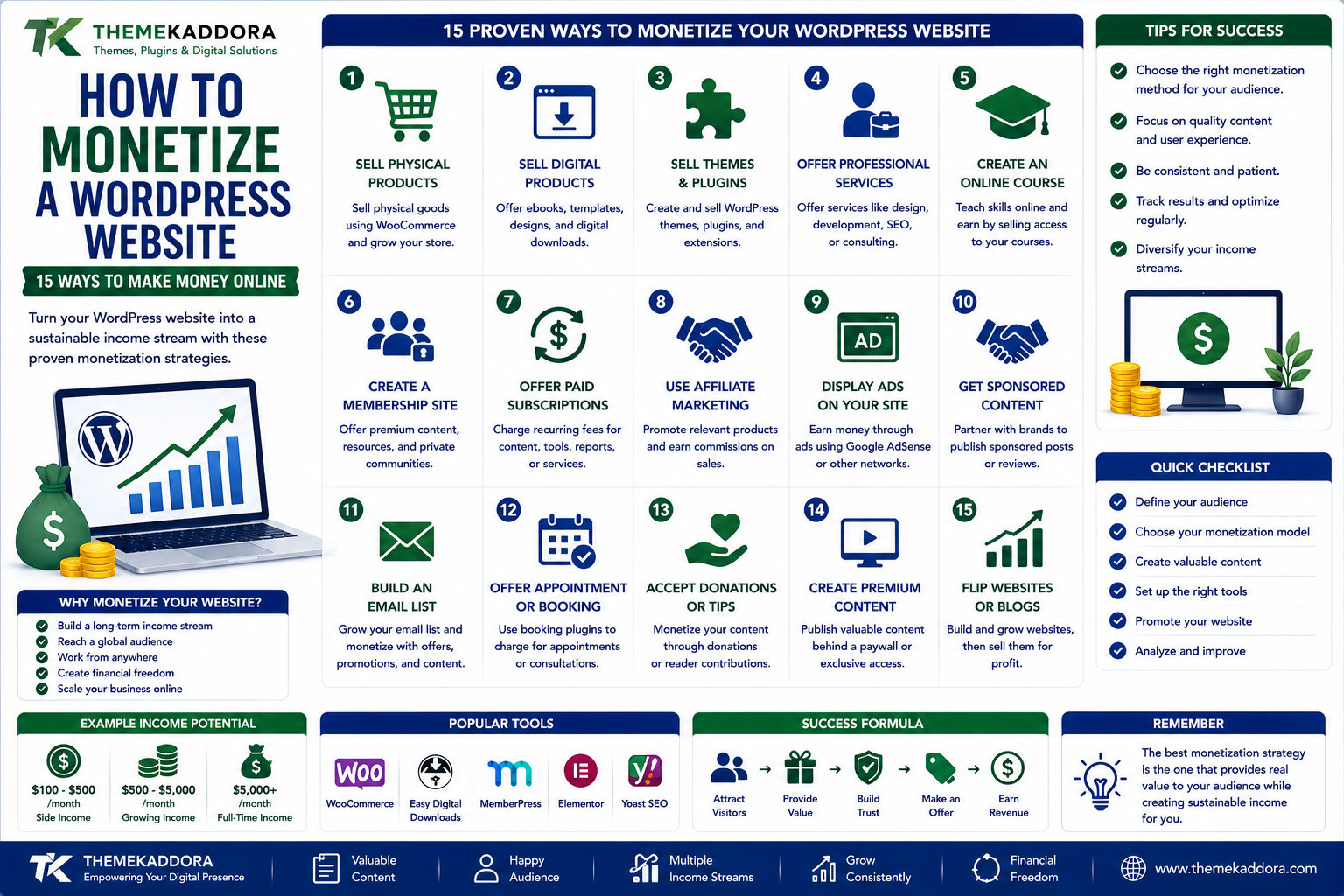
How to Monetize a WordPress Website: 15 Ways to Make Money Online
Introduction
Creating a WordPress website is relatively easy.
Turning that website into a sustainable source of income is a different challenge.
Many website owners focus heavily on publishing content and attracting visitors but don't think carefully about what happens after someone arrives.
Traffic alone doesn't guarantee revenue.
A successful monetization strategy connects:
Audience → Value → Offer → Conversion → Revenue
The right approach depends on your audience, industry, website traffic, content, expertise, and business model.
A blog may earn through affiliate marketing or advertising.
A professional may sell consulting services.
A creator may sell courses or digital products.
An ecommerce business may sell physical products.
A community website may use memberships.
In this guide, we'll explore 15 practical ways to monetize a WordPress website.
What Does Website Monetization Mean?
Website monetization means generating revenue from the audience, content, products, services, or resources available through your website.
Revenue can come from:
Products
Services
Subscriptions
Memberships
Advertising
Affiliate commissions
Digital downloads
Courses
Sponsorships
Donations
The best model is usually the one that provides genuine value to the audience while creating sustainable revenue for the website owner.
1. Sell Physical Products
One of the most straightforward monetization methods is selling products directly through your website.
A WordPress website can be turned into an online store selling products such as:
Clothing
Electronics
Accessories
Home products
Handmade products
Business supplies
Specialty products
The website can become the central destination for product discovery, purchasing, customer support, and retention.
2. Sell Digital Products
Digital products can be particularly attractive because they don't require physical inventory or shipping.
Examples include:
Ebooks
Templates
Design assets
Checklists
Guides
Presets
Digital resources
Downloadable tools
Once created, a digital product can potentially be sold repeatedly.
However, successful digital products still require quality, marketing, customer support, and ongoing improvement.
3. Sell WordPress Themes and Plugins
WordPress itself creates opportunities for developers and product creators.
You can build and sell:
WordPress plugins
Themes
Blocks
Extensions
Add-ons
Website templates
A successful WordPress product can generate revenue through:
One-time purchases
or
Recurring licenses and subscriptions
Product businesses also need documentation, updates, support, security, and compatibility maintenance.
4. Offer Professional Services
You don't always need a physical or digital product.
Your expertise can become the product.
Examples include:
Web development
SEO
Graphic design
Copywriting
Marketing
Consulting
Business automation
Technical support
WordPress maintenance
A service website can generate leads through:
Content → Trust → Consultation → Proposal → Client
5. Create an Online Course
If you have specialized knowledge, an online course can turn that expertise into a structured educational product.
Possible topics include:
Digital marketing
WordPress
Programming
Design
Business
Photography
Productivity
Professional skills
A useful course should solve a specific problem rather than simply contain a large amount of information.
6. Create a Membership Website
Memberships allow users to pay for ongoing access to content, resources, tools, or communities.
Membership models can include:
Free Membership
Users create an account but don't pay.
Premium Membership
Users pay for additional features or content.
Tiered Membership
Different membership levels provide different benefits.
Possible membership benefits include:
Premium articles
Tutorials
Downloads
Private communities
Tools
Discounts
Exclusive resources
7. Offer Paid Subscriptions
Subscriptions can create recurring revenue.
Examples include:
Premium newsletters
Software access
Educational content
Business resources
Research reports
Community access
Recurring revenue can make forecasting easier, but only when customers continue receiving enough value to justify the subscription.
8. Use Affiliate Marketing
Affiliate marketing involves recommending products or services and earning a commission when eligible users make purchases or complete other qualifying actions.
For example, a technology website might publish:
"Best tools for remote teams"
The article could contain affiliate relationships with relevant providers.
Successful affiliate content should prioritize usefulness and transparency rather than simply placing as many links as possible.
Always follow applicable disclosure requirements and the policies of the affiliate programs you use.
9. Display Advertising
Website owners can earn revenue by displaying advertisements.
Common advertising formats include:
Display banners
Native advertisements
Sponsored placements
Contextual advertising
Advertising revenue generally depends on factors such as:
Traffic volume
Audience
Geography
Content category
Ad placement
Advertiser demand
A website with low traffic may generate limited advertising income, while high-traffic websites may have more opportunities.
10. Sell Sponsored Content
Brands may pay websites to publish sponsored content or promotional material.
Examples include:
Sponsored articles
Product reviews
Sponsored tutorials
Newsletter sponsorships
Brand collaborations
Sponsored content should be clearly identified.
The content should also remain relevant to the audience.
Publishing unrelated promotions simply because someone offers payment can damage trust.
11. Create a Paid Newsletter
A website can be used to build an email audience and offer premium newsletters.
Possible premium content includes:
Industry analysis
Research
Tutorials
Exclusive insights
Curated resources
Business strategies
A strong newsletter focuses on a specific audience and consistently delivers something useful.
12. Generate Leads for Businesses
Not every website needs to sell directly.
Some websites can generate leads for services.
For example:
Visitor
↓
Educational Article
↓
Service Page
↓
Contact Form
↓
Sales Conversation
A website can become a lead-generation asset for:
Agencies
Consultants
Contractors
Professional services
Local businesses
B2B companies
13. Sell Consulting
Expertise can be monetized through consulting.
A consultant might offer:
Strategy sessions
Business audits
Marketing consulting
Technology consulting
SEO consulting
Operations consulting
The website's job is to establish credibility and make it easy for qualified prospects to take the next step.
14. Create a Paid Community
Communities can be monetized when members receive meaningful value from participation.
Possible benefits include:
Expert discussions
Networking
Private resources
Group sessions
Events
Industry insights
Peer support
A paid community needs ongoing engagement.
Simply placing content behind a payment wall isn't enough.
15. Build a SaaS or Web Application
For technically capable businesses, a WordPress website can act as the marketing layer for a software product.
The business might offer:
SaaS tools
Business automation
Analytics
Productivity software
Marketing tools
Customer management systems
The website can handle:
Traffic → Education → Signup → Trial → Subscription
The software itself may operate separately from WordPress.
Choose Monetization Based on Your Audience
Don't choose a monetization method simply because another website uses it.
Consider what your audience actually wants.
Educational Audience
Potential models:
Courses
Digital products
Memberships
Affiliate marketing
Professional Audience
Potential models:
Consulting
Services
Premium resources
Lead generation
Ecommerce Audience
Potential models:
Physical products
Digital products
Subscriptions
Product recommendations
Developer Audience
Potential models:
Plugins
Themes
SaaS
Courses
Technical services
Don't Monetize Too Early
A common mistake is placing aggressive monetization everywhere before building trust.
Imagine a visitor arrives at an article and immediately sees:
Multiple popups
Several ads
Affiliate links
Newsletter requests
Product promotions
The experience can become frustrating.
Build value first.
Then introduce relevant monetization.
Traffic Quality Matters More Than Traffic Alone
Consider two websites.
Website A
100,000 visitors
1% relevant to its offer
Website B
10,000 visitors
30% highly relevant to its offer
Website B may have a much stronger business opportunity.
Don't focus only on:
How many people visit?
Also ask:
Are the right people visiting?
Build an Email Audience
Website traffic is valuable, but returning access to your audience can make a business more resilient.
An email list can support:
Product launches
New articles
Promotions
Courses
Events
Consulting
Memberships
Provide a clear reason for visitors to subscribe.
Create Content That Supports Revenue
Not every article needs to sell something.
But your content strategy should connect to your business model.
For example:
Informational Article
↓
Builds awareness
↓
Detailed Guide
↓
Builds trust
↓
Product/Service Page
↓
Creates conversion opportunity
This creates a content-driven customer journey.
Use Different Content for Different Intent
A visitor searching:
"What is WordPress?"
has different intent from someone searching:
"Best WordPress maintenance service"
The first person may be learning.
The second may be closer to making a purchasing decision.
Create content for different stages of the customer journey.
Build Trust Before Asking for Money
People don't buy simply because a payment button exists.
Trust can come from:
Helpful content
Customer reviews
Case studies
Transparent pricing
Clear policies
Demonstrations
Expertise
Consistent communication
The stronger the trust, the easier it can become for visitors to take action.
Don't Depend on One Revenue Stream
A website doesn't necessarily need five monetization methods.
But depending entirely on one source can create risk.
For example:
Advertising
↓
Traffic falls
↓
Revenue falls
A diversified business might combine:
Products + Services + Email + Affiliate Revenue
The right mix depends on the website.
Track Monetization Performance
Monitor meaningful metrics such as:
Revenue
Conversion rate
Average order value
Customer acquisition cost
Customer lifetime value
Affiliate earnings
Subscription retention
Lead-to-customer rate
Traffic is useful.
Revenue and profitability are usually more important.
Common Website Monetization Mistakes
Placing Too Many Ads
Excessive advertising can damage user experience.
Promoting Irrelevant Products
Relevance and trust matter.
Copying Competitors
A monetization model should fit your audience.
Ignoring Conversion Optimization
Traffic doesn't automatically become revenue.
Selling Before Building Trust
Visitors need a reason to believe you.
Using Too Many Monetization Models
Complexity can make the website confusing.
Ignoring Customer Retention
Acquiring customers is only part of the business.
A Simple WordPress Monetization Strategy
If you're starting from scratch, consider this sequence:
Step 1 — Choose a Niche
Identify a specific audience and problem.
Step 2 — Create Useful Content
Answer the questions your audience is asking.
Step 3 — Build an Audience
Use search, social media, communities, and email.
Step 4 — Build Trust
Demonstrate expertise and provide useful resources.
Step 5 — Introduce One Relevant Offer
Start with a product, service, affiliate recommendation, or other suitable model.
Step 6 — Measure Results
Track conversions and revenue.
Step 7 — Improve
Optimize your content, offer, pricing, and customer experience.
Why ThemeKaddora Is Worth Exploring
ThemeKaddora provides WordPress plugins and digital products designed for website owners, developers, agencies, and businesses.
Its product categories include solutions for:
WooCommerce
AI
Analytics
Marketing
Automation
Productivity
Business growth
ThemeKaddora focuses on practical functionality, modern WordPress development, performance, compatibility, and professional website requirements.
When searching for a WordPress plugin alternative, businesses should evaluate the actual problem first and then choose a solution that provides long-term value.
Final Thoughts
A WordPress website can become much more than an online brochure.
It can become:
A store
A lead-generation machine
A publishing business
An educational platform
A membership community
A software marketing platform
A service business
The key is choosing a monetization model that matches your audience.
Don't ask:
"How can I make money from my website?"
Ask:
"What valuable problem can my website help solve, and what business model naturally supports that value?"
That shift changes everything.
Build useful content.
Understand your audience.
Create trust.
Offer something genuinely valuable.
Measure what works.
Then improve continuously.
A profitable WordPress website isn't created by adding random monetization methods.
It's created by building a valuable online business around a real audience and a real need.
Frequently Asked Questions
Can you really make money with a WordPress website?
Yes. WordPress can support many business models, including ecommerce, services, digital products, memberships, subscriptions, affiliate marketing, advertising, and software businesses.
What is the easiest way to monetize a WordPress website?
There isn't one method that works for every website. Services, affiliate marketing, digital products, ecommerce, and advertising can all work depending on the audience and business model.
How much traffic do I need to make money?
There is no universal traffic requirement. A small audience with strong purchasing intent can sometimes be more valuable than a large audience with little commercial intent.
Is affiliate marketing good for WordPress websites?
It can be effective when the products are relevant to the audience and the content genuinely helps visitors make informed decisions.
Can a WordPress website become an online store?
Yes. WordPress can support ecommerce websites that sell physical or digital products.
Can I make money from a WordPress blog?
Yes. Blogs can generate revenue through advertising, affiliate marketing, digital products, memberships, subscriptions, sponsorships, and services.
Should I use ads on my website?
Advertising can work, especially for websites with substantial relevant traffic, but excessive ads can negatively affect user experience.
Is selling services better than advertising?
It depends on the business. Service businesses can generate significant revenue from a relatively small number of qualified leads, while advertising often depends more heavily on traffic volume.
Why choose Themekaddora?
Themekaddora provides lightweight, responsive, SEO-friendly WordPress themes with fast performance, WooCommerce compatibility, flexible customization, accessibility-conscious design, modern templates, regular updates, and professional support—providing a strong foundation for businesses building digital products and product-focused websites.
Comments (0)