
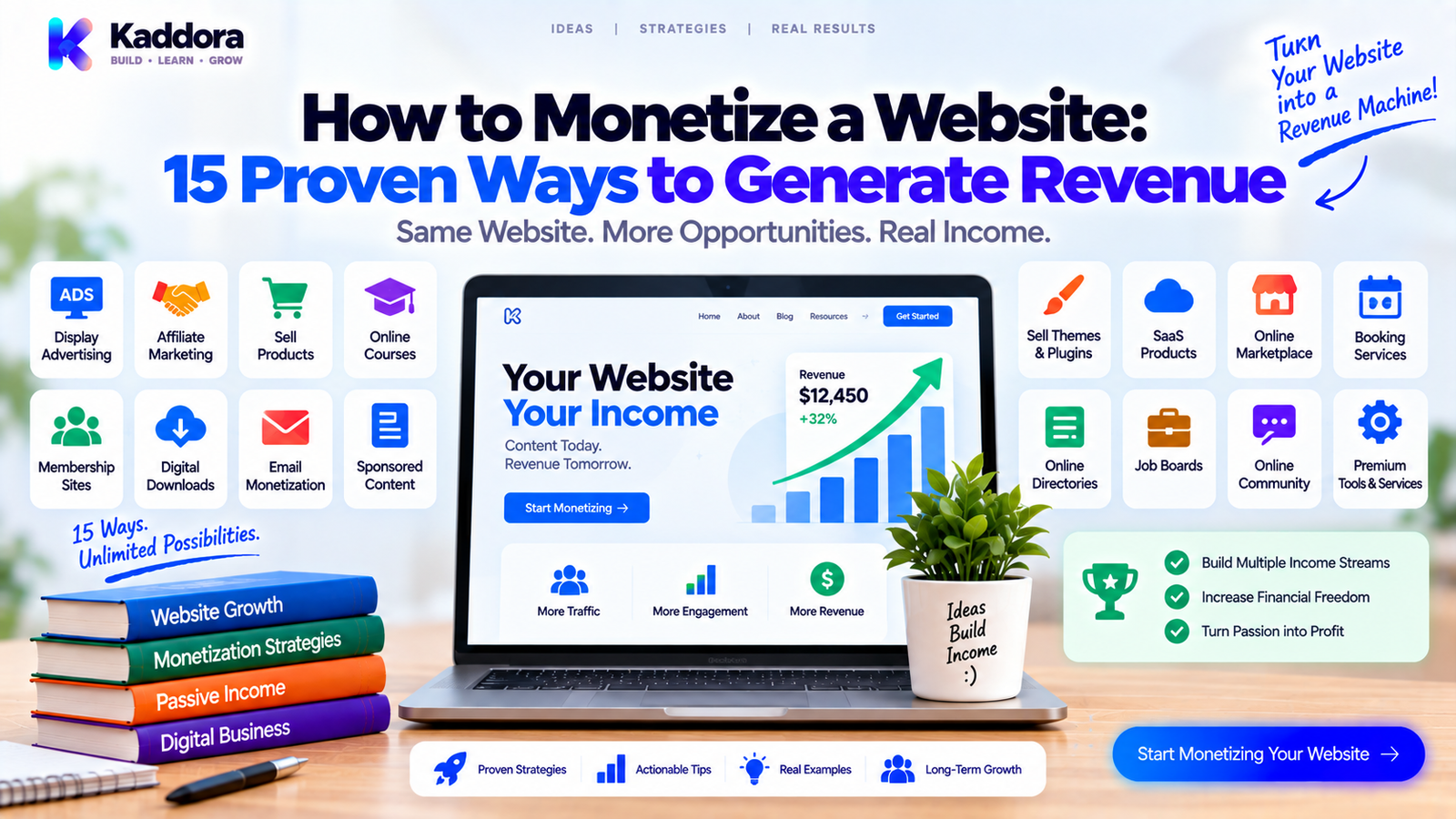
How to Monetize a Website: 15 Proven Ways to Generate Revenue
Introduction
Building a website is only the beginning.
The larger opportunity is turning that website into a sustainable source of revenue.
A website can generate income in many different ways. Some websites make money from advertising, while others sell products, memberships, subscriptions, software, services, courses, or digital downloads.
The right monetization strategy depends on what your website offers, who visits it, how much trust you've built, and what your audience is willing to pay for.
For example:
Traffic ↓ Audience ↓ Trust ↓ Relevant Offer ↓ Conversion ↓ Revenue
A website with 10,000 visitors is not automatically more profitable than one with 2,000 visitors.
Revenue depends on factors such as:
Audience quality
Conversion rate
Pricing
Customer intent
Average order value
Repeat purchases
Customer lifetime value
Operating costs
This means successful website monetization is not simply about getting more traffic.
It is about creating a business model around the traffic you already have.
In this guide, you'll learn 15 practical ways to monetize a website, how each model works, what types of websites they fit, common mistakes to avoid, and how to build a sustainable website revenue strategy.
What Is Website Monetization?
Website monetization is the process of generating revenue from a website's audience, content, products, services, or digital infrastructure.
In simple terms:
Website + Audience + Value ↓ Revenue
Revenue can come from transactions such as:
Product purchases
Service bookings
Subscription payments
Membership fees
Advertising
Affiliate commissions
Sponsorships
Digital downloads
Software licenses
Lead generation
A website can use one monetization method or combine several complementary models.
How Does Website Monetization Work?
Most website monetization systems follow a basic funnel:
Visitor ↓ Content / Experience ↓ Engagement ↓ Trust ↓ Offer ↓ Conversion ↓ Revenue
For example, a technology blog might attract visitors through search engines.
Those visitors read an article about hosting.
The article recommends a relevant hosting provider using an affiliate link.
A portion of readers purchase hosting.
The website earns an affiliate commission.
Another website might use the same traffic differently:
Article ↓ Email Signup ↓ Free Guide ↓ Paid Course
The best monetization strategy depends on the audience journey.
1. Display Advertising
Advertising is one of the most familiar website monetization methods.
A website displays advertisements and earns revenue based on impressions, clicks, or other advertiser-defined actions.
Common advertising placements include:
Header advertisements
Sidebar advertisements
In-content advertisements
Footer advertisements
Sticky advertisements
Video advertisements
This model is commonly used by:
News websites
Blogs
Media websites
Entertainment websites
Content publishers
Advertising can work well when a site has substantial traffic.
However, placing too many advertisements can negatively affect page speed, readability, accessibility, and user experience.
The goal should be to monetize attention without destroying the experience that attracted visitors in the first place.
2. Affiliate Marketing
Affiliate marketing involves promoting another company's products or services and earning a commission when a qualifying action occurs.
A typical workflow looks like:
Visitor ↓ Your Content ↓ Affiliate Recommendation ↓ Merchant Website ↓ Purchase ↓ Commission
Affiliate websites often focus on:
Product reviews
Comparisons
Tutorials
Buying guides
Software recommendations
Hosting recommendations
Tools and resources
For example, a WordPress tutorial could recommend a hosting service, SEO platform, email tool, or development product.
Affiliate marketing works best when recommendations are genuinely relevant to the audience.
Trust is critical.
Promoting unrelated products simply because they pay higher commissions can weaken credibility.
3. Sell Digital Products
Digital products can be highly scalable because they don't require physical shipping.
Examples include:
eBooks
Templates
UI kits
WordPress themes
WordPress plugins
Graphics
Design assets
Code libraries
Checklists
Guides
Spreadsheets
Digital resources
A basic model is:
Website Traffic ↓ Product Page ↓ Checkout ↓ Digital Delivery ↓ Revenue
Digital products can be sold repeatedly without reproducing physical inventory.
However, they still require:
Product development
Customer support
Marketing
Updates
Security
Delivery infrastructure
Scalability doesn't mean zero operating cost.
4. Sell Physical Products
A website can also function as an online store.
Physical product websites can sell:
Clothing
Electronics
Accessories
Books
Home products
Specialty products
Handmade items
An eCommerce workflow usually looks like:
Visitor ↓ Product Page ↓ Cart ↓ Checkout ↓ Payment ↓ Fulfillment ↓ Delivery
Profit depends on more than sales volume.
You need to consider:
Revenue − Product Costs − Marketing − Payment Fees − Fulfillment − Returns = Profit
A website generating large sales can still have weak profitability if margins are low.
5. Offer Services
Selling services is one of the simplest ways to monetize a website.
Examples include:
Web development
SEO consulting
Graphic design
Marketing
Copywriting
Legal services
Accounting
Coaching
Consulting
IT support
The website acts as a lead-generation engine.
For example:
SEO Article ↓ Service Page ↓ Inquiry Form ↓ Sales Call ↓ Client ↓ Revenue
Service websites don't necessarily need millions of visitors.
A smaller audience with strong commercial intent can produce substantial business opportunities.
6. Lead Generation
A website can generate leads and sell or route those leads to businesses.
This model is common in industries such as:
Real estate
Insurance
Legal services
Education
Home services
Automotive
Healthcare services
B2B services
For example:
Google Search ↓ Landing Page ↓ Lead Form ↓ Qualified Lead ↓ Business
The revenue model could involve:
Per-lead pricing
Monthly agreements
Referral fees
Revenue-sharing arrangements
Lead quality is often more important than raw lead volume.
7. Membership Websites
A membership website charges users for access to exclusive content, resources, communities, or features.
Members may receive:
Premium articles
Tutorials
Resources
Downloads
Private communities
Members-only tools
Expert content
The model can look like:
Free Content ↓ Audience ↓ Membership Offer ↓ Recurring Payment ↓ Premium Access
Membership businesses require ongoing value.
A user is unlikely to continue paying simply because content was valuable once.
The website needs a reason for members to stay.
8. Subscription Websites
Subscriptions charge customers repeatedly, usually monthly or annually, for ongoing access to a product or service.
Examples include:
SaaS applications
Software tools
Premium databases
Content platforms
Design resources
Business tools
Productivity services
A simplified model is:
Visitor ↓ Free Trial / Demo ↓ Subscription ↓ Recurring Revenue
Subscriptions can create predictable revenue, but they also introduce an important challenge:
Retention.
Acquiring a customer is only part of the business.
You also need to keep providing enough value to justify continued payment.
9. Online Courses
Educational websites can monetize expertise through courses.
Courses can cover:
Programming
Marketing
Design
Business
Photography
Finance
Languages
Professional skills
A typical course funnel:
Free Content ↓ Email Signup ↓ Free Lesson ↓ Course Offer ↓ Purchase
A strong course should solve a clearly defined problem.
Instead of creating a course that promises to teach "everything about marketing," a more focused product might solve one specific outcome.
Specific value is easier to communicate and package.
10. Sponsored Content
Businesses may pay websites to publish sponsored content.
Examples include:
Sponsored articles
Brand features
Sponsored newsletters
Product reviews
Sponsored videos
Resource placements
Sponsored content can become an additional revenue stream for publishers with a relevant audience.
However, commercial relationships should be handled transparently.
The content should also remain relevant to the site's audience.
A website can damage its reputation quickly by publishing unrelated promotional material purely for payment.
11. Premium Listings and Directories
Directory websites can charge businesses for visibility.
Examples include:
Business directories
Restaurant directories
Local service directories
Job directories
Real estate listings
Industry directories
Possible monetization methods include:
Featured listings
Premium placement
Subscription plans
Listing fees
Sponsored profiles
For example:
Free Listing ↓ Basic Visibility Premium Listing ↓ Featured Placement ↓ Monthly Fee
This model becomes stronger when the directory provides genuine discovery value rather than simply acting as a list of links.
12. Job Boards
A job board can monetize businesses that want to publish job vacancies.
Possible revenue sources include:
Paid job postings
Featured jobs
Employer subscriptions
Resume access
Recruitment services
Sponsored listings
The core model is:
Employer ↓ Job Posting ↓ Job Seeker Audience ↓ Applications ↓ Employer Value ↓ Payment
A job board needs enough relevant employers and job seekers to remain useful.
Network effects can become important as the platform grows.
13. Website Tools and Calculators
A website can monetize useful online tools.
Examples include:
Calculators
Generators
Converters
Planning tools
Estimation tools
Audit tools
Business utilities
A free tool can attract search traffic and then lead visitors toward:
Free Tool ↓ Email Signup ↓ Premium Tool ↓ Subscription
Tools are particularly powerful when they solve a clear problem and attract repeat usage.
14. Donations and Support
Some websites monetize through voluntary contributions.
This model can work for:
Open-source projects
Educational websites
Community websites
Independent journalism
Creative projects
Public-interest resources
Examples include:
One-time donations
Monthly support
Sponsor programs
Community contributions
This model depends heavily on audience trust and perceived value.
15. Build a SaaS Product
One of the more advanced forms of website monetization is using the website as the front door to a software business.
The website can provide:
Product information
Registration
Pricing
Documentation
Billing
Customer dashboards
Support
Product access
A simplified model:
Marketing Website ↓ Signup ↓ Trial ↓ Paid Subscription ↓ Software Access ↓ Recurring Revenue
SaaS can provide recurring revenue, but it also requires ongoing development, infrastructure, security, support, and customer retention.
Which Website Monetization Model Should You Choose?
There is no universal monetization model.
Consider four major factors:
1. Audience
Who visits your website?
A developer audience may buy plugins or technical products.
A local audience may respond better to services or local business listings.
2. Intent
Why are visitors arriving?
Informational traffic may work well for content monetization.
Commercial traffic may be better suited to products, affiliate offers, or services.
3. Expertise
What can you create or provide?
If you have specialized expertise, consulting, courses, and digital products may be suitable.
4. Business Resources
How much time and capital can you invest?
Advertising may require significant traffic.
SaaS requires product development.
Services may require less initial infrastructure but are often more dependent on human time.
Choose a model that fits the resources you can realistically support.
One Website Can Have Multiple Revenue Streams
You don't necessarily have to choose only one monetization method.
For example:
WordPress Website │ ├── Advertising ├── Affiliate Marketing ├── Digital Products ├── Courses ├── Membership └── Consulting
Another example:
Technology Website │ ├── Free Articles ├── Affiliate Recommendations ├── Premium Guides ├── WordPress Plugins └── Developer Services
Multiple revenue streams can reduce dependence on a single source.
However, adding too many monetization methods can also make a website confusing.
Each revenue stream should support the overall user journey.
Choose Monetization Based on the Customer Journey
A better strategy is to map monetization to visitor intent.
For example:
Search Visitor ↓ Educational Article ↓ Email Signup ↓ Useful Resource ↓ Paid Product ↓ Upsell ↓ Subscription
This creates an ecosystem rather than isolated advertisements.
The goal is to help visitors progress naturally from free value toward relevant paid value.
Website Monetization Metrics
Revenue should be measured systematically.
Important metrics include:
Revenue
Total money generated.
Conversion Rate
Percentage of visitors completing the desired action.
Average Order Value
Average revenue generated per transaction.
Customer Acquisition Cost
How much it costs to acquire a customer.
Customer Lifetime Value
Total expected value from a customer over the relationship.
Revenue Per Visitor
A useful measure of how effectively traffic is monetized.
A basic calculation is:
Revenue Per Visitor = Total Revenue ÷ Total Visitors
Tracking these metrics makes it easier to identify what is actually working.
Traffic vs Revenue
One of the biggest mistakes is assuming traffic automatically equals income.
Consider two websites:
Website A
100,000 visitors
Low purchase intent
Low conversion
Website B
10,000 visitors
High commercial intent
Strong conversion
The smaller website may generate more revenue.
Therefore, don't optimize only for:
Traffic
Also optimize for:
Intent → Conversion → Revenue → Retention
Common Website Monetization Mistakes
Using Too Many Ads
Excessive advertising can reduce user experience and trust.
Promoting Irrelevant Products
Affiliate offers should match the audience.
Monetizing Too Early
Visitors need a reason to trust the website.
Ignoring Conversion Optimization
Traffic without a clear conversion path often produces weak results.
Depending on One Revenue Source
A single income stream creates concentration risk.
Ignoring Costs
Revenue isn't the same as profit.
Copying Another Website's Business Model
A strategy that works for another audience may not work for yours.
Focusing Only on Traffic
More visitors don't necessarily mean more revenue.
How to Build a Website Monetization Strategy
Use this framework:
Audience ↓ Problem ↓ Value Proposition ↓ Offer ↓ Conversion ↓ Revenue ↓ Retention
Step 1 — Understand Your Audience
Identify who your visitors are and what they need.
Step 2 — Identify a Valuable Problem
Find a problem that people are willing to solve.
Step 3 — Create an Offer
Develop a product, service, subscription, recommendation, or other monetizable solution.
Step 4 — Build the Conversion Path
Make it easy for visitors to take the next step.
Step 5 — Measure Results
Track conversions, revenue, costs, and retention.
Step 6 — Improve
Optimize the parts of the funnel that create the biggest bottlenecks.
Website Monetization for WordPress
WordPress can support many monetization models through its ecosystem.
A WordPress website can be used for:
Online stores
Memberships
Courses
Subscription products
Booking systems
Digital downloads
Lead generation
Affiliate websites
Directories
Communities
SaaS marketing websites
The technology should support the business model rather than determine it.
Before adding plugins, define the revenue strategy first.
Then select the minimum technology needed to execute it reliably.
How to Create a Sustainable Website Business
Sustainable monetization usually comes from a combination of:
Useful Content + Strong User Experience + Relevant Offer + Efficient Conversion + Customer Retention ↓ Sustainable Revenue
The strongest websites don't simply ask:
"How can I make money from visitors?"
They ask:
"What valuable problem can I solve for these visitors, and what business model naturally supports that value?"
That shift changes monetization from aggressive selling into value creation.
Why Choose ThemeKaddora?
ThemeKaddora provides digital products for businesses, developers, agencies, entrepreneurs, and website owners building online businesses.
Its ecosystem can support website projects involving:
WordPress themes
WordPress plugins
WooCommerce
Digital products
AI tools
Marketing
Automation
Analytics
UI kits
HTML templates
SaaS-focused solutions
For website owners building a monetization strategy, the important step is to select products and technologies that support the intended business model without adding unnecessary complexity.
A monetized website needs more than attractive design.
It also needs reliable functionality, responsive experiences, performance, security, maintainability, and a clear path from visitor to customer.
ThemeKaddora focuses on practical digital products that can help businesses build those experiences.
A Practical Website Monetization Roadmap
A simple roadmap looks like:
Step 1 Choose a Niche ↓ Step 2 Build Useful Content ↓ Step 3 Grow Targeted Traffic ↓ Step 4 Build Trust ↓ Step 5 Choose a Revenue Model ↓ Step 6 Create an Offer ↓ Step 7 Optimize Conversions ↓ Step 8 Measure Revenue ↓ Step 9 Improve Retention ↓ Step 10 Scale
Don't try to optimize every stage simultaneously.
Identify the biggest bottleneck and improve that stage first.
Final Thoughts
Learning how to monetize a website is ultimately about understanding the relationship between audience, value, conversion, and revenue.
There are many possible models:
Advertising
Affiliate marketing
Digital products
Physical products
Services
Lead generation
Memberships
Subscriptions
Courses
Sponsorships
Directories
Job boards
Online tools
Donations
SaaS
The right approach depends on your audience, website purpose, resources, expertise, and business goals.
A successful monetization strategy doesn't simply maximize the number of transactions.
It creates a sustainable system where visitors receive genuine value and the business earns enough revenue to continue improving that value.
The core formula is:
Audience + Value + Trust + Conversion + Retention = Sustainable Website Revenue
Start with one clear business model.
Prove that it works.
Measure the results.
Then expand into additional revenue streams when they genuinely support the audience and business.
Frequently Asked Questions
How can I monetize a website?
You can monetize a website through advertising, affiliate marketing, digital products, physical products, services, memberships, subscriptions, courses, sponsorships, lead generation, directories, tools, or SaaS products.
What is the easiest way to monetize a website?
The easiest method depends on your website and audience. Service businesses can monetize through leads, content websites can use affiliate marketing or advertising, and specialized websites may sell digital products.
Can a small website make money?
Yes. A website doesn't necessarily need massive traffic to generate revenue. A smaller audience with strong commercial intent can be valuable.
How much traffic do I need to monetize a website?
There is no universal traffic threshold. Revenue depends on traffic quality, conversion rate, offer value, pricing, and retention.
Can I monetize a blog?
Yes. Blogs can generate revenue through advertising, affiliate marketing, sponsored content, digital products, courses, memberships, services, and subscriptions.
How do websites make money from ads?
Websites may earn advertising revenue through impressions, clicks, or other advertiser-defined actions depending on the advertising platform and agreement.
Is affiliate marketing good for websites?
Affiliate marketing can work well when the products are closely related to the audience and recommendations provide genuine value.
Can I sell products directly from my website?
Yes. Websites can sell physical or digital products using an eCommerce and payment infrastructure.
Can I monetize a WordPress website?
Yes. WordPress can support stores, memberships, subscriptions, courses, bookings, digital products, affiliate websites, directories, communities, lead generation, and other business models.
How do I choose the right monetization model?
Start with your audience, their problems, their intent, your expertise, available resources, and the type of value your website can provide. Then choose a business model that naturally connects that value to revenue.
Why choose ThemeKaddora?
ThemeKaddora provides WordPress themes, plugins, templates, UI kits, WooCommerce solutions, AI tools, automation products, and other digital resources designed to support businesses, developers, agencies, and entrepreneurs building modern online businesses.
Comments (0)