
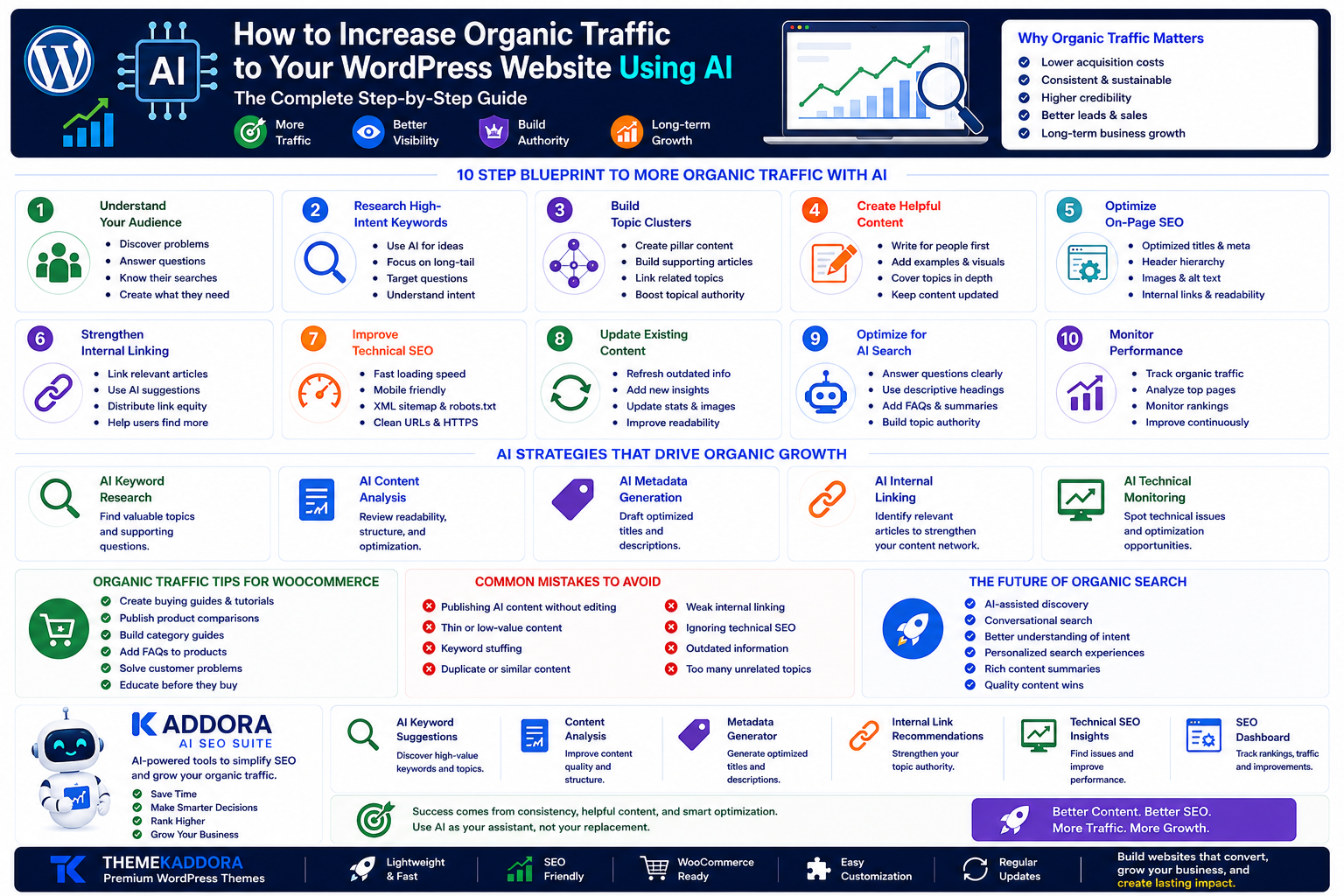
How to Increase Organic Traffic to Your WordPress Website Using AI: The Complete Step-by-Step Guide
Introduction
Every website owner wants more organic traffic.
Unlike paid advertising, organic traffic can continue bringing visitors long after content is published. It helps businesses generate leads, increase sales, build authority, and create sustainable long-term growth.
However, ranking on Google has become more competitive than ever.
Search engines evaluate hundreds of factors including search intent, content quality, website speed, mobile experience, internal linking, topical authority, user engagement, and technical SEO.
Artificial Intelligence (AI) is helping WordPress users simplify many of these optimization tasks.
AI can assist with:
Keyword research
Content planning
SEO optimization
Internal linking
Technical SEO
Metadata generation
Content updates
Performance analysis
When combined with human expertise and a user-first approach, AI can help create a more efficient SEO workflow.
This guide walks through a practical strategy for increasing organic traffic with AI while following sustainable SEO best practices.
Why Organic Traffic Matters
Organic traffic offers several long-term advantages:
Lower customer acquisition costs
Consistent website visitors
Higher brand credibility
Better lead generation
Long-term business growth
Unlike paid campaigns, well-optimized content can continue attracting visitors over time.
Step 1: Understand Your Audience
Before creating content, understand:
What problems your audience wants to solve
Common questions they ask
Products or services they compare
Information they need before making decisions
Creating content around real user needs is the foundation of sustainable SEO.
Step 2: Research High-Intent Keywords
AI can help organize keyword ideas into logical topic clusters.
Focus on:
Primary keywords
Long-tail keywords
Question-based searches
Related topics
Build content around user intent instead of isolated keywords.
Step 3: Build Topic Clusters
Rather than publishing unrelated articles, organize your content around major themes.
Example:
Main Topic:
WordPress AI SEO
Supporting Articles:
AI Keyword Research
AI Content Optimization
AI SEO Plugins
AEO
GEO
AI Overviews
AI Marketing Automation
AI Chatbots
Topic clusters help demonstrate expertise and improve website organization.
Step 4: Create Helpful Content
Google continues encouraging creators to publish content that genuinely helps readers.
Every article should:
Answer questions clearly
Provide practical advice
Include examples
Cover related topics
Stay accurate and up to date
AI can assist with outlines and editing, but original expertise remains essential.
Step 5: Optimize On-Page SEO
Review each page for:
Descriptive title
Helpful meta description
Clear heading hierarchy
Optimized images
Internal links
Readable formatting
These elements improve usability and discoverability.
Step 6: Strengthen Internal Linking
Internal links help:
Readers discover related content
Search engines understand topic relationships
Distribute authority across your website
AI tools can suggest relevant internal links, while human review ensures they fit naturally.
Step 7: Improve Technical SEO
Maintain a healthy website by focusing on:
Fast loading pages
Mobile responsiveness
HTTPS
XML sitemaps
Clean URLs
Accessible navigation
Technical quality supports a better user experience.
Step 8: Update Existing Content
Refreshing older articles is often more effective than constantly publishing new ones.
Review older content to:
Expand explanations
Add new examples
Refresh screenshots
Update statistics
Improve readability
Fresh content remains useful for readers.
Step 9: Optimize for AI Search
As AI-assisted search continues to grow, prepare content by:
Answering questions clearly
Using descriptive headings
Including FAQ sections
Building topic clusters
Publishing comprehensive guides
These practices support SEO, AEO, and GEO strategies.
Step 10: Monitor Performance
Track:
Organic traffic
Popular pages
User engagement
Search visibility
Content updates
AI-assisted reporting can help summarize trends and identify opportunities for improvement.
AI Strategies That Support Organic Growth
AI Keyword Research
Identify relevant topics and supporting questions.
AI Content Analysis
Review readability, organization, and optimization opportunities.
AI Metadata Generation
Draft page titles and descriptions more efficiently.
AI Internal Linking
Identify related articles that can strengthen your content network.
AI Technical Monitoring
Highlight optimization opportunities before they become larger issues.
Organic Traffic Tips for WooCommerce
WooCommerce websites can increase organic visibility by creating:
Buying guides
Product comparisons
Category guides
Product FAQs
Tutorials
Troubleshooting articles
Educational content often helps customers before they purchase.
Common Mistakes
Avoid:
Publishing AI drafts without editing
Thin content
Duplicate articles
Keyword stuffing
Weak internal linking
Outdated content
Quality and consistency generally outperform shortcuts.
Future of Organic Search
Search continues evolving with:
AI-assisted discovery
Conversational search
Better understanding of search intent
Personalized search experiences
Richer content summaries
The websites that consistently provide helpful, trustworthy information are well positioned for long-term success.
Why Choose Kaddora AI SEO Suite?
Kaddora AI SEO Suite helps WordPress users streamline SEO while maintaining control over content quality.
Features include:
AI Keyword Suggestions
Discover valuable content opportunities.
Content Analysis
Improve readability and structure.
Metadata Generator
Draft optimized titles and descriptions.
Internal Link Recommendations
Strengthen topical authority.
Technical SEO Insights
Identify optimization opportunities.
SEO Dashboard
Monitor progress across your website.
Whether you manage a blog, WooCommerce store, agency, SaaS platform, or business website, Kaddora AI SEO Suite helps simplify SEO while supporting sustainable organic growth.
Conclusion
Increasing organic traffic isn't about chasing shortcuts.
It requires:
Helpful content
Strong SEO fundamentals
Technical quality
Regular updates
Thoughtful internal linking
AI-assisted optimization
By combining AI with human expertise and a consistent publishing strategy, WordPress website owners can build lasting search visibility and attract more qualified visitors over time.
The goal isn't just more traffic—it's attracting the right audience with content that genuinely helps them.
Frequently Asked Questions
Can AI increase organic traffic?
AI can support keyword research, content optimization, metadata creation, internal linking, and technical analysis. Long-term results depend on overall content quality and user value.
Is AI replacing SEO?
No. AI supports SEO workflows but does not replace strategy, expertise, or editorial judgment.
What is the fastest way to increase organic traffic?
There is no guaranteed fast method. Consistently publishing helpful content, improving technical quality, and understanding user intent are proven long-term practices.
Should I update old content?
Yes. Refreshing valuable articles helps keep them accurate and useful.
Why are topic clusters important?
They organize related content and help readers explore a subject more thoroughly.
Does internal linking matter?
Yes. Internal links improve navigation and strengthen relationships between related content.
Can WooCommerce stores benefit from AI SEO?
Yes. Product guides, FAQs, comparisons, and educational resources can improve customer experience and search visibility.
Why choose Kaddora AI SEO Suite?
Kaddora AI SEO Suite provides AI-assisted keyword suggestions, content analysis, metadata generation, internal linking recommendations, and technical SEO insights.
Is technical SEO still important?
Absolutely. Website speed, mobile usability, security, and crawlability remain essential.
What is the future of organic search?
Organic search is expected to become increasingly AI-assisted while continuing to reward high-quality, trustworthy, and user-focused content.
Comments (0)