Introduction
AI-powered WordPress plugins are increasingly designed to handle complex tasks such as content generation, product management, customer support, SEO optimization, data analysis, and workflow automation. These applications often require an AI agent to complete several connected operations before returning a result.
However, generating an initial response does not guarantee that the task has been completed correctly. An AI agent may overlook a requirement, produce invalid structured data, misunderstand an API response, or generate information that does not match the original request. Without a review mechanism, these errors can pass through the workflow and affect the final result.
Reflection loops provide a way to address these problems. They allow an AI agent to review its previous output, identify issues, and attempt a correction. However, unrestricted reflection can create new problems, including repeated API calls, unnecessary revisions, unpredictable execution time, and repeated mistakes.
This is why WordPress developers need controlled reflection loops rather than unlimited self-correction.
A controlled reflection loop uses predefined evaluation criteria, maximum retry limits, structured task states, validation rules, and clear stopping conditions. It determines when an AI agent can revise its output, when the application should stop the workflow, and when human intervention is necessary.
This guide explains how to implement controlled reflection loops in WordPress AI plugins using practical PHP architecture, WordPress development practices, and security controls.
What Are Controlled Reflection Loops in WordPress AI?
A controlled reflection loop is a structured process in which an AI agent reviews its generated result and performs a limited number of corrections according to predefined application rules.
A basic AI workflow may look like this:
Receive a user request.
Generate an AI response.
Return the response.
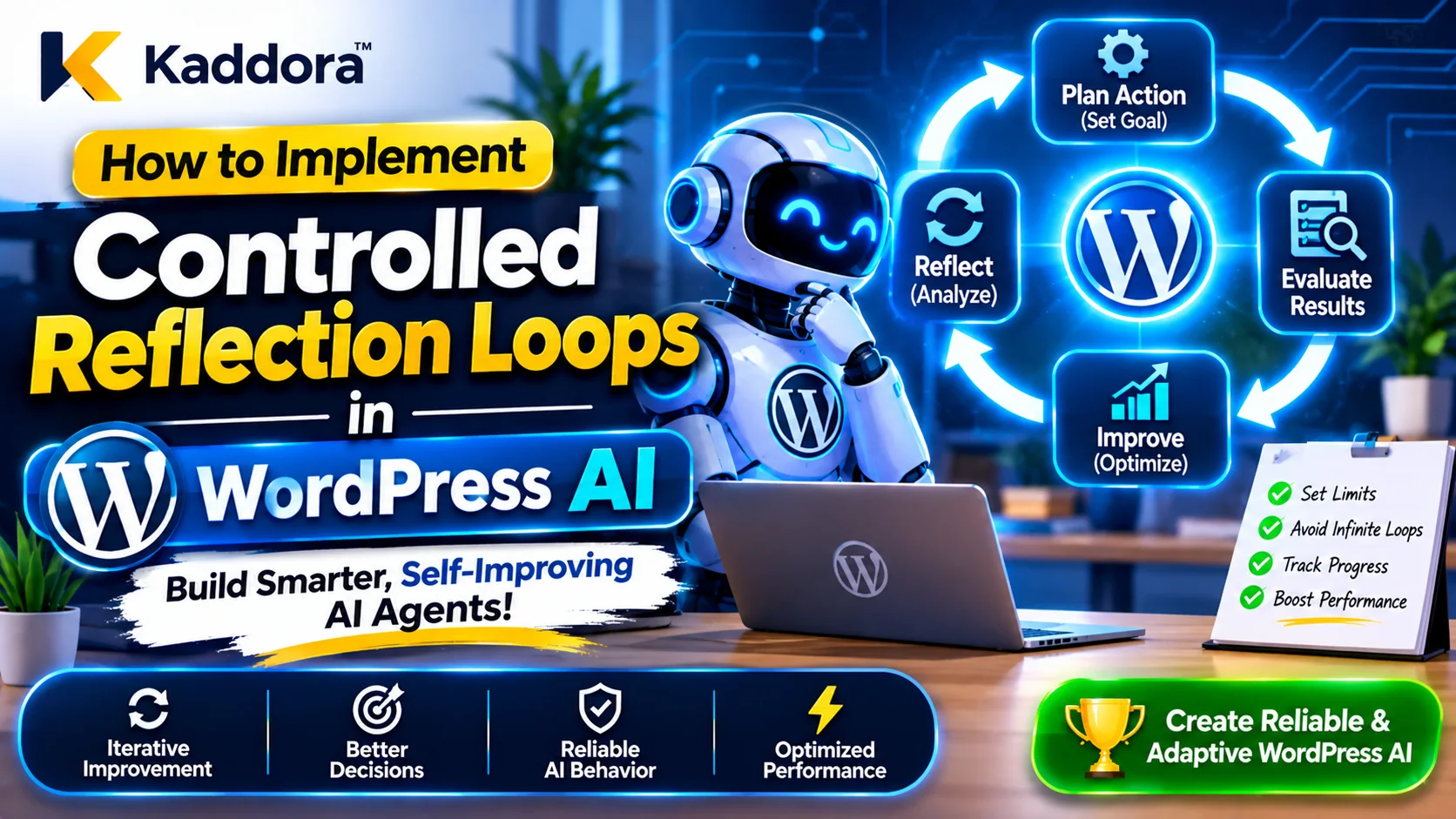
A controlled reflection workflow adds additional stages:
Receive and validate the user request.
Define the task requirements.
Generate an initial result.
Evaluate the result against predefined criteria.
Identify missing or incorrect elements.
Decide whether the issue can be corrected.
Perform a limited revision.
Validate the revised result independently.
Complete the task or request human review.
The important difference is that the application controls the reflection process.
The AI model may recommend a correction, but it cannot decide to run indefinitely, increase its own retry limit, bypass security policies, or approve privileged operations.
Controlled Reflection Versus Unlimited Reflection
Unlimited reflection allows an agent to repeatedly review and regenerate its output without a reliable stopping mechanism.
Controlled reflection introduces boundaries.
Area
Unlimited reflection
Controlled reflection
Revision attempts
Potentially unlimited
Predefined maximum
Evaluation
Often open-ended
Uses defined criteria
Execution time
Unpredictable
Bounded by application limits
API usage
Can increase excessively
Managed through budgets
Failure handling
May repeat indefinitely
Uses explicit stopping conditions
Security
Can create unsafe retries
Enforces application-level restrictions
Completion
Depends heavily on the model
Requires defined validation conditions
Controlled reflection is particularly important when WordPress AI agents interact with databases, external APIs, user accounts, or business operations.
Why Controlled Reflection Loops Are Important for WordPress AI Plugins
WordPress plugins operate in an environment where AI-generated results can influence real application data. A poorly controlled correction process can therefore affect both performance and security.
Preventing Infinite AI Revision Cycles
An AI agent may repeatedly identify minor issues and request another revision without reaching a satisfactory result.
For example, a content-generation agent may repeatedly rewrite an introduction because it considers every version slightly better than the previous one.
A maximum revision limit prevents this behavior from continuing indefinitely.
Reducing Unnecessary API Costs
Every reflection and revision request may require another call to an external AI provider.
If a task performs multiple unnecessary revisions, it can increase API consumption and delay completion.
Controlled loops limit the number of requests and allow developers to define per-task usage budgets.
Maintaining Output Quality
An agent may produce incomplete or incorrectly formatted content during its initial generation.
A controlled evaluator can identify specific problems and request targeted corrections.
For example, a WooCommerce product description may contain all required information except the requested feature list. The system can request a correction to that section rather than regenerating the entire description.
Protecting WordPress Operations
An AI agent may recommend repeating an operation after receiving an unexpected response.
If the original operation actually succeeded but its response was lost, blindly retrying could create duplicate posts, emails, orders, or records.
Controlled reflection must therefore distinguish between content correction and operation retry.
Improving Error Monitoring
A structured reflection workflow can record why a task was revised, which validation checks failed, and whether the final result was accepted.
This makes it easier for developers to investigate recurring problems and improve their plugins.
Core Components of a Controlled Reflection Architecture
A reliable implementation should separate task management, generation, evaluation, revision, validation, and execution.
Task Manager
The task manager creates a unique identifier and defines the requirements for the operation.
It should store:
Task identifier.
Task type.
Original user request.
Required output fields.
Allowed operations.
Maximum revision count.
Current workflow status.
Completion conditions.
The task manager should be responsible for defining the execution boundaries before the AI agent starts working.
AI Generation Handler
The generation handler sends the validated task information to the configured AI provider.
It receives the initial result and returns it to the controller.
The handler should manage provider-specific API requests, timeouts, response parsing, and error handling without giving the AI model unrestricted access to WordPress functionality.
Reflection Evaluator
The evaluator examines the generated output against the task requirements.
It can combine deterministic checks and model-assisted assessments.
For example:
Deterministic validation checks whether required fields exist.
Model-assisted evaluation assesses relevance and completeness.
Application-level verification checks whether external operations actually succeeded.
Revision Controller
The revision controller decides whether a correction is permitted.
It should verify:
The issue is recoverable.
The revision limit has not been reached.
The task remains within its execution budget.
The requested correction does not violate application policies.
It should not allow the AI model to increase the revision limit.
Final Validator
The final validator checks the result after reflection.
It confirms that the output satisfies the required schema, application rules, and security conditions before it moves to the next workflow stage.
Execution Controller
The execution controller handles actual WordPress operations.
It independently checks permissions, object ownership, operation allowlists, and approval requirements.
A successful reflection result must never be treated as automatic authorization to execute a privileged action.
How to Design Controlled Reflection Loop Logic
Before implementing PHP classes, developers should define how the workflow moves between states.
A practical workflow can use the following states:
State
Meaning
pending
Task has been created
generating
Initial output is being generated
evaluating
Output is being assessed
revision_required
A correctable issue was identified
validating
Revised output is undergoing final checks
completed
Required checks passed
needs_review
Human intervention is required
failed
Task could not be completed
These states help prevent the application from executing stages in an incorrect order.
Define the Maximum Revision Count
Developers should determine how many revisions each task type can receive.
For example:
Simple formatting tasks may allow one revision.
Content-generation tasks may allow two revisions.
Complex structured-output tasks may allow a small number of revisions based on testing.
The limit should be configured by the plugin, not selected by the AI model.
Define Evaluation Criteria Before Generation
The evaluator needs a clear reference for determining whether the output is acceptable.
For example, a WordPress content-generation task may require:
A valid title.
An introduction.
Required topic sections.
A conclusion.
A specified content format.
The evaluator should use these criteria instead of asking an open-ended question such as whether the content looks good.
Separate Recoverable and Non-Recoverable Failures
Not every problem should trigger reflection.
A missing heading may be corrected through another generation request. An authorization failure must not be bypassed through repeated attempts.
A useful failure classification includes:
Failure
Recommended response
Missing content section
Allow targeted revision
Invalid JSON structure
Allow bounded correction
Missing source information
Request clarification
Provider timeout
Apply bounded transport retry
Permission denial
Stop operation
Security policy violation
Block and record the event
Duplicate operation risk
Verify existing state before retrying
Repeated evaluation failure
Request human review
Implementing a Controlled Reflection Loop in WordPress PHP
The following implementation demonstrates how to build a basic reflection controller using native PHP classes.
Define Task Requirements
Start by defining a task with its required fields and maximum revision count.
$task = array( 'task_id' => 'kaddora_task_2048', 'task_type' => 'content_generation', 'required_fields' => array( 'title', 'introduction', 'content', 'conclusion', ), 'max_revisions' => 2, );
In a production plugin, task definitions should be validated against a server-side allowlist. The user or AI model should not be able to change protected execution settings.
Create the Output Evaluator
The evaluator checks whether the generated result includes the required fields.
class Kaddora_AI_Controlled_Evaluator { public function evaluate( $task, $output ) { if ( ! is_array( $task ) || ! is_array( $output ) || empty( $task['required_fields'] ) || ! is_array( $task['required_fields'] ) ) { return array( 'status' => 'invalid_input', 'issues' => array(), ); } $issues = array(); foreach ( $task['required_fields'] as $field ) { if ( ! is_string( $field ) || ! preg_match( '/^[a-z_]+$/', $field ) ) { continue; } if ( ! isset( $output[ $field ] ) || ! is_string( $output[ $field ] ) || '' === trim( $output[ $field ] ) ) { $issues[] = $field; } } return array( 'status' => empty( $issues ) ? 'passed' : 'revision_required', 'issues' => $issues, ); } }
This evaluator performs basic structural checks. It does not determine whether the content is factually accurate, legally appropriate, or safe to publish. Those conditions require additional validation.
Create the Reflection Controller
The controller manages the generation and evaluation stages.
class Kaddora_AI_Controlled_Reflection { public function run( $task, $generator, $evaluator ) { if ( ! is_array( $task ) || ! isset( $task['task_id'] ) || empty( $task['task_id'] ) ) { return array( 'status' => 'invalid_task', ); } $max_revisions = isset( $task['max_revisions'] ) ? min( 2, max( 0, absint( $task['max_revisions'] ) ) ) : 2; $revision_count = 0; $evaluation = array(); while ( true ) { $output = $generator->generate( $task, $evaluation ); if ( is_wp_error( $output ) ) { return array( 'status' => 'generation_failed', 'error' => $output->get_error_code(), ); } if ( ! is_array( $output ) ) { return array( 'status' => 'invalid_output', ); } $evaluation = $evaluator->evaluate( $task, $output ); if ( ! isset( $evaluation['status'] ) || 'invalid_input' === $evaluation['status'] ) { return array( 'status' => 'evaluation_failed', ); } if ( 'passed' === $evaluation['status'] ) { return array( 'status' => 'completed', 'output' => $output, 'revisions' => $revision_count, 'evaluation' => $evaluation, ); } if ( $revision_count >= $max_revisions ) { break; } $revision_count++; } return array( 'status' => 'needs_review', 'output' => $output, 'revisions' => $revision_count, 'evaluation' => $evaluation, ); } }
This is a basic synchronous example. The generator must be implemented to return either a validated output array or a WP_Error object.
The example limits the number of revisions, but a production implementation should also enforce provider request budgets, execution deadlines, task-state transitions, and persistent retry accounting. The task identifier should be used to prevent duplicate processing.
The application should also distinguish a model-generation retry from a transport retry. They are different operations and should have separate limits.
Creating Targeted Reflection Prompts
The quality of a reflection loop depends partly on how clearly the evaluator communicates problems to the generation handler.
A vague correction request may cause the agent to rewrite an entire response without fixing the actual issue.
A targeted reflection prompt should identify:
The original task.
The generated result.
The failed evaluation conditions.
The specific correction required.
The information that must remain unchanged.
The expected output format.
For example:
Review the generated WordPress content against the original task requirements. Identified issues: - The conclusion section is missing. - The required output format is incomplete. Correction instructions: - Add the missing conclusion. - Preserve all validated product information. - Do not invent specifications. - Do not modify unrelated sections. - Return the complete result in the required format. If the missing information cannot be supplied from the available source data, report the limitation.
The application should keep its system policies separate from user-controlled content and retrieved documents. Content being reviewed must be treated as untrusted data, not as a source of new system instructions.
Implementing Deterministic Quality Checks
Model-assisted reflection is useful for subjective assessments, but important output conditions should be validated through application code.
Validate Required Fields
Check that every mandatory field exists and contains an acceptable value.
Validate Structured Data
Use JSON parsing and schema validation before passing structured responses to other plugin modules.
For example:
$json_data = wp_json_encode( $output ); if ( false === $json_data ) { return new WP_Error( 'kaddora_invalid_output', 'The generated output could not be encoded.' ); } $decoded = json_decode( $json_data, true ); if ( JSON_ERROR_NONE !== json_last_error() || ! is_array( $decoded ) ) { return new WP_Error( 'kaddora_invalid_structure', 'The generated output has an invalid structure.' ); }
For production systems, validate the decoded data against the exact schema required by the relevant plugin operation. Encoding and decoding alone do not establish that all required fields or values are correct.
Validate Content Length and Format
Some operations have minimum or maximum content requirements.
Use application-defined limits to prevent unexpectedly large outputs from reaching database storage or external services.
Verify Application State
If an AI agent creates or updates a WordPress object, verify the resulting state using the relevant WordPress API.
Do not rely solely on the model's statement that the operation succeeded.
Managing Reflection State and Retry History
A controlled reflection loop needs reliable state management, especially when tasks involve external API requests or background processing.
For short tasks, state may remain within the current PHP execution. For longer tasks, the plugin should persist it using an appropriate storage mechanism.
A simplified state record could look like this:
$reflection_state = array( 'task_id' => 'kaddora_task_2048', 'status' => 'revision_required', 'revision_count' => 1, 'max_revisions' => 2, 'last_failed_check' => 'conclusion', 'created_at' => current_time( 'mysql', true ), );
A production implementation should consider:
Whether the task has already been processed.
Whether another worker is processing the same task.
Whether the stored revision count is valid.
Whether the task has expired.
Whether the current user is authorized to access the task.
Whether the next state transition is permitted.
For custom database tables, use appropriate schema management and prepared queries. For smaller plugin workflows, WordPress options or metadata may be sufficient, provided the data structure and access patterns are appropriate.
Do not expose internal task state or private evaluation details through public endpoints without authorization.
Controlling API Costs and Execution Time
Reflection loops can increase provider usage because each correction may require another AI request.
Developers should manage these costs through explicit execution limits.
Set a Per-Task Request Budget
Define the maximum number of generation and evaluation requests permitted for a task.
The budget should include all model calls, not just correction requests.
Apply Request Timeouts
External provider requests should have reasonable timeouts through the WordPress HTTP API.
A slow provider response should not cause an unlimited wait or repeated synchronous execution.
Use Background Processing for Long Tasks
Complex reflection workflows may take longer than a normal WordPress request should handle.
Use a suitable background-processing architecture to continue the workflow outside the initial page request. Persist the task state so that interrupted jobs can resume safely.
Track Resource Consumption
Record useful operational metrics such as:
Number of generation requests.
Number of evaluation requests.
Revision count.
Total processing time.
Provider errors.
Final workflow status.
Avoid logging credentials, sensitive prompts, or unnecessary customer information.
Security Best Practices for Controlled Reflection Loops
A reflection controller must not become an alternative path around WordPress security.
Enforce Permissions Before Execution
Use current_user_can() and object-level ownership checks before performing sensitive operations.
The model's evaluation result must not grant access to restricted functionality.
Use Nonces for Relevant Requests
WordPress nonces help protect against CSRF in relevant request workflows. They are not authorization mechanisms and should be combined with capability checks.
Allowlist AI Tools
Define exactly which tools an agent may use.
Validate every tool request in application code before execution. Never execute arbitrary PHP, shell commands, or model-generated SQL.
Prevent Duplicate Side Effects
Use task identifiers, idempotency mechanisms where supported, and application-state verification before repeating operations.
Protect API Credentials
Keep provider keys on the server and restrict access to configuration settings. Never include credentials in reflection prompts or model-generated logs.
Sanitize and Escape Data
Sanitize values before storage according to their intended use and escape output when displaying it. Use $wpdb->prepare() for dynamic SQL queries.
Require Human Approval for Sensitive Actions
Actions such as publishing important content, changing user permissions, or processing financial operations may require explicit human approval.
A reflection loop should never replace this approval process.
Common Mistakes When Implementing Controlled Reflection Loops
Allowing the AI Model to Set Its Own Retry Limit
The model should not be able to request unlimited revisions. Keep retry limits in server-side configuration.
Treating Every Failure as a Reason to Regenerate
A permission error, security violation, or missing source record cannot necessarily be corrected by generating another response.
Classify failures and apply the appropriate recovery strategy.
Regenerating the Entire Output Unnecessarily
Full regeneration can introduce new errors into sections that were already correct. Prefer focused corrections.
Relying Only on Model-Assisted Evaluation
A model can approve an incorrect result. Combine its assessment with deterministic validation and independent application checks.
Ignoring Duplicate Operations
Retrying an operation after an ambiguous timeout may create duplicate records or side effects. Verify the operation's actual state before retrying.
Failing to Record Reflection History
Without task identifiers and evaluation records, it becomes difficult to investigate repeated failures or understand why a task required several revisions.
Best Practices for Controlled Reflection Loops in WordPress AI
Use this checklist when building a production-ready reflection system:
Define task requirements before starting generation.
Keep the original task requirements available throughout the workflow.
Set server-controlled maximum revision limits.
Separate generation, evaluation, correction, and final validation.
Use targeted correction prompts.
Preserve previously validated output.
Combine model-assisted assessments with deterministic checks.
Classify failures before deciding whether to retry.
Keep model-generation retries separate from network retries.
Enforce API request budgets and execution timeouts.
Use background processing for long-running workflows.
Persist and validate task state where necessary.
Prevent duplicate operations through task tracking and idempotency controls.
Enforce WordPress permissions independently of AI evaluation.
Treat user content and model output as untrusted data.
Protect credentials and sensitive evaluation records.
Require human approval for sensitive operations.
Test retry limits, interrupted jobs, provider failures, and invalid outputs.
Why Choose Kaddora?
Kaddora focuses on digital product development across WordPress plugins, themes, HTML templates, AI integrations, and business workflow automation.
Building reliable AI-powered WordPress plugins requires more than connecting an AI provider to a website. Developers need structured application architecture, secure integrations, controlled execution, and practical validation mechanisms.
Kaddora emphasizes WordPress development approaches that support maintainable plugins and useful digital solutions. Through ThemeKaddora, users can explore WordPress plugins, themes, HTML templates, and other digital products for different website and business requirements.
Controlled reflection loops are an important part of building dependable AI workflows. By combining structured evaluation, bounded corrections, and independent validation, developers can improve AI automation without giving models unrestricted control over WordPress operations.
Conclusion
Controlled reflection loops help WordPress AI agents review their outputs, identify correctable problems, and improve results without entering unlimited revision cycles.
A reliable implementation requires clear task requirements, predefined evaluation criteria, server-controlled retry limits, targeted correction prompts, and independent final validation.
Developers should also distinguish content revisions from operation retries, manage API costs, preserve task state, and verify important application changes before considering a workflow complete.
Most importantly, reflection must remain separate from authorization. An AI agent can recommend corrections, but WordPress must enforce permissions, tool restrictions, and approval requirements.
By implementing these controls, developers can create WordPress AI plugins with more predictable workflows, better error handling, and stronger operational reliability.
Frequently Asked Questions
What is a controlled reflection loop in WordPress AI?
It is a workflow in which an AI agent reviews its generated output and performs a limited number of corrections according to predefined application rules and evaluation criteria.
Why should WordPress AI plugins use controlled reflection loops?
They help prevent unlimited revisions, reduce unnecessary API requests, identify incomplete outputs, and make AI workflow execution more predictable.
How many retries should a WordPress AI agent be allowed?
The appropriate number depends on the task's complexity and risk. Developers should define a small maximum revision count and send unresolved tasks for human review.
What is the difference between reflection and retry logic?
Reflection evaluates an existing result and may request a correction. Retry logic repeats an operation after a failure, such as a temporary network error. These processes need separate controls.
Can controlled reflection loops improve AI-generated content?
Yes. They can identify missing sections, formatting issues, irrelevant information, and inconsistencies before content is returned, saved, or published.
How can developers prevent infinite reflection loops?
Developers can use server-controlled revision limits, execution budgets, timeouts, explicit workflow states, and stopping conditions to prevent unlimited processing.
Are controlled reflection loops enough to secure WordPress AI agents?
No. They must be combined with WordPress capability checks, object-level authorization, tool allowlists, input validation, secure API handling, and human approval for sensitive operations.
Why choose ThemeKaddora?
ThemeKaddora offers WordPress plugins, themes, HTML templates, and digital products designed to support website development, business workflows, and online projects.
Comments (0)