
Introduction
AI-powered WordPress plugins are becoming increasingly capable of interpreting user requests, analyzing website information, generating recommendations, and performing automated operations. From content optimization and WooCommerce product management to customer support and business automation, AI is helping WordPress websites handle tasks that previously required manual work.
However, AI-generated decisions are not always correct.
An AI plugin may receive incomplete information, misunderstand a user's request, retrieve outdated content, or generate a recommendation that is not supported by reliable evidence. It may also encounter unexpected API responses or fail to determine whether a requested operation is appropriate.
For example, consider a WordPress AI plugin that recommends deleting outdated website articles. The AI may identify several posts as outdated based on their publication dates. However, some of those posts may still attract valuable traffic, contain important references, or support internal linking.
If the plugin automatically deletes those articles, an uncertain recommendation can become a serious website problem.
A reliable AI plugin should recognize when a decision is uncertain and respond appropriately. It may request additional information, verify the available evidence, provide a recommendation with limitations, use a safe fallback, or require administrator approval.
Handling uncertainty is not simply about assigning confidence scores to AI responses. It requires a complete decision-management process that connects evidence evaluation, risk assessment, validation, authorization, and execution.
This article explains how to handle uncertain AI decisions in WordPress plugins using practical architecture, decision policies, confidence evaluation, human oversight, and secure implementation strategies.
What Are Uncertain AI Decisions in WordPress Plugins?
An uncertain AI decision occurs when an AI system does not have enough reliable information to confidently determine the correct answer or action.
Uncertainty can appear at different stages of an AI workflow.
For example:
A chatbot cannot clearly interpret a user's question.
An AI SEO plugin receives conflicting keyword information.
A WooCommerce assistant cannot determine which product recommendation is most relevant.
A content generator receives incomplete instructions.
An AI agent retrieves outdated information from a knowledge base.
An automation agent receives an unexpected response from a WordPress function.
A security assistant identifies suspicious activity but cannot establish whether it is malicious.
In these situations, the plugin should not automatically convert an uncertain interpretation into an executable operation.
Instead, it should evaluate the decision and determine whether it is safe to proceed.
An uncertainty-handling system should answer several important questions:
Is the available information sufficient?
Are the supporting sources reliable?
Does the AI understand the user's actual request?
Are there alternative explanations?
What could happen if the decision is incorrect?
Can the result be independently verified?
Is human approval required?
The goal is to make AI-powered WordPress functionality more predictable and responsible, even when perfect information is unavailable.
Why WordPress Plugins Need an Uncertainty-Handling System
A basic AI integration may send a prompt to an AI provider and display the returned response. However, production plugins often need to perform additional validation before presenting recommendations or executing operations.
Prevent Incorrect Automated Actions
AI-generated recommendations may be incomplete or incorrect.
A content management plugin might suggest replacing a page title, while a WooCommerce automation plugin might recommend changing a product description.
These recommendations should be evaluated before being applied to important website records.
An uncertainty-handling system helps prevent unsupported conclusions from directly modifying website data.
Improve AI Response Reliability
Users expect AI plugins to provide useful information, but they also need to understand when an answer is based on incomplete evidence.
A plugin should distinguish between verified information, reasonable interpretations, and unresolved assumptions.
This makes the system more transparent and reduces misleading responses.
Protect Important WordPress Data
Some AI decisions can affect:
Published posts and pages.
WooCommerce products.
Customer information.
User permissions.
Plugin configurations.
Business records.
Marketing campaigns.
The greater the potential impact, the more carefully the decision should be evaluated.
Reduce Unnecessary Human Intervention
Not every uncertain decision requires administrator approval.
A plugin can automatically handle low-impact operations when the available evidence is sufficient, while escalating ambiguous or high-impact decisions.
This creates a practical balance between automation and human oversight.
Improve Long-Term AI Performance
Tracking uncertain decisions helps developers identify recurring problems.
For example, if an AI assistant frequently misunderstands requests related to product categories, developers can improve prompt instructions, retrieval sources, input validation, or task-specific decision policies.
Identify the Different Types of AI Uncertainty
Before building an uncertainty-handling system, developers should identify the source of uncertainty.
Different problems require different responses.
User Input Uncertainty
User input uncertainty occurs when instructions are incomplete, ambiguous, or open to multiple interpretations.
For example, an administrator may ask an AI content assistant:
"Improve my website content."
The plugin does not know whether the user wants better readability, search visibility, shorter paragraphs, updated information, or a different writing style.
The correct response may be to ask a focused clarification question.
Data Uncertainty
Data uncertainty occurs when the information used by the AI system is incomplete, inconsistent, or outdated.
A WooCommerce analytics plugin may receive product sales information without complete traffic data.
It may identify a sales decline, but it cannot reliably determine whether the cause is reduced traffic, lower conversion rates, or changing customer demand.
The plugin should explain which information is missing before presenting a definitive conclusion.
Model Uncertainty
Model uncertainty occurs when the AI model cannot reliably determine the correct interpretation or answer.
For example, two possible recommendations may appear equally reasonable based on the available information.
Developers should not assume that a fluent or detailed response is necessarily accurate.
Retrieval Uncertainty
Retrieval uncertainty occurs when a plugin uses documents, database records, or external information that may not directly support the requested answer.
An AI assistant might retrieve an old article that discusses a feature that has since changed.
The plugin should evaluate source freshness, relevance, and authority before relying on retrieved information.
Tool Execution Uncertainty
Tool execution uncertainty occurs when an AI agent cannot determine whether an operation completed successfully.
For example, an API request may time out after the server has already processed the request.
The agent should verify the actual application state instead of assuming that the operation failed.
Environmental Uncertainty
Environmental uncertainty comes from changing conditions outside the plugin's direct control.
Examples include:
Changes in website traffic.
External API outages.
Product inventory updates.
Payment provider interruptions.
Changing search trends.
New customer behavior.
An AI plugin should avoid relying on information that may no longer represent the current environment.
Evaluate Evidence Before Accepting an AI Decision
A reliable uncertainty-handling process begins with evidence evaluation.
Instead of accepting every AI-generated conclusion, the plugin should determine whether the available information actually supports it.
Collect Relevant Evidence
The plugin should retrieve information related to the requested operation.
Depending on the task, this may include:
WordPress post and page content.
WooCommerce product records.
Plugin settings.
User-provided information.
Approved analytics data.
Knowledge-base documents.
External API responses.
Only information necessary for the task should be collected.
This reduces unnecessary data exposure and makes the reasoning process easier to evaluate.
Check Source Reliability
Not every information source has the same level of authority.
For example, an authenticated WooCommerce product record may be more reliable for the current product price than an old article containing a previous price.
Evidence evaluation can consider:
Source ownership.
Information freshness.
Relevance to the task.
Completeness.
Consistency.
Independent verification.
Source reliability should also be specific to the information being checked. A product database may be authoritative for inventory, but it may not provide reliable evidence about customer preferences.
Identify Unsupported Claims
The plugin should identify statements that are not supported by the available information.
For example, an AI SEO assistant might conclude that a page has poor search visibility without receiving any search performance data.
It may still evaluate the page's title, headings, and content structure, but it should not claim to have verified search performance.
A useful decision system separates:
Verified facts.
Evidence-supported conclusions.
Assumptions.
Missing information.
Unresolved questions.
Compare Conflicting Evidence
When multiple sources disagree, the plugin should not automatically combine them into one conclusion.
It should evaluate their authority, timestamps, relevance, and applicable context.
If the conflict remains unresolved, the plugin should communicate the limitation rather than inventing a resolution.
Use Confidence Evaluation Without Overtrusting Scores
Confidence evaluation can help a WordPress plugin determine how strongly an AI-generated recommendation is supported.
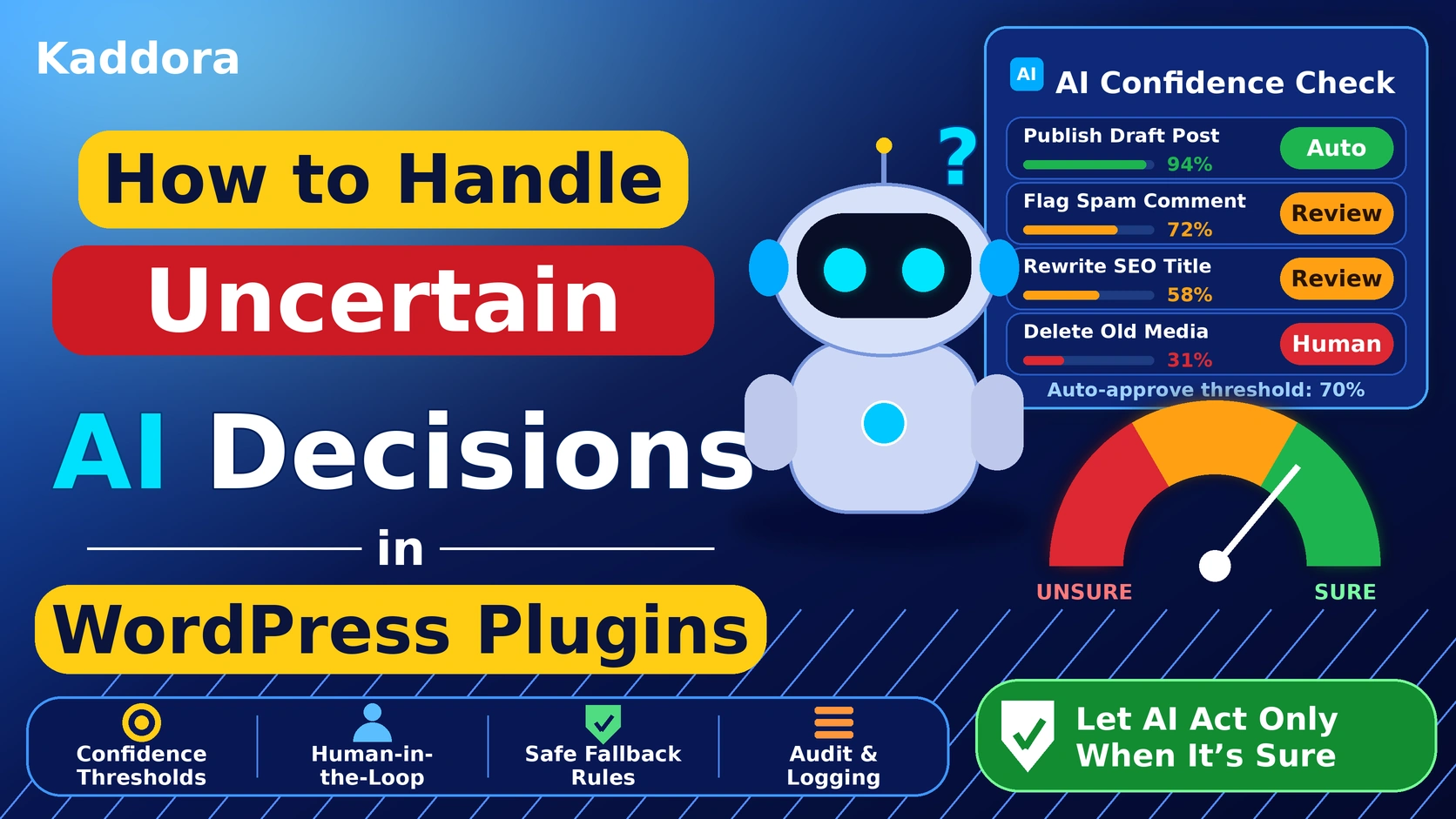
A plugin may use a confidence value between 0 and 100 as one part of its decision process.
For example:
Confidence Range
Possible Interpretation
90–100
Strong support
70–89
Reasonable support
40–69
Limited or mixed support
0–39
Insufficient support
These ranges are illustrative and should be calibrated for the specific application.
A confidence score returned by an AI model is not automatically a statistically reliable probability of correctness.
Developers should evaluate confidence against reviewed examples and actual outcomes.
Separate Model Confidence From Evidence Confidence
An AI model may express strong confidence even when the information it received is incomplete.
For example, an AI assistant might confidently recommend changing a product price based on an outdated competitor report.
The plugin should independently evaluate the supporting evidence.
A decision can therefore track two separate assessments:
Model confidence: How strongly the model supports its generated conclusion.
Evidence confidence: How reliable, relevant, and complete the supporting information is.
Both assessments can help determine whether the recommendation should be presented, investigated, or escalated.
Apply Decision-Specific Confidence Thresholds
Different plugin operations require different evidence standards.
For example:
Suggesting a blog title may tolerate moderate uncertainty.
Recommending an SEO improvement may require stronger supporting information.
Publishing an automatically generated article may require content validation and an appropriate publishing policy.
Deleting website records should require strict validation and explicit authorization.
A single confidence threshold should not control every operation.
Most importantly, confidence must never replace capability checks, permission validation, or required human approval.
Create an Uncertainty-Based Decision Policy
A decision policy defines what the plugin should do when an AI recommendation has different levels of uncertainty.
Without a policy, the system may recognize uncertainty but still behave inconsistently.
A practical policy can classify decisions into several categories.
Proceed With a Supported Recommendation
The plugin can provide a recommendation when the evidence is sufficiently reliable and the operation has an acceptable impact.
For example, an AI content assistant may identify a missing heading in a page after inspecting its actual content.
The plugin can present this finding as a supported recommendation.
Proceed With a Clear Limitation
Some decisions can be useful even when the evidence is incomplete.
For example, an analytics assistant may identify that product sales declined but lack enough information to determine why.
It can report the verified decline and explain that additional traffic or conversion data is required to identify the cause.
Request Additional Information
When essential information is missing, the plugin should ask a focused question.
For example:
"Should I optimize this product description for search visibility or improve its readability for customers?"
This is more useful than selecting an arbitrary objective.
Gather More Evidence
If additional information can be retrieved safely, the plugin may collect it before making a decision.
For example, an AI agent investigating a checkout problem can inspect approved error logs and recent payment responses.
The agent should not retrieve unrelated customer information simply because it might be available.
Escalate for Human Review
Some decisions require administrator approval because of their potential impact or unresolved uncertainty.
Examples include:
Deleting multiple posts.
Changing product prices.
Modifying user permissions.
Sending bulk customer messages.
Changing important plugin settings.
The plugin should present the proposed action, its supporting evidence, known limitations, and expected consequences.
Reject an Unsupported or Unauthorized Operation
If the decision cannot be supported or the requested operation is not permitted, the plugin should refuse execution.
A high confidence score does not make an unauthorized action acceptable.
Design Risk-Aware Uncertainty Handling
Confidence alone is not enough to determine whether an AI decision is safe.
A recommendation with moderate uncertainty may be acceptable for a reversible, low-impact operation. The same uncertainty may be unacceptable for an irreversible or sensitive operation.
A useful system evaluates both uncertainty and potential impact.
Classify Decision Impact
A plugin can classify operations into different risk categories.
Risk Category
Example
Suggested Handling
Low
Suggest a blog title
Automated recommendation
Moderate
Recommend metadata changes
Validate before applying
High
Update product prices
Review and approval
Critical
Delete important records or change permissions
Strict authorization and confirmation
These classifications are examples. Developers should create their own risk model according to the plugin's capabilities and consequences of failure.
Consider Reversibility
A reversible action is easier to recover from than a permanent action.
For example, creating a draft recommendation is generally safer than immediately publishing or deleting content.
When uncertainty is high, a plugin can prefer reversible operations such as:
Saving an AI-generated draft.
Creating a proposed change.
Displaying a preview.
Generating a report.
Adding an item to an approval queue.
This allows users to review the result before committing to a consequential change.
Use Risk-Based Approval
Human approval should be required when the combination of uncertainty and potential impact exceeds the plugin's defined policy.
Approval must be enforced by the application, not merely requested in the AI prompt.
The system should verify the approving user's capability and ensure that the approval applies to the exact operation being executed.
Build a Safe Fallback Mechanism
A fallback mechanism defines what happens when the AI plugin cannot reach a reliable conclusion.
Without a fallback strategy, developers may allow the agent to continue generating increasingly speculative responses.
A practical fallback architecture should include several options.
Return a Limited Result
If the plugin can verify only part of a request, it should return the supported portion.
For example, a content analysis operation may identify missing headings but remain unable to verify whether the page has good search performance.
The plugin can provide the heading analysis while clearly stating that search performance was not evaluated.
Ask for Clarification
When the user's intended outcome is unclear, request the missing information instead of guessing.
Use a Rule-Based Alternative
Some operations can fall back to deterministic WordPress logic.
For example, if an AI service is unavailable, a plugin may still perform basic checks for:
Missing post titles.
Empty product descriptions.
Missing image alternative text.
Invalid configuration values.
Required form fields.
The fallback should not pretend to provide the same capabilities as the AI service.
Delay the Operation
If the plugin cannot retrieve necessary information because an external provider is temporarily unavailable, it can schedule a retry.
Retries should use appropriate limits and backoff rather than repeatedly sending requests.
Require Human Intervention
When no safe automated response exists, the plugin should move the task into a review state.
This is preferable to generating an unsupported conclusion or executing an uncertain operation.
Implement Uncertainty Handling in WordPress Plugin Architecture
A maintainable WordPress plugin should separate AI response generation from decision validation and action execution.
A practical architecture can contain the following components:
AI request manager.
Evidence collection service.
Source validation module.
Confidence assessment service.
Risk evaluation module.
Decision policy engine.
Human approval manager.
Tool execution service.
Audit logging system.
Each component should have a clear responsibility.
The AI service generates a recommendation. The validation layer evaluates the response. The decision engine determines the permitted next step. The execution layer performs only authorized operations.
Create a Structured AI Decision Result
A structured result makes it easier for a plugin to validate an AI recommendation.
For example:
$decision = array( 'decision_id' => 'decision_1001', 'recommendation' => 'Update product description', 'confidence' => 72, 'evidence_status' => 'partial', 'risk_level' => 'moderate', 'missing_information' => array( 'Target customer information', 'Preferred content style', ), 'recommended_action' => 'request_clarification', 'requires_approval' => false, );
This is an illustrative data structure. A production plugin should validate all fields, use controlled values for status and risk categories, and avoid trusting model-generated authorization decisions.
The plugin should also retain references to supporting records where appropriate.
Validate the AI Decision
A simplified PHP example demonstrates how to classify an AI decision before it reaches the execution layer.
function kaddora_validate_ai_decision( $decision ) { if ( ! is_array( $decision ) || ! isset( $decision['confidence'] ) || ! isset( $decision['risk_level'] ) ) { return 'needs_review'; } $confidence = filter_var( $decision['confidence'], FILTER_VALIDATE_INT ); if ( false === $confidence || $confidence < 0 || $confidence > 100 ) { return 'needs_review'; } $allowed_risks = array( 'low', 'moderate', 'high', 'critical', ); if ( ! in_array( $decision['risk_level'], $allowed_risks, true ) ) { return 'needs_review'; } if ( 'critical' === $decision['risk_level'] ) { return 'human_approval_required'; } if ( $confidence < 70 ) { return 'insufficient_confidence'; } return 'eligible_for_policy_check'; }
This example performs basic classification only. It does not establish that the evidence is reliable or that the current user is authorized to perform the operation.
A production implementation must perform additional checks before any action is executed.
Enforce WordPress Permissions Separately
A plugin should verify the current user's capabilities before performing protected operations.
For example:
if ( ! current_user_can( 'edit_post', $post_id ) ) { return new WP_Error( 'kaddora_ai_permission_denied', 'You are not allowed to edit this post.' ); }
The plugin should also validate that the target post exists and is eligible for the requested operation.
For requests originating from WordPress interfaces, use nonce verification where appropriate. Nonces help protect against request forgery, but they do not replace capability checks.
Never allow an AI model to execute arbitrary PHP, SQL, shell commands, or unrestricted WordPress functions.
Manage Human Approval for Uncertain Decisions
Human approval provides an additional safeguard when the plugin cannot safely complete an operation automatically.
However, an approval workflow should provide enough information for an administrator to make a meaningful decision.
Display the Proposed Operation
The review interface should clearly identify:
What the AI recommends.
Which WordPress object will be affected.
Why the operation is suggested.
Which evidence supports the recommendation.
What information is missing.
What the possible consequences are.
Support Approval, Rejection, and Revision
An administrator should be able to:
Approve the proposed operation.
Reject the recommendation.
Modify the proposed changes.
Request additional analysis.
The plugin should store the review outcome and associate it with the relevant decision.
Revalidate Before Execution
Approval should not remain valid indefinitely if the underlying data changes.
For example, an administrator may approve a product update, but the product may be modified before the queued operation executes.
The plugin should revalidate important conditions immediately before execution.
Approval must also be tied to the exact action and its relevant parameters. A general approval should not authorize unrelated operations.
Handle Uncertain Tool Results and API Failures
AI plugins often depend on external providers and WordPress functions.
These operations may fail or return incomplete results.
For example, an AI agent may request a product update and receive a timeout. It cannot assume that the update was unsuccessful because the request may have reached the server before the connection failed.
Verify the Actual Application State
After performing an important operation, the plugin should retrieve the relevant WordPress record and verify the expected result.
A verification process can include:
Checking the target record.
Confirming the expected field values.
Comparing the resulting state with the approved changes.
Recording the verification outcome.
Avoid Blind Retries
Repeatedly executing an operation without checking its current state can create duplicate side effects.
Use idempotency keys where supported and implement safe retry rules.
For example, before creating a new record after a timeout, check whether the intended record already exists.
Distinguish Failure From Unknown Outcome
A plugin should distinguish between:
Confirmed success.
Confirmed failure.
Timeout.
Invalid response.
Unknown execution outcome.
An unknown outcome should trigger verification or review rather than being automatically reported as a failure.
Monitor and Improve Uncertainty Handling
Uncertainty-handling logic should be continuously evaluated.
Developers need to understand how frequently the plugin makes unsupported recommendations, requests clarification, escalates decisions, or encounters uncertain execution outcomes.
Useful metrics include:
Metric
Purpose
Unsupported decision rate
Measures recommendations without sufficient evidence
Confidence calibration
Evaluates confidence against actual correctness
Human approval rate
Tracks decisions requiring administrator review
Clarification rate
Measures requests for additional information
False-positive rate
Tracks incorrect warnings or recommendations
Verification success rate
Measures successful confirmation of important operations
Fallback frequency
Tracks how often the system uses an alternative response
Decision accuracy
Evaluates results against reviewed outcomes
Developers should test the system with ambiguous requests, incomplete records, contradictory documents, outdated information, malicious retrieved instructions, and external API failures.
Logs should record decision identifiers, policy outcomes, relevant source references, and execution results.
Avoid unnecessarily logging complete private prompts, customer information, passwords, API credentials, or sensitive documents.
Common Mistakes When Handling Uncertain AI Decisions
Treating AI Confidence as Guaranteed Accuracy
A model-generated confidence score does not prove that a recommendation is correct.
Evaluate supporting evidence and test confidence calibration.
Automatically Executing Every AI Recommendation
AI recommendations should pass validation and authorization before they can affect WordPress data.
Use approval workflows for sensitive operations.
Ignoring Missing Information
An agent may generate an answer even when important data is unavailable.
Make missing information visible and request clarification when necessary.
Using the Same Threshold for Every Operation
Different actions have different consequences.
A recommendation for a blog title should not follow the same decision policy as deleting important records.
Ignoring Conflicting Sources
Combining inconsistent information without investigation can produce misleading conclusions.
Evaluate source reliability, freshness, and context.
Retrying Every Failed Request
A timeout does not necessarily mean the original operation failed.
Verify the application state before repeating operations that may create duplicate effects.
Hiding Uncertainty From Administrators
Administrators should understand when a recommendation depends on assumptions or incomplete evidence.
Present limitations clearly rather than displaying unsupported conclusions as verified facts.
Allowing Approval to Replace Security Checks
Human approval does not eliminate the need for capability checks, input validation, and object-level authorization.
The plugin must independently enforce all security requirements.
Best Practices for Handling Uncertain AI Decisions in WordPress Plugins
Identify the sources of uncertainty in every AI workflow.
Evaluate evidence quality before accepting recommendations.
Separate verified facts from assumptions.
Validate model-generated confidence values.
Use action-specific confidence and risk policies.
Consider the impact and reversibility of proposed actions.
Ask focused questions when essential information is missing.
Provide supported partial results when possible.
Implement rule-based fallback mechanisms for suitable operations.
Require human approval for sensitive or high-impact actions.
Revalidate approved operations before execution.
Keep AI reasoning separate from authorization.
Verify important tool outcomes independently.
Use safe retries and duplicate-execution protection.
Monitor unsupported recommendations and decision accuracy.
Protect private information in logs and audit records.
Test incomplete, conflicting, outdated, and misleading inputs.
Why Choose Kaddora?
Kaddora focuses on practical digital solutions, WordPress plugins, AI-powered integrations, business applications, and workflow automation.
Developing dependable AI-powered WordPress products requires more than connecting an AI model to a website. It also requires thoughtful decision architecture, reliable data handling, secure execution, and appropriate human oversight.
A structured uncertainty-handling system helps developers create plugins that recognize information gaps, validate recommendations, and avoid unsupported automated actions.
ThemeKaddora provides WordPress plugins, themes, HTML templates, and digital products for developers and businesses building modern online platforms.
By emphasizing practical implementation, maintainable development, and responsible AI integration, Kaddora supports the creation of useful and reliable digital experiences.
Conclusion
Handling uncertain AI decisions in WordPress plugins is essential for building dependable AI-powered applications.
AI systems may encounter ambiguous instructions, incomplete information, conflicting evidence, unreliable model outputs, and unexpected tool responses. A plugin should recognize these situations instead of treating every generated recommendation as a verified fact.
A practical uncertainty-handling architecture combines evidence evaluation, confidence assessment, risk classification, decision policies, safe fallback mechanisms, and human approval.
Developers should also keep AI reasoning separate from authorization, verify important operations, and monitor decision quality over time.
The objective is not to eliminate every uncertain situation. It is to ensure that the plugin responds appropriately when certainty is unavailable.
By implementing these practices, WordPress developers can create AI plugins that are more transparent, predictable, secure, and responsible.
Frequently Asked Questions
What are uncertain AI decisions in WordPress plugins?
Uncertain AI decisions occur when a plugin's AI system does not have enough reliable information to determine the correct answer or action.
Why should WordPress plugins handle AI uncertainty?
Handling uncertainty helps prevent incorrect recommendations, unsupported conclusions, unintended changes, and unsafe automated operations.
How can Kaddora help with handling uncertain AI decisions?
Kaddora focuses on WordPress plugins, AI integrations, and workflow automation that support practical and reliable digital solutions.
What causes uncertainty in AI-powered WordPress plugins?
Common causes include ambiguous user instructions, incomplete website data, outdated documents, model limitations, conflicting sources, and external API failures.
How can developers evaluate AI confidence?
Developers can assess model confidence alongside evidence quality and validate confidence estimates against reviewed examples and actual outcomes.
When should an AI plugin request human approval?
Human approval is appropriate when an operation has significant consequences, requires special authorization, or cannot be supported by sufficiently reliable evidence.
What is an AI fallback mechanism?
A fallback mechanism defines an alternative response when the AI system cannot complete a task reliably, such as requesting clarification, returning partial results, using deterministic rules, or escalating for review.
How can WordPress plugins prevent incorrect AI actions?
They should validate AI recommendations, verify supporting evidence, enforce capability checks, use tool allowlists, and require approval for sensitive operations.
How should an AI plugin handle uncertain API results?
It should verify the actual application state, distinguish confirmed failures from unknown outcomes, and use controlled retries to prevent duplicate operations.
Why choose ThemeKaddora?
ThemeKaddora offers WordPress plugins, themes, HTML templates, and digital products designed to help developers and businesses build useful online solutions.
Comments (0)