Introduction
AI-powered WordPress plugins increasingly perform tasks that require more than generating text. They analyze website information, interpret business data, evaluate user requests, retrieve knowledge, recommend actions, and interact with WordPress functionality.
As these capabilities expand, the reliability of AI reasoning becomes increasingly important.
An AI agent may receive accurate information but still produce an incorrect conclusion because it interprets the evidence inconsistently. It might recommend publishing an article while simultaneously identifying that the article contains unverified claims. A WooCommerce assistant might conclude that a product is suitable for promotion even though its own analysis indicates that inventory is insufficient.
These situations represent conflicting AI reasoning.
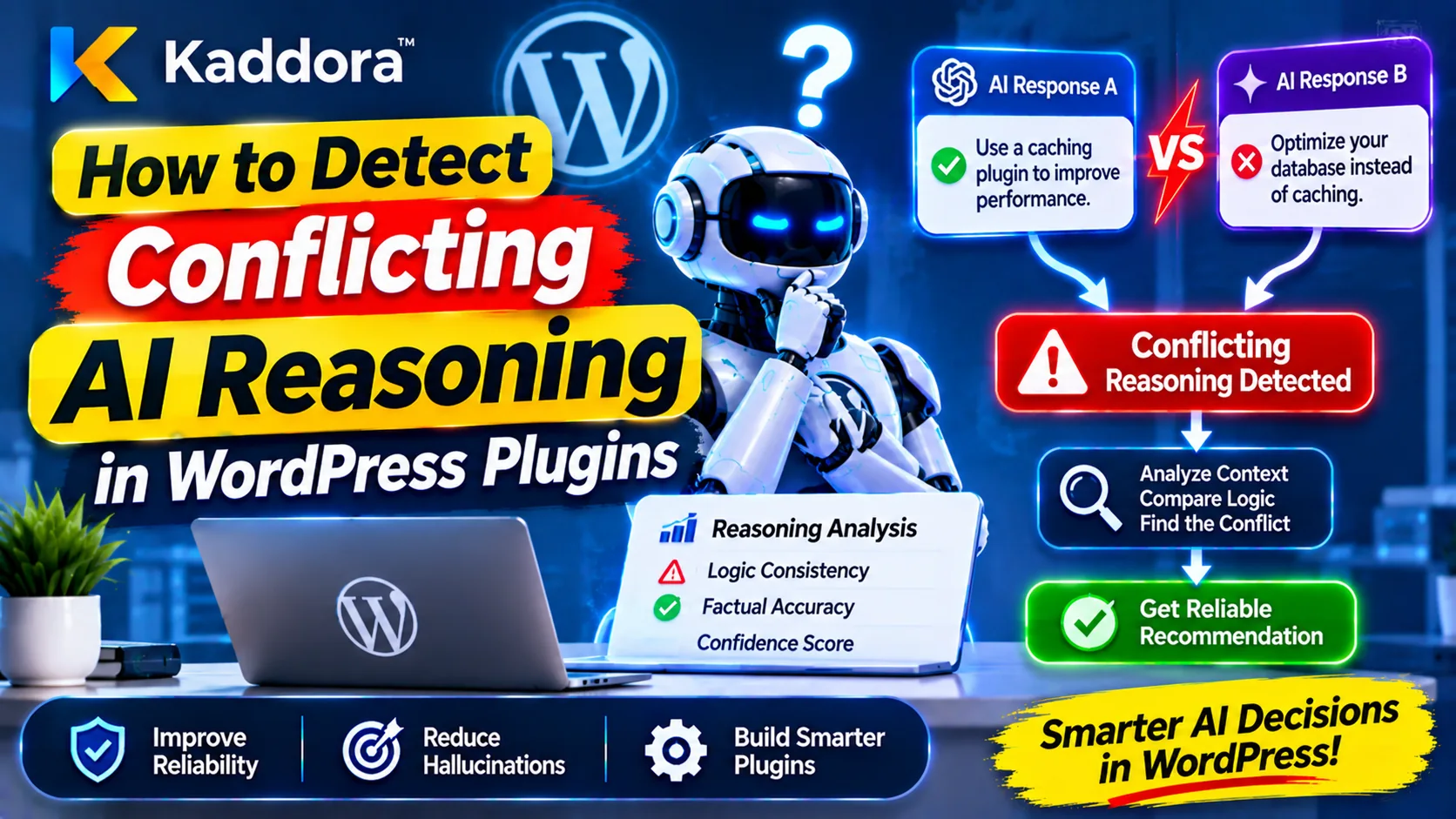
Conflicting reasoning occurs when an AI system generates conclusions, explanations, assumptions, or proposed actions that are incompatible with one another or inconsistent with the available evidence.
Detecting these conflicts is essential because an AI agent should not execute an operation simply because it has generated a confident recommendation.
WordPress developers need a structured validation process that examines AI-generated claims, compares conclusions with supporting evidence, identifies incompatible decisions, and determines whether an operation can safely continue.
In this guide, we will explore how to detect conflicting AI reasoning in WordPress plugins, design a reasoning validation architecture, implement practical PHP checks, and introduce safeguards that improve the reliability of AI-powered workflows.
What Is Conflicting AI Reasoning?
Conflicting AI reasoning occurs when an AI model or agent produces two or more conclusions that cannot reasonably be accepted together under the same conditions.
A conflict may appear in:
Multiple statements within one AI response.
Conclusions generated during different reasoning stages.
Recommendations from multiple AI agents.
AI decisions compared with verified WordPress data.
Proposed actions that violate established business rules.
New conclusions that contradict previously verified decisions.
Consider a WordPress AI content assistant.
It evaluates an article and produces these conclusions:
The article contains all required sections.
The article is missing its required conclusion.
The article is ready for publication.
The first two statements conflict if they refer to the same article version and the conclusion is mandatory. The final recommendation is also inconsistent with the identified issue.
A reasoning validation system should identify the inconsistency and prevent the publication recommendation from being accepted without further verification.
However, not every difference in reasoning is a contradiction.
An AI agent may legitimately change its conclusion after receiving new evidence. Similarly, two recommendations may appear different because they refer to different time periods or conditions.
Therefore, contradiction detection must evaluate context, evidence, timing, and decision scope rather than simply comparing sentences.
Why Detecting Conflicting AI Reasoning Matters in WordPress Plugins
WordPress AI plugins often connect language models with website data, databases, external APIs, and automated actions.
This creates several opportunities for inconsistent reasoning.
For example, an AI agent might:
Recommend an action that conflicts with its own analysis.
Interpret the same business rule differently in separate reasoning stages.
Generate a report that disagrees with verified analytics.
Recommend approving an operation after identifying a security concern.
Combine incompatible conclusions from multiple specialized agents.
Continue using an outdated assumption after receiving updated information.
These problems can affect website administration, customer communication, product management, appointment scheduling, content publishing, and security monitoring.
Conflicting reasoning is particularly dangerous when an AI agent can execute actions instead of merely providing suggestions.
A text-generation inconsistency may produce an inaccurate explanation. An execution inconsistency could change product information, publish incorrect content, update business records, or initiate an unauthorized workflow.
A reasoning validation layer helps separate AI-generated suggestions from decisions that have been verified and approved for execution.
Common Types of Conflicting AI Reasoning
Internal Reasoning Contradictions
Internal reasoning contradictions occur when different parts of one AI-generated analysis disagree.
Example:
Observation: The product has sufficient inventory.
Analysis: The product has insufficient inventory.
Recommendation: Launch a promotion immediately.
The system should check whether the observations refer to the same product, stock quantity, and reporting time before accepting the recommendation.
Evidence-to-Conclusion Conflicts
These conflicts occur when an AI-generated conclusion does not follow from its supporting evidence.
For example:
Evidence: Website traffic increased by 12%.
AI conclusion: Website traffic declined.
Recommendation: Reduce marketing activity because traffic is falling.
The system should independently verify the underlying measurements and reject unsupported conclusions.
Decision-to-Action Conflicts
A proposed action may contradict the conditions identified during reasoning.
For example:
Analysis: A customer refund requires administrator approval.
Proposed action: Process the refund automatically.
The execution controller should enforce the approval requirement regardless of the AI-generated recommendation.
Temporal Reasoning Conflicts
Temporal conflicts occur when an agent combines information from different time periods without recognizing that the underlying state has changed.
For example:
Previous analysis: An appointment slot is available.
Current booking record: The slot is already reserved.
New recommendation: Confirm the appointment.
The agent should retrieve current availability before making a decision.
Multi-Agent Reasoning Conflicts
Multiple agents may produce incompatible recommendations because they use different information, assumptions, or objectives.
For example:
Inventory agent: Do not promote the product because stock is low.
Marketing agent: Include the product in the next promotional campaign.
Sales agent: Offer a discount to increase demand.
A coordination layer should evaluate the shared evidence and business rules before combining these recommendations.
Policy and Reasoning Conflicts
An AI-generated recommendation may violate a predefined plugin policy.
For example, a plugin may require administrator approval before changing user roles. The AI agent might nevertheless recommend assigning an elevated role automatically.
The policy must take precedence over the model's suggestion.
Architecture for Detecting Conflicting AI Reasoning
A dependable architecture separates reasoning generation from reasoning validation and action execution.
AI Input and Context Layer
The input layer collects the information required by the AI agent.
Depending on the plugin, this information may include:
WordPress posts and pages.
WooCommerce products and orders.
Plugin configuration.
User-submitted information.
Approved external API responses.
Retrieved knowledge base content.
Previous verified decisions.
Business rules and operational policies.
Each item should retain relevant source information, such as its record identifier, retrieval time, source type, and verification status.
The system should also enforce access permissions before retrieving private or sensitive information.
Reasoning Output Structuring Layer
Free-form AI responses are difficult to validate reliably.
Instead of requesting only a paragraph explaining a decision, developers should ask the model to return a structured result.
A useful structure may contain:
Decision identifier.
Objective.
Identified claims.
Supporting evidence references.
Assumptions.
Proposed conclusion.
Recommended action.
Confidence estimate.
Uncertainty notes.
This makes it easier to compare individual claims and determine whether the recommendation follows from the evidence.
Structured output must still be validated against an expected schema. A valid JSON response does not prove that its reasoning is correct.
Claim Extraction Layer
The claim extraction layer separates an AI response into individual statements that can be evaluated.
For example, the response:
"The product has sufficient stock, so it is safe to promote."
Can be represented as:
Claim A: The product has sufficient stock.
Claim B: The product is suitable for promotion.
Relationship: Claim A is being used to support Claim B.
The system can then verify each claim independently.
Reasoning Consistency Engine
The consistency engine compares claims, assumptions, evidence, and conclusions.
It can use:
Rule-based checks.
Logical relationship checks.
Evidence reference validation.
Semantic contradiction analysis.
Temporal consistency checks.
Cross-agent decision comparisons.
Deterministic checks should handle important structured business conditions wherever possible.
Semantic models can help identify natural language contradictions that cannot be handled through simple field comparisons.
Policy Validation Layer
The policy validation layer checks whether a proposed decision follows the plugin's established rules.
Examples include:
A user must have the appropriate capability before an operation.
An order must meet the required status conditions.
A product must satisfy inventory requirements before promotion.
Content must receive approval before publication.
Sensitive account changes must require authorization.
These checks should be implemented independently of the AI model.
Decision and Execution Controller
The execution controller determines what happens after validation.
Possible outcomes include:
Accept the recommendation.
Request updated evidence.
Generate a revised analysis.
Ask for human approval.
Reject the proposed action.
Mark the decision as unresolved.
The controller should never assume that an AI-generated conclusion is authorized merely because the reasoning validation layer did not identify a contradiction.
Monitoring and Audit Layer
The monitoring layer records relevant validation events.
It should help administrators understand:
Which reasoning claims conflicted.
Which evidence was involved.
What validation rule failed.
Whether the decision was rejected or approved.
Whether new evidence changed the outcome.
Which authorized user approved a sensitive operation.
Logs should be minimized and protected against unauthorized access.
How to Detect Conflicting AI Reasoning Step by Step
Define the AI Decision Objective
Start by defining exactly what the AI agent is expected to decide.
For example, a WooCommerce inventory assistant may need to determine whether a product is eligible for a promotional campaign.
Its objective should specify:
The product being evaluated.
The inventory threshold.
The relevant time period.
The business rules.
The permitted recommendation types.
A clearly defined objective reduces conflicts caused by mixing unrelated assumptions or conditions.
Convert AI Responses Into Verifiable Claims
Ask the model to identify its observations, assumptions, conclusions, and proposed actions separately.
For example:
{ "objective": "Evaluate product promotion eligibility", "claims": [ { "id": "claim_1", "statement": "The product has sufficient stock", "evidence": ["inventory_record_123"] }, { "id": "claim_2", "statement": "The product is eligible for promotion", "evidence": ["inventory_record_123"] } ], "conclusion": "Approve promotion", "proposed_action": "create_campaign" }
This is an illustrative structure. Production systems should validate required fields, types, identifiers, and allowed values before using the response.
Compare Related Claims
The system should identify claims that refer to the same entity and decision.
For example:
Claim A: The product is in stock.
Claim B: The product is unavailable.
If both refer to the same product and time period, the system should flag a possible contradiction.
However, if one statement refers to yesterday and the other refers to current inventory, the difference may represent a legitimate state change.
Verify Evidence Against Authoritative Sources
The system should retrieve the relevant WordPress or WooCommerce information and compare it with the model's claims.
For example, the plugin should use the appropriate WooCommerce product APIs to retrieve current inventory information rather than relying exclusively on an AI-generated statement or cached context.
Evidence verification should consider:
Source authority.
Record ownership.
Entity identifiers.
Data freshness.
Units and formats.
Applicable business rules.
Validate the Final Conclusion
Once the claims have been checked, evaluate whether the conclusion is supported.
For example:
Verified stock quantity: 3.
Required promotional stock threshold: 10.
AI recommendation: Approve promotion.
The recommendation conflicts with the configured threshold.
The plugin should reject the recommendation or request a new analysis using the verified inventory value.
Control the Execution Decision
If a contradiction affects the proposed action, the system should prevent automatic execution.
It may request updated evidence, ask the model to reconsider the decision, or send the issue for administrator approval.
A revised AI response must go through validation again. Repeatedly asking the model to reconsider is not a substitute for independent verification.
Practical PHP Implementation
WordPress developers can implement an initial reasoning validation layer using structured claims and deterministic rules.
The following examples illustrate the basic architecture.
Create a Reasoning Validation Class
class Kaddora_AI_Reasoning_Validator { public function validate_claims( $claims ) { if ( ! is_array( $claims ) ) { return array( 'valid' => false, 'reason' => 'Invalid claims structure.', ); } $validated = array(); foreach ( $claims as $claim ) { if ( ! is_array( $claim ) || empty( $claim['id'] ) || empty( $claim['statement'] ) || ! is_string( $claim['statement'] ) ) { return array( 'valid' => false, 'reason' => 'Malformed claim detected.', ); } $validated[] = array( 'id' => sanitize_key( $claim['id'] ), 'statement' => sanitize_text_field( $claim['statement'] ), ); } return array( 'valid' => true, 'claims' => $validated, ); } }
This class checks whether claims have the expected basic structure.
It does not establish whether a statement is true or whether two claims logically contradict each other. Those checks require additional validation components.
Detect Contradictory Structured Values
For structured business information, deterministic comparison is more dependable than asking an AI model to compare numeric values.
class Kaddora_AI_Consistency_Checker { public function compare_values( $first, $second ) { if ( ! is_numeric( $first ) || ! is_numeric( $second ) ) { return array( 'conflict' => null, 'reason' => 'Numeric values required.', ); } $first = (float) $first; $second = (float) $second; return array( 'conflict' => $first !== $second, 'first' => $first, 'second' => $second, ); } }
This example detects unequal numeric values. It does not automatically classify them as logical contradictions.
For instance, a price of 100 and a price of 120 may both be correct if they refer to different dates or customer groups.
Production implementations should compare values only after confirming that the records share the same entity, field, units, and relevant context.
Validate a Business Decision
A deterministic rule can prevent an AI recommendation from violating a configured inventory threshold.
function kaddora_ai_validate_promotion( $stock_quantity, $minimum_stock ) { if ( ! is_numeric( $stock_quantity ) || ! is_numeric( $minimum_stock ) ) { return array( 'approved' => false, 'status' => 'verification_required', ); } if ( $stock_quantity < $minimum_stock ) { return array( 'approved' => false, 'status' => 'policy_conflict', ); } return array( 'approved' => true, 'status' => 'validated', ); }
The function evaluates the business condition independently of the model.
In a production WooCommerce plugin, retrieve the current product through WooCommerce APIs, verify the product identifier and permissions, and account for stock management settings before using the result.
Prevent Unvalidated Actions
The execution controller should require a successful validation result before allowing the operation.
function kaddora_ai_execute_decision( $validation_result ) { if ( ! is_array( $validation_result ) || empty( $validation_result['approved'] ) ) { return new WP_Error( 'kaddora_ai_decision_rejected', 'The AI decision has not passed validation.' ); } // Call a separately authorized business operation here. return true; }
This is a simplified execution gate. A real plugin must also check the current user's capabilities, object-level permissions, request integrity, and any required approval state inside the actual operation handler.
An AI-generated approval value must never be accepted as proof of user authorization.
Using AI to Detect Semantic Reasoning Conflicts
Some reasoning conflicts cannot be detected through numeric or exact-value comparisons.
Consider these statements:
The article is suitable for immediate publication.
The article contains unverified medical claims that require review.
Whether these statements conflict depends on the plugin's publication policy and the nature of the content.
A semantic reasoning checker can help classify their relationship.
A useful model-assisted workflow is:
Input: Provide the claims, their evidence references, and the decision objective.
Classification: Ask the model to classify the relationship between relevant claims.
Explanation: Request a concise explanation identifying the potentially incompatible statements.
Verification: Check the classification against authoritative data and deterministic policies.
Decision: Accept, reject, or escalate the recommendation.
Suggested classifications include:
Direct contradiction.
Partial contradiction.
Unsupported conclusion.
Compatible statements.
Different contexts.
Temporal difference.
Insufficient evidence.
The model should not be permitted to modify the plugin's policies or authorize its own proposed actions.
Detecting Conflicts Across Multiple AI Agents
Multi-agent WordPress systems often use specialized agents to perform different tasks.
For example, an eCommerce automation plugin may have:
An inventory analysis agent.
A pricing recommendation agent.
A marketing campaign agent.
A customer support agent.
Each agent may generate a separate recommendation.
A central reasoning coordinator should collect the structured outputs and compare their relevant claims.
Consider the following situation:
Agent
Recommendation
Inventory agent
Restrict promotion
Marketing agent
Launch a promotion
Sales agent
Increase product demand
These recommendations do not automatically represent a direct contradiction. The coordinator must evaluate the inventory level, promotion objective, campaign conditions, and applicable business rules.
A practical coordination process should:
Use consistent entity identifiers.
Standardize the reporting period.
Preserve evidence references.
Identify incompatible assumptions.
Compare recommendations with business policies.
Escalate unresolved conflicts.
Revalidate decisions before execution.
The coordinator should not select an agent simply because it reports a higher confidence score.
Handling Conflicts in Retrieval-Augmented AI Reasoning
Retrieval-Augmented Generation (RAG) can provide WordPress AI agents with relevant information from documentation, posts, product records, and knowledge bases.
However, retrieved information may contain outdated or incompatible statements.
For example:
An old support article says a feature is available to all users.
A newer product policy says the feature requires administrator access.
An internal document describes an earlier permission model.
An AI agent may combine these statements into an incorrect recommendation.
To detect such conflicts, the RAG workflow should:
Retrieve relevant records.
Identify the entities and claims they describe.
Compare the claims within the same context.
Evaluate source authority and timestamps.
Verify important facts against current WordPress records.
Exclude or label outdated information.
Provide the model with source-aware context.
Validate the generated conclusion.
Retrieved content must be treated as untrusted data. Instructions embedded in documents or external pages should not override system policies or application permissions.
Testing Conflicting AI Reasoning
Testing should include more than checking whether the model produces valid output.
Developers should build test cases covering different conflict patterns.
Direct Contradiction Tests
Provide two claims that explicitly disagree about the same entity and time period.
Expected result: The system identifies the conflict.
Evidence Mismatch Tests
Provide evidence showing one outcome and an AI conclusion stating the opposite.
Expected result: The conclusion fails evidence validation.
Temporal Difference Tests
Provide an older value and a newer value describing a legitimate state change.
Expected result: The system recognizes the time difference rather than automatically reporting a logical contradiction.
Policy Violation Tests
Provide an AI recommendation that violates a configured business rule.
Expected result: The execution controller rejects the operation.
Multi-Agent Conflict Tests
Provide recommendations from multiple agents with incompatible assumptions.
Expected result: The coordinator requests verification or escalation.
Malformed Output Tests
Provide missing claims, invalid JSON, unexpected fields, or unsupported decision values.
Expected result: The system rejects the response instead of attempting unsafe execution.
Testing should also cover model timeouts, duplicate requests, stale caches, missing evidence, permission failures, and partial database updates.
Security Best Practices for Reasoning Validation
Conflicting reasoning can sometimes result from malicious inputs rather than ordinary model errors.
A user may upload a document containing instructions designed to override the AI agent's behavior. An external API may return manipulated information. A retrieved knowledge base entry may contain instructions that conflict with the plugin's intended workflow.
WordPress developers should therefore:
Separate system instructions from user-controlled content.
Treat retrieved documents and API responses as untrusted.
Validate model output against a strict schema.
Keep API keys and credentials server-side.
Use capability checks for privileged operations.
Apply object-level authorization.
Verify nonces for appropriate state-changing requests.
Use $wpdb->prepare() for dynamic SQL.
Sanitize inputs and escape outputs.
Avoid executing model-generated PHP, SQL, or shell commands.
Require human approval for sensitive operations.
Protect reasoning logs and evidence references.
Limit the amount of personal information sent to external AI providers.
A validation engine should also be isolated from the model's ability to change application policies.
Common Mistakes When Detecting Conflicting AI Reasoning
Comparing Entire Responses Instead of Individual Claims
A long AI response may contain several unrelated statements. Comparing the entire response makes it difficult to identify the exact source of a conflict.
Extract and evaluate individual claims instead.
Treating Different Recommendations as Direct Contradictions
Two recommendations may be compatible when they refer to different objectives, conditions, or time periods.
Check the context before flagging a conflict.
Trusting AI Confidence Scores
A model can express high confidence while producing an incorrect conclusion.
Use evidence quality, source authority, and deterministic verification to evaluate decisions.
Allowing the AI Model to Approve Its Own Actions
An agent should not be able to declare its own recommendation safe and use that declaration as authorization.
Keep execution permissions and approval checks outside the model.
Ignoring Updated Evidence
An earlier conclusion may have been valid when it was generated but become outdated after a WordPress record changes.
Retrieve current information before executing important actions.
Repeating AI Requests Without Independent Validation
Asking the same model to reconsider a contradiction may produce another unsupported answer.
Use authoritative records and application rules to establish whether the conflict has actually been resolved.
Failing to Record Why a Decision Was Rejected
Without useful diagnostic information, administrators may struggle to investigate recurring reasoning failures.
Record relevant claim identifiers, evidence references, validation outcomes, and resolution statuses without exposing unnecessary sensitive information.
Best Practices for Detecting Conflicting AI Reasoning in WordPress Plugins
Use this checklist when implementing a reasoning validation system:
Define the objective and scope of every AI decision.
Request structured AI reasoning outputs.
Separate observations, assumptions, conclusions, and actions.
Extract individual claims for validation.
Match claims using reliable entity identifiers.
Check whether statements refer to the same time period.
Verify evidence against authoritative WordPress data.
Use deterministic rules for structured business conditions.
Use semantic analysis for natural language conflicts.
Validate conclusions against supporting evidence.
Apply business policies independently of AI reasoning.
Compare outputs from multiple agents before combining decisions.
Block sensitive operations when important conflicts remain unresolved.
Require approval for high-impact actions.
Test malformed responses and adversarial inputs.
Maintain protected audit records for important validation events.
Why Choose Kaddora?
Kaddora focuses on digital products and development solutions across WordPress plugins, themes, AI integrations, business applications, and workflow automation.
Developing reliable AI-powered WordPress plugins requires more than connecting an AI provider to a website. Developers need structured information processing, evidence verification, controlled permissions, and dependable execution workflows.
Reasoning validation is an important part of this architecture because it helps identify inconsistencies before they influence website content, business decisions, or automated operations.
ThemeKaddora offers WordPress plugins, themes, HTML templates, and digital products designed to support developers and website owners.
By combining practical development principles with responsible AI integration, developers can create WordPress solutions that are more transparent, consistent, and easier to maintain.
Conclusion
Detecting conflicting AI reasoning is essential for building dependable AI-powered WordPress plugins.
An AI agent may generate incompatible conclusions, misinterpret evidence, combine outdated assumptions, or recommend actions that violate application policies. These problems cannot be solved by relying on model confidence or repeatedly requesting another response.
A reliable solution requires structured claims, evidence validation, semantic conflict analysis, deterministic business rules, and controlled execution.
WordPress developers should separate reasoning generation from reasoning verification and authorization. AI models can help interpret complex information, but important decisions must be validated against trusted application data and established policies.
By implementing a dedicated reasoning validation architecture, WordPress plugins can identify inconsistent conclusions earlier, prevent unsupported actions, and provide more reliable AI-assisted workflows.
Frequently Asked Questions
What is conflicting AI reasoning in WordPress plugins?
Conflicting AI reasoning occurs when an AI-powered WordPress plugin generates incompatible conclusions, assumptions, or recommendations that cannot reasonably be accepted together under the same conditions.
Why should WordPress plugins detect conflicting AI reasoning?
Detection helps prevent inaccurate recommendations, unsupported conclusions, and potentially unsafe automated actions. It also improves transparency and makes AI decisions easier to validate.
How can developers detect conflicting AI reasoning?
Developers can extract structured claims, compare related statements, verify supporting evidence, check business rules, and use semantic analysis to identify conflicts that require deeper interpretation.
Can AI models detect contradictions in their own responses?
AI models can help identify inconsistencies within their responses, but their findings should be independently validated. A model cannot reliably establish that its own reasoning is correct simply by reviewing it again.
What is the difference between data contradictions and reasoning contradictions?
Data contradictions involve incompatible source information, such as different inventory values. Reasoning contradictions occur when conclusions or recommendations are inconsistent with one another or with the evidence.
How can WordPress developers validate AI-generated decisions?
They can use structured output validation, authoritative WordPress records, deterministic business rules, capability checks, and execution controls before accepting a proposed decision.
How do multiple AI agents create reasoning conflicts?
Different agents may use different evidence, assumptions, objectives, or reporting periods. A central coordinator should compare their claims and verify incompatible recommendations before combining their outputs.
Can RAG systems produce conflicting AI reasoning?
Yes. RAG systems can retrieve outdated, incomplete, or incompatible information. Source evaluation, temporal validation, claim comparison, and evidence-aware context building help reduce these problems.
Why choose ThemeKaddora?
ThemeKaddora offers WordPress plugins, themes, HTML templates, and digital products designed to support website development, business functionality, and modern digital experiences.
Comments (0)