
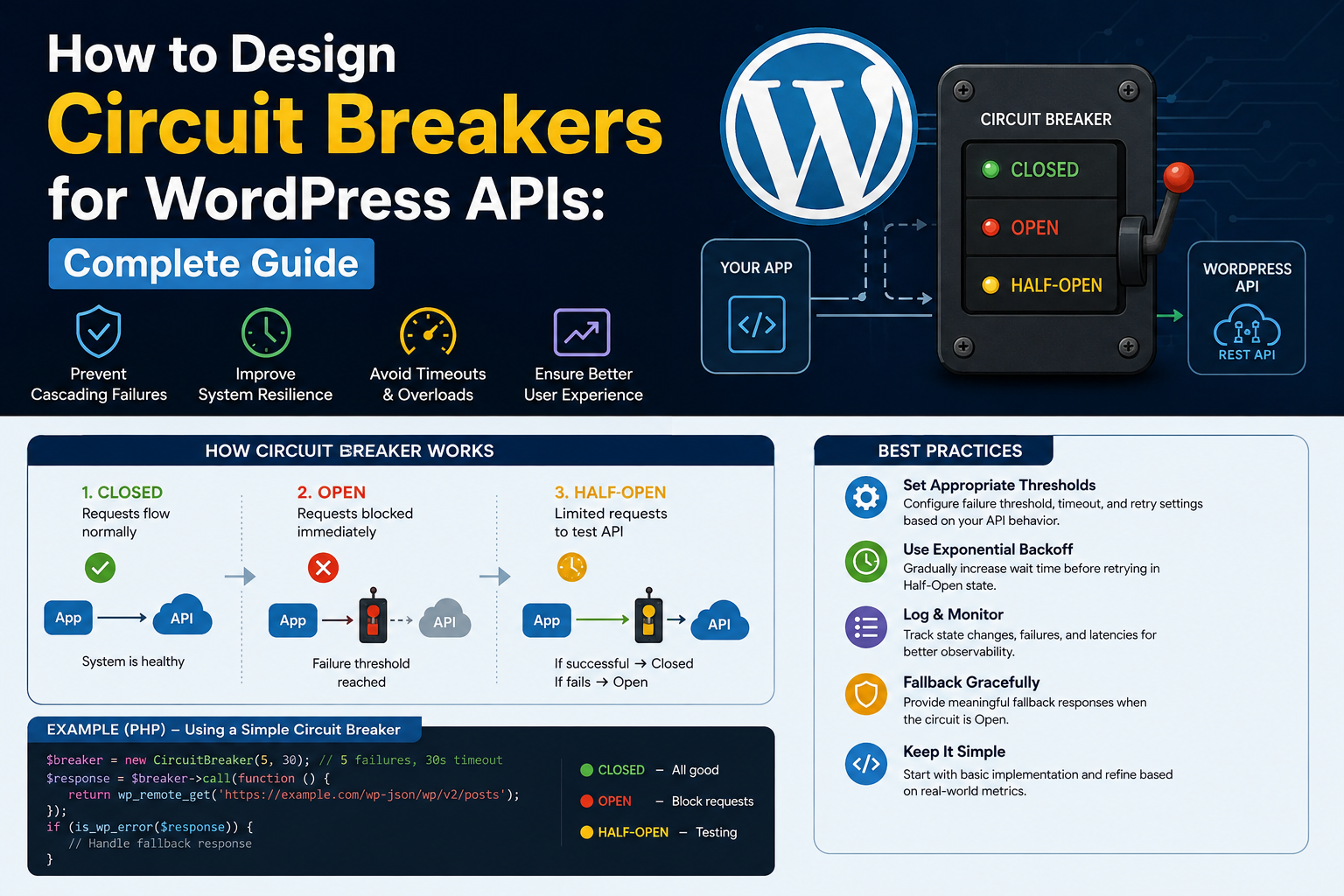
How to Design Circuit Breakers for WordPress APIs: Complete Guide
Introduction
Modern WordPress plugins increasingly depend on external APIs.
A plugin may connect to:
ERP platforms
Payment providers
AI services
Analytics platforms
Email services
SaaS applications
Shipping services
Marketing platforms
Normally, the architecture looks like:
WordPress ↓ API Client ↓ External Provider ↓ Response
When the provider is healthy, requests complete normally.
But when the external service becomes unavailable, a poorly designed plugin may continue sending requests:
API Request ↓ 503 ↓ Retry ↓ 503 ↓ Retry ↓ 503 ↓ Retry
This creates a retry storm.
The provider is already struggling, yet the plugin keeps sending traffic.
At the same time, WordPress may consume:
PHP workers
CPU
Memory
Queue capacity
Network connections
API quota
A circuit breaker helps prevent this.
Instead of continuing to call an unhealthy dependency, the application temporarily stops unnecessary requests:
Provider Failure ↓ Failure Threshold ↓ Circuit Opens ↓ Requests Fail Fast ↓ Wait ↓ Controlled Test ↓ Provider Recovered? ┌───────┴───────┐ ▼ ▼ Yes No ↓ ↓ Closed Open
Circuit breakers are especially useful for ThemeKaddora products that integrate with external CRM, ERP, AI, payment, SaaS, and business automation services.
The key principle is:
When a dependency repeatedly fails, stop creating additional load until there is evidence that the dependency has recovered.
What Is a Circuit Breaker?
A circuit breaker is a reliability mechanism that temporarily prevents requests to a failing external service.
It is inspired by an electrical circuit breaker.
When failures reach a defined threshold:
Normal Traffic ↓ Repeated Failures ↓ Circuit Opens
While open, new requests do not immediately call the provider.
After a waiting period:
Open ↓ Half-Open ↓ Test Request
If the provider works again:
Half-Open ↓ Success ↓ Closed
If it still fails:
Half-Open ↓ Failure ↓ Open
Why WordPress Plugins Need Circuit Breakers
Without a circuit breaker, one provider outage can affect the entire WordPress application.
For example:
CRM Down ↓ 1000 Jobs ↓ 1000 API Requests ↓ 1000 Timeouts ↓ More Retries
The original provider outage becomes a WordPress resource problem.
With a circuit breaker:
CRM Down ↓ Failure Threshold Reached ↓ Circuit Opens ↓ New Requests Stop
This protects both sides of the integration.
Circuit Breaker vs Retry
They solve different problems.
Retry
Retry asks:
Can this request succeed if I try again?
Useful for:
Temporary 503 errors
Transient network issues
Rate-limited operations
Circuit Breaker
Circuit breaker asks:
Should I even attempt another request right now?
Useful when failures become persistent.
They work together:
Request ↓ Failure ↓ Retry ↓ Repeated Failure ↓ Circuit Opens
Circuit Breaker States
The classic model uses three states:
Closed Open Half-Open
Closed State
Normal operation.
Requests are allowed:
Request ↓ Provider ↓ Response
The circuit tracks failures.
Example:
Failure Count = 0
Open State
The dependency has experienced enough failures.
The circuit stops normal requests:
Request ↓ Circuit Open ↓ Fail Fast
No unnecessary external request is made.
Half-Open State
After the configured recovery window:
Open ↓ Wait ↓ Half-Open
A limited test request determines whether the provider has recovered.
Why Half-Open Matters
Without half-open behavior, a circuit might remain open indefinitely.
The half-open state provides a controlled recovery mechanism.
Instead of:
1000 requests
the system sends:
1 test request
If successful, normal traffic can resume gradually.
What Should Trigger a Circuit?
Potential signals include:
Repeated 5xx errors
Repeated timeouts
Provider connection failures
Sustained high latency
Provider-wide outage indicators
Do not necessarily count every error.
For example:
401
may indicate broken credentials rather than provider failure.
Do Not Open the Circuit for Every Error
A circuit breaker should usually focus on dependency availability.
Avoid treating:
400 401 403 404 422
as provider outages unless the provider's documented behavior justifies it.
429 and Circuit Breakers
A 429 means rate limiting.
It can interact with a circuit breaker, but it is often better handled primarily by rate-limit infrastructure.
For example:
429 ↓ Respect Retry-After ↓ Throttle
A widespread sustained 429 condition may justify broader traffic reduction.
Choosing a Failure Threshold
A simple policy might be:
5 consecutive failures → Open
But a fixed count is not always ideal.
A high-volume API may need:
Error Rate > 20%
within a time window.
Count-Based vs Rate-Based Policies
Count-Based
5 failures → Open
Simple and useful for low-volume integrations.
Rate-Based
20% failures over 5 minutes → Open
Better for high-volume services.
Time Windows
Circuit policies often evaluate failures within a window:
10 failures within 60 seconds
This prevents an ancient failure from affecting current health.
Consecutive Failures
Another approach is:
Success Success Failure Failure Failure
then open the circuit after a defined number of consecutive failures.
A successful request resets or reduces the failure count.
Combining Signals
A mature system can combine:
Failure Rate + Latency + Consecutive Failures + Provider Status
This provides stronger detection than a single signal.
Detecting Timeouts
Timeouts are often useful circuit-breaker signals.
For example:
Timeout Timeout Timeout
may indicate that continuing requests will only consume more WordPress resources.
Detecting 5xx Errors
A circuit breaker can count:
500 502 503 504
as temporary provider failures, according to the integration's retry policy.
Don't Count Client Errors Blindly
A response such as:
400 Bad Request
often means the plugin sent invalid data.
Opening the circuit will not fix the request.
The request itself must be corrected.
Circuit Breaker Recovery Window
When the circuit opens:
Open ↓ Recovery Timeout ↓ Half-Open
The recovery timeout should be long enough to avoid immediately testing an obviously unhealthy dependency.
Half-Open Probe
The first request after the recovery period should be controlled.
Ideally:
1 Probe
rather than:
1000 Requests
Successful Probe
If the provider responds successfully:
Half-Open ↓ Success ↓ Closed
Normal traffic can resume.
Failed Probe
If the probe fails:
Half-Open ↓ Failure ↓ Open
Wait again before another test.
Gradual Recovery
Even after the provider recovers, an existing queue may contain thousands of jobs.
Do not instantly restore full concurrency.
Use:
Recovery ↓ Low Concurrency ↓ Healthy Metrics ↓ Increase Gradually
Why Gradual Recovery Matters
Suppose:
10,000 jobs queued
When the provider returns:
10,000 immediate requests
could simply create another outage.
Circuit breakers work best with controlled queue recovery.
Circuit Breakers and Queues
A useful architecture is:
Queue Job ↓ Circuit Check ↓ Closed? ┌─────┴─────┐ ▼ ▼ Yes No ↓ ↓ API Reschedule
When the circuit is open, jobs should normally be rescheduled rather than repeatedly failing immediately.
Avoid Fail-Fast Job Loss
Failing fast does not mean losing the job.
For retryable background work:
Circuit Open ↓ Job remains pending ↓ Retry Later
For user-requested operations, the UI can return a temporary-unavailable state.
Connection-Level Circuit Breakers
For multi-tenant systems, one connection may be unhealthy:
Tenant A → Broken Tenant B → Healthy
If each tenant has an independent provider account, use connection-specific circuit state.
Provider-Level Circuit Breakers
If many tenants share one provider and the provider is down:
Tenant A Tenant B Tenant C ↓ Same Provider ↓ Provider Outage
a provider-level breaker can prevent unnecessary traffic across all connections.
Two-Level Circuit Breaking
A sophisticated ThemeKaddora SaaS system may use:
Provider Circuit │ ┌───┴───┐ ▼ ▼ Tenant A Tenant B Circuit Circuit
This can distinguish:
Provider-wide problems
Connection-specific problems
Circuit State Storage
Circuit state needs to survive beyond one PHP request when the integration is distributed.
Possible storage options include:
WordPress options for low-volume use
Transients for short-lived state
Custom tables for structured integration state
Redis or another shared cache for distributed systems
Choose based on scale and consistency requirements.
Avoid Local-Only Circuit State in Distributed Systems
If one PHP worker opens its circuit while another worker does not know about it:
Worker A → Open Worker B → Closed
Worker B may continue sending traffic.
Shared circuit state is important when multiple workers process the same integration.
Redis-Based Circuit State
For high-volume SaaS systems, shared Redis state can provide fast access to:
state failure_count opened_at next_probe_at
The exact implementation depends on the hosting environment.
WordPress-Only Circuit Storage
For smaller plugins, a WordPress database or transient-based implementation may be sufficient.
The important requirement is consistency within the scale of the integration.
Circuit State Data Model
A simple record might contain:
provider connection_id state failure_count opened_at next_probe_at last_failure
Do not store sensitive credentials in the circuit record.
Circuit Breaker Algorithm
Conceptually:
if state == OPEN: if now < next_probe_at: reject else: state = HALF_OPEN if state == HALF_OPEN: allow one probe if probe succeeds: state = CLOSED failure_count = 0 if probe fails: state = OPEN next_probe_at = future_time if state == CLOSED: allow request if failure threshold reached: state = OPEN
Real implementations need concurrency protection and careful state transitions.
Prevent Multiple Half-Open Probes
If 100 workers all see:
next_probe_at reached
they might all send probes.
Use a distributed lock or atomic state transition so only one worker performs the half-open test.
Circuit Breaker Locking
Conceptually:
OPEN ↓ Acquire Probe Lock ↓ HALF_OPEN ↓ One Probe
Other workers should wait or reschedule.
Circuit Breaker and Concurrency
A circuit breaker protects the provider by reducing traffic.
A concurrency limiter controls how many requests can run simultaneously.
They work well together:
Circuit ↓ Concurrency Limiter ↓ API
Circuit Breaker and Rate Limiter
These mechanisms solve different problems.
Rate Limiter
Controls how fast requests are sent.
Circuit Breaker
Controls whether requests should be sent at all.
Together:
Circuit Check ↓ Rate Limiter ↓ API
Circuit Breaker and Retry Policy
Retry policy determines:
Should I try again?
Circuit breaker determines:
Should I make another request at all?
A useful sequence is:
Request ↓ Failure ↓ Retry Policy ↓ Retry ↓ Repeated Failure ↓ Circuit Opens
Circuit Breaker and Timeouts
Timeouts can be strong failure signals.
For example:
5 timeouts within 60 seconds
may open the circuit.
But a single slow request should not necessarily trigger an outage state.
Circuit Breaker and Latency
A provider can remain technically successful but extremely slow.
A circuit policy can optionally consider:
P95 Latency P99 Latency
However, be careful not to open the circuit because of normal provider latency variation.
Error Budgets
Large systems may define an acceptable failure budget.
For example:
Expected Error Rate: < 1%
A sustained rate above that may trigger degradation measures.
The exact policy should match business requirements.
Circuit Breaker Metrics
Track:
Circuit Opens Circuit Closes Half-Open Probes Probe Failures Failure Rate Open Duration Recovery Time
These metrics help diagnose provider reliability.
Incident Monitoring
When the circuit opens, create an operational event:
CRM Provider: Circuit Open Failures: 38 Affected Connections: 120 Opened: 10:42
Avoid sending an alert for every failed request.
Circuit Breaker Alert Deduplication
Use one incident per dependency or relevant connection scope.
Update the incident as new failures occur.
Recovery Alerts
When:
Open ↓ Healthy
record a recovery event.
This allows teams to measure outage duration.
Circuit Open vs Connection Error
These are not the same.
A connection could be:
Credentials Invalid
without the provider being down.
The circuit breaker should generally focus on dependency availability, not permanent configuration errors.
Authentication and Circuit Breakers
Do not open the circuit simply because:
401 401 401
This may indicate a broken credential.
Instead:
Credential State → Reauthorization Required
The credential issue needs its own recovery path.
Permission Errors
Likewise:
403
may indicate missing scopes or permissions.
Changing the circuit state will not fix the underlying problem.
Validation Errors
A:
422
often means the payload is invalid.
Do not keep retrying it through the circuit breaker.
Fix the data or business logic.
Provider-Specific Error Mapping
The API adapter can normalize:
500 → temporary_provider_failure 503 → temporary_provider_failure Timeout → dependency_timeout 401 → authentication_failure 429 → rate_limited
The circuit breaker can then react only to applicable categories.
Circuit Breaker and Health Checks
Health checks should not bypass the circuit breaker without a reason.
Otherwise:
Provider Down ↓ Normal Requests Stop ↓ Health Checks Continue Every Second
Health checks can become their own traffic source.
Half-Open Probe as Health Check
The circuit breaker's probe can often serve as the recovery test.
Avoid adding many redundant recovery requests.
Circuit Breaker and Webhooks
If an external webhook arrives while the provider circuit is open:
Webhook ↓ Persist ↓ Queue ↓ Provider Circuit Open ↓ Reschedule API Fetch
Do not discard the event merely because the provider is temporarily unavailable.
Circuit Breaker and Sync Checkpoints
When the circuit opens during synchronization:
Current Checkpoint ↓ Provider Failure ↓ Pause
The checkpoint remains at the last safe position.
When the circuit closes:
Resume From Checkpoint
Circuit Breaker and Reconciliation
If the provider experienced a prolonged outage:
Circuit Open ↓ Provider Recovers ↓ Sync Resumes ↓ Reconciliation
This reduces the risk of missing remote changes.
Circuit Breaker and Non-Idempotent Writes
For uncertain writes:
POST ↓ Timeout ↓ Circuit Opens
The circuit should not simply discard the operation.
Mark the operation:
unknown
and reconcile when the provider is available.
Circuit Breaker and Queue Priorities
During recovery:
Critical High Normal Low
jobs can be processed in priority order while respecting provider capacity.
Fair Recovery
One tenant should not monopolize the provider after recovery.
Use:
Tenant Fairness + Global Concurrency
when appropriate.
Preventing Recovery Storms
When the circuit closes:
Closed
do not immediately unlock all possible workers.
Gradually restore concurrency.
Circuit Breaker Test Scenarios
Test:
Healthy Requests Repeated 500 Repeated 503 Repeated Timeout Mixed Success / Failure Circuit Opens Circuit Waits Half-Open Probe Succeeds Half-Open Probe Fails Circuit Reopens Recovery
Test Authentication Exclusion
Verify that repeated:
401
does not incorrectly open a provider circuit if the integration classifies it as a credential issue.
Test Rate Limit Interaction
Simulate:
429
and verify that rate-limit handling throttles traffic appropriately without incorrectly declaring the provider unavailable.
Test Multiple Workers
Simulate multiple workers reaching the half-open state simultaneously.
Verify that only one probe is sent.
Test Shared Circuit State
In a multi-worker environment:
Worker A → Opens Circuit Worker B → Sees Open Worker C → Sees Open
This validates shared state.
Test Recovery Storm Protection
Queue thousands of jobs and then close the circuit.
Verify that traffic increases gradually rather than all at once.
Test Provider Recovery
Simulate:
503 503 503 200 200
Verify:
Open ↓ Half-Open ↓ Closed
and that normal processing resumes.
Test Permanent Provider Failure
Keep returning:
503
Verify that the circuit remains open and jobs are delayed appropriately.
Common Circuit Breaker Mistakes
Opening for Every HTTP Error
Client errors may not indicate provider failure.
No Half-Open State
The circuit can remain open indefinitely.
No Shared State
Other workers continue sending traffic.
Multiple Half-Open Probes
Hundreds of workers can restart the outage.
Immediate Full Recovery
A large backlog can overwhelm the recovered provider.
No Queue Integration
Jobs may simply fail instead of waiting.
No Monitoring
Teams cannot see why traffic stopped.
No Credential Distinction
Authentication problems become provider-outage incidents.
No Tenant Isolation
One tenant can affect unrelated connections.
No Reconciliation
Unknown write outcomes remain unresolved.
Best Practices for WordPress API Circuit Breakers
A professional circuit-breaker implementation should:
Focus primarily on dependency availability failures.
Distinguish 5xx and timeout failures from authentication and validation errors.
Combine circuit breakers with retries rather than replacing retry logic.
Use bounded failure windows and thresholds.
Include a half-open recovery state.
Allow only controlled probes during half-open.
Use shared state in multi-worker environments.
Integrate with queues and retry scheduling.
Coordinate with rate limiting and concurrency controls.
Recover gradually instead of releasing the entire backlog at once.
Keep circuit state scoped appropriately to providers and connections.
Monitor opens, closes, probes, failures, and recovery time.
Protect synchronization checkpoints.
Reconcile uncertain non-idempotent operations.
Test outage and recovery scenarios before production.
Keep credentials and sensitive data out of circuit logs.
Why choose ThemeKaddora?
ThemeKaddora provides WordPress plugins and digital products designed for website owners, developers, agencies, and businesses.
Its product categories include solutions for:
WooCommerce
AI
Analytics
Marketing
Automation
Productivity
Business growth
ThemeKaddora focuses on practical functionality, modern WordPress development, performance, compatibility, and professional website requirements.
When searching for a WordPress plugin alternative, businesses should evaluate the actual problem first and then choose a solution that provides long-term value.
Conclusion
Circuit breakers are an important reliability mechanism for WordPress integrations that depend on external APIs.
The basic problem is:
Provider Fails ↓ WordPress Retries ↓ Provider Fails ↓ WordPress Retries
This can create a feedback loop.
A circuit breaker changes the behavior:
Provider Fails ↓ Failure Threshold ↓ Circuit Opens ↓ Stop Unnecessary Requests ↓ Wait ↓ Controlled Probe ↓ Recover
The first principle is fail fast when the dependency is known to be unhealthy.
Failing fast protects WordPress resources and prevents unnecessary traffic.
The second principle is use circuit breakers with retries.
Retries help with transient failures.
Circuit breakers help when failures become persistent.
The third principle is focus on the right failure categories.
Repeated:
503 504 Timeout
may justify opening the circuit.
Repeated:
401 403 422
usually require a different recovery path.
The fourth principle is use half-open probes.
After the recovery period, allow a controlled test rather than immediately reopening full traffic.
The fifth principle is protect the probe itself.
In distributed WordPress environments, multiple workers may become eligible to test simultaneously. Use shared state or locking so only the intended number of probes run.
The sixth principle is integrate with queues.
When the circuit is open, background jobs should wait rather than repeatedly failing.
The seventh principle is recover gradually.
Once the provider becomes healthy, restore traffic in stages.
The eighth principle is preserve synchronization state.
An outage should pause work at the last safe checkpoint rather than skipping data.
The ninth principle is reconcile uncertain writes.
A 504 or timeout does not prove that a non-idempotent operation failed.
The tenth principle is monitor the circuit itself.
Track:
Open Count Failure Rate Probe Success Recovery Time Affected Connections
A circuit breaker is not useful if nobody knows when it opened or why.
For ThemeKaddora products, a mature architecture can be:
WordPress Entry Point ↓ Application Service ↓ Provider Adapter ↓ API Client ↓ Retry Policy ↓ Circuit Breaker ↓ Rate Limiter ↓ External Provider
with:
Queue Monitoring Idempotency Reconciliation Checkpoint Store
This architecture can support:
CRM
ERP
Payments
AI
WooCommerce
Analytics
SaaS
Marketing
The most important rule is:
When a dependency repeatedly fails, protect the WordPress application and the provider by stopping unnecessary requests, then test recovery carefully before restoring normal traffic.
A professional WordPress API circuit-breaker system should be:
Failure-Aware
→ Retry-Aware
→ Stateful
→ Queue-Integrated
→ Rate-Limit-Aware
→ Tenant-Aware
→ Observable
→ Idempotent
→ Recovery-Aware
→ Secure
When these principles are followed, external API outages become controlled degradation events rather than cascading failures that consume PHP workers, flood providers, duplicate operations, or create synchronization problems.
Frequently Asked Questions
What is a circuit breaker in WordPress API integrations?
A circuit breaker temporarily prevents requests to an unhealthy external service after repeated failures and periodically tests whether the service has recovered.
What are the main circuit breaker states?
The common states are Closed, Open, and Half-Open.
What should open a circuit?
Repeated provider availability failures such as 5xx responses, timeouts, or sustained dependency failures can trigger a circuit. Authentication and validation errors normally need separate handling.
Is a circuit breaker the same as a retry system?
No. Retries attempt a failed operation again, while a circuit breaker decides when further requests should be stopped because the dependency appears unhealthy.
Why is half-open important?
It allows a controlled recovery test instead of immediately sending normal production traffic to a provider that may still be failing.
How should a circuit breaker work with WordPress queues?
When the circuit is open, retryable jobs should generally remain pending or be rescheduled rather than repeatedly calling the unavailable provider.
Should a circuit breaker open for 429 responses?
Usually, rate limiting should primarily be handled by shared throttling and Retry-After logic. A sustained provider-wide rate-limit condition can justify broader traffic reduction.
Should 401 responses open the circuit?
Usually not. Repeated 401 responses more often indicate an authentication or credential problem requiring reauthorization.
Why choose Themekaddora?
Themekaddora provides lightweight, responsive, SEO-friendly WordPress themes with fast performance, WooCommerce compatibility, flexible customization, accessibility-conscious design, modern templates, regular updates, and professional support—providing a strong foundation for businesses building digital products and product-focused websites.
Comments (0)