
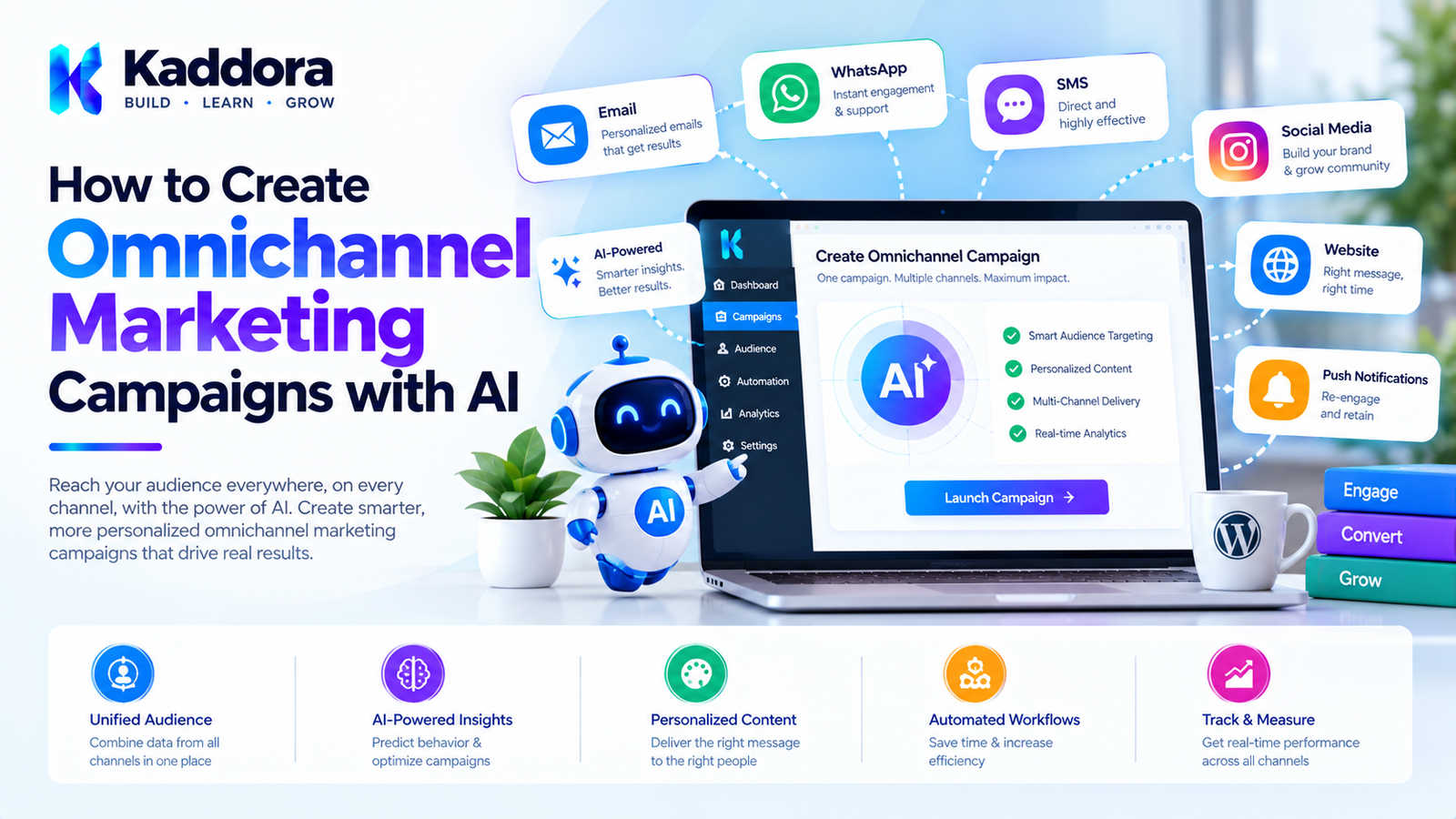
How to Create Omnichannel Marketing Campaigns with AI
Introduction
Modern customers interact with businesses through multiple channels.
A customer may discover a business through Google, visit its WordPress website, subscribe to an email list, interact with an Instagram post, receive a WhatsApp message, and eventually make a purchase through WooCommerce.
If each channel operates independently, the customer experience can become fragmented.
For example:
Website ↓ Email ↓ Social Media ↓ WhatsApp ↓ SMS ↓ Purchase
An omnichannel strategy attempts to connect these interactions into a coordinated customer journey.
Artificial intelligence can make this process more efficient by assisting with:
Customer segmentation
Content generation
Personalization
Campaign planning
Message variations
Audience analysis
Lead classification
Campaign optimization
Performance summaries
WordPress can serve as the central website and content platform, while integrations connect it with external communication channels.
A practical architecture can look like:
Customer Data ↓ WordPress ↓ Marketing Automation ↓ ┌─────────────┬────────────┬─────────────┐ ↓ ↓ ↓ ↓ Email WhatsApp SMS Social │ │ │ │ └─────────────┴────────────┴─────────────┘ ↓ Analytics ↓ AI
The objective is not to send the same message everywhere.
The goal is to coordinate relevant messages across the channels customers actually use.
What Is Omnichannel Marketing?
Omnichannel marketing is an approach where customer interactions across multiple channels are connected into a more consistent journey.
Common channels include:
Website
SMS
Social media
Push notifications
Mobile applications
Search
Online stores
A multichannel approach may simply use several channels.
An omnichannel approach focuses on how those channels work together.
For example:
Customer visits website ↓ Downloads guide ↓ Email follow-up ↓ WhatsApp reminder ↓ Product page visit ↓ Personalized campaign ↓ Purchase
Each interaction can contribute to the next step.
What Does AI Add to Omnichannel Marketing?
Traditional marketing automation can follow predefined rules.
For example:
If user registers → Send email.
AI can add more flexible capabilities:
Customer Data ↓ AI Analysis ↓ Customer Intent ↓ Personalized Content ↓ Best-Suited Workflow
AI can assist with:
Content creation
Customer classification
Intent analysis
Message personalization
Recommendations
Campaign summaries
Content variations
The underlying automation system should still control critical workflow conditions.
Why Use AI for Omnichannel Campaigns?
Managing several channels manually creates repetitive work.
Marketing teams may need to create:
Email campaigns
SMS messages
WhatsApp messages
Social posts
Website banners
Push notifications
Follow-up messages
AI can help create channel-specific versions from a common campaign brief.
For example:
Campaign Brief ↓ AI ↓ Email Version SMS Version WhatsApp Version Social Version Website Version
Each version can then be reviewed and approved.
WordPress as an Omnichannel Marketing Hub
WordPress can act as the central content and customer-interaction platform.
For example:
WordPress Website ↓ Forms WooCommerce Content Users Events Bookings ↓ Marketing Automation ↓ External Channels
WordPress does not need to directly handle every communication channel.
Instead, integrations can connect the website with specialized services.
Connect WordPress With Marketing Channels
A WordPress-based omnichannel system may integrate with:
Email providers
SMS providers
WhatsApp providers
CRM platforms
Social media tools
Analytics platforms
WooCommerce
Customer-support systems
The exact architecture depends on the business requirements and the providers being used.
Build a Central Customer Profile
Omnichannel campaigns work better when customer information is organized.
A customer profile might include:
Customer ├── Contact Information ├── Website Activity ├── Purchases ├── Form Submissions ├── Email Engagement ├── Preferences ├── Bookings └── Campaign Interactions
Only appropriate and consented data should be collected and used.
Customer Data Collection
WordPress can collect customer information through:
Registration forms
Contact forms
Newsletter forms
WooCommerce purchases
Appointment bookings
Event registrations
Surveys
Lead forms
The information should be collected for clear purposes.
Avoid collecting unnecessary personal data simply because it may be useful later.
AI Customer Segmentation
Customer segmentation divides an audience into meaningful groups.
For example:
Customers ├── New Leads ├── Existing Customers ├── Repeat Customers ├── Inactive Customers ├── High-Engagement Users └── Product-Specific Audiences
AI can assist in identifying patterns within available customer data.
The segmentation criteria should be documented and appropriate for the campaign purpose.
Behavioral Segmentation
Segments can be based on actions such as:
Website visits
Product views
Purchases
Email engagement
Event registration
Appointment bookings
Content downloads
For example:
Viewed Product ↓ No Purchase ↓ Follow-Up Campaign
The actual trigger should come from reliable tracking data.
AI Intent Detection
AI can analyze customer messages or interactions to identify potential intent.
For example:
"I want pricing information." ↓ Pricing Intent
or:
"Can someone help me choose a plan?" ↓ Purchase Assistance
This can help route customers into appropriate workflows.
AI Lead Classification
A lead-management system can classify inquiries into categories such as:
Lead ├── Sales Inquiry ├── Support Question ├── Partnership ├── Product Interest └── General Inquiry
AI can assist with classification.
Important sales or customer decisions should still use defined business rules and appropriate human review.
AI Campaign Planning
AI can help marketers create an initial campaign plan.
For example:
Campaign Objective ↓ Audience ↓ Channels ↓ Messages ↓ Timing ↓ Measurement
An AI assistant can suggest content and workflow ideas based on the campaign brief.
The marketing team should approve the final campaign.
Create One Campaign, Multiple Channel Versions
Instead of writing every message separately, start with a central campaign brief.
For example:
Campaign: New Product Launch Audience: Existing Customers Offer: Product Introduction Goal: Drive Product Discovery
AI can generate channel-specific drafts:
Email SMS WhatsApp Social Website Banner
This improves consistency while allowing each channel to use appropriate formatting.
AI Email Marketing
AI can help create:
Subject lines
Email introductions
Product descriptions
Calls to action
Follow-up emails
Re-engagement campaigns
For example:
Campaign Brief ↓ AI ↓ Email Draft ↓ Human Review ↓ Email Platform
The email system should handle delivery and unsubscribe requirements.
AI SMS Marketing
SMS requires concise messaging.
AI can convert a longer campaign message into a shorter version.
For example:
Campaign ↓ AI ↓ Short SMS
SMS campaigns should respect applicable consent and messaging requirements.
AI WhatsApp Marketing
Businesses can use WhatsApp for:
Order notifications
Appointment reminders
Event updates
Customer support
Promotional campaigns where permitted
AI can help generate or personalize message drafts.
The actual delivery should use an appropriate WhatsApp business integration and comply with applicable platform rules.
AI Social Media Campaigns
A campaign can be adapted for different social channels.
For example:
Campaign ↓ AI ├── Instagram Caption ├── Facebook Copy ├── LinkedIn Copy └── Short-Form Content
Each platform should receive content appropriate to its audience and format.
AI Website Personalization
A WordPress website can potentially personalize experiences based on appropriate user information.
Examples include:
Relevant product recommendations
Recently viewed products
Returning customer messaging
Personalized content suggestions
Personalization should respect privacy and applicable consent requirements.
AI WooCommerce Omnichannel Marketing
WooCommerce provides useful commerce events such as:
Product views
Orders
Purchases
Cart activity
Customer accounts
These can be used as triggers for marketing workflows where appropriate.
For example:
WooCommerce Purchase ↓ Customer Profile ↓ Post-Purchase Workflow ↓ Email / WhatsApp / Other Channel
AI Product Recommendations
AI can help recommend products based on relevant customer behavior.
For example:
Customer Activity ↓ Product Relationships ↓ AI Recommendation ↓ Marketing Channel
Recommendations should be based on available data and appropriate business rules.
AI Abandoned Cart Campaigns
For WooCommerce stores, abandoned-cart workflows can trigger follow-up communication.
A simplified workflow is:
Product Added to Cart ↓ No Purchase ↓ Reminder ↓ Optional Follow-Up
AI can help personalize the message.
The workflow should respect applicable marketing permissions and channel rules.
AI Post-Purchase Campaigns
After a purchase, an omnichannel workflow may include:
Purchase ↓ Confirmation ↓ Product Education ↓ Support ↓ Review Request ↓ Relevant Follow-Up
AI can help generate content for each stage.
AI Customer Journey Mapping
AI can help summarize customer journeys.
For example:
Advertisement ↓ Website ↓ Product Page ↓ Email ↓ Purchase ↓ Support
This can help marketing teams understand how customers interact with different channels.
AI Campaign Personalization
Instead of sending exactly the same message to every customer, marketers can personalize:
Greeting
Product recommendations
Content
Offers
Timing
Calls to action
Personalization should use appropriate data and should not become invasive.
AI Dynamic Content
A campaign can contain different content blocks based on customer segments.
For example:
Customer Segment ↓ Content Rule ↓ Relevant Message
AI can help create the content variations.
The marketing automation system should determine which version is shown or sent.
AI Campaign Timing
AI can analyze historical engagement data to provide timing suggestions.
For example:
Historical Engagement ↓ AI Analysis ↓ Timing Suggestion
These are recommendations rather than guarantees.
The campaign platform should control the actual delivery schedule.
Omnichannel Campaign Workflow
A complete campaign might look like:
Customer Enters Segment ↓ Email ↓ No Engagement? ↙ ↘ Yes No ↓ ↓ WhatsApp Continue Journey ↓ Website Visit ↓ Product Interaction ↓ Follow-Up
Each condition should be based on actual tracked events.
AI Customer Journey Automation
AI can assist in identifying patterns, while the automation engine executes the workflow.
A useful architecture is:
Customer Data ↓ AI Analysis ↓ Segment / Intent ↓ Automation Rules ↓ Communication Channel
This separation makes campaigns easier to control.
AI Marketing Automation Rules
Not every decision needs AI.
For example:
If order is completed → Send order confirmation.
A deterministic rule is preferable.
AI is more useful for tasks such as:
Summarize customer request Generate personalized copy Classify customer intent Recommend content
Use AI where it adds value rather than adding AI to every step.
AI Omnichannel Customer Support
Customer support can also become part of an omnichannel strategy.
A customer may ask a question through:
Website
Social media
An AI support system can help classify and route these conversations.
A central customer context can make the experience more consistent.
AI Support Ticket Classification
Support messages can be categorized:
Support Request ↓ AI ↓ Billing Technical Order Booking General
The ticketing system can then route the request appropriately.
AI Response Drafting
AI can help customer-service teams draft replies.
For example:
Customer Message ↓ AI Draft ↓ Agent Review ↓ Customer Response
Human review can be especially important for sensitive, complex, or high-impact communications.
Omnichannel Analytics
An omnichannel dashboard can combine:
Website traffic
Email engagement
SMS activity
WhatsApp interactions
Social engagement
Orders
Conversions
Customer retention
AI can summarize these metrics.
AI Campaign Performance Summaries
Instead of manually reviewing multiple dashboards, marketers can use AI to create summaries.
For example:
Campaign Data ↓ AI ↓ Performance Summary ↓ Marketing Team
The summary should link back to actual metrics.
AI Conversion Analysis
AI can help identify patterns in:
Landing pages
Email engagement
Product views
Cart activity
Purchases
For example:
Campaign ↓ Website Visit ↓ Product Interaction ↓ Purchase
AI can summarize where users appear to drop off based on available analytics.
AI Customer Retention Campaigns
Retention campaigns can target customers based on appropriate activity patterns.
For example:
No Purchase for Defined Period ↓ Retention Segment ↓ Campaign
AI can help generate personalized messages or content.
The timing and eligibility should be controlled by explicit campaign rules.
AI Re-Engagement Campaigns
Inactive users can be grouped into a re-engagement workflow.
For example:
Inactive Customer ↓ Email ↓ No Engagement ↓ Alternative Channel
The system should respect consent and communication preferences.
AI Cross-Channel Consistency
A campaign should maintain consistent:
Brand voice
Product information
Offer details
Visual identity
Calls to action
AI can help adapt content while preserving the central campaign message.
AI Campaign Content Repurposing
One campaign can produce many assets.
For example:
Long-Form Article ↓ AI ├── Email ├── Social Post ├── SMS ├── WhatsApp ├── Website Banner └── Short Summary
This can reduce repetitive content production.
WordPress AI Omnichannel Plugin Architecture
A scalable WordPress plugin could use:
WordPress │ ├── Customer Data ├── WooCommerce ├── Forms ├── Content │ ├── Campaign Manager │ ├── Segmentation │ ├── AI Service │ ├── Automation Engine │ ├── Channel Adapters │ ├── Email │ ├── SMS │ ├── WhatsApp │ └── Other Channels │ └── Analytics
The important principle is to keep each responsibility separate.
Use a Campaign Service
Instead of placing campaign logic directly into WordPress hooks, use an application service.
For example:
final class Campaign_Service { public function launch( $campaign_id ) { // Load campaign. // Resolve audience. // Prepare content. // Trigger channel workflows. } }
The service can coordinate the workflow while channel-specific classes handle delivery.
Channel Adapters
Each communication channel can have its own integration.
For example:
Campaign Service ↓ Channel Interface ↓ Email Adapter SMS Adapter WhatsApp Adapter
This makes it easier to replace or add providers.
AI Service Layer
AI functionality can also be isolated:
Campaign Service ↓ AI Service ↓ AI Provider
The campaign system should not be tightly coupled to a specific AI provider.
Structured AI Output
For campaign automation, structured AI output is preferable.
For example:
{ "segment": "repeat_customer", "message_type": "promotion", "content": "...", "recommended_channel": "email" }
The application should validate the output before using it.
Validate AI Campaign Content
AI-generated content should be checked for:
Missing information
Incorrect prices
Incorrect dates
Unsupported claims
Invalid URLs
Excessive length
Brand requirements
Critical campaign details should come from structured campaign data.
Protect Customer Data
Omnichannel systems may contain significant amounts of customer information.
Examples include:
Names
Email addresses
Phone numbers
Purchases
Preferences
Website activity
Communication history
Only necessary information should be transmitted to external AI providers.
Consent and Communication Preferences
Marketing systems should respect customer preferences.
For example:
Customer ├── Email: Allowed ├── SMS: Not Allowed ├── WhatsApp: Allowed └── Promotional Messages: Allowed
The automation system should check channel eligibility before sending messages.
AI and Marketing Privacy
Before sending customer data to an AI provider, businesses should consider:
What data is being transmitted?
Why is it necessary?
Is the customer expecting this processing?
What does the provider do with the data?
How long is it retained?
Can the workflow operate without that data?
Data minimization should be part of the design.
AI API Security
AI API credentials should remain server-side.
Avoid exposing API keys through:
JavaScript
HTML
Browser storage
Public REST endpoints
Debug logs
Use secure server-side integrations.
Omnichannel Campaign Performance
An omnichannel system should measure meaningful outcomes.
Useful metrics can include:
Reach
Engagement
Click-through rate
Conversion rate
Revenue
Customer retention
Unsubscribe rate
Campaign cost
Channel performance
Metrics should be interpreted in context.
AI Campaign Reporting
AI can turn campaign metrics into readable summaries.
For example:
Campaign Data ↓ AI Analysis ↓ Summary ↓ Recommendations
Recommendations should be treated as analytical suggestions rather than guaranteed outcomes.
AI Marketing Attribution
Attribution can become complex when customers interact with multiple channels.
For example:
Google Search ↓ Website ↓ Email ↓ WhatsApp ↓ Purchase
Different attribution models can assign credit differently.
AI can summarize attribution data, but marketers should understand which attribution methodology is being used.
Common Omnichannel Marketing Mistakes
1. Sending the Same Message Everywhere
Each channel has different user expectations.
2. Ignoring Customer Preferences
Respect communication choices.
3. Collecting Excessive Data
Only collect information that serves a clear purpose.
4. Letting AI Invent Offers
Prices, discounts, dates, and product details should come from verified campaign data.
5. Using AI for Every Decision
Simple deterministic rules are often better for straightforward workflows.
6. No Central Customer Context
Disconnected systems can create inconsistent experiences.
7. Ignoring Channel Limits
SMS, WhatsApp, email, and social platforms have different requirements.
8. No Human Review
Important campaigns may require approval before publication.
9. Exposing API Credentials
External service credentials must remain secure.
10. No Measurement
Campaigns should be measured using meaningful metrics.
Best Practices for AI Omnichannel Marketing
1. Start With a Clear Customer Journey
Define the journey before adding automation.
2. Centralize Important Customer Data
Use a controlled customer profile where appropriate.
3. Use AI for Language and Analysis
AI is especially useful for content, classification, summarization, and recommendations.
4. Use Rules for Critical Conditions
Payment status, consent, subscription status, and order state should use authoritative systems.
5. Personalize Responsibly
Use relevant information without becoming invasive.
6. Respect Communication Preferences
Check channel eligibility before sending.
7. Keep Channel Integrations Modular
Use adapters or dedicated integrations.
8. Validate AI Output
Do not automatically trust generated campaign data.
9. Keep Human Approval
Use review workflows for important campaigns.
10. Measure the Complete Journey
Look beyond individual channel metrics.
AI Omnichannel Marketing Checklist
Strategy
Define campaign objective
Define target audience
Map customer journey
Select channels
Define conversion goal
WordPress
Connect forms
Connect WooCommerce
Configure customer data
Set up campaign triggers
Configure analytics
AI
Content generation
Customer segmentation
Intent classification
Personalization
Campaign summaries
Content repurposing
Channels
Email integration
SMS integration
WhatsApp integration
Social integrations
Website personalization
Security
Protect customer data
Secure API keys
Validate external responses
Respect communication preferences
Limit unnecessary data transmission
Analytics
Track campaign engagement
Track conversions
Track revenue where appropriate
Monitor unsubscribes
Review channel performance
The Future of AI Omnichannel Marketing
Future marketing platforms are likely to become more conversational and interconnected.
A customer could interact with a business through a website, email, messaging platform, or application while the underlying system maintains relevant context.
A possible architecture is:
Customer ↓ Any Channel ↓ Customer Identity ↓ Central Context ↓ AI ↓ Marketing Automation ↓ Relevant Channel
For WordPress businesses, this could connect:
WordPress + WooCommerce + CRM + Email + WhatsApp + SMS + Analytics + AI
The most useful systems will not simply send more messages.
They will coordinate relevant communication based on actual customer interactions, preferences, and campaign objectives.
Why Choose Kaddora?
Kaddora focuses on WordPress and WooCommerce solutions involving AI, marketing automation, customer engagement, analytics, and business workflows.
For businesses building omnichannel campaigns, AI-assisted functionality can support:
Customer segmentation
Campaign content generation
Email automation
WhatsApp workflows
Customer communication
WooCommerce campaigns
Lead management
Personalization
Analytics
AI-powered recommendations
Kaddora's practical approach is to combine AI assistance with structured WordPress and WooCommerce data.
The objective is not to automate communication simply for the sake of sending more messages.
Instead, AI can help businesses create relevant content, organize customer information, automate repetitive workflows, and understand campaign performance while keeping important marketing rules and customer preferences under controlled systems.
Conclusion
AI can make omnichannel marketing more scalable by helping businesses coordinate content, customer data, segmentation, personalization, communication, and analytics across multiple channels.
A practical workflow is:
Customer Data ↓ Segmentation ↓ Campaign ↓ AI-Assisted Content ↓ Channel Automation ↓ Customer Interaction ↓ Analytics ↓ Optimization
WordPress can act as the central website and content platform, while WooCommerce, CRM systems, email providers, messaging services, and analytics tools can extend the marketing ecosystem.
AI is particularly useful for:
Content generation
Personalization
Segmentation
Intent classification
Customer support
Campaign summaries
Content repurposing
However, AI should not replace authoritative systems for consent, payment status, customer records, order status, or other critical business information.
For developers, a scalable AI omnichannel marketing solution should use modular integrations, a dedicated AI service layer, structured customer data, validated AI output, secure API credentials, and reliable fallback workflows.
For marketers, the goal should be a connected customer journey rather than simply increasing the number of messages.
When WordPress, automation, AI, WooCommerce, customer data, and communication channels are connected thoughtfully, businesses can create more coordinated marketing experiences while keeping control over important data and decisions.
Frequently Asked Questions
What is AI omnichannel marketing?
AI omnichannel marketing combines artificial intelligence with multiple marketing channels such as websites, email, SMS, WhatsApp, social media, and commerce platforms to coordinate customer journeys and marketing workflows.
What is the difference between multichannel and omnichannel marketing?
Multichannel marketing uses multiple communication channels. Omnichannel marketing focuses on connecting those channels so customer interactions can form a more coordinated journey.
Can WordPress be used for omnichannel marketing?
Yes. WordPress can act as a central website and content platform and connect with email, CRM, WooCommerce, messaging, analytics, and other marketing systems.
What can AI do in omnichannel marketing?
AI can assist with content generation, segmentation, personalization, intent classification, customer support, recommendations, campaign analysis, and content repurposing.
Can AI create content for multiple marketing channels?
Yes. AI can create channel-specific drafts from a central campaign brief for email, SMS, WhatsApp, social media, and website content.
Can AI personalize marketing campaigns?
Yes. AI can assist with personalized content and recommendations using appropriate customer information and campaign rules.
Can AI segment customers?
Yes. AI can identify patterns in customer data and assist with segmentation based on factors such as engagement, purchases, interests, or other appropriate attributes.
Can AI analyze customer intent?
Yes. AI can analyze customer messages and interactions to classify possible intent, such as product interest, support requests, or pricing questions.
What is an AI omnichannel marketing plugin for WordPress?
It is a WordPress extension that can connect customer data, marketing automation, AI services, and communication channels to coordinate marketing workflows.
How should developers build an AI omnichannel WordPress plugin?
A practical architecture can include customer data, campaign management, segmentation, an AI service layer, automation rules, channel adapters, integrations, and analytics.
Why choose Themekaddora?
Themekaddora provides lightweight, responsive, SEO-friendly WordPress themes with fast performance, WooCommerce compatibility, flexible customization, accessibility-conscious design, modern templates, regular updates, and professional support—providing a strong foundation for businesses building digital products and product-focused websites.
Comments (0)