
Introduction
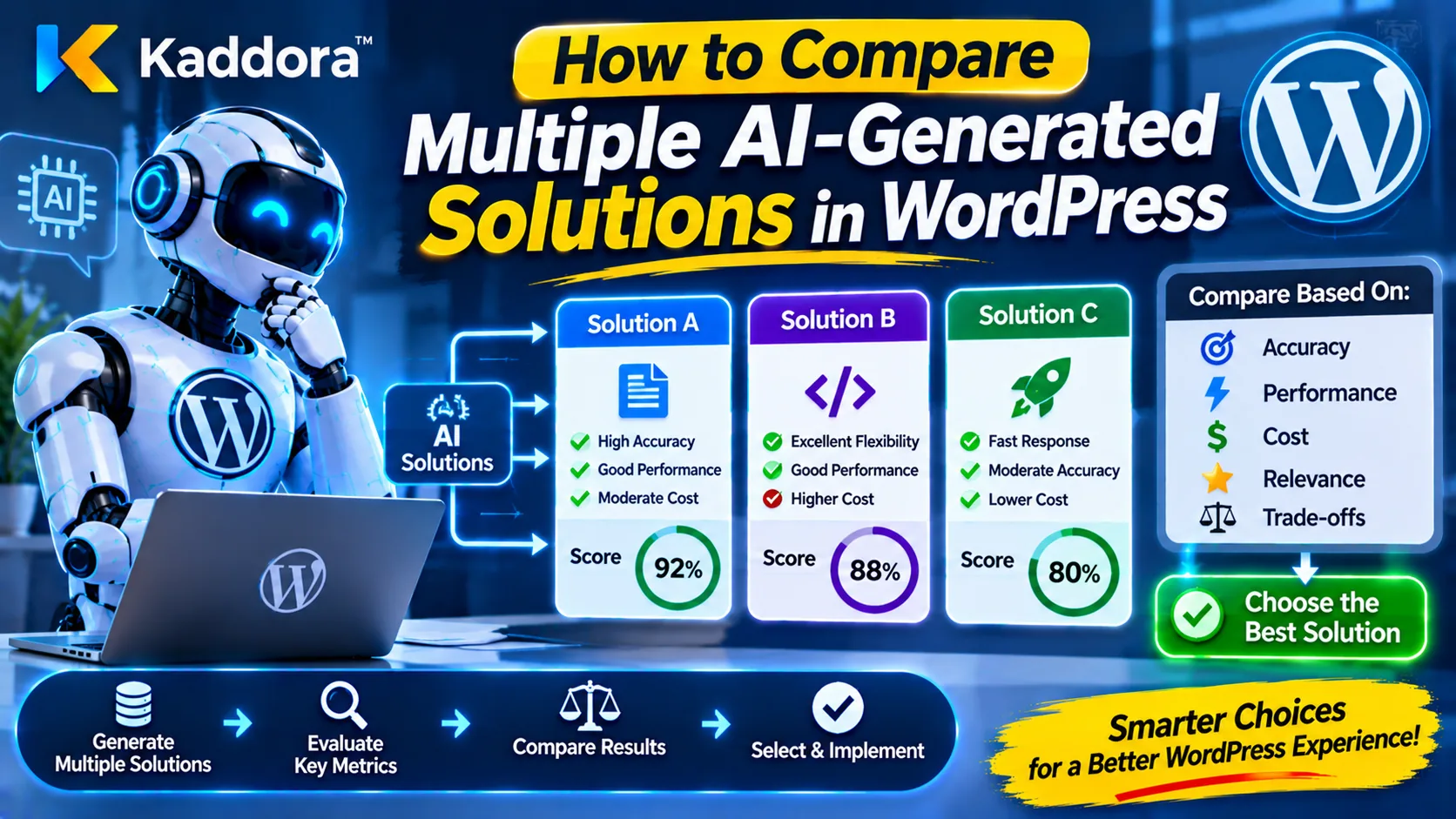
AI-powered WordPress plugins are increasingly being used to analyze website problems, generate recommendations, automate business processes, and support complex decisions. However, an AI agent may generate several possible solutions for the same problem, and selecting the right one requires more than choosing the first recommendation.
For example, a WordPress performance assistant may identify slow page loading and generate several solutions:
Optimize large images.
Configure page caching.
Reduce unnecessary JavaScript.
Improve database query performance.
Upgrade the hosting environment.
Each solution may offer different benefits, implementation requirements, costs, and risks. An option that works well for one website may be unsuitable for another because of its existing plugins, theme, hosting configuration, or business requirements.
This makes solution comparison an important part of AI agent architecture.
Comparing multiple AI-generated solutions in WordPress means systematically evaluating different AI-proposed approaches against the same objective, verified evidence, technical constraints, and predefined evaluation criteria. The system then identifies the most suitable option or presents several alternatives for administrator review.
A reliable comparison process should not depend entirely on AI-generated opinions or confidence scores. It should combine structured evaluation, deterministic calculations, evidence verification, compatibility checks, and application-level security controls.
In this guide, we will explore how to compare multiple AI-generated solutions in WordPress, design a solution evaluation architecture, implement practical PHP examples, and build a reliable selection process for AI-powered plugins.
What Does Comparing Multiple AI-Generated Solutions Mean?
Comparing multiple AI-generated solutions is the process of examining different approaches to the same problem and determining which one best satisfies the required objective.
An AI agent first identifies a problem and generates possible solutions. A comparison engine then evaluates each option using consistent criteria.
Consider a WooCommerce store experiencing declining product conversions.
An AI agent generates three possible solutions:
Solution
Approach
Primary objective
Solution A
Improve product descriptions
Increase content relevance
Solution B
Optimize product images
Improve product presentation
Solution C
Simplify checkout
Reduce purchase friction
All three approaches may be reasonable, but they address different parts of the customer journey.
The comparison engine should evaluate the available evidence, expected effectiveness, implementation complexity, cost, compatibility, and risk before recommending an approach.
The goal is not simply to identify the highest-scoring suggestion. It is to select a solution that is technically feasible, aligned with business requirements, and supported by reliable evidence.
Why Comparing AI-Generated Solutions Matters in WordPress Plugins
WordPress websites have different technical environments and operational requirements. A solution that performs well on one installation may introduce problems on another.
For example, installing an additional caching plugin may create conflicts with an existing optimization setup. Replacing a theme might improve performance but disrupt custom layouts and integrations.
Similarly, automatically reducing product prices may increase sales volume while reducing profitability.
Comparing alternatives helps AI agents make more informed recommendations.
Important benefits include:
Improved decision quality: Multiple approaches can be evaluated before selecting an action.
Reduced implementation risk: Compatibility and security concerns can be identified before changes are made.
Better resource allocation: Developers can compare estimated cost, effort, and infrastructure requirements.
Greater transparency: Administrators can understand why one option was preferred over another.
More flexible automation: The agent can adapt its recommendation when website conditions or business requirements change.
Evidence-based recommendations: Solutions can be compared against actual WordPress data rather than relying only on model-generated assumptions.
This is especially valuable when AI agents can modify content, update products, change settings, or execute other business operations.
Core Architecture for Comparing Multiple AI-Generated Solutions
A reliable comparison system should separate solution generation from evaluation and execution.
Problem Definition Layer
The first layer defines the problem and establishes what a successful solution must achieve.
It should identify:
The problem being addressed.
The affected WordPress component.
The desired outcome.
Technical limitations.
Business requirements.
Available resources.
Prohibited operations.
Required approval conditions.
For example, an AI performance plugin may need to improve page loading without changing the active theme, disabling essential plugins, or affecting checkout functionality.
These requirements become the basis for comparing generated alternatives.
Solution Generation Layer
The solution generation layer collects multiple possible approaches from an AI model, predefined workflows, or an approved knowledge base.
Each alternative should have a consistent structure containing:
Unique solution identifier.
Solution title.
Description.
Expected outcome.
Supporting evidence.
Implementation requirements.
Estimated complexity.
Potential risks.
Dependencies.
Assumptions.
Structured information makes it easier to compare different solutions without relying on long, unorganized AI-generated paragraphs.
Solution Normalization Layer
AI models may describe similar solutions using different language or formats.
One recommendation might say "Enable full-page caching," while another says "Configure server-side page caching."
The normalization layer identifies duplicate or overlapping approaches and converts comparable attributes into a consistent format.
It should preserve the original recommendations so that the system does not lose important implementation details.
Evaluation Criteria Layer
This layer defines how solutions will be compared.
Typical criteria include:
Expected effectiveness.
Implementation complexity.
Cost.
Compatibility.
Security impact.
Reversibility.
Maintenance requirements.
Evidence quality.
Time required.
The criteria should reflect the actual objective. A security plugin may prioritize risk reduction and authorization, while an SEO plugin may prioritize technical correctness and content relevance.
Evidence Validation Layer
The evidence validation layer checks whether each solution is supported by reliable information.
For example, an AI agent may recommend optimizing images because it believes large images are slowing down a website.
The plugin should verify image sizes and relevant performance measurements before treating that recommendation as evidence-based.
A solution based on an incorrect assumption should not receive the same evaluation as a solution supported by verified data.
Scoring and Ranking Engine
The scoring engine assigns comparable scores to validated alternatives.
It can use weighted criteria, deterministic calculations, mandatory constraints, and business-specific evaluation rules.
The system should distinguish between a solution's numerical score and its actual eligibility.
A high score must never override a mandatory security or compatibility requirement.
Recommendation and Approval Layer
After comparison, the system determines how to present the results.
Possible outcomes include:
Recommend the highest-ranked eligible solution.
Present the top alternatives for administrator selection.
Recommend a combination of compatible solutions.
Request additional information.
Escalate a high-risk decision for review.
Report that none of the alternatives is suitable.
Execution and Monitoring Layer
Only approved solutions should reach the execution controller.
The controller validates permissions and parameters before calling predefined WordPress functions or plugin services.
After execution, the system monitors the outcome and compares actual results with the original objective.
Important Criteria for Comparing AI-Generated Solutions
The quality of a solution comparison depends on selecting appropriate evaluation criteria.
Effectiveness
Effectiveness measures how well a solution is expected to achieve the defined objective.
For a performance optimization plugin, this may involve expected improvements in loading time, server response, or resource usage.
For an SEO plugin, it may involve technical correctness, search intent alignment, and content quality.
Effectiveness should be supported by available measurements, testing, or credible evidence rather than unsupported AI estimates.
Implementation Complexity
Complexity measures how difficult a solution is to implement and maintain.
Consider two performance recommendations:
Compress existing images.
Migrate the website to a new hosting environment.
The second approach may require significantly more planning, testing, and operational coordination.
A simple solution may be preferable when two alternatives offer similar benefits.
Cost and Resource Requirements
The system should compare direct and indirect costs.
These may include:
Software subscriptions.
Hosting resources.
Development time.
External services.
Maintenance expenses.
Migration costs.
If cost information is unavailable, the plugin should mark it as unknown rather than inventing a value.
Compatibility
A solution must work with the existing WordPress environment.
Compatibility checks may include:
WordPress version.
PHP version.
Active theme.
Installed plugins.
WooCommerce configuration.
Existing integrations.
Hosting limitations.
The system should distinguish verified compatibility from an assumption based on documentation or model knowledge.
Security Risk
Security risk should be evaluated independently of general solution quality.
A recommendation that requires disabling an essential security component should be rejected or escalated, even if the model predicts a performance improvement.
Reversibility
Reversibility measures how easily an implementation can be undone.
A configuration adjustment may be relatively easy to reverse, while a database migration or bulk content deletion may require extensive recovery procedures.
High-impact changes should have appropriate backup and rollback planning.
Evidence Quality
Evidence quality measures how well the recommendation is supported.
Useful evidence may include:
Current WordPress records.
Performance measurements.
Verified error logs.
WooCommerce analytics.
Plugin compatibility documentation.
Previous test results.
A solution based primarily on assumptions should be identified as uncertain.
How to Compare Multiple AI-Generated Solutions Step by Step
Define a Shared Evaluation Objective
All alternatives must be evaluated against the same objective.
For example:
"Improve product page performance without changing checkout behavior or removing existing business functionality."
This prevents the comparison engine from evaluating different solutions against different goals.
Collect and Verify Relevant Evidence
Before comparing alternatives, retrieve the information needed to evaluate them.
For a performance-related task, this could include:
Current loading measurements.
Image file sizes.
Existing cache configuration.
Active optimization plugins.
Relevant database performance information.
Known compatibility limitations.
The system should record the source and timestamp of important evidence.
Generate Structured Alternatives
Ask the AI agent to produce a defined number of distinct solutions.
Each alternative should explain:
What it proposes.
Which problem it addresses.
Why it may work.
What evidence supports it.
What resources it requires.
What risks or dependencies exist.
The model should also identify missing information instead of filling gaps with invented assumptions.
Normalize Evaluation Values
Different solutions should use consistent scoring scales and field definitions.
For example, complexity might be represented as a normalized value from 0 to 100, where a higher value means greater difficulty.
Risk should be evaluated separately so that the scoring system does not confuse a high complexity score with a high security risk.
Apply Mandatory Constraints
Before calculating rankings, reject alternatives that violate non-negotiable requirements.
Examples include:
Incompatible PHP requirements.
Unauthorized operations.
Prohibited changes to essential plugins.
Missing required approval.
Unacceptable security risks.
Mandatory constraints should not be treated as ordinary scoring preferences.
Calculate Scores and Rank Alternatives
The comparison engine can calculate a weighted score for each eligible solution.
The weights should reflect the problem being solved.
For example, a performance plugin might give effectiveness more importance than implementation simplicity, while a security plugin might prioritize risk reduction and policy compliance.
Explain the Ranking
The system should explain why the preferred solution ranked higher.
Useful explanations include:
Stronger supporting evidence.
Lower implementation complexity.
Better compatibility.
Lower estimated cost.
Easier rollback.
Better alignment with business requirements.
Request Approval and Monitor Results
The system should present the recommendation to the appropriate user.
If implementation is approved, execute the predefined operation and monitor the result.
If the selected solution fails, use the new evidence to reevaluate the remaining alternatives.
Practical PHP Implementation in WordPress
Developers can build a basic comparison engine using structured solution data and deterministic evaluation rules.
The following examples demonstrate the core workflow.
Define Structured AI-Generated Solutions
Each alternative should contain comparable attributes.
$solutions = array( array( 'id' => 'solution_001', 'title' => 'Optimize product images', 'effectiveness' => 90, 'simplicity' => 85, 'compatibility' => 95, 'risk_level' => 'low', 'evidence' => array( 'large_images_detected', ), ), array( 'id' => 'solution_002', 'title' => 'Configure page caching', 'effectiveness' => 85, 'simplicity' => 70, 'compatibility' => 80, 'risk_level' => 'medium', 'evidence' => array( 'cache_not_configured', ), ), );
These values are illustrative. In a real plugin, scores should be derived from verified measurements, documented evaluation rules, or carefully calibrated assessments.
Create a Solution Comparison Class
A dedicated comparison class helps keep evaluation logic separate from the AI provider integration.
class Kaddora_AI_Solution_Comparator { private $weights = array( 'effectiveness' => 0.50, 'simplicity' => 0.20, 'compatibility' => 0.30, ); public function calculate_score( $solution ) { $score = 0; foreach ( $this->weights as $criterion => $weight ) { if ( ! isset( $solution[ $criterion ] ) || ! is_numeric( $solution[ $criterion ] ) ) { return false; } $value = (float) $solution[ $criterion ]; if ( $value < 0 || $value > 100 ) { return false; } $score += $value * $weight; } return round( $score, 2 ); } }
This class calculates a weighted score using three criteria.
The weights add up to 1.0, making the final score remain on a 0–100 scale.
The values are examples, not universal evaluation standards. A production plugin should configure weights according to its specific use case.
Add Mandatory Risk Validation
A solution should be checked against mandatory requirements before ranking.
class Kaddora_AI_Solution_Policy { public function validate( $solution ) { if ( ! is_array( $solution ) ) { return array( 'eligible' => false, 'reason' => 'Invalid solution structure.', ); } if ( ! isset( $solution['risk_level'] ) || ! in_array( $solution['risk_level'], array( 'low', 'medium', 'high', 'critical' ), true ) ) { return array( 'eligible' => false, 'reason' => 'Unknown risk classification.', ); } if ( 'critical' === $solution['risk_level'] ) { return array( 'eligible' => false, 'reason' => 'Critical risk requires review.', ); } return array( 'eligible' => true, 'reason' => 'Passed basic policy validation.', ); } }
This example rejects critical-risk alternatives and invalid risk classifications.
A real implementation should also validate compatibility, required evidence, permissions, dependencies, and other mandatory application rules.
Compare and Rank Multiple Solutions
The next example combines policy validation with weighted scoring.
function kaddora_ai_rank_solutions( $solutions ) { $comparator = new Kaddora_AI_Solution_Comparator(); $policy = new Kaddora_AI_Solution_Policy(); $ranked = array(); foreach ( $solutions as $solution ) { $validation = $policy->validate( $solution ); if ( empty( $validation['eligible'] ) ) { continue; } $score = $comparator->calculate_score( $solution ); if ( false === $score ) { continue; } $solution['comparison_score'] = $score; $ranked[] = $solution; } usort( $ranked, function ( $first, $second ) { return $second['comparison_score'] <=> $first['comparison_score']; } ); return $ranked; }
Usage:
$ranked_solutions = kaddora_ai_rank_solutions( $solutions ); if ( ! empty( $ranked_solutions ) ) { $recommended_solution = $ranked_solutions[0]; }
This example ranks alternatives that pass the basic policy and scoring checks.
It does not authorize execution. The selected recommendation must still pass current permission checks, evidence validation, and any required approval process.
Validate Evidence Before Comparison
A scoring engine should not treat every AI-generated evidence reference as trustworthy.
For example, a solution may claim that large images are responsible for slow loading. The plugin should verify the relevant image and performance records before treating this claim as established.
A simplified evidence validation function might look like this:
function kaddora_ai_validate_evidence( $evidence, $verified_ids ) { if ( ! is_array( $evidence ) || ! is_array( $verified_ids ) ) { return false; } foreach ( $evidence as $evidence_id ) { if ( ! is_string( $evidence_id ) || ! in_array( $evidence_id, $verified_ids, true ) ) { return false; } } return true; }
This checks whether referenced identifiers belong to a verified identifier list.
It does not prove that the evidence supports the solution. A production system must also validate the content, source, relevance, and freshness of each evidence record.
Using AI Models to Explain Solution Comparisons
Deterministic scoring can rank solutions, but administrators may also need an understandable explanation of the comparison.
An AI model can help generate a summary based on validated evaluation results.
For example:
Recommended solution: Optimize existing product images.
Reason: The website has verified oversized product images, and image optimization offers a practical improvement without requiring changes to the active theme or checkout configuration.
Alternative: Configure page caching.
Reason: Caching may improve performance, but the current website already uses an optimization plugin that needs compatibility verification.
The explanation should be generated from the actual evaluation results.
The model must not invent test results, compatibility confirmations, cost estimates, or performance improvements.
The application should also validate the explanation before displaying it, particularly when it contains numerical claims.
Handling Similar, Duplicate, and Conflicting Solutions
AI models may generate several recommendations that are effectively the same.
For example:
Reduce image file sizes.
Compress website images.
Optimize product image formats.
These recommendations may represent one underlying solution rather than three independent alternatives.
A comparison system should identify duplicate or overlapping options before ranking them.
It should also identify alternatives that cannot be implemented together.
For example, two caching approaches may require incompatible configurations. Combining both could create unnecessary complexity or unexpected behavior.
Useful comparison relationships include:
Duplicate solutions.
Complementary solutions.
Mutually exclusive solutions.
Dependent solutions.
Conflicting solutions.
Unrelated solutions.
Semantic analysis can help identify these relationships, while deterministic compatibility rules should validate important technical constraints.
Multi-Criteria Decision Analysis for WordPress AI Plugins
A more advanced comparison system can use Multi-Criteria Decision Analysis (MCDA).
MCDA evaluates alternatives using multiple criteria instead of relying on a single measurement.
For example, a WordPress plugin might compare solutions using:
Criterion
Weight
Expected effectiveness
40%
Compatibility
25%
Implementation simplicity
15%
Cost efficiency
10%
Reversibility
10%
The system calculates a weighted score for each alternative and ranks the eligible options.
However, weighted scoring has limitations.
A high overall score can hide a serious weakness in one criterion. For example, a solution might score highly on effectiveness and cost but fail a mandatory security requirement.
Therefore, MCDA should be combined with mandatory constraints, minimum thresholds, and human review where appropriate.
The system should also explain how weights were selected and allow authorized administrators to adjust them when business requirements change.
Alternative Comparison in Retrieval-Augmented Generation
Retrieval-Augmented Generation (RAG) can improve solution comparison by providing relevant information from WordPress documentation, plugin knowledge bases, business records, and previous troubleshooting results.
For example, a WordPress troubleshooting agent may retrieve:
Documentation about existing caching settings.
Previous optimization reports.
Plugin compatibility notes.
Server configuration information.
Known implementation limitations.
The agent can use this information to evaluate whether a generated solution is suitable for the actual environment.
A reliable RAG comparison workflow should:
Retrieve: Collect relevant technical and business information.
Verify: Check source quality, timestamps, and applicability.
Generate: Produce multiple distinct solutions.
Normalize: Convert alternatives into a consistent structure.
Compare: Identify duplicate, complementary, and incompatible approaches.
Evaluate: Score solutions against predefined criteria.
Validate: Apply technical, security, and permission rules.
Recommend: Present eligible alternatives with supporting evidence.
Monitor: Measure the outcome after an approved solution is implemented.
Retrieved documents and external content must be treated as untrusted information. They should never override system instructions, business policies, or WordPress authorization checks.
Testing the AI Solution Comparison Engine
Testing should verify both the ranking process and the reliability of the underlying evaluation.
Important test cases include:
Different Solution Scores
Provide multiple alternatives with valid but different criterion scores.
Expected result: The system ranks eligible alternatives according to the configured weights.
Missing Evaluation Data
Provide a solution without one of its required scoring fields.
Expected result: The system excludes or flags the solution rather than inventing a score.
Critical-Risk Alternative
Provide a solution that violates a mandatory risk policy.
Expected result: The system rejects it regardless of its numerical score.
Duplicate Alternatives
Provide several solutions with similar objectives and implementation steps.
Expected result: The system identifies potential duplicates before presenting the final comparison.
Conflicting Alternatives
Provide solutions that cannot safely be implemented together.
Expected result: The system marks their incompatibility and avoids recommending an unsafe combination.
Unsupported Evidence
Provide an AI-generated solution with evidence identifiers that do not exist in the verified dataset.
Expected result: The system rejects or flags the unsupported evidence.
Changing Website Conditions
Update relevant WordPress data after generating alternatives.
Expected result: The system refreshes the necessary evidence and reevaluates affected solutions before execution.
Testing should also cover API failures, malformed AI responses, duplicate requests, permission errors, stale caches, and interrupted operations.
Security Best Practices for Comparing AI-Generated Solutions
Solution comparison should never become a way for an AI model to bypass WordPress security controls.
An AI-generated alternative might recommend disabling a security plugin, changing administrator permissions, deleting records, or modifying payment settings.
Developers should apply the following safeguards:
Use an allowlist of permitted operations.
Validate AI-generated output against a strict schema.
Check current_user_can() before privileged operations.
Apply object-level authorization.
Verify nonces for appropriate state-changing requests.
Use $wpdb->prepare() for dynamic SQL queries.
Keep API credentials server-side.
Treat model output and retrieved content as untrusted.
Require approval for sensitive or irreversible changes.
Maintain rollback procedures for important operations.
Protect audit logs and evidence references.
Never execute arbitrary PHP, SQL, or shell commands generated by an AI model.
The comparison engine should evaluate what is appropriate, while the application remains responsible for deciding what is authorized.
Common Mistakes When Comparing Multiple AI-Generated Solutions
Using Different Evaluation Criteria
Comparing one solution based on cost and another based on effectiveness produces an unreliable ranking.
All alternatives should use the same relevant criteria.
Trusting AI-Generated Scores Without Verification
A model may assign a high score to a solution based on assumptions or incomplete information.
Scores should be validated against actual evidence and deterministic rules.
Ignoring Mandatory Constraints
A solution may achieve a high weighted score while violating a security or compatibility requirement.
Mandatory constraints must be applied before ranking.
Treating Every Alternative as Independent
Some solutions are complementary, while others are mutually exclusive.
The system should identify these relationships before recommending combinations.
Ignoring Implementation Costs
A technically effective solution may require expensive infrastructure or extensive development work.
Cost and maintenance requirements should be included where relevant.
Selecting Only the Highest-Ranked Option
The highest-scoring alternative may not always be suitable for the administrator's circumstances.
Present other eligible options when they provide meaningful trade-offs.
Failing to Reevaluate After Website Changes
A solution that was suitable before a plugin update or configuration change may no longer be appropriate.
Refresh relevant evidence before executing important decisions.
Best Practices for Comparing Multiple AI-Generated Solutions in WordPress
Use this checklist when building an AI solution comparison system:
Define a common objective for all alternatives.
Identify website-specific technical and business constraints.
Generate distinct and structured solutions.
Normalize evaluation fields and scoring scales.
Verify supporting evidence before scoring.
Evaluate effectiveness, complexity, cost, and compatibility.
Assess security risk and reversibility separately.
Apply mandatory constraints before ranking.
Use weighted scoring where appropriate.
Identify duplicate, complementary, and conflicting alternatives.
Explain why a solution received its ranking.
Preserve rejected solutions and rejection reasons.
Present multiple eligible options when useful.
Require approval for sensitive operations.
Revalidate evidence before execution.
Monitor actual results after implementation.
Why Choose Kaddora?
Kaddora focuses on digital products and development solutions across WordPress plugins, themes, HTML templates, AI integrations, business applications, and workflow automation.
Building reliable AI-powered WordPress plugins requires more than generating recommendations. Developers need structured data processing, evidence verification, practical evaluation methods, security controls, and transparent decision-making.
Comparing multiple AI-generated solutions helps make these systems more adaptable by allowing them to evaluate different approaches before recommending an action.
ThemeKaddora offers WordPress plugins, themes, HTML templates, and digital products designed to support website owners and developers.
By combining practical development principles with responsible AI integration, developers can create WordPress applications that are more flexible, maintainable, and suitable for real-world workflows.
Conclusion
Comparing multiple AI-generated solutions in WordPress is an important capability for building reliable AI-powered plugins.
An AI agent may generate several approaches to the same problem, but not every suggestion will be technically feasible, cost-effective, compatible, or safe. A structured comparison process helps developers evaluate these differences before selecting an appropriate solution.
A dependable architecture combines problem definition, evidence collection, structured alternatives, consistent evaluation criteria, weighted scoring, policy validation, and controlled execution.
Developers should also distinguish between numerical ranking and actual authorization. A high-scoring solution must still pass security checks, permission validation, and any required approval process.
By implementing these practices, WordPress developers can build AI agents that make more informed recommendations, explain their decisions, and adapt when website requirements change.
Frequently Asked Questions
What does comparing multiple AI-generated solutions mean in WordPress?
It means evaluating different AI-proposed approaches to the same WordPress problem using consistent criteria such as effectiveness, cost, complexity, compatibility, security, and supporting evidence.
Why should WordPress AI plugins compare multiple solutions?
Comparing alternatives helps plugins avoid relying on a single recommendation, identify implementation risks, improve decision quality, and provide administrators with more suitable options.
How can developers compare AI-generated solutions?
Developers can use structured solution data, evidence validation, predefined evaluation criteria, weighted scoring, mandatory constraints, and policy checks to compare alternatives systematically.
What criteria should be used to compare AI-generated solutions?
Common criteria include expected effectiveness, implementation complexity, cost, compatibility, security risk, reversibility, maintenance requirements, and evidence quality.
What is weighted scoring in AI solution comparison?
Weighted scoring assigns different importance levels to evaluation criteria and calculates a combined score for each solution. It helps rank alternatives according to the defined objective.
Can AI automatically select the best solution in WordPress?
Yes. An AI-powered plugin can recommend the highest-ranked eligible alternative, provided that its evaluation rules are defined and the solution passes evidence, security, and permission checks.
How can developers identify duplicate AI-generated solutions?
They can normalize solution descriptions, compare implementation steps, identify overlapping objectives, and use semantic analysis to detect recommendations that represent essentially the same approach.
How does RAG improve AI solution comparison?
RAG retrieves relevant website records, documentation, and previous troubleshooting information so that alternatives can be evaluated using context that is more closely aligned with the actual WordPress environment.
Why choose ThemeKaddora?
ThemeKaddora offers WordPress plugins, themes, HTML templates, and digital products designed to support website development, business functionality, and modern digital experiences.
Comments (0)