
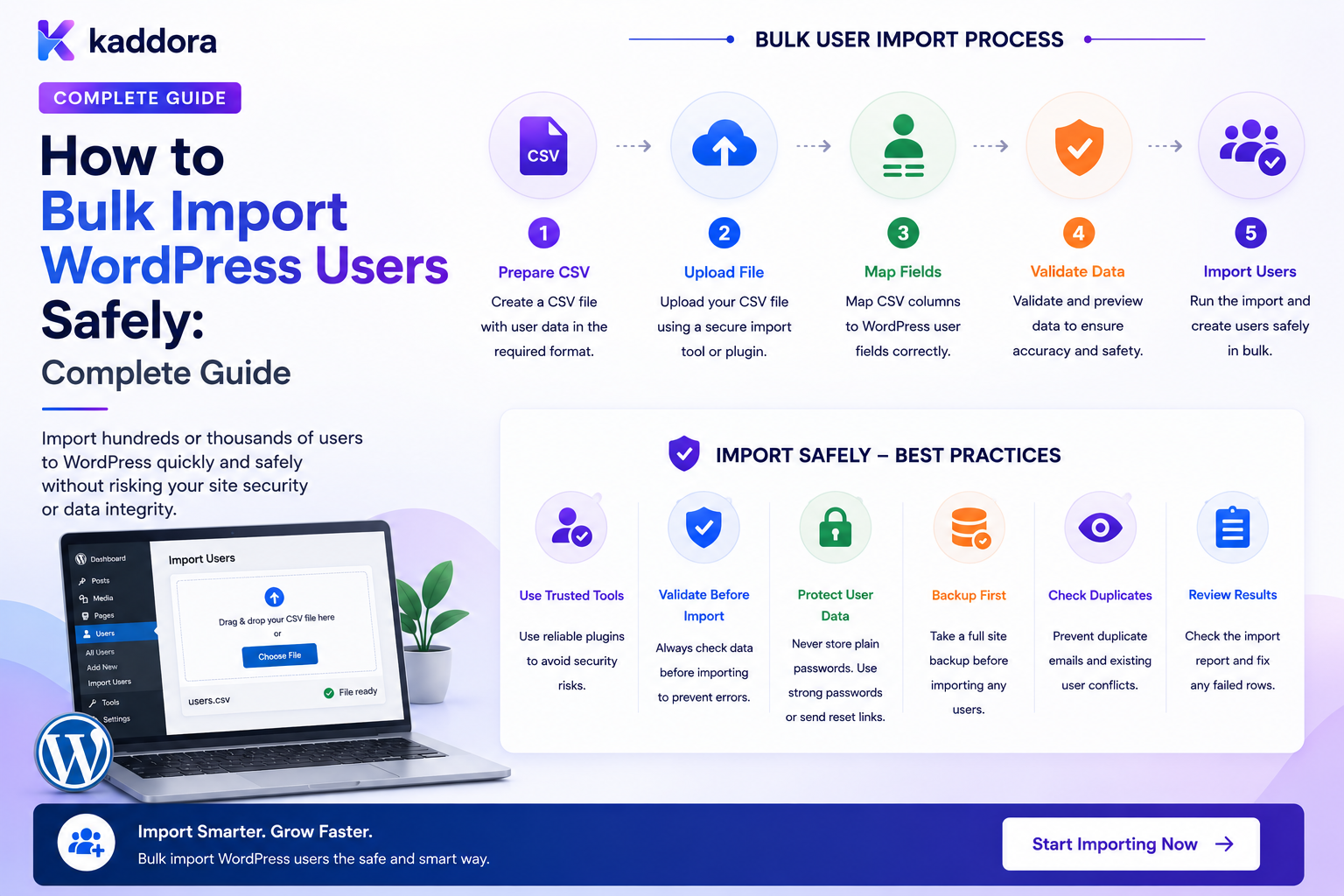
How to Bulk Import WordPress Users Safely: Complete Guide
Introduction
Bulk importing WordPress users can save hours of manual account creation.
Instead of creating users one at a time:
User 1 User 2 User 3 ... User 10,000
an import tool can process a structured dataset:
CSV ↓ Validation ↓ Mapping ↓ Batch Processing ↓ WordPress Users
This is useful during:
Website Migrations CRM Migrations Membership Migrations Employee Imports Customer Imports SaaS Migrations Agency Projects Legacy System Replacements
But bulk imports also introduce significant risks.
A poorly designed process can:
Create Duplicate Accounts Overwrite Existing Data Assign Incorrect Roles Expose Passwords Mix Tenant Data Flood Email Systems Create Partial Migrations Corrupt Business Data
For that reason, "bulk import" should never mean:
Upload CSV ↓ INSERT Everything
A safer architecture is:
Source File ↓ Secure Upload ↓ Preview ↓ Field Mapping ↓ Validation ↓ Duplicate Analysis ↓ Dry Run ↓ Approval ↓ Batch Import ↓ Checkpoint ↓ Verification ↓ Reconciliation
The key principle is:
A bulk WordPress user import should be treated as a controlled migration operation with validation, identity matching, explicit role rules, secure credential handling, resumable processing, and post-import reconciliation.
What Is a Bulk WordPress User Import?
A bulk user import creates or updates multiple WordPress accounts from an external data source.
Common sources include:
CSV Excel Export CRM ERP Another WordPress Site Legacy Database SaaS Application API
The destination may contain:
Users User Meta Roles Team Membership Tenant Membership Verification State Onboarding State
Why Bulk Import Users?
Bulk imports are useful when:
Launching a migrated website
Moving from another CMS
Migrating membership accounts
Importing employees
Moving CRM contacts
Creating customer portals
Consolidating WordPress installations
Setting up a SaaS application
Why Bulk Import Is Risky
A bulk operation magnifies mistakes.
A single bad mapping may affect:
10 Users
but a bad bulk mapping can affect:
100,000 Users
This makes prevention more important than recovery alone.
Start With a Migration Plan
Before importing, document:
Source Destination Fields Identity Keys Roles Password Strategy Verification Approval Tenant Mapping Duplicate Policy Failure Policy Rollback Strategy
Define the Import Objective
Decide whether the operation is:
Create New Users Update Existing Users Synchronize Users Migrate Accounts Merge Data
Each mode requires different rules.
One-Time Migration vs Recurring Import
A one-time migration:
Legacy ↓ WordPress
has different requirements from recurring synchronization:
CRM ↔ WordPress
Recurring imports require stable identity mapping and source-of-truth rules.
Identify the Source of Truth
For every field, determine which system owns it.
For example:
CRM: Company Phone WordPress: Avatar Notification Preferences Identity System: Email Authentication
Without ownership rules, repeated imports can overwrite useful local data.
Choose a Stable Identity Key
A strong importer should identify users using a stable identifier.
Possible keys include:
External Customer ID Legacy User ID Verified Email Migration ID
Names are poor identity keys.
Why Names Are Unsafe Matching Keys
Two different users can be:
John Smith
and the same person can appear as:
John Smith Jonathan Smith
Use stable external identifiers where possible.
Email Matching
Email can be useful when no stronger identifier exists.
But define normalization carefully.
For example:
" USER@EXAMPLE.COM "
may be normalized for matching.
Avoid making assumptions about email aliases beyond what the application can safely establish.
External ID Mapping
Maintain a mapping such as:
Source System: CRM External ID: CRM-10482 WordPress User: 5012
This makes future imports safer.
Import Preview
Never import a large dataset without previewing it first.
A good preview shows:
Detected Columns Mapped Fields Sample Records Duplicate Counts Validation Errors Warnings
Example Preview
Source Field Destination email_address → Email full_name → Display Name company → Company phone → Phone department → Department
This gives administrators a chance to correct mistakes before writing data.
Validate the Entire File Structure
Before processing individual users, validate:
File Type Encoding Headers Required Columns Duplicate Headers Row Format Maximum Size
Validate Each User Record
For every row, validate:
Email Username Password Strategy Role Mapping Custom Fields Tenant
A single malformed record should not silently create a broken account.
Validate Required Fields
For example:
Email: Required Display Name: Optional Role: Required by Import Policy
The required-field definition should come from the import configuration.
Validate Field Types
Examples:
Email → Email Phone → String / Normalized Phone Age → Integer Website → URL Date → Date
Do not assume imported data is correctly typed because it came from a spreadsheet.
Validate Allowed Values
For example:
Source Status: Active Inactive Pending
The importer should map only known values.
Unexpected values should become errors or controlled warnings.
Validate Custom Fields
If a source contains:
department = Finance
the importer should verify that:
Finance
is valid for the destination system.
Conditional Validation
If:
account_type = business
then:
company_name
may be required.
The import engine must enforce this server-side.
Validate Tenant Mapping
For multi-tenant systems:
Source Tenant ↓ Destination Tenant
Every source organization must map to a valid destination tenant before its users are imported.
Never Trust Tenant IDs Directly
A row containing:
tenant_id = 25
should not automatically create membership in Tenant 25.
The importer must resolve tenant ownership through trusted configuration.
Role Mapping
Create an explicit role map:
Source Role Destination customer customer employee employee partner partner manager manager
The available destination roles should be controlled by the administrator configuring the import.
Never Map admin Automatically to administrator
Different systems use role names differently.
For example:
Legacy: admin
may mean:
Internal Customer Manager
rather than full WordPress administration.
Role mappings must therefore be deliberate.
Prevent Privilege Escalation
Never allow imported fields to decide:
Capabilities Administrator Status Super Admin Tenant Owner
unless the import policy explicitly grants that authority and the operator has permission to apply it.
Password Strategy
One of the hardest migration decisions is how users will authenticate after import.
Possible approaches include:
New Password Setup Activation Link Password Reset Compatible Hash Migration
Never Import Plain-Text Passwords
A source file such as:
email,password
should not be used to import readable passwords into WordPress.
Do not place passwords into:
CSV Logs Preview Screens Reports Emails
Recommended Password Setup Flow
A secure approach can be:
Import User ↓ Mark Password Setup Required ↓ Send Activation / Recovery Flow ↓ User Creates Password ↓ Account Activated
This allows users to establish their own credentials.
Compatible Password Hash Migration
Password-hash migration can sometimes be possible between systems, but only if the source hash format and verification behavior are fully understood and compatible.
Never copy an unfamiliar password hash format into WordPress simply because it "looks encrypted."
Email Verification During Import
Imported users can be:
Unverified
and asked to verify their email after migration.
Alternatively, trusted migration data may include a known verification state.
The policy should be explicit.
Account Approval During Import
A migrated user can start in:
Pending Approval
rather than receiving immediate access.
This can be useful when importing:
Partners Vendors Employees Members
Import and Onboarding
Imported users may need:
Profile Setup Password Setup Workspace Setup Security Enrollment
After import:
Imported ↓ Activation ↓ Onboarding ↓ Active
Dry Run
A dry run is one of the safest features an import tool can provide.
For example:
100,000 Records Valid: 96,200 Duplicates: 2,000 Errors: 1,800
No users are changed.
Dry Run Should Match Real Validation
The dry run should use the same:
Field Rules Role Rules Duplicate Rules Tenant Rules
that will be used during actual processing.
Otherwise the preview may provide false confidence.
Import Batches
Never process 100,000 users inside one request.
Instead:
100,000 ↓ 500 per Batch ↓ Queue ↓ Workers
The ideal batch size depends on the environment.
Why Batch Processing Helps
Batching reduces:
Memory Usage Request Duration Transaction Size Failure Scope Worker Risk
Queue-Based Imports
A scalable architecture:
Import Job ↓ Generate Batches ↓ Queue Jobs ↓ Worker ↓ Process Batch ↓ Checkpoint
This lets the importer continue even when the browser is closed.
Checkpointing
Store progress after each successful batch:
Batch 1: Completed Batch 2: Completed Batch 3: Processing
If a worker crashes, the system can resume from the correct point.
Avoid Duplicate Batch Processing
A worker could accidentally receive the same batch twice.
Use:
Job ID Batch ID Idempotency Key Unique Constraints
as appropriate.
Import Job Locking
An import may need to prevent:
Two Workers + Same Batch
from processing the same records concurrently.
Use safe job-claiming and locking mechanisms.
Progress Tracking
The administrator should see:
Imported: 35,500 / 100,000 Created: 31,200 Updated: 4,000 Skipped: 200 Failed: 100
The server should calculate these values.
Error Handling
Classify import errors:
Invalid Data Duplicate Unknown Role Missing Tenant Permission Storage System External Integration
This helps administrators understand what needs correction.
Row-Level Errors
For example:
Row 1,482 Field: email Error: Invalid email format
The error report should avoid including passwords or unnecessary sensitive information.
Continue After Row Errors
A common migration mode is:
Bad Row ↓ Record Error ↓ Continue Next Row
This lets the import complete while isolating problematic records.
Fail-Fast Mode
For critical migrations, administrators may choose:
First Critical Error ↓ Stop Import
This is useful when partial imports would create unacceptable inconsistency.
Partial Success
An import may finish with:
Created: 9,700 Updated: 200 Failed: 100
The tool should provide enough information to retry only the failed records.
Failed Row Export
A useful feature is:
Download Failed Rows
with:
Row Field Reason
Do not include sensitive authentication data.
Existing User Updates
If the importer updates existing users, define which fields it owns.
For example:
Import Owns: Company Department WordPress Owns: Avatar Notifications Preferences
This prevents accidental overwrites.
Never Blindly Overwrite Email
Changing a user's email can affect:
Login Password Recovery Security Notifications Account Ownership
Email changes during import may require a dedicated policy or verification process.
Preserve Local Data
A recurring import should not overwrite:
Manual Profile Changes Local Preferences Security Settings
unless the source system is explicitly authoritative for them.
Field Ownership Rules
Possible rules include:
Source Always Wins Destination Always Wins Fill Empty Only Update If Newer Manual Review
Use the rule that matches business ownership.
Importing User Meta
Custom fields can be mapped into user metadata:
company phone department employee_id external_id
Use consistent, namespaced metadata keys.
Do Not Put Relational Data Into Random Meta
Data such as:
Team Membership Projects Roles Across Organizations Multiple Addresses
may require dedicated tables.
Tenant Membership Import
For SaaS systems, importing the user may not be enough.
You may also need:
User ↓ Tenant Membership ↓ Tenant Role
These should be created atomically where required.
User and Membership Transactions
For local records:
BEGIN ↓ Create User ↓ Create Membership ↓ Assign Approved Role ↓ COMMIT
If a required local operation fails, rollback can preserve consistency.
External Systems Are Different
A CRM or ERP usually cannot participate in the same local database transaction.
Use:
Local Commit ↓ Outbox / Event ↓ Queue ↓ CRM / ERP
This makes external failure recoverable.
Outbox Pattern
A migration can record an event locally:
User Created ↓ Outbox Event ↓ Worker ↓ CRM
This reduces the chance that the WordPress record is created without its downstream event being recorded.
Import Email Notifications
Creating thousands of users may cause thousands of emails.
The import system should offer an explicit email policy:
Welcome Email: Off / On Verification: Off / On Activation: Off / On
The default should be chosen carefully.
Email Queue Protection
If emails are enabled:
100,000 Users ↓ 100,000 Emails
can overwhelm:
Mail Provider Server Users
Use throttling and queues.
Import and Verification Emails
A useful approach is:
Import ↓ Create Pending Account ↓ Queue Verification Email ↓ User Verifies
This keeps the migration process separate from user activation.
Import and Security Logs
Do not copy the entire source file into logs.
Import logs should record operational information such as:
Job ID Actor Status Counts Errors
not raw personal datasets.
Protect Uploaded Import Files
CSV files can contain:
Names Emails Phone Numbers Employee Data Business Information
Store them with appropriate access restrictions.
Import File Retention
Once processing is complete:
Import File ↓ No Longer Needed? ↓ Delete
according to the system's retention requirements.
Import Permissions
Bulk user imports should be available only to appropriately authorized administrators.
Use dedicated capabilities where useful:
import_users manage_bulk_users
Do not rely only on hiding the import page.
Protect Import APIs
If an import system exposes APIs, every endpoint should independently enforce:
Authentication Capability Tenant Scope Request Integrity
Never Trust Client-Supplied File Paths
Avoid requests such as:
/import?file=/server/users.csv
where the user controls a filesystem path.
The application should manage safe file references internally.
Bulk Import and Multi-Tenancy
A multi-tenant importer must isolate:
Users Memberships Roles Import Jobs Files Logs Credentials
by tenant where applicable.
Fair Resource Allocation
One tenant should not consume all import resources.
For a SaaS platform, consider:
Per-Tenant Concurrency File Size Limits Job Quotas Worker Limits
Import Quotas
A platform can limit:
Users Imported / Month Rows / Job Jobs / Day Storage
depending on the product model.
Bulk Import Monitoring
A good import dashboard can show:
Queued Processing Paused Completed Failed
with:
Records Errors Warnings Queue Lag Worker Status
Reconciliation
After import, compare:
Source Count vs Destination Count
and:
Source Identity Map vs WordPress Users
This catches missing or duplicate records.
Example Reconciliation
Source: 50,000 Created: 48,500 Updated: 1,200 Skipped: 250 Failed: 50 Total: 50,000
The numbers should reconcile exactly.
Verify Sample Accounts
After a large import, manually test a representative sample:
Customer Employee Manager Partner Special Role Multi-Tenant User
Check:
Login Profile Role Tenant Verification Permissions
Post-Import Monitoring
For several days after migration, monitor:
Login Failures Password Resets User Complaints Role Errors Duplicate Accounts Email Delivery Integration Failures
This can reveal migration issues that weren't visible during import.
Rollback Strategy
Before production import, define:
What Can Be Reversed? What Cannot? Which Users Were Created? Which Were Updated?
Newly created users are easier to identify than overwritten existing fields.
Track Import-Originated Changes
For high-risk imports, record:
Import Job ID User ID Operation Fields Changed
This can support investigation and selective recovery.
Do Not Blindly Delete Imported Users
If an imported user already had activity:
Orders Tickets Posts Memberships
deleting the account during rollback could cause data loss.
Use a recovery strategy that respects business relationships.
Staging First
Always test large imports in staging when practical:
Source Sample ↓ Staging ↓ Validate ↓ Production
Use a Small Production Canary
For very large migrations, consider importing a small controlled subset first:
100 Users ↓ Verify ↓ 500 Users ↓ Verify ↓ Full Import
This can reveal unexpected performance or role-mapping problems early.
Load Testing
For large imports, measure:
Users / Minute Database Writes Memory CPU Queue Depth Failure Rate
Then tune batch sizes and workers based on observed behavior.
Concurrency Testing
Test whether:
Worker A Worker B
can accidentally create the same user or membership.
Stable identity mappings and database constraints should prevent duplicates.
Import Security Testing
Test:
Unauthorized Import Role Injection Tenant Injection Malformed File Oversized File Duplicate Records CSV Formula Injection in Reports Path Manipulation Credential Leakage
CSV Formula Injection Consideration
If imported values are later exported into spreadsheet-compatible reports, values beginning with certain spreadsheet formula characters can be dangerous in some spreadsheet applications.
If the system generates CSV reports from untrusted imported values, consider neutralizing potentially executable spreadsheet formulas during output generation.
Common Bulk WordPress Import Mistakes
Importing Directly Into Production
Errors immediately affect real users.
No Dry Run
Problems are discovered after accounts have changed.
Matching Only by Name
Duplicate people can be incorrectly merged.
Blind Email Overwrites
Account recovery and login behavior can be disrupted.
Importing Plain-Text Passwords
Credentials become exposed.
Importing Raw Roles
Source roles may create privilege escalation.
No Batch Processing
Large jobs time out or exhaust resources.
No Checkpoints
Failed jobs must restart from zero.
No Identity Mapping
Repeated imports create duplicates.
No Reconciliation
Missing or duplicate records remain unnoticed.
Safe Bulk User Import Checklist
- [ ] Define migration objective - [ ] Identify source of truth - [ ] Define identity key - [ ] Validate source file - [ ] Preview records - [ ] Map fields explicitly - [ ] Define transformations - [ ] Define duplicate strategy - [ ] Define create / update behavior - [ ] Define field ownership - [ ] Define password strategy - [ ] Define verification state - [ ] Define approval state - [ ] Define role mapping - [ ] Define tenant mapping - [ ] Run dry test - [ ] Use staging - [ ] Use batch processing - [ ] Use queues - [ ] Add checkpoints - [ ] Add idempotency - [ ] Track progress - [ ] Capture row-level errors - [ ] Protect import files - [ ] Add audit history - [ ] Reconcile results - [ ] Verify sample accounts - [ ] Monitor after migration
Best Practices for Safely Bulk Importing WordPress Users
A professional bulk import process should:
Define the migration objective and source-of-truth rules before touching production.
Use stable external identifiers whenever possible for identity matching.
Preview the source data and field mapping before any records are changed.
Run a complete dry-validation pass before production processing.
Explicitly define duplicate handling and whether each field can be overwritten.
Never import plain-text passwords or expose credentials in previews, reports, logs, or emails.
Use secure activation or password-setup workflows for migrated accounts.
Map source roles through trusted configuration rather than accepting arbitrary role names from imported data.
Process large datasets asynchronously in batches with checkpoints and safe job claiming.
Make user and membership creation idempotent.
Keep tenant mapping and membership authorization server-controlled.
Protect source files and remove temporary copies according to retention requirements.
Provide row-level errors and the ability to retry failed records without repeating successful work.
Reconcile source and destination counts after the import.
Verify representative user accounts manually before declaring the migration successful.
Monitor login, verification, email, authorization, and integration behavior after deployment.
Define a recovery strategy before importing existing users whose data may be overwritten.
Why choose ThemeKaddora?
ThemeKaddora provides WordPress plugins and digital products designed for website owners, developers, agencies, and businesses.
Its product categories include solutions for:
WooCommerce
AI
Analytics
Marketing
Automation
Productivity
Business growth
ThemeKaddora focuses on practical functionality, modern WordPress development, performance, compatibility, and professional website requirements.
When searching for a WordPress plugin alternative, businesses should evaluate the actual problem first and then choose a solution that provides long-term value.
Conclusion
Bulk importing WordPress users is not just a CSV-processing task.
It is a controlled migration involving:
Identity Security Roles Data Membership Verification Privacy Performance Recovery
A safe import looks like:
Source ↓ Preview ↓ Map ↓ Validate ↓ Dry Run ↓ Approve ↓ Batch Import ↓ Checkpoint ↓ Reconcile ↓ Monitor
The first principle is plan before processing.
Know what the source system means, what WordPress means, and how the two models will be translated.
The second principle is use stable identity keys.
Matching users by names or approximate data creates dangerous duplicate and merge problems.
The third principle is protect existing accounts.
Define exactly which fields the migration owns and which fields should remain under WordPress or user control.
The fourth principle is never import readable passwords.
Use secure password-setup or activation workflows instead.
The fifth principle is treat roles as authorization data.
Never allow source data to silently grant powerful WordPress capabilities.
The sixth principle is use dry runs and staging.
The cheapest time to discover a bad mapping is before production accounts are changed.
The seventh principle is process large jobs asynchronously.
Batches, queues, checkpoints, retries, and progress tracking make large migrations more reliable.
The eighth principle is make the import idempotent.
A worker retry should not create duplicate accounts or memberships.
The ninth principle is reconcile after completion.
The final counts and identity mappings should explain exactly what happened to every source record.
The tenth principle is prepare for recovery.
Know which changes were created by the import, which were updates, and what can safely be reversed.
For ThemeKaddora, bulk user import can support:
Customer Migrations Employee Imports Partner Imports Vendor Imports Membership Migrations CRM Imports ERP Migrations SaaS User Migrations Multi-Tenant Migrations
The most important principle is:
A bulk user import should behave like a controlled migration pipeline—not a database dump—so every account is validated, every identity is mapped intentionally, every privilege is controlled, and the entire operation can be observed and recovered.
A professional bulk WordPress user import system should be:
Planned
→ Previewable
→ Validated
→ Batch-Based
→ Idempotent
→ Secure
→ Recoverable
→ Tenant-Aware
→ Auditable
→ Reconciled
→ Maintainable
When these principles are applied, even large WordPress user migrations can be performed systematically without turning account creation, role assignment, or personal data handling into an uncontrolled production risk.
Frequently Asked Questions
What is the safest way to bulk import WordPress users?
Use a staged workflow with secure upload, field mapping, validation, dry run, duplicate detection, role mapping, batch processing, checkpoints, reconciliation, and post-import monitoring.
Can I bulk import WordPress users from CSV?
Yes. CSV is a common source, but the file should be validated, previewed, mapped, and processed in controlled batches.
Should I import passwords with the users?
Do not import plain-text passwords. Prefer secure account-activation or password-setup workflows. Hash migration should only be considered when the source format is fully understood and compatible.
How should duplicate users be detected?
Use stable external IDs when available. Verified email can be useful as a fallback, but names alone should not be treated as reliable identity keys.
Can bulk imports update existing WordPress users?
Yes, but define field ownership before doing so. Otherwise a migration can overwrite newer local profile information.
How can I safely import WordPress roles?
Use explicit, trusted source-to-destination mappings. Never allow imported role values to automatically grant arbitrary privileged WordPress capabilities.
How do I import users into multiple WordPress SaaS tenants?
Map source organizations to trusted destination tenants and validate every membership relationship server-side. Never trust a tenant ID supplied directly by the import file.
Should a large import run in one request?
No. Large imports should normally use batches, queues, workers, and checkpoints to avoid timeouts and resource exhaustion.
What is a dry run?
A dry run validates the complete import and reports what would happen without creating or modifying actual user accounts.
How should import failures be handled?
Use row-level error reporting, retry failed records, checkpoints, and idempotency so successful records do not need to be processed again.
Should imported users receive welcome emails?
Only according to an explicit migration policy. Sending thousands of messages at once can overwhelm email infrastructure, so use a controlled queue and rate limits.
Why choose Themekaddora?
Themekaddora provides lightweight, responsive, SEO-friendly WordPress themes with fast performance, WooCommerce compatibility, flexible customization, accessibility-conscious design, modern templates, regular updates, and professional support—providing a strong foundation for businesses building digital products and product-focused websites.
Comments (0)