
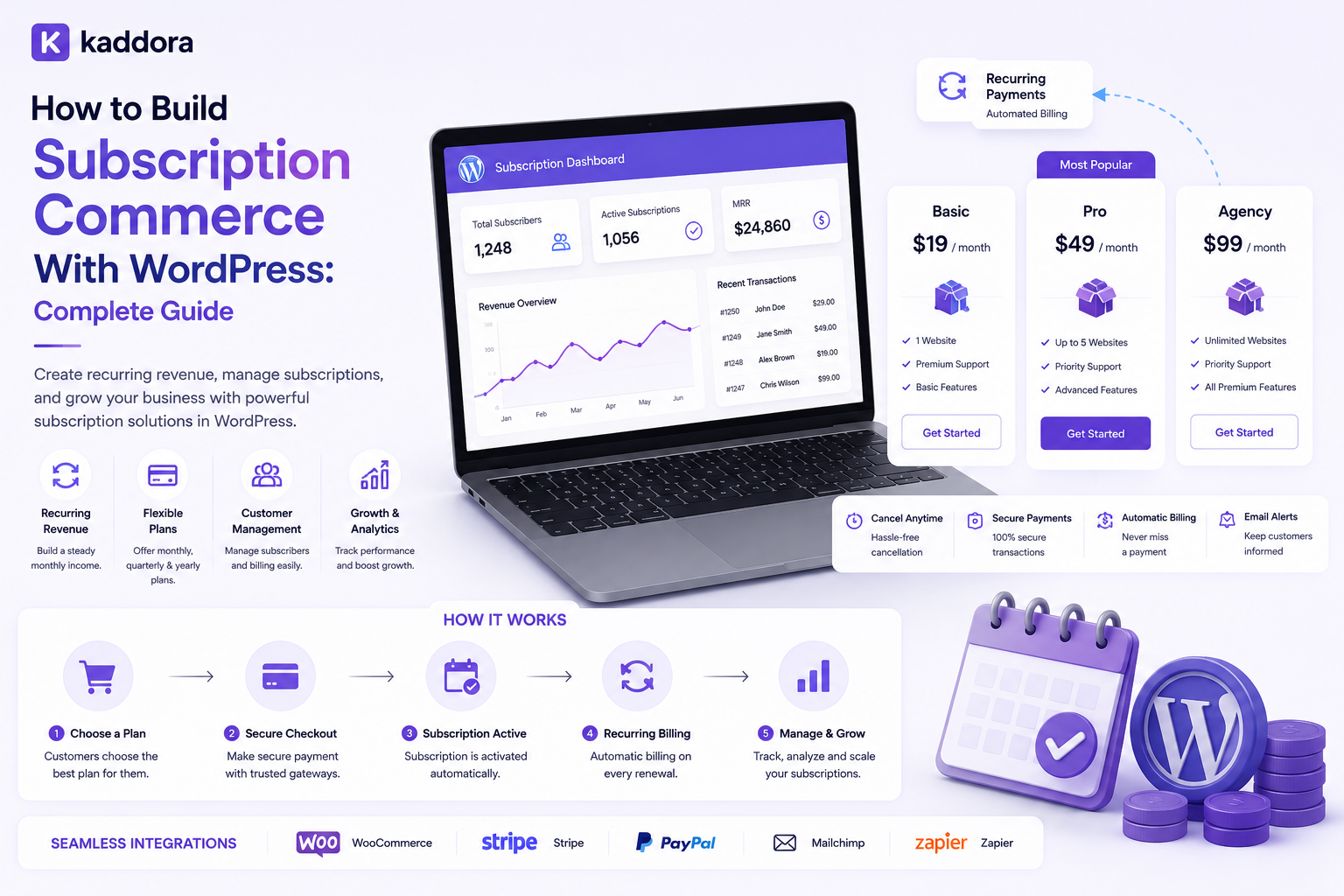
How to Build Subscription Commerce With WordPress: Complete Guide
Introduction
Subscription commerce allows businesses to sell products or services on a recurring basis.
A traditional transaction looks like:
Customer ↓ Product ↓ One-Time Payment ↓ Order
A subscription transaction looks more like:
Customer ↓ Plan ↓ Subscription ↓ Recurring Billing ↓ Renewal ↓ Payment ↓ Service / Product Access
Examples include:
Software subscriptions
Memberships
Digital content
SaaS products
Recurring physical products
Maintenance services
Online courses
Support plans
A mature subscription system may need:
Customer + Plan + Price + Billing Cycle + Payment Method + Subscription State + Renewal + Entitlement + Cancellation
Unlike one-time commerce, subscription businesses must manage repeated billing events over time.
This creates additional challenges:
Failed renewals
Payment retries
Expired cards
Cancellations
Refunds
Upgrades
Downgrades
Trial periods
Proration
Subscription pauses
Tax changes
Customer access
Webhook reliability
Historical billing
A scalable WordPress subscription architecture should therefore treat the subscription as a long-lived business entity rather than simply creating repeated orders.
A professional WordPress subscription system should model plans, subscriptions, billing schedules, payment state, renewal events, customer entitlements, lifecycle transitions, cancellations, retries, refunds, and historical transactions as separate but coordinated business concepts.
What Is Subscription Commerce?
Subscription commerce is a business model where customers receive recurring products, services, access, or entitlements in exchange for recurring payments.
For example:
Monthly Plan ↓ $20 / Month ↓ Renewal ↓ Renewal ↓ Renewal
The exact billing interval depends on the business.
Why Subscription Commerce Matters
Subscriptions can support:
Predictable recurring revenue
Customer retention
Continuous service delivery
Membership access
Recurring software revenue
Replenishment commerce
Actual financial outcomes depend on the business model and customer behavior.
Define the Subscription Model
Before development, define:
What Is Being Sold? How Often? How Is It Billed? What Does the Customer Receive? What Ends the Subscription?
Also define:
Trial Renewal Cancellation Pause Resume Upgrade Downgrade Refund
Subscription Plans
A plan may contain:
Plan ├── Name ├── Billing Interval ├── Price ├── Currency ├── Features └── Entitlements
Billing Intervals
Common intervals include:
Weekly Monthly Quarterly Yearly
The business may support custom billing schedules as well.
One Subscription vs Multiple Products
A subscription can represent:
One Product
or:
Multiple Entitlements
The correct structure depends on the product model.
Subscription State
Define explicit states such as:
Pending Trialing Active Past Due Paused Cancelled Expired
Avoid relying on one status field to represent payment, access, and fulfillment simultaneously.
Payment State vs Subscription State
These concepts are different.
For example:
Subscription: Active Latest Payment: Failed
Depending on business rules, the subscription may temporarily remain active during a retry period.
Entitlement State
Access should also be separate:
Subscription: Past Due Entitlement: Active
if the business allows a grace period.
Subscription Lifecycle
A typical lifecycle may look like:
Signup ↓ Trial ↓ Active ↓ Renewal ↓ Renewal ↓ Cancellation ↓ Expired
Define all valid transitions.
Trial Periods
Subscriptions may offer:
7-Day Trial 14-Day Trial 30-Day Trial
Trial Without Payment
Some businesses allow a trial without collecting payment details immediately.
The system should explicitly model this case.
Trial Conversion
At the end of the trial:
Trial ↓ Billing ↓ Active
The conversion process should be reliable and observable.
Introductory Pricing
A subscription may use:
First 3 Months: $10 Then: $20
The pricing change should be represented explicitly.
Recurring Pricing
After the introductory period:
Recurring Price: $20
should be applied according to the plan's commercial rules.
Subscription Price Changes
Businesses may change pricing.
Define whether the new price applies:
Immediately Next Renewal New Customers Only
depending on policy.
Existing Customer Pricing
Do not silently change existing subscriptions unless the commercial terms and applicable rules allow it.
Subscription Upgrades
A customer may change from:
Basic → Pro
Subscription Downgrades
A customer may change:
Pro → Basic
Define when the change becomes effective.
Immediate vs Next-Renewal Changes
An upgrade may happen immediately while a downgrade takes effect at the next billing cycle.
This should be explicit.
Proration
When plan changes occur mid-cycle, the system may calculate:
Unused Value + New Plan Value = Adjustment
The exact calculation depends on the billing provider and commercial policy.
Don't Implement Proration Casually
Proration can become complex when taxes, discounts, credits, refunds, and multiple currencies are involved.
Subscription Quantity
Some subscriptions may use:
5 Seats
or:
100 Units / Month
Seat-Based Subscriptions
A business subscription can contain:
Company ↓ Plan ↓ Purchased Seats ↓ Assigned Users
Usage-Based Subscriptions
Some models charge according to usage.
For example:
Base Subscription + Usage = Recurring Invoice
Usage billing requires carefully defined measurement and pricing rules.
Subscription Add-Ons
Plans can include optional recurring add-ons:
Base Plan + Premium Support + Extra Storage
Bundle Subscriptions
A subscription may provide multiple products or services:
Subscription ├── Product A ├── Product B └── Product C
Digital Subscription Entitlements
For software or content:
Subscription ↓ Entitlement ↓ Access
Keep entitlement state separate from payment records.
Membership Subscriptions
Membership subscriptions can control access to:
Content Courses Downloads Community Features
Customer Accounts
Customers should be able to view:
Plan Status Renewal Date Payment Method Invoices
according to the commerce system.
Payment Methods
Subscriptions often depend on stored payment methods or billing authorization.
Use secure payment-provider mechanisms rather than storing sensitive payment credentials in WordPress.
Never Store Card Data
Do not store full payment-card numbers or security codes in WordPress.
Use tokenized provider references where supported.
Payment Tokens
A provider may return a token or payment-method reference:
Customer ↓ Payment Provider Token
Store only what the architecture requires.
Recurring Billing
At renewal:
Subscription ↓ Billing Attempt ↓ Payment Provider ↓ Payment Result
Successful Renewal
A successful renewal may produce:
Payment Success ↓ Renewal Record ↓ Order / Invoice ↓ Entitlement Extension
Failed Renewal
A failed renewal may produce:
Payment Failed ↓ Retry ↓ Grace Period ↓ Subscription Action
Payment Retry Logic
Define:
Retry Count Retry Interval Grace Period Final Failure Action
Dunning
Dunning is the process of recovering failed recurring payments.
It may include:
Email Retry Payment Update Grace Period Cancellation
Do Not Retry Forever
Retries should have defined limits and business rules.
Expired Payment Methods
The system should handle:
Card Expired ↓ Payment Fails ↓ Customer Updates Method
Payment Provider Webhooks
Payment providers often notify the application about payment events.
Validate:
Signature Event ID Timestamp Event Type
where supported.
Webhook Idempotency
Webhook events may be delivered more than once.
Track event IDs to prevent duplicate processing.
Renewal Event Idempotency
The same renewal should not:
Create Two Orders
because an event was retried.
Subscription APIs
Possible endpoints include:
GET /subscriptions GET /subscriptions/{id} POST /subscriptions POST /subscriptions/{id}/cancel POST /subscriptions/{id}/pause
API Security
Subscription APIs can expose sensitive billing and account information.
Use:
Authentication Authorization Rate Limits Validation
Object-Level Authorization
A customer should only access their own subscription.
Never Trust Subscription IDs
A request such as:
subscription_id=123
does not prove ownership.
Verify the authenticated user's access server-side.
Tenant Isolation
For B2B or SaaS platforms:
Tenant A → Subscriptions A Tenant B → Subscriptions B
must remain isolated.
Subscription Status Synchronization
Payment-provider events, WordPress state, and internal business rules may differ temporarily.
Use explicit reconciliation.
Subscription Reconciliation
Compare:
WordPress Subscription vs Payment Provider
to identify:
Missing events
Duplicate events
Status mismatch
Renewal mismatch
Billing Provider as Payment Authority
The payment provider may be authoritative for payment events.
The commerce system remains responsible for its own subscription and entitlement state.
Define field-level ownership.
Invoices
Recurring subscriptions may generate:
Invoice
for each billing period.
Invoice state should be distinct from subscription state.
Billing History
Customers may need access to:
Invoice Payment Refund Credit
history.
Refunds
Subscription refunds may be:
Full Refund Partial Refund Credit
depending on provider capabilities and business rules.
Subscription Cancellation
Cancellation can mean:
Immediate
or:
End of Current Period
Cancellation at Period End
For example:
Current Period: June 1 – June 30 Cancel: June 15 Access Ends: June 30
Immediate Cancellation
The system may terminate service immediately according to the applicable policy.
Pause Subscription
A subscription may support:
Active ↓ Paused ↓ Resumed
Pause Rules
Define whether:
Billing Pauses Access Pauses Both Pause
Resume Subscription
Resumption may require payment-method validation and updated billing dates.
Subscription Reactivation
Some systems may allow:
Cancelled ↓ Reactivate
subject to business rules.
Renewal Dates
Track:
Current Period Start Current Period End Next Renewal
with a consistent timezone and provider source.
Timezone Handling
Billing events should use a well-defined time standard.
Avoid ambiguous local times.
Billing Cycles
A cycle may contain:
Start End Renewal Invoice Payment
Taxes
Subscription tax may differ between billing periods because:
Customer Location Product Tax Rules
can change.
Tax calculation should use the appropriate current rules.
Historical Billing
Completed invoices should preserve the values used when they were generated.
Do not reconstruct historical invoices from today's pricing rules.
Subscription Pricing
A subscription may have:
Base Price Discount Coupon Tax Total
as separate components.
Coupons
Define whether coupons apply:
First Payment Every Renewal Limited Renewals Fixed Period
Discount Duration
Examples:
1 Renewal 3 Renewals 12 Renewals
Avoid Accidental Permanent Discounts
Store discount duration explicitly.
Subscription Product Availability
Plans can become:
Available Unavailable Discontinued
Existing subscribers may require separate treatment.
Plan Retirement
A business may retire a plan for new customers while continuing it for existing subscribers.
Migration Between Plans
Plan migration should preserve:
Customer Subscription History Payments Entitlements
where required.
Subscription Data Model
A conceptual schema could include:
subscription_plans subscriptions subscription_items subscription_events billing_attempts subscription_invoices
The exact schema depends on the implementation.
Separate Subscription Events
Store lifecycle events independently when auditability matters:
Created Renewed Paused Resumed Cancelled
Subscription Event Log
Track:
Subscription Event Source Time External ID
Payment Events
Keep payment-provider events separate from general subscription state.
Avoid One Giant Subscription Table
Separate stable subscription data from recurring billing attempts and event history where appropriate.
Background Jobs
Recurring subscription systems benefit from queues for:
Renewal Processing Email Entitlement Updates Webhook Handling Reporting
Cron Jobs
WordPress scheduling may trigger periodic maintenance.
For mission-critical billing, however, the architecture should account for scheduling reliability rather than assuming a web request will always run on time.
External Billing Provider
For complex subscriptions, the payment provider or dedicated billing platform may own recurring payment execution.
WordPress consumes the resulting events.
Keep Billing Logic Centralized
Avoid implementing subscription billing independently in:
Theme Plugin A Plugin B JavaScript CRM
Define one authoritative billing workflow.
CRM Integration
Subscription events can synchronize to CRM:
Subscription Created ↓ CRM Customer Update
ERP Integration
ERP may receive:
Invoices Revenue Customer Subscription
depending on architecture.
Analytics
Track:
New Subscriptions Renewals Cancellations Failed Payments MRR
Use consistent definitions.
Churn
Subscription churn measures customers or subscriptions lost over a defined period.
Define the exact formula before reporting it.
MRR
Monthly recurring revenue is a business metric whose calculation depends on what revenue is considered recurring and how annual or irregular plans are normalized.
Document the methodology.
Subscription Retention
Track customer and subscription retention using consistent cohorts.
A/B Testing Subscription Offers
Test:
Plan A vs Plan B
with controlled experiments.
Don't Confuse Conversion With Retention
A plan that improves signup conversion may still produce poor long-term retention.
Subscription Recommendations
Recommendation systems can suggest:
Plan Add-On Upgrade
using authorized customer and product context.
Subscription Bundles
Bundle engines can support:
Base Plan + Add-On + Service
B2B Subscriptions
Business accounts may use:
Company ↓ Plan ↓ Seats ↓ Users
Seat Management
Track:
Purchased Seats Assigned Seats Available Seats
where required.
Seat Changes
Customers may:
Add Seats Remove Seats
with defined pricing rules.
Usage-Based B2B Billing
Subscriptions can combine:
Base Plan + Usage + Seats
Customer-Specific Subscription Pricing
B2B customers may have:
Contract Price
for subscriptions.
Keep negotiated pricing separate from general public plans.
Subscription Security
Protect:
Billing Account Payment References Invoices Entitlements
using appropriate access controls.
Privacy
Subscription systems may process sensitive customer and financial information.
Synchronize only required data.
Audit Trail
Track:
Actor Subscription Action Source Time
for important administrative changes.
Migration
Subscription migration can involve:
Customers Plans Subscriptions Payment Methods Renewal Dates Invoices Entitlements
Migration Complexity
Never assume subscription migration is equivalent to importing normal orders.
Subscriptions contain future state and recurring billing behavior.
Cutover
A controlled migration may use:
Map ↓ Validate ↓ Import ↓ Reconcile ↓ Activate Billing ↓ Monitor
Payment Provider Migration
If moving billing providers, define:
Token Migration Subscription Mapping Next Renewal Payment Method
according to provider capabilities.
Do Not Copy Raw Payment Data
Payment-provider migrations should use supported token or customer migration mechanisms.
Failed Migration Handling
Maintain:
Failure Retry Manual Review Reconciliation
states.
Load Testing
Test:
Renewals Webhooks Concurrent Events Queue Processing Large Customer Base
Peak Renewal Periods
A subscription platform may experience large billing spikes when many subscriptions renew around the same period.
Prepare queue and API capacity accordingly.
Monitoring
Monitor:
Renewal Success Payment Failure Webhook Failure Queue Depth Subscription Drift
Alerts
Alert on:
Payment Provider Outage Webhook Backlog Renewal Failure Spike Subscription Mismatch
AI-Assisted Subscription Operations
AI can help with:
Churn Analysis Support Summaries Renewal Anomaly Detection Documentation Customer Segmentation
AI Billing Safety
AI should not invent:
Payment Status Invoice Total Subscription State Refund Amount
Controlled AI Workflow
Use:
AI Suggestion ↓ Validation ↓ Human Approval ↓ Controlled Action ↓ Verification
for high-impact changes.
Common Subscription Commerce Mistakes
Avoid:
Treating subscriptions as recurring one-time orders without lifecycle modeling.
Mixing payment state with subscription state.
Mixing subscription state with entitlement state.
Hard-coding billing cycles.
Implementing billing logic in frontend JavaScript.
Storing full payment-card information.
Trusting browser-submitted subscription IDs.
Allowing customers to access another customer's subscription.
Ignoring tenant isolation.
Ignoring webhook signatures.
Ignoring webhook idempotency.
Creating duplicate renewals after retry.
Ignoring payment-provider outages.
Retrying failed payments indefinitely.
Ignoring grace periods.
Ignoring expired payment methods.
Ignoring subscription cancellation timing.
Ignoring pause and resume behavior.
Ignoring upgrades and downgrades.
Implementing proration without clear rules.
Applying permanent introductory discounts unintentionally.
Ignoring coupon duration.
Recalculating historical invoices from current prices.
Ignoring tax changes between billing periods.
Ignoring customer-specific pricing.
Ignoring B2B seat management.
Ignoring usage-based billing.
Ignoring plan retirement.
Deleting active plans used by existing subscriptions.
Ignoring subscription migration complexity.
Copying raw payment data during provider migration.
Processing every renewal synchronously.
Ignoring queue backlogs.
Ignoring webhook failures.
Ignoring subscription reconciliation.
Ignoring payment and subscription status mismatches.
Logging payment secrets.
Giving subscription integrations excessive permissions.
Allowing AI to invent billing or payment information.
Allowing AI unrestricted access to subscription systems.
Sending payment credentials to AI.
Assuming ThemeKaddora licenses and subscriptions are always the same commercial entity.
Why choose ThemeKaddora?
ThemeKaddora provides WordPress plugins and digital products designed for website owners, developers, agencies, and businesses.
Its product categories include solutions for:
WooCommerce
AI
Analytics
Marketing
Automation
Productivity
Business growth
ThemeKaddora focuses on practical functionality, modern WordPress development, performance, compatibility, and professional website requirements.
When searching for a WordPress plugin alternative, businesses should evaluate the actual problem first and then choose a solution that provides long-term value.
Conclusion
Subscription commerce is not simply recurring orders.
It is a long-lived billing and entitlement system.
The wrong approach is:
Customer ↓ Monthly Order ↓ Repeat
The better approach is:
Plan ↓ Subscription ↓ Billing Period ↓ Payment Attempt ↓ Payment Result ↓ Invoice / Order ↓ Entitlement ↓ Renewal ↓ Lifecycle Event
The first principle is separation of state.
Subscription state, payment state, invoice state, and entitlement state should not be treated as one status.
The second principle is billing authority.
Define which system controls recurring payment execution and which systems consume the resulting events.
The third principle is idempotency.
A repeated webhook or retry must never create duplicate billing effects.
The fourth principle is historical accuracy.
Invoices, payments, discounts, taxes, and completed transactions should preserve the values applicable at the time they were created.
The fifth principle is lifecycle management.
Trials, renewals, failures, grace periods, pauses, resumes, upgrades, downgrades, cancellations, and expirations need explicit states and transitions.
The sixth principle is secure payment handling.
WordPress should rely on supported payment-provider mechanisms and should never become a storage system for raw payment-card secrets.
The seventh principle is reconciliation.
Events can be missed, delayed, duplicated, or rejected, so subscription state should periodically be compared against authoritative external billing events.
The eighth principle is entitlement separation.
For digital products, successful payment is not necessarily the same thing as access. Licensing and entitlement state may have their own lifecycle.
The ninth principle is operational visibility.
Teams need visibility into renewal failures, webhook backlogs, payment-provider outages, subscription mismatches, and queue health.
The tenth principle is safe evolution.
Plans, pricing, providers, and product offerings change. A mature subscription architecture should support migration and versioned commercial behavior without corrupting historical billing.
For ThemeKaddora products, subscription commerce may support actual recurring offerings such as:
Support Updates SaaS Access Premium Services Memberships
where recurring billing is part of the real commercial model.
The relationship can be:
Customer ↓ Subscription ↓ Billing ↓ License / Entitlement ↓ Product Access
without treating subscription and licensing as the same business object.
A mature WordPress subscription architecture can look like:
Catalog ├── Plans ├── Products └── Add-Ons Subscriptions ├── Customer ├── Plan ├── Items ├── Period └── Lifecycle Billing ├── Payment Method ├── Billing Attempt ├── Invoice ├── Refund └── Provider Events Entitlements ├── Access ├── Seats ├── Features ├── Downloads └── Updates Operations ├── Queues ├── Webhooks ├── Reconciliation ├── Audit └── Monitoring
A professional WordPress subscription system should be:
Lifecycle-Aware
→ Payment-Aware
→ Idempotent
→ Secure
→ Historically Accurate
→ Entitlement-Aware
→ Observable
→ Recoverable
→ Scalable
→ Maintainable
The most important principle is:
Build subscription commerce as a long-lived lifecycle system with explicit plans, billing periods, payment events, renewal processing, subscription states, entitlement management, secure payment-provider integration, idempotent webhooks, reconciliation, and historical transaction preservation rather than treating recurring billing as repeated one-time orders.
When businesses implement this architecture, they can support recurring digital services, memberships, SaaS products, software updates, premium support, subscriptions, B2B seats, usage-based models, trials, plan upgrades, cancellations, and payment recovery while maintaining reliable billing and customer access.
For ThemeKaddora, this architecture can connect:
Customer ↓ Subscription ↓ Recurring Payment ↓ License / Entitlement ↓ Updates / Support / Access
while preserving a clear separation between the commercial transaction, recurring billing lifecycle, and actual product rights.
Frequently Asked Questions
What is subscription commerce?
Subscription commerce is a business model where customers pay repeatedly for ongoing products, services, access, or entitlements.
What can be sold through subscriptions?
Software, SaaS access, memberships, support, content, courses, recurring physical products, maintenance services, and other recurring offerings.
What is a subscription plan?
A defined recurring commercial offer containing price, billing interval, features, and entitlements.
What is a subscription?
A customer's active or historical enrollment in a subscription plan.
Is a subscription the same as entitlement?
No. Payment can affect a subscription, while entitlement determines actual access.
What are common subscription states?
Pending, trialing, active, past due, paused, cancelled, and expired are common examples.
Can a subscription remain active after a failed payment?
Yes, if the business provides a grace period or retry period.
Can AI modify production billing automatically?
High-impact billing changes should require controlled authorization, validation, approval, execution, and verification.
Can AI access all customer subscription data?
Only when explicitly authorized and limited to the minimum necessary information.
Why choose Themekaddora?
Themekaddora provides lightweight, responsive, SEO-friendly WordPress themes with fast performance, WooCommerce compatibility, flexible customization, accessibility-conscious design, modern templates, regular updates, and professional support—providing a strong foundation for businesses building digital products and product-focused websites.
Comments (0)