
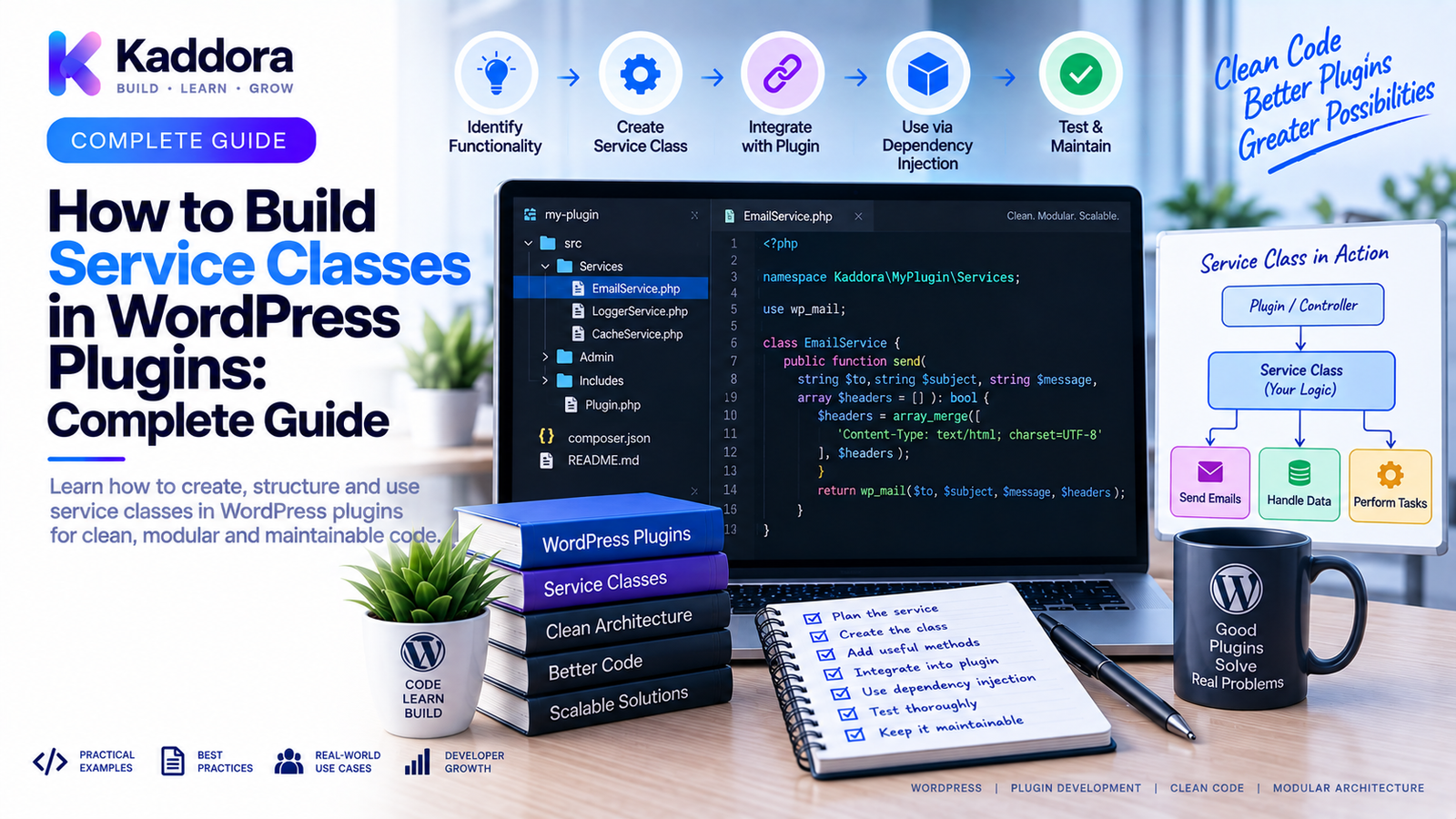
How to Build Service Classes in WordPress Plugins
Introduction
As a WordPress plugin grows, the amount of code involved in managing business logic can become difficult to control.
A small plugin may start with a few functions:
function create_product() {} function update_product() {} function send_notification() {}
This approach can work initially.
But as features increase, those functions may start depending on:
Database queries
WordPress hooks
REST APIs
External services
Validation
Authentication
Notifications
Caching
WooCommerce
Background jobs
Eventually, the plugin can turn into a collection of large procedural functions that are difficult to test and maintain.
A service class provides a way to organize application behavior around clear responsibilities.
Instead of putting business logic inside hooks, controllers, AJAX callbacks, or admin pages, you can move that logic into dedicated service classes.
A typical architecture becomes:
WordPress Hook / REST / Admin ↓ Service ↓ Repository / API ↓ Database / External System
This creates a cleaner separation between WordPress integration and business logic.
In this guide, you'll learn what service classes are, when to use them, how to design them, how to inject dependencies, how they work with repositories and interfaces, how to test them, common mistakes, and how to build a scalable WordPress service layer.
What Is a Service Class?
A service class is an object that contains application-level behavior related to a specific responsibility.
For example:
namespace Kaddora\MyPlugin\Services; class OrderService { public function processOrder(int $orderId): void { // Application logic. } }
The important idea is responsibility.
OrderService should contain behavior related to processing orders rather than unrelated operations such as rendering an admin page or registering a database table.
What Is the Service Layer?
The service layer is the part of an application that coordinates business operations.
A simplified WordPress architecture is:
User Request ↓ Controller / Hook ↓ Service Layer ↓ Repositories / Integrations ↓ Infrastructure
The service layer acts as an application boundary.
For example:
Create Order ↓ OrderService ├── Validate Data ├── Calculate Values ├── Save Order └── Send Notification
This can make complex operations easier to reason about.
Why Use Service Classes in WordPress?
Service classes can provide several architectural benefits.
Separation of Concerns
A REST controller shouldn't need to contain all order-processing logic.
Reusability
The same service can be called from:
REST API
Admin actions
AJAX
WP-Cron
CLI commands
Other plugin components
Testability
A service with injected dependencies can be tested without invoking the entire WordPress application.
Maintainability
Related business operations remain grouped in meaningful classes.
Extensibility
New implementations can often be introduced without rewriting every caller.
Service Classes vs WordPress Hooks
WordPress hooks are integration mechanisms.
For example:
add_action( 'save_post', [ $this, 'handlePostSave' ] );
The hook tells WordPress when something should happen.
The service defines what should happen.
A useful separation is:
WordPress Event ↓ Hook Handler ↓ Service ↓ Business Logic
This prevents hook callbacks from becoming giant functions.
A Simple Service Class
Consider a product service:
namespace Kaddora\MyPlugin\Services; class ProductService { public function create(array $data): int { // Validate and create product. return 0; } }
This is a good starting point, but larger applications should inject the components required to perform the operation.
Service Classes Should Have Focused Responsibilities
A service named:
ProductService
should generally manage product-related application behavior.
Avoid turning it into:
ProductService ├── Products ├── Orders ├── Emails ├── Users ├── Reports ├── Payments └── Everything Else
A class with too many responsibilities eventually becomes a God class.
Instead, split meaningful operations:
ProductService OrderService CustomerService PaymentService NotificationService ReportService
Service Class vs Repository
These two concepts are often confused.
A repository primarily handles data access.
A service coordinates application behavior.
For example:
OrderService ↓ OrderRepository ↓ Database
The service might say:
1. Validate order 2. Calculate total 3. Save order 4. Trigger notification
The repository focuses on persistence:
create() find() update() delete()
Keeping these concerns separate improves architecture.
Creating a Repository Dependency
Example:
namespace Kaddora\MyPlugin\Services; use Kaddora\MyPlugin\Repositories\OrderRepository; class OrderService { public function __construct( private OrderRepository $repository ) { } public function create(array $data): int { return $this->repository->create($data); } }
The service does not need to know the details of the SQL query.
Dependency Injection in Service Classes
A strong service architecture generally uses dependency injection.
Avoid:
class OrderService { public function create(array $data): int { $repository = new OrderRepository(); return $repository->create($data); } }
Prefer:
class OrderService { public function __construct( private OrderRepository $repository ) { } public function create(array $data): int { return $this->repository->create($data); } }
The second design makes dependencies explicit.
It also makes testing easier.
Using Interfaces With Services
For larger plugins, services can depend on interfaces.
For example:
namespace Kaddora\MyPlugin\Contracts; interface PaymentGatewayInterface { public function charge( int $amount, string $currency ): bool; }
The service can depend on the contract:
use Kaddora\MyPlugin\Contracts\PaymentGatewayInterface; class PaymentService { public function __construct( private PaymentGatewayInterface $gateway ) { } public function charge( int $amount, string $currency ): bool { return $this->gateway->charge( $amount, $currency ); } }
This decouples application logic from a specific payment provider.
Service Classes and WordPress Functions
Service classes can still use WordPress APIs.
For example:
namespace Kaddora\MyPlugin\Services; class SettingsService { public function get(string $key, mixed $default = null): mixed { return \get_option($key, $default); } }
The namespace does not prevent use of WordPress's global functions.
Using the global prefix can make the intended function source obvious.
Registering a Service With a WordPress Hook
Suppose you have:
class ProductService { public function handleProductSave(int $postId): void { // Business logic. } }
You can register it with WordPress:
add_action( 'save_post_product', [ $productService, 'handleProductSave' ], 10, 1 );
The service handles the operation while WordPress controls the lifecycle event.
Don't Put Hook Registration Everywhere
One common architecture problem is having every class independently register dozens of hooks without any clear initialization strategy.
A larger plugin can use a bootstrap process:
Plugin ↓ Service Registration ↓ Hook Registration ↓ Application Ready
The exact mechanism can be simple or container-based depending on project complexity.
Service Providers
Some WordPress plugins use service-provider-style classes to register dependencies.
For example:
class AdminServiceProvider { public function register(): void { // Register admin services. } public function boot(): void { // Register WordPress hooks. } }
This is useful for large applications but isn't mandatory.
Don't create service providers solely because another framework uses them.
Application Services vs Infrastructure Services
Not every class called a "service" should contain business logic.
It is useful to distinguish:
Application Service
Coordinates a business operation.
Example:
OrderService
Infrastructure Service
Wraps a technical capability.
Example:
HttpClient CacheService FilesystemService
This distinction prevents application logic from being mixed with low-level implementation details.
Service Class Example: Order Processing
A realistic example:
namespace Kaddora\MyPlugin\Services; use Kaddora\MyPlugin\Repositories\OrderRepository; use Kaddora\MyPlugin\Contracts\PaymentGatewayInterface; use Kaddora\MyPlugin\Services\NotificationService; class OrderService { public function __construct( private OrderRepository $repository, private PaymentGatewayInterface $paymentGateway, private NotificationService $notifications ) { } public function process( int $customerId, int $amount, string $currency ): int { if ($amount <= 0) { throw new \InvalidArgumentException( 'Amount must be greater than zero.' ); } $paymentSuccessful = $this->paymentGateway->charge( $amount, $currency ); if (! $paymentSuccessful) { throw new \RuntimeException( 'Payment failed.' ); } $orderId = $this->repository->create([ 'customer_id' => $customerId, 'amount' => $amount, 'currency' => $currency, ]); $this->notifications->sendOrderConfirmation( $orderId ); return $orderId; } }
The service coordinates the workflow.
It does not directly implement every technical detail.
Service Classes and Validation
Validation belongs close to application boundaries.
A service can validate business rules:
if ($amount <= 0) { throw new \InvalidArgumentException( 'Amount must be greater than zero.' ); }
But request-level validation should also happen before data reaches the service.
For example:
HTTP Request ↓ Input Validation ↓ Authorization ↓ Service
Defense in depth is important.
Service Classes and Authorization
A service may need to enforce business-level permissions.
For example:
if ( ! \current_user_can('manage_options') ) { throw new \RuntimeException( 'Unauthorized operation.' ); }
However, be deliberate about where authorization lives.
HTTP or WordPress request handlers should normally perform request-context checks, while domain/application services can enforce critical business rules when operations might be invoked from multiple entry points.
Service Classes and Transactions
Some operations involve multiple database changes.
For example:
Create Order ↓ Create Payment Record ↓ Update Inventory ↓ Create Audit Record
If a failure occurs halfway through, data may become inconsistent.
Where the underlying database and application design support it, transaction boundaries should be handled intentionally.
The service layer is often a natural place to coordinate the operation, while transaction implementation belongs to an appropriate persistence/infrastructure component.
Don't assume every WordPress database operation is automatically transactional.
Service Classes and Caching
Services may use a cache abstraction:
use Kaddora\MyPlugin\Contracts\CacheInterface; class ProductService { public function __construct( private CacheInterface $cache ) { } }
The service can decide:
Get Product ↓ Cache Hit? ├── Yes → Return Cached Value └── No → Load Data → Store Cache
The actual cache implementation can remain separate.
Service Classes and External APIs
Suppose a service sends customer data to an external CRM.
Avoid embedding raw HTTP requests throughout the service.
Instead:
CustomerService ↓ CRM Interface ↓ CRM Adapter ↓ HTTP Client ↓ External API
The service remains focused on the application workflow.
Service Classes and REST APIs
A REST controller should remain relatively thin.
Avoid:
public function createOrder($request) { // 200 lines of validation, // database queries, // payment logic, // notifications... }
Prefer:
public function createOrder($request) { $data = $request->get_params(); $orderId = $this->orderService->process( (int) $data['customer_id'], (int) $data['amount'], sanitize_text_field($data['currency']) ); return new \WP_REST_Response( [ 'order_id' => $orderId ], 201 ); }
The controller handles HTTP concerns.
The service handles the application operation.
Service Classes and AJAX
The same principle works with AJAX.
AJAX Callback ↓ Validate Request ↓ Authorize ↓ Service ↓ Response
This allows the business logic to be reused by other entry points.
Service Classes and WP-Cron
Scheduled jobs should also delegate to services.
For example:
class SyncProductsJob { public function __construct( private ProductSyncService $service ) { } public function run(): void { $this->service->sync(); } }
Then:
WP-Cron ↓ SyncProductsJob ↓ ProductSyncService ↓ External API
This keeps scheduling separate from application behavior.
Service Classes and WP-CLI
The same service can be called from a CLI command:
WP-CLI Command ↓ ProductSyncService ↓ Repository / API
This demonstrates one of the biggest benefits of a service layer:
The same business operation can have multiple entry points.
Service Class Naming
Use names that describe the responsibility.
Good:
OrderService ProductImportService CustomerSyncService ReportGenerationService NotificationService
Less useful:
Manager Handler Processor Helper Utility
Naming is part of architecture.
Avoid Giant Generic Services
A class named:
AppService
can quickly become a dumping ground.
Instead:
ProductService OrderService CustomerService AnalyticsService
The smaller boundaries make the code easier to understand.
Service Class Methods Should Be Meaningful
Avoid methods such as:
doStuff() run() handle() process()
without meaningful context.
Prefer:
createOrder() syncCustomers() generateMonthlyReport() sendPasswordReset()
The method name should communicate the operation.
Keep Services Focused on Application Behavior
A service should usually answer:
What does the application need to accomplish?
For example:
"Sync all eligible customers with the CRM."
Then the service coordinates:
Fetch Customers ↓ Validate Eligibility ↓ Transform Data ↓ Send to CRM ↓ Record Result
The service is the orchestrator.
Service Classes and DTOs
When operations have complex input, Data Transfer Objects can improve clarity.
Instead of:
$service->create( $customerId, $amount, $currency, $coupon, $shippingMethod );
A DTO could be used:
final class CreateOrderData { public function __construct( public int $customerId, public int $amount, public string $currency ) { } }
Then:
$orderId = $service->create( new CreateOrderData( customerId: 10, amount: 5000, currency: 'USD' ) );
DTOs become particularly useful when application operations have many parameters.
Service Classes and Domain Objects
For more sophisticated plugins, domain objects can represent business concepts.
For example:
Order Customer Subscription Product
Then services coordinate those objects:
OrderService ↓ Order Domain Object ↓ Repository
This can provide stronger modeling for complex products.
Not every WordPress plugin needs a full domain-driven architecture.
Service Classes and WordPress Context
One important design rule is avoiding unnecessary dependence on global WordPress state.
For example, instead of repeatedly reading globals in every method:
global $wpdb;
consider isolating database access in repositories or infrastructure components.
This makes services easier to test and reason about.
Testing Service Classes
Services are excellent candidates for unit tests.
For example:
$repository = $this->createMock( OrderRepository::class ); $gateway = $this->createMock( PaymentGatewayInterface::class ); $notifications = $this->createMock( NotificationService::class );
Then:
$service = new OrderService( $repository, $gateway, $notifications );
You can test behavior without requiring every real dependency.
What Should a Service Test?
Test meaningful behavior:
Valid input
Invalid input
Successful operation
Failed dependency
Business rules
Error conditions
Correct dependency interaction
Avoid tests that merely prove a trivial getter returns a value.
Integration Testing
Unit tests aren't enough for every WordPress behavior.
Integration tests can verify:
Service ↓ Repository ↓ WordPress Database
They are useful when interactions with WordPress, WooCommerce, database schemas, or external boundaries matter.
Service Classes and Static Analysis
Strongly typed service methods improve analysis.
For example:
public function findOrder( int $orderId ): ?Order { // ... }
Static analysis tools can detect mismatches early.
For production plugins, combine services with:
PHPStan
PHPUnit
PHPCS
Composer
CI
Service Classes and Error Handling
Services should use predictable error-handling strategies.
Depending on the architecture, that can include:
Exceptions
Result objects
WP_Error
Explicit return values
For WordPress integration boundaries, WP_Error may be appropriate.
For internal domain/application code, exceptions or typed results may provide clearer control flow.
Choose one strategy deliberately rather than mixing patterns randomly.
Using WP_Error in a Service
A WordPress-oriented service may return:
public function create( array $data ): int|\WP_Error { if (empty($data['name'])) { return new \WP_Error( 'missing_name', 'Product name is required.' ); } // Create product. return 123; }
The calling layer can then handle the error.
Don't Let Services Become Controllers
A service should not need to know:
Which REST endpoint called it
Which HTML form submitted the request
Which AJAX action triggered it
That is controller-level information.
Instead, pass application data into the service.
REST ┐ AJAX ├──→ Service Cron ┘
The service remains independent of the entry point.
Service Classes and Logging
Logging is often useful for important operations.
But services should depend on a logger abstraction rather than directly calling random logging functions everywhere.
For example:
interface LoggerInterface { public function error( string $message, array $context = [] ): void; }
Then the service can use:
$this->logger->error( 'Customer synchronization failed.', [ 'customer_id' => $customerId ] );
This improves testing and control.
Service Classes and Background Processing
Large workloads shouldn't always execute during a normal frontend request.
A service can coordinate work while a background-processing layer handles execution.
For example:
User Request ↓ Create Job ↓ Queue / WP-Cron ↓ Worker ↓ Service ↓ Repository / API
This architecture can be useful for large imports, synchronization, reporting, and batch processing.
Service Classes and Caching Strategy
Services should know when cached data is appropriate, but cache implementation can remain abstract.
For example:
ProductService ↓ CacheInterface ├── Hit → Return └── Miss ↓ Repository ↓ Cache
Be especially careful when cached data changes frequently.
Cache invalidation should be part of the service's application workflow.
Service Layer and Event Dispatching
After important operations, a service can dispatch a domain-specific event through WordPress hooks.
For example:
do_action( 'kaddora_myplugin_order_processed', $orderId );
Other modules can respond without tightly coupling themselves to the service.
This can support extensibility.
Use distinctive hook names and document their arguments.
Service Classes and Idempotency
Some WordPress services may execute multiple times.
For example:
Cron jobs
Webhooks
Retry logic
Queue workers
External API callbacks
Design important operations to be idempotent when appropriate.
For example:
Webhook Received ↓ Check Event ID ↓ Already Processed? ├── Yes → Ignore └── No → Process
This can prevent duplicate actions.
Service Classes and Security Boundaries
A service layer should never become an excuse to skip validation.
Important operations may require:
Authentication ↓ Authorization ↓ Validation ↓ Service ↓ Persistence
For WordPress:
Verify capabilities
Validate input
Sanitize where appropriate
Escape output
Protect nonces at request boundaries
Secure external API credentials
Services should operate within these controls.
Service Classes and WooCommerce
WooCommerce extensions can benefit substantially from focused services.
For example:
OrderService ProductService RefundService AnalyticsService RecommendationService
A WooCommerce order workflow might be:
WooCommerce Event ↓ Order Listener ↓ OrderService ↓ OrderRepository ↓ Analytics / CRM / Notification
This is easier to expand than putting all logic directly into WooCommerce hooks.
Service Classes and AI Features
AI plugins can use services to encapsulate AI workflows.
For example:
ContentService ↓ PromptBuilder ↓ AIProviderInterface ↓ Provider Adapter ↓ External AI API
The service can coordinate:
Input preparation
Prompt construction
Provider selection
Response handling
Validation
Logging
Persistence
This keeps AI integration details out of controllers and admin pages.
Recommended Service Directory
A plugin might use:
src/ ├── Services/ │ ├── ProductService.php │ ├── OrderService.php │ ├── CustomerService.php │ ├── ReportService.php │ └── NotificationService.php │ ├── Repositories/ ├── Contracts/ ├── Integrations/ ├── Admin/ ├── Rest/ └── Infrastructure/
Keep the directory structure aligned with the actual architecture.
Service Class Dependencies
A complex service might depend on several components:
OrderService │ ┌───────────────────┼───────────────────┐ ↓ ↓ ↓ OrderRepository PaymentGateway NotificationService │ │ │ Database External Provider Email/API
This makes dependency relationships visible.
When a service accumulates too many dependencies, treat that as an architecture signal.
It may be doing too much.
When a Service Has Too Many Dependencies
Suppose:
MegaOrderService ├── Payment ├── Email ├── CRM ├── Analytics ├── Shipping ├── Coupons ├── Inventory └── Reporting
This may indicate multiple responsibilities.
Potentially split:
OrderService PaymentService CustomerSyncService AnalyticsService ShippingService
Then coordinate them through a smaller application workflow.
How to Refactor Procedural Code Into a Service
Start with:
function create_order(array $data) { // Validation // SQL // Payment // Email }
Extract responsibilities:
Validation Payment Persistence Notification
Then create:
OrderService OrderRepository PaymentGateway NotificationService
The result is easier to test and extend.
Step-by-Step Service Class Development
Step 1: Identify a Business Operation
For example:
Import Products
Step 2: Define the Responsibility
Create:
ProductImportService
Step 3: Identify Dependencies
For example:
ProductRepository
External API client
Logger
Step 4: Inject Dependencies
Use constructor injection.
Step 5: Implement the Workflow
Keep business orchestration inside the service.
Step 6: Move Technical Details Out
Database access belongs in a repository.
HTTP details belong in an integration/client.
Step 7: Connect WordPress Entry Points
Register hooks, REST endpoints, AJAX handlers, or cron jobs.
Step 8: Add Tests
Test success, failure, and business rules.
Step 9: Add Static Analysis
Run PHPStan and coding-standard checks.
Step 10: Monitor Production Behavior
Log important failures and measure expensive operations.
Recommended WordPress Service Architecture
A scalable plugin can follow:
WordPress │ ┌──────────────┼──────────────┐ ↓ ↓ ↓ REST Admin Hooks │ │ │ └──────────────┼──────────────┘ ↓ Services ↓ Business Logic ↓ ┌────────────┴────────────┐ ↓ ↓ Repositories Contracts ↓ ↓ Database Integrations ↓ External APIs
This creates a clean flow from WordPress entry points into application behavior.
Common Service Class Mistakes
Giant Services
One class handles everything.
Direct Database Queries Everywhere
Services become tightly coupled to storage.
Constructing Dependencies Internally
Testing becomes more difficult.
Mixing HTTP and Business Logic
Application services become vendor-specific.
Controllers With Business Logic
REST and AJAX endpoints become difficult to reuse.
Too Many Abstractions
Every class gets multiple interfaces without meaningful benefit.
Global Mutable State
Static properties and global variables make behavior harder to predict.
No Error Strategy
Different methods use unrelated error-handling approaches.
No Tests
Business logic becomes risky to refactor.
WordPress Plugin Service Class Checklist
Design
Clear responsibility
Meaningful class name
Focused public methods
Reasonable dependency count
Dependencies
Constructor injection where useful
Interfaces used when justified
Database access isolated
External APIs isolated
WordPress
Hooks kept thin
REST handlers kept thin
AJAX handlers kept thin
Cron jobs delegate to services
Security
Input validation
Authorization
Capability checks
Nonce protection at appropriate boundaries
Secure external API handling
Quality
Unit tests
Integration tests where needed
PHPStan
PHPCS
CI checks
Service Classes and AI-Assisted Refactoring
AI can help developers discover service candidates in an existing WordPress plugin.
A useful workflow is:
Legacy Functions ↓ Group Related Operations ↓ Identify Responsibilities ↓ Suggest Service Classes ↓ Extract Dependencies ↓ Developer Review ↓ Tests
AI can help identify:
Repeated business logic
Large hook callbacks
God classes
Database code embedded in controllers
External API code mixed with business logic
Candidate service boundaries
However, automated refactoring should be reviewed carefully.
Moving code into services can accidentally change:
Hook order
Return values
Error handling
WordPress lifecycle behavior
Database transactions
Backward compatibility
AI is useful as an engineering assistant, not as a substitute for architectural review.
Why Choose ThemeKaddora?
ThemeKaddora develops WordPress themes, plugins, WooCommerce solutions, AI products, HTML templates, UI kits, SaaS-oriented products, and business-focused digital solutions.
As products grow, service classes can provide a strong foundation for separating:
WordPress Integration ↓ Application Services ↓ Repositories ↓ Infrastructure ↓ External Systems
This architecture can support:
Modular plugin development
Composer and PSR-4
Dependency injection
REST API integrations
WooCommerce workflows
AI providers
Background processing
Unit and integration testing
Static analysis
CI/CD
For a growing product ecosystem, standardizing service naming, namespace conventions, dependency injection patterns, and testing practices can make future development more predictable.
The important goal is not to make every ThemeKaddora product architecturally identical.
The goal is to create a consistent engineering foundation while allowing each product to use an architecture appropriate to its complexity.
Final Thoughts
Service classes are one of the most practical ways to organize business logic in modern WordPress plugins.
They provide a bridge between WordPress's event-driven architecture and application-level design.
The core pattern is:
WordPress Entry Point ↓ Service ↓ Repository / Integration ↓ Infrastructure
A good service class should have:
One clear responsibility.
Meaningful methods.
Explicit dependencies.
Minimal knowledge of HTTP or UI details.
Limited direct interaction with global state.
Clear error handling.
Good test coverage.
A predictable dependency direction.
Services are particularly useful when the same business operation can be triggered through multiple entry points:
REST AJAX Admin Cron WP-CLI ↓ Service
This makes the application behavior reusable instead of duplicating it across WordPress integration points.
At the same time, service classes should not become an excuse for overengineering.
A small plugin may only need a few focused services.
A large WooCommerce, AI, analytics, automation, or SaaS-oriented plugin may benefit from a more structured service layer.
The practical rule is:
Extract real business responsibilities, inject meaningful dependencies, keep infrastructure separate, and test important workflows.
When service classes are combined with namespaces, Composer, PSR-4, repositories, interfaces, dependency injection, static analysis, PHPUnit, and CI/CD, they form a strong foundation for scalable WordPress plugin development.
The objective isn't to create the most complex architecture.
The objective is to make business logic easier to understand, reuse, test, and safely evolve.
Frequently Asked Questions
What is a service class in WordPress?
A service class is a PHP class that contains application-level behavior or coordinates a specific business operation inside a WordPress plugin.
Why should WordPress plugins use service classes?
Service classes separate business logic from WordPress hooks, REST controllers, admin pages, AJAX callbacks, and infrastructure code, making the plugin easier to maintain and test.
What is the difference between a service and a repository?
A service coordinates application behavior, while a repository primarily handles data retrieval and persistence.
Should every WordPress plugin use services?
No. Small plugins may not require a formal service layer. Services become increasingly useful as business logic and application complexity grow.
Should WordPress service classes use interfaces?
Interfaces are useful when they provide real decoupling, such as supporting multiple payment providers, storage systems, cache implementations, or external API adapters.
Can service classes use WordPress functions?
Yes. Namespaced classes can use WordPress's global functions such as \get_option(), \add_action(), \wp_remote_get(), and \current_user_can().
How do services work with REST APIs?
A REST controller should handle HTTP-specific concerns and delegate the actual business operation to a service.
Can services be used with AJAX?
Yes. AJAX callbacks can validate the request, perform authorization, call the service, and format the response.
Can WP-Cron call a service?
Yes. A scheduled job can invoke a service to perform synchronization, cleanup, reporting, or other application operations.
Can WP-CLI commands use services?
Yes. WP-CLI commands can reuse the same services used by REST endpoints, admin interfaces, and scheduled jobs.
How many dependencies should a service have?
There is no universal number, but a service with many unrelated dependencies can indicate that it has too many responsibilities and should be split.
What is a God service?
A God service is an excessively large service that handles many unrelated business responsibilities. It is usually better to divide it into smaller focused services.
Should services return WP_Error or throw exceptions?
Both approaches can be valid. WordPress-facing boundaries often use WP_Error, while internal application code can use exceptions or typed result objects. Choose a consistent strategy appropriate to the architecture.
Can service classes improve plugin performance?
Service classes primarily improve organization and maintainability. They do not automatically make a plugin faster. Performance depends on database queries, caching, API requests, hooks, and implementation details.
How should service classes handle external APIs?
Keep HTTP and provider-specific behavior in dedicated integrations or adapters. The service should coordinate the application workflow rather than implement the entire HTTP client.
Can service classes use caching?
Yes. Services can depend on a cache abstraction and coordinate cache reads and invalidation while keeping the underlying cache implementation separate.
Should services register WordPress hooks themselves?
They can, especially in smaller applications. Larger plugins may benefit from centralized hook registration or service-provider-style initialization. The important goal is clear lifecycle management.
How do I test a WordPress service class?
Inject its dependencies as mocks or fakes and test business behavior independently. Add integration tests when interaction with WordPress, databases, WooCommerce, or other infrastructure needs verification.
Can service classes support WooCommerce plugins?
Yes. WooCommerce extensions can use focused services for orders, products, customers, refunds, analytics, recommendations, and synchronization.
Can AI plugins use service classes?
Yes. AI services can coordinate prompts, provider selection, validation, response handling, persistence, logging, and external API integrations.
Can AI help extract service classes from old WordPress code?
Yes. AI can help identify related functions and candidate responsibilities, but developers should review the resulting architecture and test behavior carefully.
Why choose ThemeKaddora?
ThemeKaddora develops WordPress themes, plugins, WooCommerce solutions, AI products, HTML templates, UI kits, SaaS-oriented solutions, and business-focused digital products using maintainable development practices, modular architecture, API integrations, performance considerations, and scalable engineering workflows.
Comments (0)