
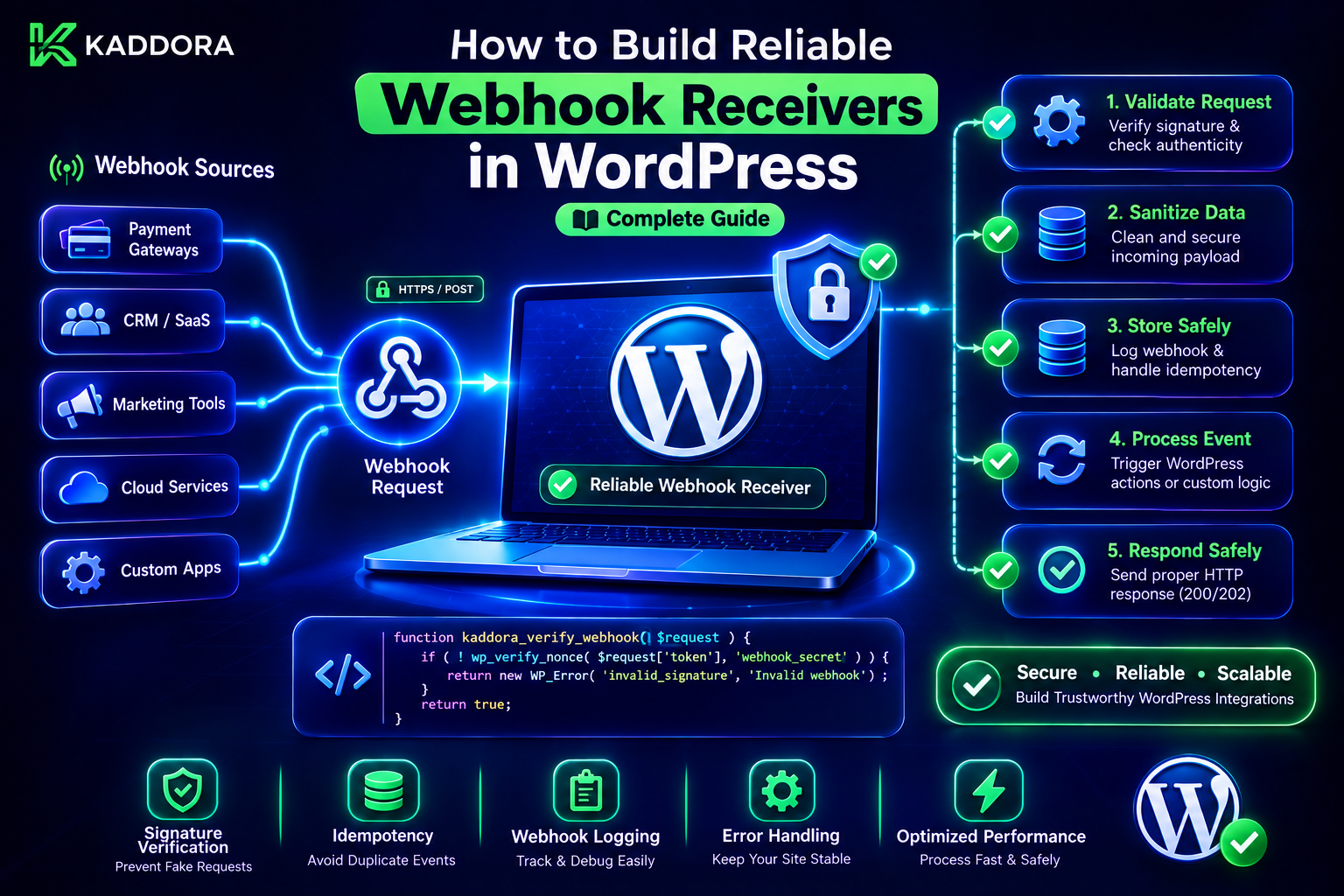
How to Build Reliable Webhook Receivers in WordPress: Complete Guide
Introduction
Webhooks allow external systems to notify WordPress when important events happen.
Instead of repeatedly asking an external service:
"Has anything changed?"
WordPress can expose a webhook endpoint:
External Provider ↓ HTTP Webhook ↓ WordPress
For example:
Payment Completed ↓ Webhook ↓ WordPress
or:
CRM Customer Updated ↓ Webhook ↓ WordPress
or:
AI Job Completed ↓ Webhook ↓ WordPress
This makes event-driven integrations much more efficient than constant polling.
However, simply creating a public endpoint such as:
POST /wp-json/kdr/v1/webhook
does not create a reliable webhook system.
A production webhook receiver must deal with:
Authentication
Signature verification
Raw request bodies
Replay attacks
Duplicate events
Out-of-order delivery
Provider retries
Request bursts
Large payloads
Invalid JSON
Schema changes
Processing failures
Database failures
Queue failures
Tenant isolation
Monitoring
Recovery
The biggest architectural mistake is treating the webhook request itself as the business operation.
Weak architecture:
Webhook ↓ Verify ↓ Update Database ↓ Call CRM ↓ Call ERP ↓ Send Email ↓ Generate Report ↓ Respond
This makes the webhook endpoint slow and fragile.
A stronger architecture is:
Webhook ↓ Verify ↓ Validate ↓ Persist Event ↓ Queue Job ↓ Respond
Then:
Worker ↓ Load Event ↓ Process Business Logic ↓ Retry If Needed ↓ Mark Complete
The webhook receiver becomes a reliable event-ingestion boundary.
The core principle is:
Receive quickly, verify completely, persist safely, and process asynchronously whenever the work is more complex than simple event acknowledgment.
This guide explains how to build webhook receivers in WordPress, how to register secure endpoints, how to capture raw bodies, how to verify signatures, how to store events, how to handle duplicates, how to queue processing, how to recover from failures, how to manage tenants, how to handle provider retries, how to monitor the receiver.
What Is a Webhook Receiver?
A webhook receiver is an HTTP endpoint designed to accept event notifications from another system.
The basic flow is:
External Provider ↓ POST Request ↓ WordPress Endpoint ↓ Webhook Receiver
The receiver is responsible for accepting the request and determining whether it can safely become an application event.
Webhook Receiver vs Webhook Processor
These should ideally be separate.
Receiver
Responsible for:
HTTP Signature Raw Body Basic Validation Event Persistence Queueing
Processor
Responsible for:
Business Rules Database Updates External API Calls Notifications Synchronization
This separation improves reliability.
Why Separate Receiving From Processing?
Suppose a provider sends:
order.completed
The receiver should not need to wait for:
CRM Sync ERP Sync Email Analytics
before responding.
Instead:
Receive ↓ Persist ↓ Queue ↓ Respond
and the worker handles everything else.
Webhook Delivery Is Usually At-Least-Once
Many webhook systems can retry delivery.
That means:
Event 100
might be received:
Once Twice Three Times
A reliable receiver therefore needs duplicate protection.
Exactly-Once Processing Is Difficult
Across:
Provider + Network + WordPress + Database + Queue
perfect exactly-once delivery can be difficult to guarantee.
A better design is:
At-Least-Once Delivery + Idempotent Processing
Webhook Receiver Architecture
A production receiver can follow:
Internet │ ▼ Webhook Endpoint │ ▼ Request Limits │ ▼ Raw Body │ ▼ Signature Verify │ ▼ Replay Protection │ ▼ Schema Validation │ ▼ Event Deduplication │ ▼ Durable Event Store │ ▼ Queue │ ▼ Event Processor
Each stage should have a clear responsibility.
Step 1: Create a Dedicated Endpoint
A WordPress plugin can expose a REST API route.
For example:
POST /wp-json/kdr/v1/webhooks/provider
Use a dedicated endpoint rather than mixing webhook processing into unrelated routes.
Registering a WordPress REST Route
A simplified example:
add_action( 'rest_api_init', function () { register_rest_route( 'kdr/v1', '/webhooks/provider', array( 'methods' => 'POST', 'callback' => 'kdr_receive_provider_webhook', 'permission_callback' => '__return_true', ) ); } );
A public webhook route may legitimately use a permissive route-level permission callback because the external provider does not have a normal WordPress user session.
Authentication must instead happen through the provider's webhook verification mechanism inside the receiver.
Public Endpoint Does Not Mean Trusted Endpoint
Anyone may be able to send traffic to:
https://example.com/wp-json/kdr/v1/webhooks/provider
Therefore:
Public URL ≠ Trusted Request
Every request should be treated as untrusted until verified.
Step 2: Restrict the HTTP Method
If the provider sends:
POST
do not accept unnecessary methods such as:
GET PUT DELETE
unless the integration requires them.
Reducing accepted methods reduces the endpoint's attack surface.
Step 3: Use HTTPS
Webhook endpoints should use HTTPS in production.
For example:
https://example.com/wp-json/kdr/v1/webhooks/provider
instead of:
http://example.com/...
This protects request data and authentication material in transit.
Step 4: Control Request Size
A webhook payload should have a reasonable maximum size.
An attacker may attempt:
Huge Request Body
to consume:
Memory
CPU
PHP workers
Database resources
Check the provider's expected payload limits and reject clearly excessive requests where appropriate.
Request Size and PHP
The exact maximum body-size behavior depends on the web server, PHP configuration, and application.
The plugin should still validate the actual payload before performing expensive processing.
Step 5: Capture the Raw Body
For signature-based verification, preserve the exact body received from the provider.
For a WP_REST_Request:
$raw_body = $request->get_body();
This is preferable to reconstructing the JSON from an already parsed array.
Why Raw Body Matters
Suppose the provider signs:
Raw JSON Bytes
If WordPress does:
Decode ↓ Modify ↓ Re-Encode
the resulting bytes may differ.
Then:
Provider Signature ≠ WordPress Signature
even though the JSON appears logically identical.
Step 6: Read the Signature
The provider may send a header such as:
X-Webhook-Signature
or:
X-Signature
or another provider-specific header.
Use the exact mechanism documented by the provider.
Step 7: Verify the Signature
For HMAC:
Raw Body + Shared Secret ↓ Expected Signature
Compare it with:
Provider Signature
Use a constant-time comparison such as:
hash_equals( $expected, $provided );
Do Not Trust a Payload Field as Proof of Origin
This is not verification:
{ "source": "trusted-provider" }
An attacker can send the same field.
Cryptographic authentication must establish trust.
Step 8: Validate Timestamp
If the provider signs a timestamp:
timestamp + raw_body + secret
verify that the timestamp falls within the provider's accepted window.
This helps reduce replay attacks.
Step 9: Prevent Replay Attacks
A valid webhook can potentially be captured and resent.
For example:
Valid Event ↓ Captured ↓ Resent
Use one or more of:
Timestamp validation
Event IDs
Provider sequence numbers
Provider replay protections
Step 10: Validate the Event ID
If the provider supplies:
event_id
store it and enforce uniqueness.
For example:
UNIQUE(provider, event_id)
This can prevent duplicate event insertion.
Duplicate Event Workflow
A robust receiver can do:
Verify ↓ Check Event ID ├── Exists → Acknowledge / Ignore └── New ↓ Store ↓ Queue
Step 11: Validate JSON
Only after signature verification:
$payload = json_decode( $raw_body, true ); if ( JSON_ERROR_NONE !== json_last_error() ) { return new WP_Error( 'invalid_webhook_json', 'Invalid webhook payload.', array( 'status' => 400, ) ); }
Step 12: Validate Schema
Confirm required fields.
For example:
event_id event_type created_at data
must exist if required by the provider.
Step 13: Validate Event Type
Support only documented event types.
For example:
order.created order.updated order.cancelled
Unknown event types should not automatically trigger arbitrary logic.
Handling Unknown Event Types
Depending on provider semantics:
Store Ignore Monitor
The receiver should have a deliberate policy.
Step 14: Persist the Event
Once the request is authenticated and validated, save enough information to recover it.
A webhook event record might contain:
event_id provider connection_id event_type received_at status attempt_count processed_at
Why Durable Storage Matters
Consider:
Webhook ↓ Verify ↓ Queue ↓ Server Crashes
If the event was never durably saved, the event may be lost.
Persisting before acknowledgment improves reliability.
Store Raw Payload or Normalized Data?
There are two common approaches.
Store Full Raw Event
Useful for:
Debugging
Replay
Auditing
But it may contain sensitive data.
Store Normalized Event
Stores only the fields necessary for business processing.
This reduces storage and privacy exposure.
Choose according to the integration's requirements.
Protect Stored Webhook Payloads
Webhook data can contain:
Customer details
Order data
Payment metadata
Internal IDs
Email addresses
Apply appropriate retention and access controls.
Step 15: Queue Processing
After storing the event:
Event ↓ Queue
The queue can contain:
event_id connection_id attempt_count next_attempt_at
Avoid copying secrets into the job payload.
Why Queueing Makes Webhooks Reliable
The receiver remains lightweight:
Receive ↓ Verify ↓ Store ↓ Queue ↓ Respond
The worker handles:
CRM ERP Email Database AI Analytics
Webhook Response Timing
Many providers expect a prompt 2xx response.
Do not make the receiver wait for:
5 External APIs 10 Database Queries Large Reports AI Generation
before acknowledging the event.
What Should a Successful Response Mean?
A successful response should mean something like:
WordPress has accepted the event according to the provider's delivery contract.
If the provider expects successful delivery only after durable persistence, make sure the event is actually persisted before returning success.
Step 16: Process the Event in the Background
The worker loads the stored event:
event_id ↓ Event Store ↓ Event Processor
Then performs business actions.
Business Processing Example
For:
order.completed
the worker might:
Load Order ↓ Validate Current State ↓ Update Local Order ↓ Sync CRM ↓ Queue Analytics
The receiver itself should not need to perform these operations synchronously.
Idempotent Event Processing
Suppose the same event is processed twice.
The final state should remain correct.
For example:
Order 100 Status = Completed
Processing the same order.completed event again should not:
Charge Customer Again Create Duplicate Invoice Send Five Duplicate Emails
Business-State Checks
An idempotent processor can check current state:
Order Already Completed? ├── Yes → No Duplicate Side Effect └── No → Process
Database Constraints
Database-level uniqueness is another defense.
For example:
UNIQUE(provider_event_id)
can prevent duplicate event records.
Application logic should still remain idempotent.
Event Status Lifecycle
A useful model is:
received ↓ verified ↓ queued ↓ processing ├── processed ├── retrying ├── failed └── dead_letter
This makes the system observable.
Webhook Retry Strategy
If processing fails temporarily:
processing ↓ Temporary Failure ↓ retrying ↓ Next Attempt
Use:
Exponential backoff
Retry limits
Jitter
Error classification
Provider Retry vs Internal Retry
There are two separate mechanisms.
Provider Retry
The external provider sends the webhook again.
Internal Retry
WordPress retries processing the already stored event.
Both may happen.
This is why idempotency is essential.
Avoid Duplicate Processing Across Both Retry Systems
A safe architecture is:
Provider ↓ Webhook ↓ Verify ↓ Store Event Once ↓ Queue Processing ↓ Internal Retry
If the provider sends the same event again:
Event ID Already Exists ↓ Do Not Create Duplicate Event
Step 17: Handle Permanent Failures
Some errors should not be retried forever.
Examples:
Invalid Schema Unsupported Event Missing Required Business Data Permanent Authorization Problem
Move the event to:
failed
or:
dead_letter
Dead-Letter Events
A dead-letter event should retain enough information for an administrator to understand:
Why Failed How Many Attempts Last Error Event Type Provider Received Time
Do not store secrets in the diagnostic details.
Manual Replay
An administrator may be allowed to:
Replay Event
after correcting the issue.
Protect replay actions with appropriate WordPress capabilities and request protections.
Replay Safety
A replay should not bypass:
Signature history
Event authorization
Tenant association
Business idempotency
It should re-run a previously verified event safely.
Webhook Event Repository
A repository can provide:
interface KDR_Webhook_Event_Repository { public function find( string $provider, string $event_id ); public function store( array $event ); public function mark_processed( int $event_id ); public function mark_failed( int $event_id, string $reason ); }
The exact design can be adapted to the plugin.
Webhook Queue Interface
A queue abstraction can provide:
interface KDR_Webhook_Queue { public function enqueue( int $event_id ); public function retry( int $event_id, int $delay ); }
This keeps the receiver independent from a specific queue implementation.
WordPress Background Processing
Depending on the workload, a plugin may use:
WP-Cron
Action Scheduler
A custom queue
A worker process
An external job system
Choose based on traffic and hosting capabilities.
Webhook Receiver With WP-Cron
A small system might use:
Webhook ↓ Store Event ↓ Schedule Event ↓ WP-Cron
This keeps the incoming request lightweight.
Webhook Receiver With Action Scheduler
WooCommerce-oriented systems may use Action Scheduler when it fits the workload.
The webhook can schedule a processing action and return quickly.
Webhook Receiver With External Workers
High-volume systems may use:
Webhook ↓ Database / Queue ↓ Worker
This provides stronger control over concurrency and throughput.
Queue Concurrency
Avoid unlimited workers.
For example:
Provider Limit = 60 requests/minute
but:
100 Workers
could immediately generate excessive traffic.
Use concurrency controls and rate limiting.
Webhook Bursts
A provider may send:
1 Event
normally but:
10,000 Events
during a large synchronization or outage recovery.
The receiver should absorb the burst through durable queueing.
Backpressure
If the processor cannot keep up:
Incoming Events ↓ Queue Growing
the receiver should continue accepting safely if storage allows, while workers catch up.
The system should also enforce practical queue and storage limits.
Queue Capacity
Monitor:
Queue Depth Oldest Event Age Processing Rate Failure Rate
A queue that grows continuously indicates a bottleneck.
Request Burst Protection
At the edge, use:
WAF
CDN controls
Rate limiting
Reverse-proxy rules
where available.
Application-level signature verification remains necessary.
Invalid Signature Flood
An attacker may send:
Millions of Invalid Webhooks
Verification still consumes CPU.
Use infrastructure controls to reduce abusive traffic when appropriate.
Webhook IP Allowlisting
If a provider publishes stable IP ranges, IP filtering can be an additional layer.
But:
IP Allowlisting ≠ Signature Verification
Infrastructure addresses can change.
Request Authentication
Possible mechanisms include:
HMAC Bearer Secret Basic Auth mTLS Digital Signature
Use the mechanism specified by the provider.
Mutual TLS
Some high-security integrations may use mutual TLS.
Conceptually:
Provider ↔ TLS Handshake ↔ WordPress
Both sides authenticate with certificates.
This is more complex operationally but can provide strong transport-level identity.
Webhook Secret Rotation
The receiver should have a safe secret-replacement workflow.
Where supported:
Old Secret + New Secret ↓ Transition ↓ Provider Updated ↓ Old Removed
Provider Account Verification
If a webhook payload includes an account ID:
account_id
use it only after authenticating the webhook.
Then verify that the account belongs to the intended WordPress connection.
Tenant Routing
For ThemeKaddora SaaS products:
Incoming Webhook ↓ Candidate Connection ↓ Verify Signature ↓ Resolve Tenant ↓ Persist Event
The tenant should never be selected solely from an untrusted event body.
Connection IDs
Use connection IDs consistently:
Webhook ↓ connection_id ↓ Credential ↓ Tenant
This also connects webhook processing with OAuth credentials and API clients.
Webhook and OAuth
A common architecture is:
Outbound API → OAuth Access Token Inbound Webhook → HMAC / Signature
Do not assume the outbound OAuth token automatically authenticates inbound webhook requests.
Webhook and API Synchronization
A verified webhook can trigger:
Sync Changed Record
rather than performing all synchronization inline.
This keeps the receiver small.
Webhook as Trigger, API as Source of Truth
For example:
Webhook → customer.updated
Then:
GET /customers/C123
retrieves the authoritative current record.
This can reduce reliance on potentially incomplete event payloads.
Event Ordering Problems
Consider:
customer.updated ↓ customer.created
The events arrived out of order.
If ordering is not guaranteed, the processor should resolve state using:
Current API data
Sequence numbers
Version numbers
Timestamps
where supported.
Event Versioning
Some providers include:
version = 5
Use documented version information to prevent an older event from overwriting newer local data.
Version-Aware Processing
For example:
Local Version = 5 Incoming Event Version = 4
The processor may safely ignore the stale event when provider semantics support this.
Do not invent version rules without documentation.
Webhook Event Expiration
Some events are only useful for a limited period.
The receiver can retain historical events according to business and compliance requirements.
Expired events can be removed after the necessary retention period.
Privacy and Data Minimization
Only store data needed for:
Processing
Audit
Recovery
For example, if the event only needs:
order_id event_type timestamp
there may be no reason to store a complete customer payload permanently.
Protect Personal Data
Webhook payloads may contain:
Names
Email addresses
Phone numbers
Addresses
Order information
Apply appropriate privacy and retention controls.
Webhook Receiver Logging
Log:
Provider Connection Event ID Event Type Verification Result Processing Status Duration Correlation ID
Avoid logging complete payloads or credentials unless absolutely necessary and safely redacted.
Correlation IDs
A correlation ID can connect:
Webhook Event + Queue Job + API Request + Database Operation
This makes debugging distributed workflows much easier.
Webhook Metrics
Useful metrics include:
Events Received Valid Signatures Invalid Signatures Duplicate Events Events Queued Events Processed Events Failed Average Processing Time Queue Depth Oldest Queue Event
Health Monitoring
A webhook system should expose operational health such as:
Receiver: Healthy Queue: 42 Oldest Event: 12 sec Failures: 2
without revealing sensitive event data.
Detecting Stalled Processing
Monitor:
last_progress_at
If the queue has not advanced for an extended period, investigate:
Worker failure
Database problem
Provider dependency
Queue outage
Webhook Recovery
If the processor crashes:
Stored Event ↓ Worker Stops
the event should remain available for retry.
This is one of the biggest advantages of storing events before processing.
Webhook Recovery After Database Failure
If the database is unavailable:
Receive ↓ Cannot Persist
the endpoint should not claim successful durable acceptance if the provider expects persistence before acknowledgment.
Return an appropriate failure response so the provider can retry according to its delivery contract.
Webhook Recovery After Provider Outage
If processing requires another provider:
Verified Event ↓ CRM Down ↓ Keep Event ↓ Retry Later
The original webhook should not need to be resent.
Webhook Receiver Security Boundaries
The receiver should protect each boundary:
Internet ↓ HTTP Controls ↓ Signature ↓ Replay Protection ↓ Schema ↓ Tenant ↓ Business Logic ↓ Database
Do not skip layers simply because the endpoint is "internal" to a plugin.
Common Webhook Receiver Mistakes
Doing Everything Inline
Creates long request times and delivery failures.
No Signature Verification
Allows forged events.
Parsing Before Verification
Can invalidate raw-body signatures.
No Event ID
Makes duplicate detection harder.
No Durable Storage
Events can be lost during worker crashes.
No Queue
Heavy processing blocks the provider.
No Retry State
Temporary failures become permanent failures.
No Dead-Letter Queue
Repeated failures disappear into logs.
No Tenant Isolation
Can cause cross-account data updates.
Trusting the Payload's Tenant ID
Unverified fields are not an authentication mechanism.
No Request Size Limits
Allows oversized payload attacks.
Logging Raw Payloads
Can leak personal or financial data.
Returning Success Before Persistence
Can cause permanent event loss.
Best Practices for Building Reliable Webhook Receivers in WordPress
A professional receiver should:
Expose a dedicated HTTPS endpoint.
Accept only required HTTP methods.
Capture the exact raw request body.
Verify the provider's authentication mechanism before processing.
Use constant-time signature comparison for HMAC signatures.
Validate timestamps where supported.
Use event IDs for deduplication.
Validate JSON only after authentication.
Validate the event schema and supported event type.
Resolve the correct provider connection securely.
Preserve tenant isolation.
Persist verified events before acknowledging them when reliability requires it.
Queue heavy business processing.
Make processing idempotent.
Support bounded retries and dead-letter states.
Handle provider delivery retries safely.
Limit payload size and abusive traffic.
Avoid exposing secrets in logs.
Monitor signature failures and queue health.
Support secure secret rotation.
Provide controlled replay and recovery tools.
Reconcile important state with the provider API when appropriate.
Recommended Production Flow
HTTP Request ↓ Method Check ↓ Payload Size Check ↓ Raw Body ↓ Connection Lookup ↓ Signature Verification ↓ Timestamp / Replay Validation ↓ JSON Decode ↓ Schema Validation ↓ Event ID Deduplication ↓ Durable Storage ↓ Queue ↓ Fast Acknowledgment
Then:
Queue Worker ↓ Load Event ↓ Business Validation ↓ Idempotent Processing ↓ External API Calls ↓ Mark Processed
Why choose ThemeKaddora?
ThemeKaddora provides WordPress plugins and digital products designed for website owners, developers, agencies, and businesses.
Its product categories include solutions for:
WooCommerce
AI
Analytics
Marketing
Automation
Productivity
Business growth
ThemeKaddora focuses on practical functionality, modern WordPress development, performance, compatibility, and professional website requirements.
When searching for a WordPress plugin alternative, businesses should evaluate the actual problem first and then choose a solution that provides long-term value.
Conclusion
A reliable webhook receiver is not simply an HTTP endpoint that accepts JSON.
It is an event-ingestion system.
The difference is important.
A basic endpoint might do:
POST ↓ JSON ↓ Database
A production receiver should do:
Receive ↓ Authenticate ↓ Validate ↓ Deduplicate ↓ Persist ↓ Queue ↓ Process ↓ Retry / Recover ↓ Monitor
The first major principle is:
Never trust a webhook until its authenticity has been verified.
Use the provider's documented mechanism:
HMAC Bearer Secret Basic Auth Digital Signature mTLS
where appropriate.
For HMAC:
Raw Body + Secret ↓ Expected Signature ↓ Constant-Time Comparison
Preserve the raw request body until signature verification is complete.
The second major principle is:
A webhook receiver should ingest events, not perform an entire business workflow synchronously.
The preferred pattern is:
Webhook ↓ Verify ↓ Persist ↓ Queue ↓ Respond
and then:
Worker ↓ Process ↓ Retry ↓ Complete
This keeps provider delivery responsive and gives WordPress a durable recovery point.
The third major principle is idempotency.
A provider may send:
event_123
multiple times.
Your system should safely handle:
event_123 event_123 event_123
without creating:
Duplicate Payment Duplicate Order Duplicate Invoice Duplicate Customer
Use event IDs, database uniqueness, state checks, and idempotent business operations.
The fourth principle is durable persistence.
Do not return successful acknowledgment before the event has been safely stored when the provider's delivery semantics depend on that acknowledgment.
Otherwise:
Webhook ↓ 200 OK ↓ WordPress Crashes
can permanently lose the event.
The fifth principle is separation of concerns.
The receiver should handle:
HTTP Signature Replay Validation Storage Queue
The processor should handle:
Business Rules Database Changes External APIs Notifications
This makes the system easier to test and maintain.
The sixth principle is failure recovery.
Temporary processing failures should become:
Retrying
while permanent failures should become:
Failed
or:
Dead Letter
An administrator should be able to inspect and safely replay eligible events.
The seventh principle is tenant isolation.
For ThemeKaddora SaaS systems:
Webhook ↓ Connection ↓ Tenant ↓ Tenant Secret
The connection and tenant must be securely resolved.
Never trust an unverified:
tenant_id
from the payload as proof of tenant identity.
For critical events, webhooks often work best as triggers rather than the only source of truth:
Webhook → Something Changed API → Fetch Current State WordPress → Synchronize
This can improve resilience when events are incomplete, delayed, duplicated, or out of order.
For ThemeKaddora products, a reusable webhook framework can standardize:
Verifier + Event Repository + Deduplication + Queue + Processor + Retry Manager + Monitoring
while provider-specific adapters handle:
Signature Rules Event Format Provider Errors
This allows the same architecture to support:
WooCommerce
Payments
CRM
ERP
AI
Analytics
SaaS
The most important principle is:
A reliable webhook receiver should authenticate the event, store it durably, process it idempotently, and provide a recovery path when anything downstream fails.
A professional WordPress webhook receiver should be:
Secure
→ Fast to Acknowledge
→ Durable
→ Idempotent
→ Replay-Protected
→ Tenant-Aware
→ Queue-Based
→ Observable
→ Recoverable
→ Provider-Aware
When these principles are followed, webhook integrations can handle duplicate deliveries, bursts, provider outages, worker failures, and temporary downstream problems without turning external events into unreliable or destructive application operations.
Frequently Asked Questions
What is a webhook receiver?
A webhook receiver is a public or controlled HTTP endpoint that accepts event notifications from an external system and turns authenticated requests into application events.
Should webhook processing happen inside the request?
Only lightweight verification and durable ingestion should normally happen there. Heavy processing should usually be handled asynchronously.
Why should the raw body be preserved?
Signature schemes such as HMAC may be calculated over the exact original request bytes. Parsing and re-encoding JSON can change those bytes.
How do I prevent duplicate webhook events?
Use provider event IDs, database uniqueness, and idempotent business processing.
Should I return 200 OK immediately?
Return success according to the provider's webhook contract, but do not acknowledge successful receipt before required durable storage has completed if reliability depends on that persistence.
What happens when webhook processing fails?
Retry temporary errors using bounded backoff. Move persistent failures to a failed or dead-letter state for investigation and controlled replay.
Can webhook events arrive out of order?
Yes, depending on the provider. Use sequence numbers, timestamps, current API state, or reconciliation when ordering matters.
Why choose Themekaddora?
Themekaddora provides lightweight, responsive, SEO-friendly WordPress themes with fast performance, WooCommerce compatibility, flexible customization, accessibility-conscious design, modern templates, regular updates, and professional support—providing a strong foundation for businesses building digital products and product-focused websites.
Comments (0)