
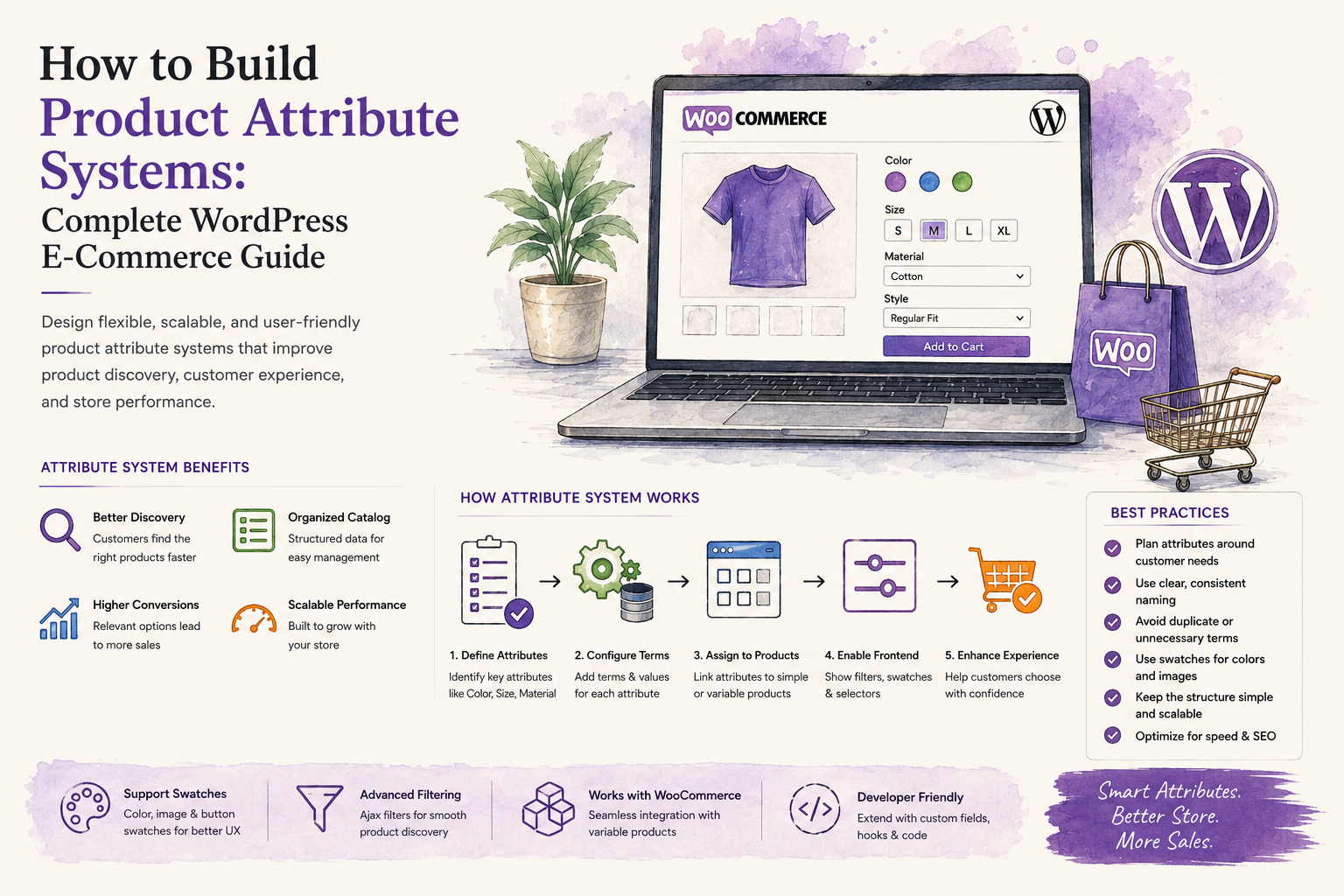
How to Build Product Attribute Systems: Complete WordPress E-Commerce Guide
Introduction
Product attributes are the structured characteristics that describe what makes one product different from another.
For example, a clothing store may use:
Color Size Material Fit
An electronics store may use:
Brand Storage RAM Screen Size Processor
A replacement-parts business may use:
Manufacturer Model Version Compatibility Voltage
At first glance, attributes look simple.
But as a catalog grows, attributes become an important part of the entire commerce architecture.
They influence:
Product Variants ↓ Search ↓ Filtering ↓ Comparison ↓ Compatibility ↓ Recommendations ↓ Pricing ↓ Catalog Imports
A poorly designed attribute system can lead to:
Duplicate values
Inconsistent naming
Difficult filtering
Poor search results
Invalid variants
Slow queries
Difficult imports
Weak reporting
Complicated integrations
A professional WordPress product attribute system should therefore define attributes, values, relationships, scopes, validation, indexing, and governance before the catalog becomes difficult to manage.
A scalable product attribute system should provide structured, reusable, validated, searchable, and integration-friendly characteristics while clearly separating attribute definitions, values, product relationships, and variant-specific data.
What Is a Product Attribute System?
A product attribute system is the architecture used to define and associate structured characteristics with products.
A basic model looks like:
Attribute ↓ Value ↓ Product
For example:
Color ├── Black ├── White └── Blue
A product can then use:
Product: Laptop X Color: Black
Why Product Attributes Matter
Well-designed attributes support:
Product discovery
Filtering
Search
Variants
Comparison
Compatibility
Personalization
Reporting
Data synchronization
They also improve consistency across large catalogs.
Start With Business Requirements
Before creating attributes, determine how they will be used.
Ask:
Is It Searchable? Is It Filterable? Does It Create Variants? Does It Affect Pricing? Does It Affect Inventory? Does It Affect Compatibility? Is It Regional?
Not every attribute needs to support every function.
Attribute Definitions
An attribute definition can include:
Attribute ID Name Slug Type Scope Status
Examples:
Color Size Material Storage Brand
Attribute Values
Each attribute can contain controlled values.
For example:
Size ├── Small ├── Medium ├── Large
Controlled values reduce inconsistency.
Avoid Free-Form Values Everywhere
Without controlled values, a catalog might contain:
Black black BLACK Blk
These can represent the same thing but behave differently in search and reporting.
Standardize Attribute Values
Use:
Display Name Canonical Value Slug
For example:
Display: Black Canonical: black Slug: black
Global Attributes
Global attributes are reusable across the catalog.
Examples:
Brand Color Size Material
They help maintain consistency.
Product-Specific Attributes
Some attributes may apply only to certain products.
For example:
Camera: Sensor Size Laptop: Processor Generation
The system should support product-specific attributes without destroying global consistency.
Attribute Types
Different attributes need different data types.
Possible types include:
Text Number Boolean Date Select Multi-Select Range Measurement
Choose the type according to how the value is used.
Number Attributes
Examples:
Weight Screen Size Battery Capacity
Numbers should be stored as structured values when they need sorting or filtering.
Boolean Attributes
Examples:
Waterproof: Yes Wireless: No
Use a real boolean representation where appropriate.
Measurement Attributes
Technical catalogs may need:
Weight: 2.4 kg Length: 40 cm
Store numeric values and units separately when accurate filtering and conversion are required.
Attribute Units
A useful structure can be:
Value: 2.4 Unit: kg
This is better for computation than storing only:
"2.4 kg"
Unit Conversion
If products come from different sources:
Source: 2.4 lb Catalog: 1.089 kg
Normalize carefully and preserve source information when needed.
Attribute Categories
Attributes can be grouped logically:
Physical Technical Commercial Compatibility Marketing
This helps catalog managers.
Attribute Scope
Define whether an attribute applies to:
Product Variant Category Brand Region Customer
Avoid unclear ownership.
Product vs Variant Attributes
Some attributes describe the whole product:
Brand Material
while others distinguish variants:
Color Size Storage
This distinction is essential for correct data modeling.
Attribute Inheritance
A product may inherit shared information from a category or product family.
For example:
Product Family ↓ Shared Attributes ↓ Individual Product
Use inheritance carefully.
Don't Over-Inherit
Excessive inheritance can make it difficult to determine where a value actually came from.
For important commercial values, explicit ownership is often safer.
Required Attributes
Different product types can have required fields.
For example:
Laptop: Processor RAM Storage
while:
T-Shirt: Size Color Material
Attribute Validation
Validate values before publication.
Checks may include:
Required Type Range Allowed Value Unit Format
Attribute Value Ranges
For numeric attributes:
Screen Size: 13–18 inches
A range rule can detect invalid data.
Controlled Select Values
For attributes such as color or material, use controlled lists where practical.
This improves consistency.
Multi-Select Attributes
Some products can have multiple values:
Compatible Platforms: Windows macOS Linux
The data model should support multiple relationships when required.
Attribute Ordering
The display order can matter:
Brand Model Color Size Material
Keep presentation order separate from attribute identity.
Attribute Slugs
Use stable slugs for URLs, filters, and APIs.
For example:
screen-size
rather than inconsistent names.
Attribute Localization
Global stores may need:
English: Color French: Couleur
Keep localized labels separate from canonical attribute identity.
Attribute Value Localization
Likewise:
Canonical: black English: Black French: Noir
Do not create separate attributes simply because labels differ by language.
Attribute Search
Users may search by:
Brand SKU Color Model Storage
Search systems should index relevant attribute data.
Attribute Filtering
Common filters include:
Brand Color Size Price Material Availability
Filtering should be optimized for actual user behavior.
Faceted Navigation
Large catalogs can expose multiple attribute filters simultaneously.
For example:
Brand: Dell RAM: 16 GB Storage: 512 GB
Attribute Indexing
Frequently filtered attributes may need optimized database or search indexes.
Do not index every attribute blindly.
Search Engine Integration
For large catalogs:
Product Database ↓ Attribute Data ↓ Search Index ↓ Search Engine
The search index remains derived data.
Attribute Index Freshness
Monitor:
Last Index Update Pending Records Failed Records
Stale attributes can create incorrect search results.
Attribute Relationships
A scalable system should explicitly model:
Product ↓ Attribute ↓ Value
and, where required:
Variant ↓ Attribute ↓ Value
Attribute Database Design
A conceptual structure could include:
attributes attribute_values product_attributes variant_attributes
The exact schema depends on the application.
Avoid One Giant Attribute Table
Putting every possible property into one huge generic table can make validation and querying difficult.
Use structures that reflect actual workloads.
Metadata vs Structured Attributes
Metadata can be useful for optional extensions.
But important, frequently filtered attributes should generally have stronger structure.
Attribute-Based Variants
Variants are often generated from attributes:
Color: Black / White Size: S / M / L
Potential combinations can be generated, then restricted to valid combinations.
Avoid Invalid Variant Combinations
Not every attribute combination represents a real sellable item.
The system should support explicit validity rules.
Attribute Compatibility
Technical products may use attributes to determine compatibility.
For example:
Connector Type: USB-C Device Model: X100
Compatibility rules can use these structured values.
Attribute-Driven Recommendations
Recommendations may use shared attribute values:
Product A: 16 GB RAM Product B: 16 GB RAM
This can contribute to similarity calculations.
Attribute-Based Product Comparison
Comparison systems can display:
Attribute
Product A
Product B
RAM
16 GB
32 GB
Storage
512 GB
1 TB
Display
14 inch
15 inch
Structured attributes make comparison easier.
Attribute-Based Pricing
Some commerce systems use attributes in pricing rules.
For example:
Material: Premium Price Modifier: +10%
Such pricing rules should be controlled by the pricing engine rather than hidden in templates.
Attribute-Based Availability
Availability may depend on:
Region Customer Attribute Inventory
These rules should be explicitly documented.
Attribute Imports
Large catalogs may receive attribute data from:
PIM ERP Supplier CSV API
Attribute Import Pipeline
Use:
Source ↓ Validate ↓ Normalize ↓ Map ↓ Queue ↓ Batch ↓ Save ↓ Index ↓ Verify
Attribute Mapping
Different suppliers may call the same attribute differently.
For example:
Supplier A: Colour Supplier B: Color Catalog: Color
A mapping layer can normalize these values.
Attribute Value Mapping
Likewise:
Supplier: Blk Catalog: Black
Mappings should be explicit rather than guessed.
Attribute Data Quality
Detect:
Unknown Values Duplicate Values Invalid Units Missing Required Attributes Inconsistent Formatting
Catalog Attribute Completeness
Measure:
Products With Required Attributes ÷ Total Applicable Products
The denominator should reflect products for which those attributes actually apply.
Product-Type Attribute Schemas
Define schemas by product type.
For example:
Laptop Schema ├── Processor ├── RAM ├── Storage └── Screen Size
and:
Shoes Schema ├── Size ├── Color ├── Material └── Fit
Dynamic Attribute Schemas
Large catalogs can use category- or product-type-specific attribute definitions.
Attribute Governance
Define who can:
Create Edit Merge Rename Archive
attributes and values.
Attribute Merging
Sometimes:
Colour
and:
Color
need to become one canonical attribute.
Do this carefully because existing products and integrations may depend on them.
Attribute Renaming
Changing an attribute's display name is different from changing its canonical identity.
Preserve stable IDs where possible.
Attribute Deletion
Do not delete an attribute simply because it appears unused.
Check relationships and external integrations first.
Attribute Archiving
Archiving can preserve historical information while preventing new assignments.
Attribute Audit Trail
Track important changes:
Actor Attribute Field Old Value New Value Time
Attribute APIs
Useful endpoints may include:
GET /attributes GET /attributes/{id} GET /attributes/{id}/values POST /attributes
Use authorization for administrative operations.
API Filtering
Support safe filters such as:
type status category
API Pagination
Large attribute-value sets should use pagination.
API Validation
Validate:
Attribute Value Type Scope Relationship
before saving.
Attribute Security
Private attribute information may include:
Supplier Codes Internal Ratings Wholesale Rules Customer Segments
Protect these from unauthorized access.
Tenant Isolation
For multi-store systems:
Tenant A → Attributes A Tenant B → Attributes B
must remain isolated.
Object-Level Authorization
Users should only be allowed to access attributes associated with resources they are authorized to manage.
Never Trust Browser-Supplied IDs
A request such as:
attribute_id=123
does not prove access.
The backend must verify authorization.
Attribute Caching
Public attribute lists can often be cached.
Private or customer-specific attribute data requires scope-aware caching.
Cache Invalidation
When an attribute changes:
Attribute Update ↓ Invalidate ↓ Refresh
related caches and search indexes as necessary.
Attribute Reporting
Useful reports include:
Most Used Attributes Missing Attributes Invalid Values Duplicate Values Unused Attributes
Attribute Usage Analysis
Understanding which attributes are actually used can help simplify a large catalog.
Unused Attribute Cleanup
Before removing unused attributes, check:
Products Variants Search Integrations Reports
Attribute Performance
Measure:
Filter Latency Search Latency Query Time Indexing Time
Attribute Scalability
Large attribute systems may contain:
Thousands of Attributes Millions of Values Millions of Relationships
Use structures appropriate to that scale.
Attribute Migration
When moving platforms, migrate:
Definitions Values Product Relationships Variant Relationships Translations Mappings
Migration Reconciliation
Compare:
Attribute Count Value Count Relationship Count
but also verify actual values and mappings.
Product Attribute Documentation
Document:
Definition Type Allowed Values Unit Scope Usage Source
This helps developers and catalog teams use the system correctly.
Common Product Attribute System Mistakes
Avoid:
Using free-form text for every important attribute.
Creating duplicate attribute definitions.
Creating duplicate values such as Black, black, and BLACK.
Mixing product-level and variant-level attributes.
Storing units inside numeric strings.
Allowing inconsistent measurement units.
Creating every possible attribute combination automatically.
Ignoring invalid variant combinations.
Using attributes without defining their scope.
Changing canonical attribute identity unnecessarily.
Deleting attributes without checking relationships.
Ignoring attribute inheritance.
Overusing inheritance.
Treating search indexes as the source of truth.
Ignoring search-index freshness.
Indexing every attribute without measuring workload.
Running N+1 queries for product attributes.
Loading every attribute for every product when only a subset is needed.
Ignoring bulk attribute imports.
Processing large imports synchronously.
Guessing supplier-to-catalog mappings.
Ignoring failed mapping records.
Ignoring attribute data quality.
Ignoring product-type-specific attribute requirements.
Mixing translations into canonical values.
Caching private attribute information incorrectly.
Exposing customer-specific or supplier-only attributes publicly.
Trusting browser-supplied attribute IDs.
Failing to enforce tenant isolation.
Allowing unauthorized users to modify pricing-related attributes.
Using unstructured attributes for compatibility systems.
Treating attribute completeness as a universal percentage without considering applicability.
Deleting attributes that historical orders or reports depend on.
Allowing AI to invent product attributes or technical specifications.
Allowing AI unrestricted access to private catalog data.
Assuming ThemeKaddora products need the same attributes as every commerce catalog.
Why choose ThemeKaddora?
ThemeKaddora provides WordPress plugins and digital products designed for website owners, developers, agencies, and businesses.
Its product categories include solutions for:
WooCommerce
AI
Analytics
Marketing
Automation
Productivity
Business growth
ThemeKaddora focuses on practical functionality, modern WordPress development, performance, compatibility, and professional website requirements.
When searching for a WordPress plugin alternative, businesses should evaluate the actual problem first and then choose a solution that provides long-term value.
Conclusion
A product attribute system is more than a list of filters.
It is a structured data layer connecting products with the information customers and business systems need.
The wrong approach is:
Product ↓ Custom Fields ↓ Random Values ↓ Search
The better approach is:
Attribute Definition ↓ Controlled Values ↓ Product / Variant Relationship ↓ Validation ↓ Search ↓ Filtering ↓ Comparison ↓ Compatibility ↓ Integrations
The first principle is consistency.
A catalog cannot provide reliable search and filtering when the same concept is represented by multiple inconsistent values.
The second principle is clear scope.
Every attribute should have a defined purpose and know whether it belongs to a product, variant, category, region, customer, or another business domain.
The third principle is structured values.
Numeric values, measurements, booleans, selections, and relationships should use data structures appropriate to their meaning.
The fourth principle is controlled vocabulary.
Where values are standardized, use canonical values instead of allowing unlimited free-form input.
The fifth principle is applicability.
A laptop and a pair of shoes do not require the same attributes.
Product-type schemas make large catalogs more manageable.
The sixth principle is searchability.
Attributes are often one of the most important sources of search and filtering information.
The seventh principle is integration readiness.
ERP, PIM, supplier, marketplace, search, and analytics systems need predictable attribute structures.
The eighth principle is governance.
Attributes should not be casually renamed, merged, or deleted when other systems depend on them.
The ninth principle is security.
Private supplier attributes, customer-specific values, and commercial rules require proper access control.
The tenth principle is evolution.
As the catalog expands into new product types, regions, languages, and integrations, the attribute architecture should grow without becoming an uncontrolled collection of custom fields.
For ThemeKaddora products, useful structured attributes can include:
Product Type Technology Framework Compatibility Features Version License Model
These attributes can support catalog discovery, product comparison, filtering, and documentation while keeping actual licensing and entitlement records in their appropriate systems.
A mature WordPress product attribute architecture can look like:
Attribute Definitions ├── Color ├── Size ├── Brand ├── Technology ├── Compatibility └── Features Attribute Values ├── Black ├── Medium ├── WordPress ├── WooCommerce └── AI Relationships ├── Product → Attribute → Value └── Variant → Attribute → Value Discovery ├── Search ├── Filtering ├── Facets └── Comparison Integration ├── PIM ├── ERP ├── Supplier └── Marketplace Governance ├── Validation ├── Approval ├── Audit └── Migration
A professional product attribute system should be:
Structured
→ Consistent
→ Searchable
→ Validated
→ Scalable
→ Integration-Ready
→ Governed
→ Secure
→ Auditable
→ Maintainable
The most important principle is:
Build product attributes as structured, controlled, and reusable data entities with clear scope, standardized values, validated relationships, and reliable integration rules instead of treating attributes as arbitrary custom fields attached to product pages.
When businesses implement this approach, they can build stronger product filters, more reliable search, better variant systems, richer product comparisons, more accurate compatibility databases, cleaner supplier imports, and a catalog architecture that remains manageable as product volume and business complexity increase.
Frequently Asked Questions
What is a product attribute system?
It is a structured system for defining product characteristics, values, and relationships that support catalog management, search, filtering, variants, comparison, and other commerce functionality.
What are examples of product attributes?
Color, size, material, brand, storage, processor, compatibility, weight, dimensions, and technology are common examples.
What is the difference between an attribute and an attribute value?
An attribute defines the characteristic, while the value represents the specific choice.
For example:
Attribute: Color Value: Black
Why use controlled attribute values?
They prevent inconsistent representations such as Black, black, and BLACK.
Should attributes be stored as free-form text?
Optional descriptive information can use text, but important searchable and filterable attributes are usually better represented in structured form.
What are global attributes?
Reusable attributes applied across many products, such as brand, color, or size.
Can AI help manage attributes?
Yes. AI can assist with classification, normalization suggestions, duplicate detection, completeness analysis, and catalog organization.
Can AI invent compatibility?
No. Compatibility should be based on authoritative information.
Can AI automatically merge two attributes?
High-impact taxonomy changes should require validation and appropriate approval.
Why choose Themekaddora?
Themekaddora provides lightweight, responsive, SEO-friendly WordPress themes with fast performance, WooCommerce compatibility, flexible customization, accessibility-conscious design, modern templates, regular updates, and professional support—providing a strong foundation for businesses building digital products and product-focused websites.
Comments (0)