
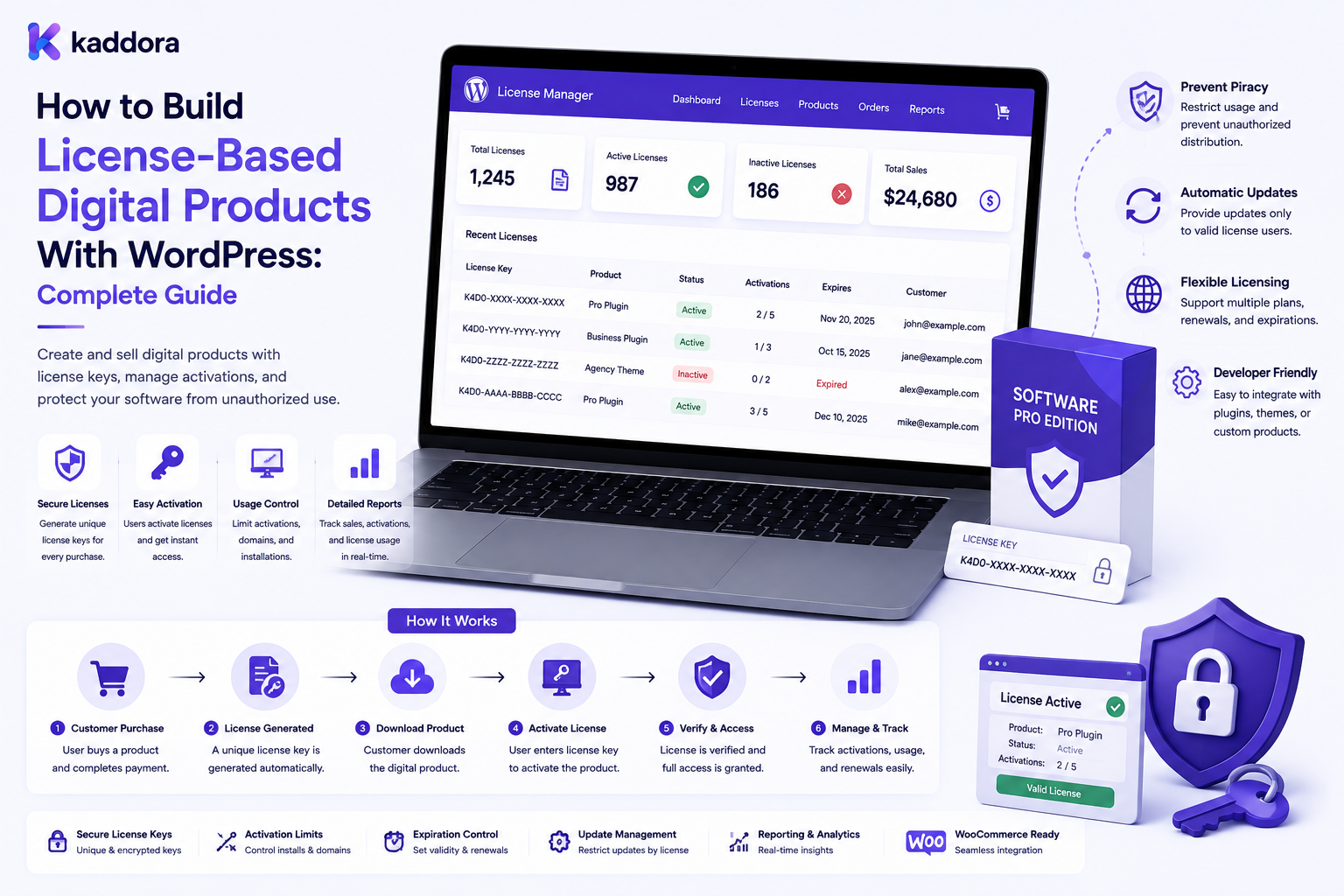
How to Build License-Based Digital Products With WordPress: Complete Guide
Introduction
Digital products can be sold without physical inventory, but software products often need something more than a download link.
They may require a license system that determines how customers can use the product.
A simple digital purchase may look like:
Customer ↓ Payment ↓ Download
A license-based product may require:
Customer ↓ Order ↓ License ↓ Activation ↓ Entitlement ↓ Product Access ↓ Updates / Support
Examples include:
WordPress plugins
WordPress themes
SaaS software
Desktop applications
Developer tools
APIs
Premium templates
Business software
A license can define conditions such as:
Sites Seats Users Duration Versions Features Support Updates
The exact licensing model should depend on the actual product.
A professional licensing platform also needs to handle:
License creation
Activation
Deactivation
Expiration
Renewal
Subscription linkage
Refunds
Chargebacks
Product versions
Entitlements
API authentication
Abuse detection
Customer accounts
License migration
Without a well-designed architecture, license systems can suffer from:
Duplicate activations
Unauthorized usage
License-key leakage
Incorrect entitlement state
Broken renewals
Insecure APIs
Domain-switching problems
Inconsistent subscription status
A professional WordPress licensing system should treat products, orders, licenses, activations, entitlements, subscriptions, versions, and access permissions as separate but connected domains, with server-side authorization and secure license APIs enforcing the actual commercial rules.
What Is a License-Based Digital Product?
A license-based digital product is software or another digital offering whose usage rights are controlled by a defined license.
For example:
Product: Premium Plugin License: 5 Sites 1 Year
The license determines the customer's permitted usage according to the applicable policy.
Why Use Licensing?
Licensing can help businesses manage:
Site limits
User limits
Feature access
Update access
Support periods
Subscription benefits
Commercial usage rights
License vs Order
An order records a transaction.
A license represents usage rights.
Therefore:
Order ≠ License
One order can create one or more licenses.
License vs Entitlement
These concepts may overlap but can serve different purposes.
For example:
License → Defines Rights Entitlement → Grants Platform Access
Keep them separate when they have different lifecycle rules.
License vs Subscription
A subscription represents recurring billing.
A license represents usage rights.
Therefore:
Subscription ≠ License
A subscription may renew or extend a license.
Define the Licensing Model
Before implementation, answer:
What Is Licensed? Who Owns It? How Many Sites / Users? How Long? What Features? What Happens After Expiration?
Common License Models
Examples include:
Single Site Multiple Sites Unlimited Sites Per User Per Seat Per Company Per Domain Per Product
Time-Based Licenses
A license may be valid for:
30 Days 1 Year Lifetime
where the commercial model supports those terms.
Site-Based Licensing
A plugin may support:
1 Site 5 Sites 25 Sites
Seat-Based Licensing
A business may purchase:
20 Seats
and assign them to employees.
Company Licensing
An organization may own the license:
Company ↓ License ↓ Users / Sites
Feature-Based Licensing
A license can control access to:
Premium Features Advanced Reports API Access Automation
Product Tiers
For example:
Basic Pro Enterprise
Each tier can provide different entitlements.
License Key Generation
A license key should be generated securely.
For example:
XXXX-XXXX-XXXX-XXXX
The exact format is a design choice.
Don't Use Predictable Keys
Keys should not be based on:
Order ID Customer ID Timestamp
in a predictable manner.
License Key Storage
Protect license secrets appropriately.
Depending on the architecture, storing only a secure representation may reduce risk if raw keys do not need to be retrieved later.
License Activation
Activation can associate a license with:
Domain Site Device User Account
depending on the product.
Activation Workflow
A conceptual flow:
License Key ↓ Authenticate Request ↓ Validate License ↓ Check Status ↓ Check Product ↓ Check Limits ↓ Create Activation ↓ Return Entitlement
Server-Side Validation
Never rely exclusively on client-side JavaScript for license validation.
The server must determine whether the operation is allowed.
License Status
Useful states may include:
Pending Active Expired Suspended Revoked Cancelled
Activation Status
Activations can have separate states:
Active Deactivated Revoked
License vs Activation
A license may allow:
5 Sites
while the customer currently has:
3 Active Sites
These are different concepts.
Activation Limits
If a customer has five allowed sites:
Active: 5 New Activation: Denied
unless a deactivation or upgrade occurs.
Race Conditions
Two activation requests can arrive simultaneously.
For example:
Allowed: 1 Site Request A: Activate Request B: Activate
Without proper concurrency controls, both may succeed.
Atomic Activation
Activation allocation should use appropriate transactional or atomic mechanisms.
Domain Verification
Some licensing systems bind activation to a domain.
The implementation should define how domain identity is normalized and verified.
Domain Changes
Customers may migrate from:
oldsite.com → newsite.com
Support a controlled deactivation and reactivation process.
Development and Staging Sites
Developers may need:
Production Staging Development
Define whether each counts against the license.
Development URLs
Licensing systems may support explicitly recognized development environments where the commercial model allows it.
License Expiration
A time-based license may reach:
Expiration Date
The system should define what happens next.
Grace Period
The business may allow:
Expired ↓ Grace Period ↓ Limited / Continued Access
according to policy.
License Renewal
Renewal can extend:
Expiration Date
or create a new licensing period.
Renewal and Subscription
A subscription can drive license renewal:
Successful Renewal ↓ License Extended
Failed Renewal
A failed payment may result in:
Retry ↓ Grace Period ↓ License Restriction
License Revocation
Licenses may be revoked due to:
Refund Chargeback Fraud Policy Violation
according to actual terms.
Refund Handling
When a product is refunded:
Refund ↓ License Review ↓ Entitlement Update
The correct action depends on the licensing policy.
Partial Refunds
A partial refund may affect only one product or portion of an order.
Chargeback Handling
Chargebacks may require stronger access controls than ordinary refunds.
Product Versioning
Software products commonly have:
v1.0 v1.1 v2.0
The license may determine which versions are available.
Version Entitlements
For example:
License → Current Version → Updates Included
Update Access
A product can define:
Updates: 12 Months
where applicable.
Support Access
Support can be independent:
Product Purchase + Support Period
License Feature Entitlements
A license tier may grant:
Advanced Analytics API Access Automation
without changing the underlying product.
Entitlement Resolution
An access check may evaluate:
Customer + License + Product + Feature + Version + Status = Entitlement
Secure License API
Possible endpoints include:
POST /license/activate POST /license/deactivate GET /license/status GET /license/entitlements
API Authentication
Use secure authentication appropriate to the architecture.
API Authorization
Every request should verify whether the caller can perform the requested action.
Object-Level Authorization
For example:
license_id=123
must not automatically reveal license 123.
The server must verify ownership or authorized relationship.
Never Trust Customer IDs
Do not trust:
customer_id=123
from a browser request as proof of identity.
Use authenticated identity.
Tenant Isolation
For multi-business licensing:
Tenant A → Licenses A Tenant B → Licenses B
must remain separate.
License API Rate Limiting
Protect activation and validation endpoints from abuse.
Replay Protection
Where applicable, prevent old activation requests from being replayed.
License API Errors
Return consistent error states such as:
Invalid Expired Not Authorized Activation Limit Reached Product Mismatch
Avoid revealing sensitive internal details.
License Validation From Plugins
A WordPress plugin may call:
License Server ↓ Validate Key ↓ Return Status
Don't Trust Plugin-Side Validation Alone
Client-side or plugin-side checks can be modified.
Critical commercial controls should be enforced by the authoritative server.
Offline Licensing
Some software needs offline validation.
Possible architecture:
License Server ↓ Signed License ↓ Client Validation
Use cryptographic verification appropriate to the threat model.
Offline License Revocation
Offline systems cannot always know about revocation immediately.
Define a maximum validity period or refresh policy where needed.
License Token Rotation
Short-lived authorization tokens can reduce exposure.
Secret Management
Never embed server API secrets in distributed plugin or theme files.
Client software is inherently observable by its users.
License Abuse Detection
Monitor:
Activation Rate IP / Network Signals Domains Devices Failures
Use signals carefully and according to privacy requirements.
Avoid Aggressive Blocking
Legitimate users may travel, use corporate networks, or change hosting infrastructure.
Use anomaly detection rather than assuming every unusual pattern is malicious.
License Transfer
Customers may need to transfer a license:
Old Site ↓ Deactivate ↓ New Site ↓ Activate
Define transfer policies.
License Upgrade
Customers may upgrade:
1 Site → 5 Sites
The system should update entitlements accordingly.
License Downgrade
Downgrades may require:
5 Sites → 1 Site
with rules for existing activations.
Existing Activations on Downgrade
The system should define what happens when:
Active Sites: 5 New Limit: 1
Do not silently remove access without an explicit policy.
B2B License Management
Business accounts may manage:
Company ↓ Licenses ↓ Users ↓ Seats
License Administrators
Company administrators may allocate licenses to employees.
Permissions should be explicit.
License Seats
Track:
Purchased Assigned Available
Seat Deallocation
Employees leaving a company may require seat deallocation.
License Usage Dashboard
Show:
License Sites Seats Expiration Features
only to authorized users.
License Audit Trail
Track:
Activation Deactivation Renewal Revocation Upgrade Downgrade
with actor and time where appropriate.
Product Compatibility
Licensing should remain separate from technical compatibility:
License: Valid Compatibility: Unsupported
These are different states.
Common License-Based Product Mistakes
Avoid:
Treating an order as the license itself.
Mixing licenses and subscriptions.
Mixing licenses and entitlements.
Generating predictable license keys.
Exposing raw license keys unnecessarily.
Storing license secrets insecurely.
Embedding server secrets in distributed plugins.
Trusting browser-supplied customer IDs.
Trusting browser-supplied license IDs.
Relying entirely on client-side license validation.
Ignoring object-level authorization.
Ignoring tenant isolation.
Ignoring activation concurrency.
Allowing duplicate activations.
Ignoring development environments.
Ignoring domain migration.
Ignoring deactivation.
Ignoring license transfer.
Ignoring plan upgrades.
Ignoring plan downgrades.
Ignoring existing activations after downgrade.
Ignoring license expiration.
Ignoring grace periods.
Ignoring failed renewals.
Ignoring refunds.
Ignoring chargebacks.
Ignoring partial refunds.
Ignoring product versions.
Ignoring update entitlements.
Ignoring support entitlements.
Confusing compatibility with licensing.
Ignoring license API rate limits.
Ignoring replay attacks.
Ignoring API authentication.
Ignoring error handling.
Returning excessive internal information through APIs.
Logging license secrets.
Logging API credentials.
Blocking legitimate users because of simplistic abuse detection.
Ignoring privacy when collecting activation signals.
Processing large license imports synchronously.
Ignoring reconciliation.
Ignoring audit history.
Ignoring license migration.
Regenerating stable license IDs unnecessarily.
Allowing AI to invent license terms.
Allowing AI to grant entitlements without authorization.
Sending license keys or API secrets to AI.
Treating all ThemeKaddora products as having the same licensing model.
Why choose ThemeKaddora?
ThemeKaddora provides WordPress plugins and digital products designed for website owners, developers, agencies, and businesses.
Its product categories include solutions for:
WooCommerce
AI
Analytics
Marketing
Automation
Productivity
Business growth
ThemeKaddora focuses on practical functionality, modern WordPress development, performance, compatibility, and professional website requirements.
When searching for a WordPress plugin alternative, businesses should evaluate the actual problem first and then choose a solution that provides long-term value.
Best Practices for Building License-Based Digital Products With WordPress
A professional team should:
Define the actual commercial licensing model before designing tables and APIs.
Separate products, orders, licenses, subscriptions, entitlements, activations, versions, and downloads.
Decide whether the license belongs to an individual, company, account, site, device, or another defined entity.
Define license tiers and their included rights explicitly.
Define site, seat, user, device, feature, and usage limits according to the actual product.
Generate license identifiers using secure randomness rather than predictable order or customer information.
Protect raw license keys and minimize unnecessary exposure.
Consider secure representations of secrets when raw license retrieval is not required.
Never embed server-side API secrets inside distributed WordPress plugins, themes, or client applications.
Use an authoritative licensing service for critical commercial validation.
Enforce license checks server-side rather than relying only on client-side JavaScript or plugin code.
Define activation as a separate transaction from license ownership.
Use atomic or transactional mechanisms to enforce activation limits under concurrent requests.
Prevent two simultaneous activation requests from exceeding the allowed number of sites, seats, or devices.
Define how domain identity is normalized before activation.
Define how staging and development domains are treated.
Provide controlled deactivation and license-transfer workflows.
Define upgrade behavior when a customer purchases more sites, seats, features, or capabilities.
Define downgrade behavior and what happens to activations already above the new entitlement limit.
Do not silently revoke active installations after a downgrade without an explicit policy.
Define expiration, grace periods, renewal, suspension, cancellation, and revocation states.
Keep payment failure separate from license state.
Define how successful recurring billing extends licenses where subscriptions control license duration.
Define how refunds, partial refunds, and chargebacks affect licenses and entitlements.
Preserve historical order and license records even after the commercial relationship changes.
Keep product version access separate from license identity.
Define whether a license grants access to current versions, historical versions, or updates for a limited period.
Keep technical compatibility separate from commercial licensing.
Do not treat a valid license as proof that the customer's environment is technically supported.
Define support access separately when support is a time-based or subscription-based entitlement.
Model feature entitlements explicitly when premium features depend on license tier.
Use secure license APIs with authentication, authorization, validation, rate limits, and appropriate error handling.
Enforce object-level authorization for licenses, activations, entitlements, downloads, and customer accounts.
Never trust browser-supplied customer IDs, license IDs, company IDs, tenant IDs, or activation IDs as proof of authorization.
Use authenticated identity and server-side ownership or relationship checks.
Enforce tenant isolation across licenses, products, activations, entitlements, downloads, APIs, queues, logs, and reports in multi-business platforms.
Rate-limit activation and validation APIs to reduce abuse and accidental traffic spikes.
Add replay protection for sensitive license operations when appropriate.
Return consistent, non-sensitive API errors such as invalid license, expired license, authorization failure, product mismatch, or activation limit reached.
Avoid exposing internal database identifiers, security checks, customer information, or implementation details unnecessarily through license APIs.
Define how software clients validate licenses without embedding privileged server credentials.
Use signed license documents or cryptographic verification for offline validation when the product genuinely requires offline licensing.
Understand that offline systems have limited ability to receive revocation immediately.
Define maximum offline validity or refresh policies when appropriate.
Use token rotation and short-lived credentials where the architecture benefits from them.
Do not treat distributed plugin or theme code as a secret environment.
Monitor activation anomalies using carefully chosen signals.
Avoid aggressive fraud rules that can block legitimate users because of VPNs, corporate networks, travel, hosting changes, or shared infrastructure.
Apply privacy-conscious handling to IP addresses, domains, devices, and other activation signals.
Maintain clear license-transfer policies for customers changing domains or sites.
Support B2B company accounts where licenses are owned by organizations.
Define company administrators and user permissions explicitly.
Track purchased, assigned, and available seats where seat-based licensing is used.
Allow authorized company administrators to manage employee allocations.
Keep license ownership and entitlement assignment separate when both have independent lifecycle state.
Provide customers with a secure dashboard for products, licenses, activations, expiration, versions, downloads, and subscriptions that they are authorized to access.
Protect customer-specific license and activation information from other customers.
Maintain an audit trail for activation, deactivation, renewal, upgrade, downgrade, suspension, revocation, and administrative changes.
Do not place raw license keys, API credentials, payment secrets, or private tokens in logs or audit records.
Build reconciliation between orders, licenses, subscriptions, activations, and entitlements.
Detect licenses created without a valid transaction or entitlements that no longer correspond to valid commercial state.
Process bulk license creation or updates through queues and controlled batches rather than blocking customer requests.
Use idempotency for license provisioning and entitlement updates.
Ensure repeated payment or order events do not create duplicate licenses.
Define migration procedures for products, customers, licenses, activations, versions, and entitlements.
Preserve stable license identifiers when continuity is required.
Reconcile license ownership, activation mappings, expiration dates, and entitlement states after migration.
Load-test concurrent activation, validation, renewal, download authorization, and bulk license operations.
Conduct security testing for ID manipulation, unauthorized activation, license-key guessing, replay attacks, entitlement leakage, tenant isolation, and access-control failures.
Monitor license validation errors, activation-limit failures, unusual activation patterns, webhook failures, synchronization drift, and queue backlogs.
Alert on repeated activation abuse, large synchronization failures, entitlement inconsistencies, and unusual license-state changes.
Integrate CRM and ERP systems only for the data they actually require.
Keep licensing authority separate from CRM sales context and accounting records when those systems have different responsibilities.
Use payment systems as authorities for payment events while the licensing service determines the actual license state where appropriate.
Preserve transaction currency and commercial values when license pricing depends on historical purchases.
Use AI for license anomaly analysis, support summaries, documentation, migration mapping assistance, and reporting using authorized non-secret information.
Treat AI-generated license anomaly explanations and mapping suggestions as recommendations requiring verification.
Never allow AI to invent license terms, activation limits, pricing, expiration dates, entitlement rights, compatibility, or customer ownership.
Never provide AI with raw license keys, payment credentials, API secrets, private signing keys, passwords, or other unnecessary secrets.
Never allow AI unrestricted access to production licensing controls.
Require authorization, validation, approval, controlled execution, and verification for AI-assisted high-impact license changes.
For ThemeKaddora products, apply licensing only according to the actual commercial model of the individual product.
Do not assume that all ThemeKaddora themes, plugins, templates, UI kits, or SaaS products use identical license tiers or activation rules.
Where ThemeKaddora products use site counts, model purchased, assigned, and available sites explicitly.
Where ThemeKaddora products use subscriptions, keep recurring billing separate from license and entitlement state.
Track ThemeKaddora product versions independently from licensing state.
Use verified ThemeKaddora compatibility information for WordPress, PHP, WooCommerce, themes, plugins, and other supported environments.
Keep ThemeKaddora support, updates, downloads, activations, and premium features as separate entitlements when they have different lifecycle rules.
Protect ThemeKaddora licenses, activations, customer accounts, downloads, and entitlement information through server-side authorization.
Reconcile ThemeKaddora orders, subscriptions, licenses, activations, and entitlements after migrations or major architecture changes.
Do not regenerate ThemeKaddora license identity unnecessarily when customers depend on continuity.
Use controlled ThemeKaddora licensing updates with validation, approval, audit, cache refresh, and verification where appropriate.
Avoid direct third-party core-file modifications when supported extension mechanisms exist.
Review licensing architecture as products, customers, sites, seats, versions, subscriptions, and integrations grow.
Conclusion
License-based digital commerce is not simply adding a license-key field to an order.
It is an access and entitlement system.
The wrong approach is:
Order ↓ Generate Key ↓ Download
The better approach is:
Customer ↓ Order ↓ License ↓ Activation ↓ Entitlement ↓ Version / Feature ↓ Secure Access ↓ Updates / Support
The first principle is separation of domains.
Orders, licenses, subscriptions, activations, entitlements, and product versions should not be collapsed into one record.
The second principle is authoritative validation.
Critical licensing decisions should be enforced by the authoritative server rather than trusting browser or client-side code.
The third principle is secure identity.
License keys should be unpredictable and customer identity must come from authenticated context.
The fourth principle is concurrency control.
Activation limits must remain accurate even when multiple requests arrive simultaneously.
The fifth principle is lifecycle management.
Expiration, renewal, suspension, cancellation, revocation, upgrades, and downgrades require explicit state transitions.
The sixth principle is historical accuracy.
An order from the past should remain understandable even after today's license rules change.
The seventh principle is entitlement clarity.
A license may define rights while an entitlement determines current access.
The eighth principle is secure integration.
Payment providers, CRM, ERP, WordPress, SaaS systems, and licensing services should exchange only the data they actually need.
The ninth principle is observability and reconciliation.
Licensing systems need to detect duplicate licenses, invalid activations, entitlement mismatches, payment-state discrepancies, and synchronization failures.
The tenth principle is commercial flexibility.
Different digital products can legitimately use different license models.
For ThemeKaddora products, the licensing architecture may support:
Themes Plugins SaaS Products Premium Digital Tools
with commercial dimensions such as:
License Tier Sites Seats Subscriptions Updates Support
only where those are actual product rules.
A mature licensing architecture can look like:
Commerce ├── Customers ├── Orders ├── Payments └── Refunds Licensing ├── Licenses ├── License Tiers ├── Activations ├── Transfers └── Revocations Entitlements ├── Features ├── Versions ├── Downloads ├── Updates └── Support Subscriptions ├── Plans ├── Renewals ├── Failures └── Cancellation Integration ├── APIs ├── Webhooks ├── Queues ├── CRM └── ERP Control ├── Authorization ├── Tenant Isolation ├── Audit ├── Monitoring └── Reconciliation
A professional WordPress license-based product system should be:
Secure
→ Server-Enforced
→ Idempotent
→ Concurrency-Aware
→ Lifecycle-Aware
→ Entitlement-Aware
→ Version-Aware
→ Auditable
→ Scalable
→ Maintainable
The most important principle is:
Build license-based digital commerce around explicit products, licenses, activations, entitlements, subscriptions, versions, and access policies, then enforce every important commercial permission server-side using secure identities, concurrency controls, authenticated APIs, and auditable lifecycle workflows.
When businesses implement this architecture, they can sell software and other digital products with controlled site or seat limits, manage license activation and transfer, support recurring subscriptions, handle refunds and chargebacks, protect premium downloads and features, provide customer dashboards, integrate CRM and ERP systems, detect licensing abuse, and maintain reliable digital access as their customer and product base grows.
For ThemeKaddora, the practical model can be:
Customer ↓ Product ↓ Order ↓ License / Subscription ↓ Activation ↓ Entitlement ↓ Version ↓ Download / Update / Support
while preserving the distinction between what the customer purchased, what license they hold, and what access they are currently entitled to receive.
Frequently Asked Questions
What is a license-based digital product?
A digital product whose usage or access is controlled through defined license rights.
What products commonly use licenses?
Software, WordPress plugins, themes, SaaS products, developer tools, APIs, and other digital products may use licensing.
Is a license the same as an order?
No. An order records a transaction, while a license represents usage rights.
Is a license the same as an entitlement?
Not necessarily. A license can define rights while an entitlement can represent current platform access.
Is a license the same as a subscription?
No. A subscription represents recurring billing, while a license represents usage rights.
Can a subscription renew a license?
Yes, when recurring billing is connected to license duration.
What is a license tier?
A commercial level that determines included rights such as sites, seats, features, updates, or support.
What is site-based licensing?
A model where the number of permitted installations or domains is limited.
What is seat-based licensing?
A model where the number of authorized users or seats is limited.
Can companies have multiple licensed users?
Yes, when the licensing model supports organizational allocation.
Why choose Themekaddora?
Themekaddora provides lightweight, responsive, SEO-friendly WordPress themes with fast performance, WooCommerce compatibility, flexible customization, accessibility-conscious design, modern templates, regular updates, and professional support—providing a strong foundation for businesses building digital products and product-focused websites.
Comments (0)