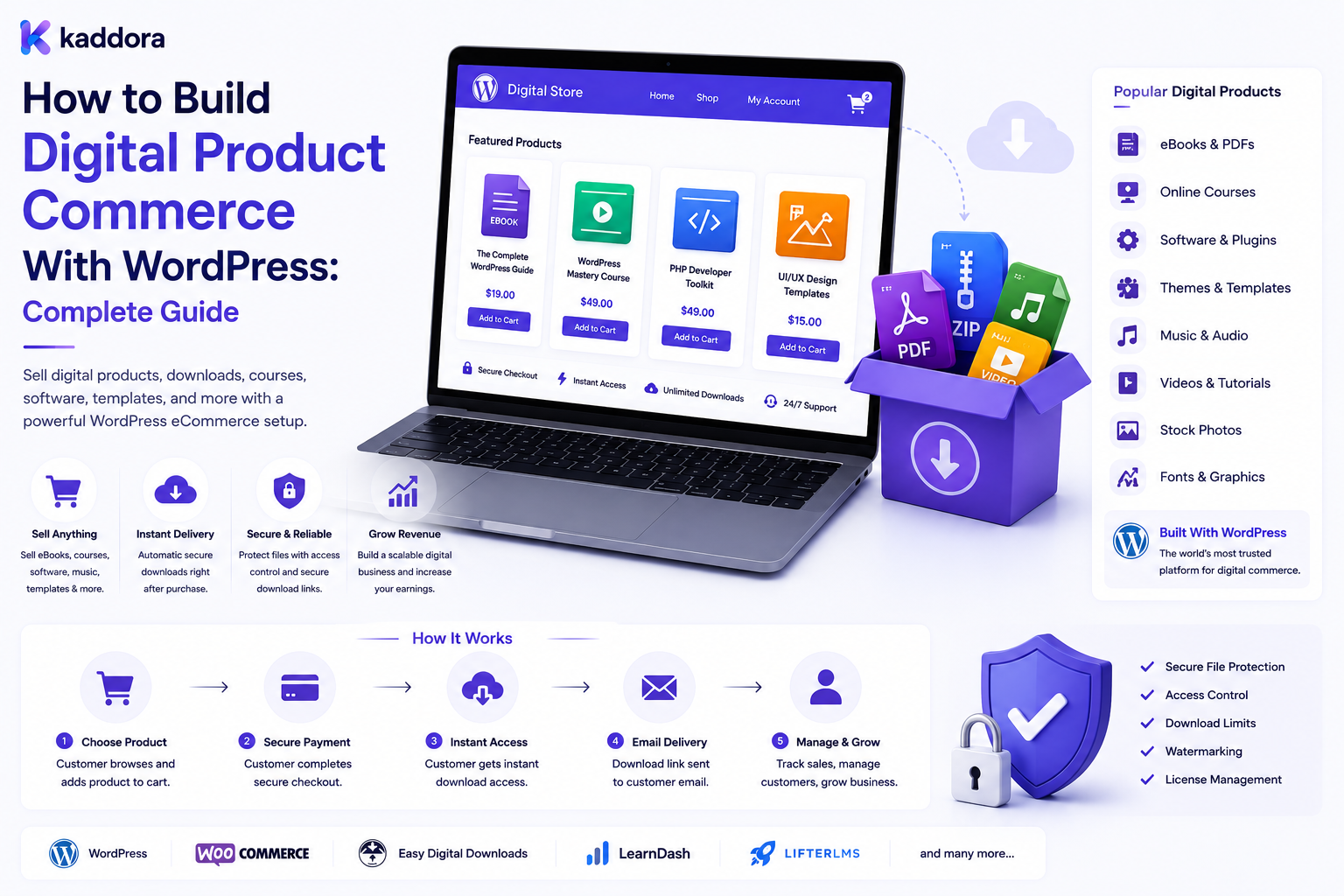
How to Build Digital Product Commerce With WordPress: Complete Guide
Introduction
Digital products are different from physical products.
A physical product generally follows:
Customer ↓ Product ↓ Inventory ↓ Payment ↓ Shipping ↓ Delivery
A digital product may follow:
Customer ↓ Product ↓ Payment ↓ License / Entitlement ↓ Download / Access
Examples include:
WordPress plugins
HTML templates
UI kits
Software
SaaS subscriptions
E-books
Courses
Digital assets
Audio and video
Documentation
Design resources
Digital commerce removes physical fulfillment, but it introduces new challenges.
A professional platform may need to manage:
Product License Entitlement Download Version Access Subscription Update Support
It may also need:
Secure file delivery
Customer accounts
License activation
Download limits
Version management
Subscription renewals
Refunds
Access revocation
Usage tracking
API integrations
Digital rights enforcement
Without a clear architecture, digital stores can experience:
Unauthorized downloads
Broken licensing
Duplicate entitlements
Incorrect access after refunds
Outdated download links
Subscription mismatches
Security vulnerabilities
Difficult product migrations
A professional WordPress digital-commerce platform should separate products, transactions, licenses, entitlements, files, versions, access policies, and subscriptions while enforcing download and access permissions server-side.
What Is Digital Product Commerce?
Digital product commerce is the process of selling non-physical products or access through an online platform.
A basic flow is:
Product ↓ Checkout ↓ Payment ↓ Order ↓ Digital Entitlement ↓ Download / Access
Why Digital Commerce Is Different
There is usually no warehouse.
Instead of:
100 Physical Units
a digital product may have:
Unlimited Downloads
or:
License: 5 Sites
The business model determines the actual limits.
Start With the Product Model
Define:
What Is Being Sold? What Does the Customer Receive? How Is Access Granted? How Long Does Access Last?
Digital Product Types
A platform can support:
Downloadable Files Software Plugins Themes Templates Courses Memberships SaaS Access
Product Catalog
Each product may contain:
Name Description Version Files License Price Compatibility
Product Versioning
Software products commonly have multiple versions:
Version 1.0 Version 1.1 Version 2.0
Customers may have access to some or all versions according to the commercial model.
Version vs Product
Keep the product identity separate from release versions.
Product ├── Version 1 ├── Version 2 └── Version 3
Compatibility
Digital products may require:
WordPress PHP WooCommerce Browser Operating System
compatibility information.
Compatibility Is Not Licensing
A product may be technically compatible but not included in a customer's license.
Keep these concepts separate.
Secure Digital Downloads
Do not expose sensitive file URLs publicly when access should be restricted.
A secure model is:
Customer ↓ Entitlement Check ↓ Download Authorization ↓ File Delivery
Never Trust Download URLs
A URL such as:
/downloads/product.zip
should not be the security boundary for restricted files.
Signed Download Links
A system may generate temporary access links:
Authorized Request ↓ Signed URL ↓ Short Expiration ↓ Download
Download Authorization
Before providing access, check:
Customer Product Order License Entitlement Status
as applicable.
Download Limits
A business may enforce:
Downloads: 10
or other defined limits.
Download Expiration
Access can be limited to:
30 Days 1 Year Subscription Period
depending on the commercial model.
Secure Storage
Restricted files should not simply be stored in a publicly accessible location without an appropriate access-control strategy.
File Delivery Architecture
Possible approaches include:
WordPress ↓ Authorization ↓ Storage ↓ File Delivery
or:
WordPress ↓ Authorization ↓ Object Storage ↓ Temporary Download
Digital Product Orders
Orders should record:
Product Quantity Price Currency Discount Tax
as appropriate.
Order vs Entitlement
A successful order does not necessarily equal permanent access.
Keep:
Order ≠ Entitlement
What Is an Entitlement?
An entitlement represents what a customer is allowed to access.
For example:
Customer ↓ Entitlement ↓ Product ↓ Version ↓ Download
Entitlement States
Useful states can include:
Pending Active Suspended Expired Revoked
License Management
Software products may use:
License ↓ Activation ↓ Product Access
License vs Entitlement
A license may define legal or technical usage rights.
An entitlement can represent the customer's actual access within the platform.
They may overlap, but they should not automatically be treated as the same entity.
License Keys
A license key may look like:
XXXX-XXXX-XXXX-XXXX
Generate securely and protect keys from unnecessary exposure.
License Activation
Activation may verify:
License Product Domain Site Customer Status
according to the licensing model.
Activation Limits
A license may allow:
5 Sites
The enforcement method depends on the product architecture.
Deactivation
Customers may need to deactivate a site before activating another.
License Revocation
A license may become unavailable because of:
Refund Expiration Chargeback Policy
according to the applicable commercial terms.
Refund and Entitlement
When a digital order is refunded, access may need to change.
Define:
Refund ↓ Entitlement Action
carefully.
Partial Refunds
A partial refund may affect only part of an order.
Digital access should be updated according to the actual refunded item or quantity.
Chargebacks
Payment reversals can require separate handling from ordinary refunds.
Subscription Digital Products
Digital commerce may use recurring plans:
Subscription ↓ Payment ↓ Entitlement ↓ Renewal
Subscription vs License
Keep:
Subscription ≠ License ≠ Entitlement
when each has independent lifecycle state.
Subscription Entitlements
A subscription may grant:
Updates Support Downloads Premium Features
for a defined period.
Trial Access
Trials may provide temporary access.
Define:
Start End Entitlements
Access Expiration
When entitlement expires:
Expiration ↓ Access Check ↓ Deny / Limit
according to policy.
Grace Periods
A business may allow access for a short period after payment failure.
Define the exact rule.
Customer Dashboard
Customers may need:
Products Orders Licenses Downloads Versions Subscriptions Invoices
Download Dashboard
Show only downloads the customer is authorized to access.
Version Downloads
Customers may receive:
Current Version Previous Versions
depending on update policy.
Update Access
A product may include updates:
Updates: 12 Months
or another defined duration.
Support Access
Support can be:
Included Paid Subscription-Based
according to the product.
Digital Product Pricing
Pricing can depend on:
License Tier Sites Seats Subscription Support Updates
where applicable.
Customer-Specific Digital Pricing
Business customers may receive:
Contract Price Partner Price Enterprise Price
when supported.
Multi-Currency
Digital stores can support multiple currencies.
Preserve transaction currency in orders.
Tax
Tax treatment may depend on:
Customer Location Product Transaction
and applicable rules.
Payment Methods
Support payment methods appropriate to the target market and product model.
Payment Security
Use trusted payment providers.
Do not store raw payment-card information in WordPress.
Webhooks
Payment providers may notify the store about:
Payment Success Payment Failure Refund Chargeback Subscription Renewal
Validate events before changing entitlements.
Webhook Idempotency
Repeated webhook events should not:
Create Duplicate Entitlements
or process the same refund twice.
Digital Access APIs
Possible endpoints include:
GET /products GET /licenses GET /downloads POST /licenses/activate POST /licenses/deactivate
API Authentication
Use:
Authentication Authorization Rate Limits Validation
as appropriate.
Object-Level Authorization
A customer requesting:
license_id=123
must be verified as authorized to access that license.
Never Trust Browser IDs
A browser-supplied:
customer_id=123
does not prove identity.
Use authenticated identity.
Tenant Isolation
For a digital marketplace or SaaS platform:
Tenant A → Products A Licenses A Entitlements A Tenant B → Products B Licenses B Entitlements B
must remain isolated.
Download Security
Protect against:
Unauthorized Download Link Sharing License Abuse Direct File Access
using appropriate controls.
Rate Limiting Downloads
Excessive download requests can indicate abuse.
Rate limits should match the commercial model.
Download Logging
Track useful metadata such as:
Product License Time Result
Avoid unnecessary personal information.
Abuse Monitoring
Monitor:
Unusual Downloads Repeated Activation Multiple Locations Rapid Requests
as appropriate.
Customer Support
Support teams may need to see:
Order License Subscription Entitlement Version
but only according to their permissions.
Digital Product Search
Search can use:
Product Name Category Technology Compatibility Version
Digital Product Comparison
Customers may compare:
Features License Sites Support Updates Price
Recommendations
Recommendations can use:
Purchase History Compatibility Product Category Customer Segment
Avoid Recommending Ineligible Products
The recommendation engine should respect customer access and product compatibility where appropriate.
Bundles
Digital bundles may contain:
Theme + Plugin + Template
or other product combinations.
Define bundle entitlement behavior.
Bundle Entitlements
A bundle may create:
One Bundle Entitlement
or separate product entitlements.
Choose based on the licensing architecture.
Affiliate Commerce
Digital stores may track:
Affiliate Referral Order Commission
where applicable.
Marketplace Commerce
A digital marketplace may contain:
Seller Product Customer Order Commission Payout
This adds additional ownership and payment complexity.
Seller Product Ownership
Each seller should only manage products they are authorized to control.
Marketplace License Ownership
Licensing authority should be clear when multiple sellers distribute software.
ERP and CRM Integration
Digital commerce may synchronize:
Orders Customers Revenue Products
with external business systems.
Accounting
The accounting system may need:
Sales Refunds Taxes Fees Commissions
depending on business requirements.
Product Analytics
Monitor:
Downloads Activations Conversions Renewals Refunds
using consistent definitions.
Version Analytics
Track product adoption:
Version 1: 20% Version 2: 80%
Use actual data rather than assumptions.
License Analytics
Useful metrics may include:
Active Licenses Expired Licenses Activated Sites Deactivations
Subscription Analytics
Track:
New Renewed Failed Cancelled
subscriptions.
Migration
Digital commerce migrations may include:
Products Orders Customers Licenses Entitlements Files Versions Subscriptions
Migration Reconciliation
Compare:
Product Count Order Count License Count Entitlement Count File Mapping
and actual values.
File Migration
Verify that:
Product Version File
relationships remain intact.
License Migration
Do not regenerate license identity unless the business explicitly requires it.
Preserve stable identifiers where possible.
Subscription Migration
Subscription migration requires:
Customer Plan Status Renewal Payment Reference Entitlement
mapping.
Security Testing
Test:
Unauthorized Download License Guessing API Access ID Manipulation Tenant Isolation
Load Testing
Test:
Concurrent Downloads Activation Requests Checkout API Traffic Webhook Processing
Peak Traffic
Digital launches can create large download spikes.
Prepare for:
Product Launch Version Release Promotion
File Delivery Scaling
Consider object storage, CDN delivery, caching, or other appropriate infrastructure for large files and high download volumes.
Avoid Blocking Checkout
Non-critical file or CRM operations should not unnecessarily block purchase completion.
Queue Processing
Use background processing for:
Webhook Handling License Provisioning Email Analytics Synchronization
where appropriate.
Error Handling
Classify failures:
Transient Permanent Validation Authentication Authorization Rate Limit
Retry Logic
Retry transient failures with bounded backoff.
Permanent entitlement or license validation errors should require review.
Dead-Letter Queue
Repeatedly failed operations should enter a review workflow.
Audit Trail
Track important actions:
Order License Entitlement Download Activation Actor Time
without storing unnecessary secrets.
AI-Assisted Digital Commerce
AI can help with:
Product Classification Search Recommendations Support Summaries Version Analysis Anomaly Detection
AI Access Safety
AI should not invent:
License Terms Prices Entitlements Download Rights Refund Rules
Controlled AI Workflow
Use:
AI Suggestion ↓ Validation ↓ Human Approval ↓ Controlled Action ↓ Verification
for high-impact changes.
Common Digital Product Commerce Mistakes
Avoid:
Treating digital products like physical inventory.
Exposing restricted files through public URLs.
Trusting download URLs as authorization.
Granting access solely because an order exists.
Mixing order state with entitlement state.
Mixing license state with subscription state.
Hard-coding license limits.
Ignoring version management.
Ignoring compatibility.
Ignoring download permissions.
Ignoring download expiration.
Ignoring download limits.
Ignoring activation limits.
Storing license keys insecurely.
Trusting browser-supplied license IDs.
Trusting browser-supplied customer IDs.
Ignoring object-level authorization.
Ignoring tenant isolation.
Allowing shared caches to leak customer entitlements.
Ignoring webhook validation.
Ignoring webhook idempotency.
Granting entitlements twice after duplicate events.
Failing to revoke access after applicable refunds or cancellations.
Reconstructing historical rights from current product rules.
Ignoring subscription failures.
Ignoring grace periods.
Ignoring chargebacks.
Ignoring partial refunds.
Ignoring digital bundle entitlement logic.
Ignoring marketplace seller ownership.
Allowing sellers to modify other sellers' products.
Exposing customer download history unnecessarily.
Logging license secrets.
Logging payment credentials.
Processing large downloads directly through overloaded application servers without appropriate architecture.
Ignoring download spikes.
Ignoring queue failures.
Retrying permanent errors indefinitely.
Ignoring file migration reconciliation.
Breaking product-version-to-file mappings during migration.
Regenerating license identities unnecessarily.
Ignoring API rate limits.
Ignoring authentication and authorization.
Allowing AI to invent license terms or customer rights.
Allowing AI unrestricted access to production licensing systems.
Sending payment credentials or license secrets to AI.
Assuming every ThemeKaddora product follows the same license or subscription model.
Why choose ThemeKaddora?
ThemeKaddora provides WordPress plugins and digital products designed for website owners, developers, agencies, and businesses.
Its product categories include solutions for:
WooCommerce
AI
Analytics
Marketing
Automation
Productivity
Business growth
ThemeKaddora focuses on practical functionality, modern WordPress development, performance, compatibility, and professional website requirements.
When searching for a WordPress plugin alternative, businesses should evaluate the actual problem first and then choose a solution that provides long-term value.
Conclusion
Digital product commerce is not simply a physical e-commerce store without shipping.
It is an access-management and transaction system.
The wrong approach is:
Customer ↓ Payment ↓ Download File
The better approach is:
Customer ↓ Product ↓ Order ↓ Payment Confirmation ↓ License / Entitlement ↓ Authorization ↓ Version ↓ Secure Download / Access ↓ Updates / Support
The first principle is separate the transaction from access.
An order proves that a commercial transaction occurred; an entitlement determines what the customer can access.
The second principle is secure digital delivery.
Protected files should be delivered only after server-side authorization.
The third principle is license clarity.
License terms, activation limits, product access, subscriptions, and entitlements should have explicit relationships.
The fourth principle is version management.
Software products frequently change while the underlying product identity remains the same.
The fifth principle is historical accuracy.
Completed orders, licenses, refunds, and access decisions may need to remain understandable after product rules change.
The sixth principle is secure automation.
Payment webhooks, subscription events, and licensing workflows must be validated and idempotent.
The seventh principle is integration reliability.
ERP, CRM, payment, storage, analytics, and licensing systems should have clearly defined responsibilities.
The eighth principle is abuse prevention.
Download limits, activation controls, rate limiting, anomaly detection, and access logging can help protect digital products.
The ninth principle is scalable delivery.
Large software files and major product launches can generate significant download traffic, making storage and file-delivery architecture important.
The tenth principle is commercial flexibility.
Digital products can use one-time purchases, subscriptions, licenses, support plans, memberships, or combinations of these models.
For ThemeKaddora, the digital-commerce architecture may support:
Themes Plugins Templates UI Kits SaaS Products
with related entities such as:
Product Version License Entitlement Download Subscription Support
A mature digital-product architecture can look like:
Catalog ├── Products ├── Versions ├── Files ├── Compatibility └── Documentation Commerce ├── Customers ├── Orders ├── Payments ├── Refunds └── Subscriptions Access ├── Licenses ├── Entitlements ├── Activations ├── Downloads └── Updates Integrations ├── Payment Provider ├── ERP ├── CRM ├── Storage └── Analytics Control ├── Authorization ├── Rate Limits ├── Audit ├── Monitoring ├── Reconciliation └── Recovery
A professional WordPress digital-commerce system should be:
Secure
→ Entitlement-Aware
→ License-Aware
→ Version-Aware
→ Payment-Aware
→ Scalable
→ Auditable
→ Integration-Ready
→ Privacy-Aware
→ Maintainable
The most important principle is:
Build digital product commerce around separate product, order, payment, license, entitlement, version, file, subscription, and access domains while enforcing secure server-side authorization for every protected download or digital capability.
When businesses implement this architecture, they can sell software, themes, plugins, templates, courses, memberships, SaaS access, and other digital products more securely, manage versions and licenses, deliver protected downloads, support subscriptions, handle refunds and entitlement changes, integrate business systems, and scale digital delivery without turning the storefront itself into the entire licensing and access-control system.
For ThemeKaddora, the model can be expressed as:
Customer ↓ Purchase ↓ License / Subscription ↓ Entitlement ↓ Version ↓ Secure Download ↓ Updates / Support
while keeping every stage independently auditable and appropriately secured.
Frequently Asked Questions
What is digital product commerce?
Digital product commerce is the sale and delivery of software, files, content, subscriptions, memberships, access rights, and other non-physical products.
Can WordPress sell digital products?
Yes.
What digital products can WordPress sell?
Plugins, themes, templates, software, e-books, courses, UI kits, media, memberships, SaaS access, and other digital products can be sold when the chosen commerce architecture supports them.
How is digital commerce different from physical commerce?
Digital commerce usually replaces shipping and warehouse fulfillment with secure access, downloads, licenses, subscriptions, or entitlements.
What is a digital product?
A non-physical product such as software, a plugin, theme, template, document, course, or digital asset.
What is a downloadable product?
A product that provides a customer with authorized access to a digital file.
What is secure digital download?
A download mechanism that verifies customer authorization before delivering the protected file.
Should protected files use public URLs?
Not as the authorization boundary.
Can a hidden file URL protect a digital product?
No. Security should be enforced server-side.
What is entitlement?
An entitlement represents a customer's right to access a product, feature, file, update, or service.
Can digital commerce use AI?
Yes.
What can AI help with?
Product classification, search assistance, recommendations, support summaries, version analysis, anomaly detection, and documentation.
Can AI grant downloads independently?
High-impact access changes should use controlled authorization, validation, and verification.
Can AI access production licensing systems?
Only through tightly controlled and explicitly authorized workflows.
Why choose Themekaddora?
Themekaddora provides lightweight, responsive, SEO-friendly WordPress themes with fast performance, WooCommerce compatibility, flexible customization, accessibility-conscious design, modern templates, regular updates, and professional support—providing a strong foundation for businesses building digital products and product-focused websites.
Comments (0)