
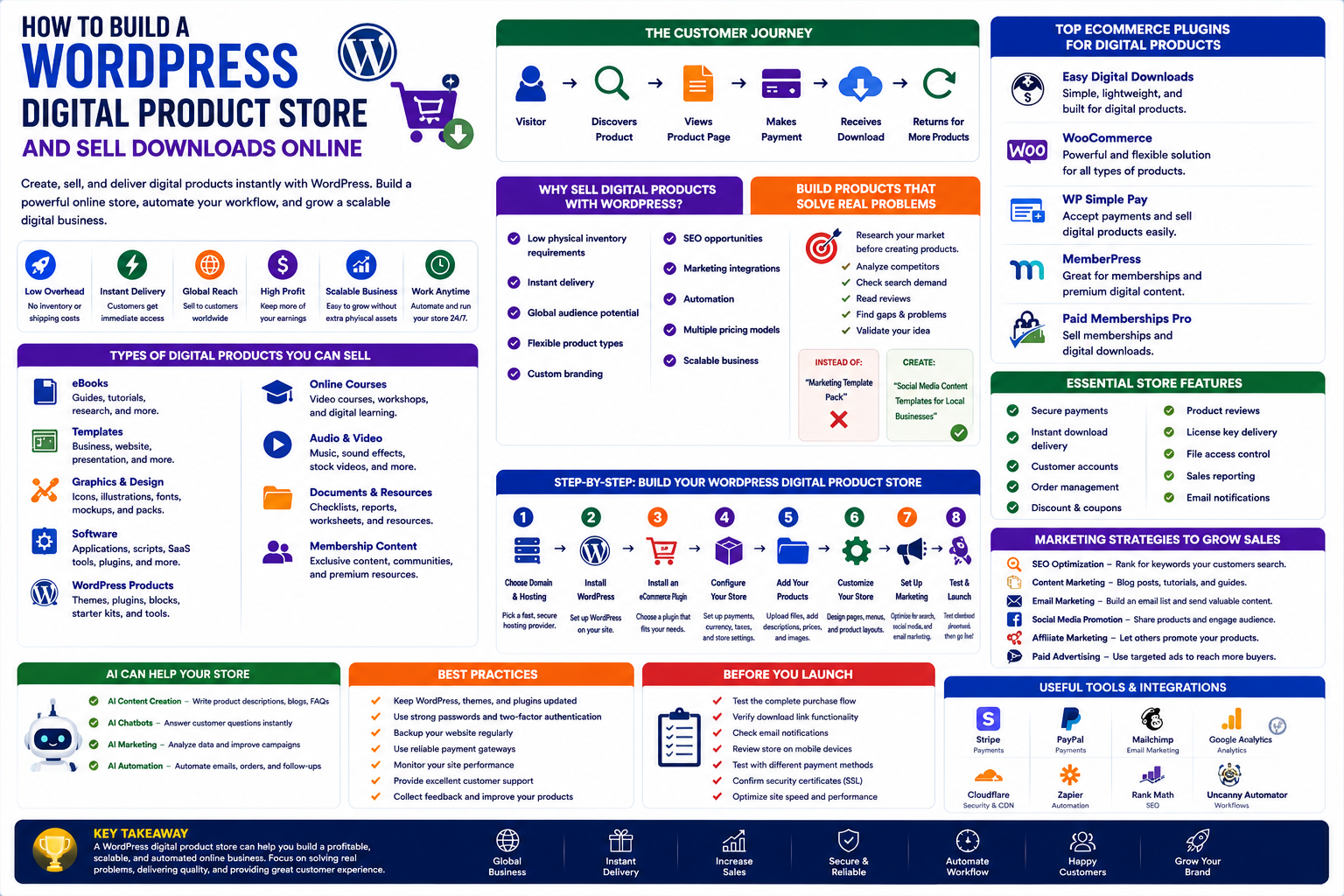
How to Build a WordPress Digital Product Store and Sell Downloads Online
Introduction
Digital products have changed the way creators, businesses, developers, educators, and entrepreneurs make money online.
Unlike physical products, digital products can often be delivered instantly without warehouses, shipping companies, or physical inventory.
A WordPress website can provide a flexible foundation for creating a digital product business.
You can sell:
eBooks
Graphics
WordPress themes
Plugins
Software
Online courses
Design assets
Audio files
Video content
Documents
Business resources
Membership resources
With the right combination of WordPress, plugins, payment systems, SEO, marketing, automation, and AI, a simple website can become a complete digital product store.
What Is a WordPress Digital Product Store?
A WordPress digital product store is a website that allows customers to discover, purchase, and download digital products.
Unlike a traditional online store, there may be no physical shipping process.
A typical journey looks like:
Visitor
↓
Discovers Product
↓
Views Product Page
↓
Makes Payment
↓
Receives Download
↓
Uses Product
↓
Returns for More Products
This model can work for both individuals and established businesses.
Why Sell Digital Products With WordPress?
WordPress offers flexibility for building different types of digital businesses.
Potential advantages include:
Low physical inventory requirements
Instant delivery
Global audience potential
Flexible product types
Custom branding
SEO opportunities
Marketing integrations
Automation
Multiple pricing models
However, digital products still require research, quality, customer support, marketing, and ongoing improvement.
Types of Digital Products You Can Sell
eBooks
Authors and businesses can sell guides, research, tutorials, and educational resources.
Templates
Examples include:
Business templates
Presentation templates
Website templates
Marketing templates
Social media templates
Graphics
Designers can sell:
Icons
Illustrations
Fonts
Mockups
Graphics packs
Software
Developers can sell:
Applications
Scripts
SaaS tools
Extensions
Plugins
WordPress Products
WordPress businesses can sell:
Themes
Plugins
Starter kits
Website templates
Blocks
Development tools
Courses
Educational businesses can sell structured learning experiences.
Choose a Specific Product Category
One common mistake is trying to sell everything.
A focused digital product store can make positioning easier.
For example:
Website Templates
or
Marketing Templates
or
WordPress Plugins
or
Business Resources
A specific audience and clear product category can make marketing more focused.
Research Before Creating Products
Do not create a product simply because you think people might want it.
Research the market.
Look at:
Existing products
Customer complaints
Search demand
Competitors
Pricing
Reviews
Missing features
Common questions
The goal is to identify a real problem that your product can solve.
Create Products That Solve Problems
The strongest digital products usually solve a specific problem.
For example:
Instead of:
"Marketing Template Pack"
you could create:
"Social Media Content Templates for Local Businesses"
The second description communicates a clearer audience and use case.
Specific positioning can make a product easier to understand.
WordPress eCommerce Plugins
WordPress can be extended with eCommerce plugins designed to manage digital products.
Depending on your requirements, a solution may provide:
Product management
Shopping carts
Checkout
Payments
Download delivery
Customer accounts
Order management
Discount codes
Sales reports
Choose a solution based on your business requirements rather than simply selecting the most popular option.
Digital Download Delivery
A digital product store needs a reliable delivery process.
After successful payment, customers should be able to receive access to their purchased products.
Depending on the product, delivery might happen through:
Download links
Customer dashboards
License portals
Account areas
The process should be simple and secure.
Protect Your Digital Products
Digital products can be copied more easily than physical products.
Depending on the type of product, protection options can include:
Expiring download links
Download limits
Customer authentication
License keys
Software activation
Watermarks
No protection method can completely eliminate unauthorized sharing.
The goal is to create reasonable protection without making legitimate customers struggle.
Software Licensing
If you sell software, themes, or plugins, licensing can become an important part of the business model.
A license system can manage:
Activation
Renewal
Updates
Product versions
Customer access
For subscription products, licensing can also connect product access to an active subscription.
Pricing Digital Products
Digital products can use different pricing models.
One-Time Purchase
Customers pay once and receive the product.
Subscription
Customers pay monthly or annually.
Tiered Pricing
Different plans provide different features.
Bundle Pricing
Multiple products are combined into one package.
Freemium
A basic product is free while advanced features are paid.
The best model depends on the type of product and customer expectations.
Free Products as a Marketing Strategy
A free digital product can attract new visitors.
For example:
Free Template
↓
Email Signup
↓
Useful Content
↓
Premium Product
This allows a business to build an audience before asking customers to make a purchase.
Digital Product SEO
SEO can be a powerful acquisition channel for digital product stores.
Optimize:
Product titles
Product descriptions
Category pages
Blog content
FAQs
Internal links
Metadata
Images
Create content around the problems your products solve.
Content Marketing for Digital Products
Suppose you sell WordPress templates.
Instead of publishing only product pages, create useful articles such as:
How to choose a WordPress business theme
Website design mistakes to avoid
How to create a professional homepage
WordPress design trends
How to improve website conversions
Your content can attract people before they are ready to purchase.
The Digital Product Funnel
A simple funnel could look like:
Awareness
SEO articles, social media, videos, and free resources.
↓
Interest
Product guides, comparisons, demos, and case studies.
↓
Consideration
Product pages, testimonials, previews, and FAQs.
↓
Purchase
Simple checkout.
↓
Retention
Updates, support, new products, and special offers.
Product Landing Pages
A digital product landing page should answer important questions quickly.
Include:
What is the product?
Who is it for?
What problem does it solve?
What is included?
How does it work?
What makes it different?
What does it cost?
How does delivery work?
Clear information can reduce purchase hesitation.
Product Demonstrations
Digital products are intangible.
Customers may want to see what they are purchasing.
Useful demonstrations can include:
Screenshots
Video demonstrations
Live previews
Product samples
Feature lists
Before-and-after examples
The more clearly customers understand the product, the easier it becomes to evaluate the purchase.
Reviews and Social Proof
Customer feedback can help new visitors understand the product.
Depending on the business, social proof can include:
Customer reviews
Testimonials
Ratings
Case studies
Usage statistics
Authentic feedback is more valuable than exaggerated claims.
AI and Digital Products
AI has created new opportunities for digital product businesses.
AI can help with:
Product research
Content creation
Product descriptions
Customer support
Idea generation
Personalization
Marketing
Data analysis
But AI should be used responsibly.
A digital product should provide genuine value rather than simply package generic AI-generated material.
AI-Generated Digital Products
AI can assist in creating products such as:
Writing templates
Marketing prompts
Business worksheets
Research frameworks
Educational resources
Human expertise and quality control remain important.
Customers should receive something useful and thoughtfully designed.
AI Product Recommendations
A digital store with many products can become difficult to navigate.
AI can potentially help customers find relevant products.
For example:
Customer:
"I need a WordPress template for a small consulting business."
AI Assistant:
Could recommend suitable products based on the customer's needs.
This can improve product discovery.
AI Customer Support
AI assistants can answer common questions about:
Product features
Compatibility
Installation
Download instructions
Licensing
Refund policies
Complex problems should still be transferred to human support.
Automation for Digital Product Stores
Automation can reduce repetitive tasks.
For example:
Payment Completed
↓
Order Confirmed
↓
Download Delivered
↓
Welcome Email
↓
Product Usage Guidance
↓
Review Request
Automation can improve the customer experience while reducing manual work.
Email Marketing
Email marketing can help digital product businesses build long-term relationships.
Useful campaigns include:
Welcome sequences
Product announcements
Educational newsletters
Product updates
Abandoned cart reminders
Special offers
Cross-selling campaigns
Avoid sending excessive promotional emails.
Useful content should remain part of the strategy.
Cross-Selling Digital Products
Once customers purchase one product, related products can be introduced.
For example:
WordPress Theme
↓
Plugin
↓
Website Template
↓
SEO Toolkit
This can increase customer lifetime value when the products genuinely complement each other.
Customer Support
Digital products do not eliminate support requirements.
Customers may need help with:
Downloads
Installation
Compatibility
Updates
Licensing
Usage
Good documentation can reduce repetitive support requests.
Create:
Installation guides
FAQs
Tutorials
Troubleshooting pages
Knowledge bases
Digital Product Updates
Digital products should be maintained when necessary.
This is especially important for:
WordPress themes
WordPress plugins
Software
Templates
Technical resources
Updates can improve compatibility, fix issues, add features, or improve usability.
Refund Policies
A clear refund policy helps customers understand what happens if a product does not meet their expectations.
The policy should be easy to find and written clearly.
Requirements can vary depending on the product, business, location, and applicable laws.
Security for Digital Product Stores
Digital stores should protect:
Customer accounts
Payment processes
Download links
Product files
License information
Website administration
Keep WordPress, themes, plugins, and other software properly maintained.
Use appropriate authentication and backup practices.
Common Digital Product Store Mistakes
1. Selling Too Many Unrelated Products
A confusing product catalog can weaken positioning.
2. Poor Product Descriptions
Customers need enough information to make decisions.
3. Complicated Checkout
Unnecessary steps can create friction.
4. No Product Demonstration
Customers may hesitate when they cannot see what they are buying.
5. Ignoring Customer Support
Digital products still require assistance.
6. Creating Low-Value AI Products
AI-generated content without expertise or quality control may provide little value.
7. Ignoring SEO
Search engines can be a valuable source of qualified traffic.
8. Never Updating Products
Outdated digital products can lose customer trust.
How to Build a WordPress Digital Product Store
Step 1: Choose Your Niche
Define your target customer and product category.
Step 2: Research Demand
Study competitors, search behavior, customer problems, and market gaps.
Step 3: Create Your Product
Focus on solving a specific problem.
Step 4: Set Up WordPress
Choose appropriate hosting, a theme, and required plugins.
Step 5: Add eCommerce Functionality
Configure product pages, checkout, payments, and digital delivery.
Step 6: Create Product Pages
Explain the product clearly with demonstrations and benefits.
Step 7: Configure Delivery
Make downloads or account access simple and secure.
Step 8: Build SEO Content
Create useful articles related to your products.
Step 9: Create an Email Funnel
Turn visitors and customers into long-term subscribers.
Step 10: Add Automation
Automate repetitive customer and marketing processes.
Step 11: Monitor Performance
Track traffic, sales, conversions, refunds, and customer behavior.
Step 12: Improve Products
Use customer feedback to release better versions.
WordPress Digital Product Store Checklist
Target audience is defined
Product niche is clear
Customer problem is understood
Products provide genuine value
WordPress is configured
eCommerce system is installed
Payment methods are tested
Digital delivery works
Product files are protected
Product pages are optimized
SEO strategy is created
Email marketing is configured
Customer support is available
Refund policy is clear
Product updates are planned
Website security is maintained
Analytics are configured
Why Choose Themekaddora?
1. WordPress Expertise
Themekaddora covers WordPress themes, plugins, development, customization, and website strategy.
2. AI and Technology
The platform explores how AI and emerging technologies can influence digital businesses.
3. Marketing and SEO
Readers can learn how content, search, and marketing can support website growth.
4. Business-Focused Approach
Themekaddora connects technology with practical business opportunities.
5. Practical Resources
The content focuses on useful strategies for website owners, developers, marketers, and entrepreneurs.
6. Growing Knowledge Hub
Themekaddora brings WordPress, AI, technology, SEO, marketing, and business together in one digital resource.
Conclusion
WordPress provides a flexible foundation for building a digital product business.
With the right combination of products, eCommerce functionality, SEO, content marketing, email, automation, AI, and customer support, a website can become much more than an online catalog.
It can become a complete digital business.
The most important principles are simple:
Solve a real problem.
Create genuine value.
Make purchasing easy.
Deliver products reliably.
Support customers.
Keep improving.
For Themekaddora, digital product businesses represent another important intersection between WordPress, plugins, AI, SEO, marketing, technology, and entrepreneurship.
The opportunity is not simply to sell downloads.
It is to build a digital product ecosystem that customers trust and want to return to.
Frequently Asked Questions
1. What is a WordPress digital product store?
A WordPress digital product store is a website where customers can purchase and receive products such as ebooks, templates, software, courses, graphics, themes, or plugins digitally.
2. What can I sell as a digital product?
You can sell ebooks, templates, graphics, software, WordPress themes, plugins, courses, audio, video, documents, and other downloadable resources.
3. Can I sell digital products without physical inventory?
Yes. Digital products generally do not require physical inventory or traditional shipping.
4. How are digital products delivered?
Products can be delivered through secure download links, customer dashboards, email, license systems, or other digital delivery methods.
5. Can AI help a digital product business?
Yes. AI can assist with product research, content creation, recommendations, customer support, marketing, personalization, and automation.
6. How can I protect digital products?
Depending on the product, you can use secure download links, download limits, account authentication, licensing, activation systems, or watermarks.
7. Can WordPress themes and plugins be sold as digital products?
Yes. WordPress themes and plugins are examples of digital products that can be distributed through an online store.
8. Is SEO important for a digital product store?
Yes. SEO can help potential customers discover product pages and educational content through search engines.
9. How can I increase digital product sales?
Focus on a clear audience, solve a specific problem, improve product pages, simplify checkout, demonstrate product value, build trust, and continuously improve your products.
10. Why Choose Themekaddora?
Themekaddora combines WordPress resources with content about themes, plugins, AI, technology, SEO, marketing, business, and digital entrepreneurship.
Comments (0)