
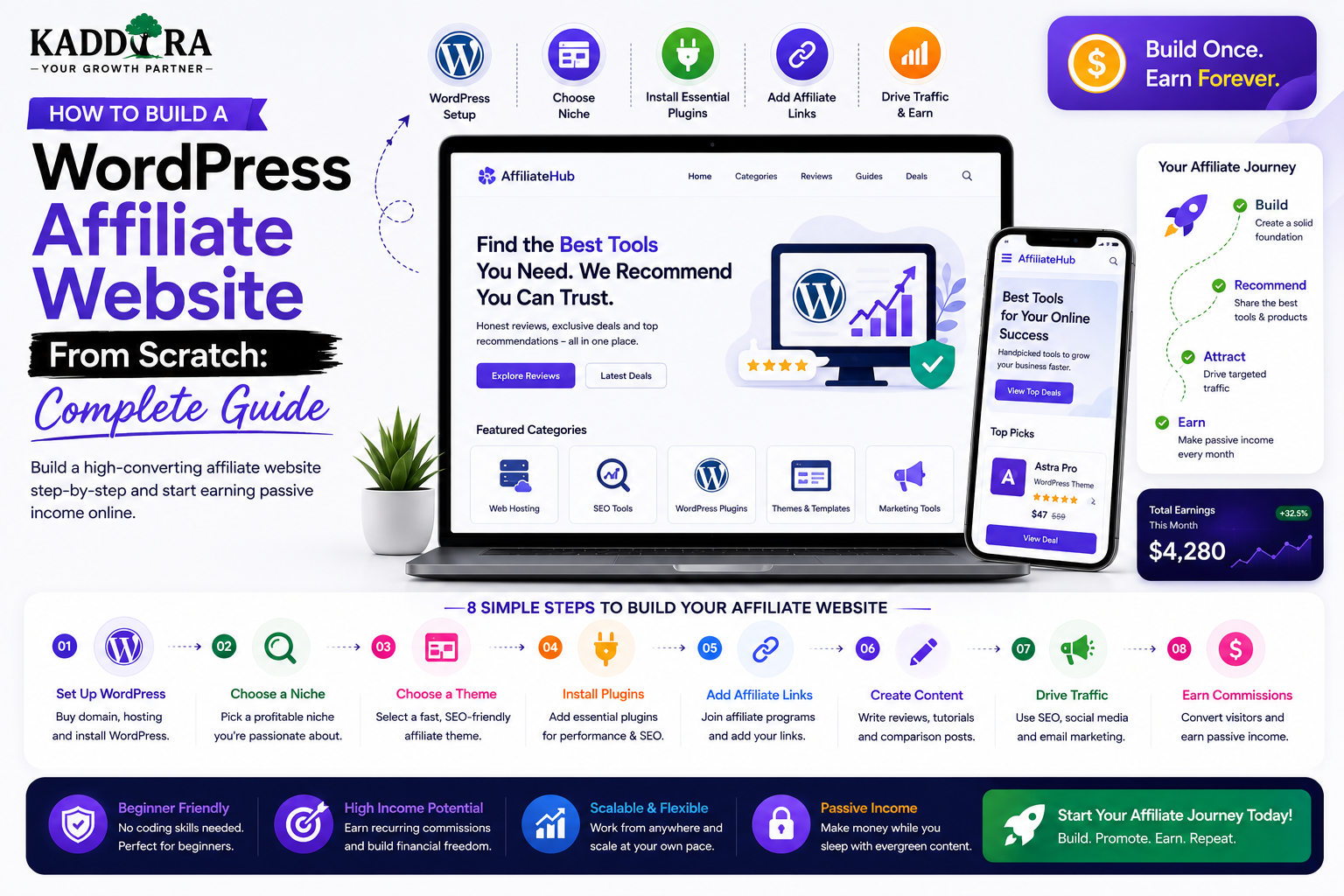
How to Build a WordPress Affiliate Website From Scratch: Complete Guide
Introduction
Affiliate marketing is a business model where a website earns a commission by referring visitors to products or services offered by other companies.
Instead of creating your own inventory, payment system, shipping process, or product development operation, your website focuses on:
Audience ↓ Useful Content ↓ Product Recommendation ↓ Affiliate Link ↓ Partner Website ↓ Qualifying Action ↓ Commission
WordPress is a popular platform for affiliate websites because it makes it relatively easy to publish articles, build content categories, create comparison pages, manage landing pages, and optimize a website for search.
A successful affiliate website, however, is not simply a collection of affiliate links.
It needs:
A focused niche
Helpful content
Strong search intent
Trustworthy recommendations
Good website structure
SEO
Conversion-focused pages
Disclosure of commercial relationships
Analytics
Consistent publishing
In this guide, you'll learn how to build a WordPress affiliate website from scratch, choose a niche, research affiliate programs, structure the website, create high-value content, use affiliate links correctly, optimize for SEO, improve conversions, build trust, measure performance, and grow the business over time.
What Is a WordPress Affiliate Website?
A WordPress affiliate website publishes content that helps visitors discover, evaluate, and choose third-party products or services.
The site earns a commission when users complete qualifying actions through tracked referral links.
For example:
Visitor Searches "Best WordPress Hosting" ↓ Helpful Comparison Article ↓ Hosting Recommendation ↓ Affiliate Link ↓ Hosting Provider ↓ Qualifying Purchase ↓ Commission
The affiliate website acts as a discovery and decision-support layer.
Why Use WordPress for Affiliate Marketing?
WordPress provides many features useful for content-focused businesses:
Blog publishing
Categories
Tags
Custom post types
Media management
Landing pages
Internal linking
SEO configuration
Analytics integrations
Forms
Custom plugins
REST APIs
This makes it flexible enough for both simple affiliate blogs and larger content platforms.
Choose a Niche First
One of the most important affiliate decisions is choosing the right niche.
Potential niches include:
Technology WordPress SaaS Business Finance Education Travel Fitness Home Photography
Don't choose a niche solely because it has expensive products.
Look for a combination of:
Audience demand
Strong commercial intent
Useful products
Content opportunities
Sustainable interest
Your ability to create genuinely helpful content
Broad vs Niche Affiliate Websites
A broad website might target:
Technology
A niche site might target:
WordPress tools for small businesses
A narrower focus can make it easier to develop topical expertise and create highly relevant content.
The niche should still be large enough to support sustainable content and monetization.
Define Your Target Audience
Don't simply target:
"People interested in WordPress."
Define the audience more clearly.
For example:
Small Business Owners ↓ Need Affordable WordPress Tools ↓ Want Easy Setup ↓ Compare Solutions
Understanding the audience makes content and product recommendations much more useful.
Identify the Problems Your Audience Has
Affiliate content works best when it solves a genuine problem.
For example:
Problem: Website is slow ↓ Content: How to Improve WordPress Performance ↓ Relevant Solutions: Hosting Caching Optimization Tools
Start with the problem, not the affiliate link.
Research Affiliate Programs
Once the niche is selected, find relevant programs.
Consider:
Commission structure
Cookie or attribution rules
Product quality
Refund policies
Brand reputation
Support
Payment terms
Geographic availability
Affiliate restrictions
Don't join programs simply because they pay high commissions.
The product must make sense for your audience.
Build a Relevant Affiliate Portfolio
A website may promote several complementary product categories.
For example:
WordPress ├── Hosting ├── Themes ├── Plugins ├── Security ├── Analytics └── Marketing
This creates multiple monetization opportunities while keeping the website focused.
Don't Promote Products You Wouldn't Recommend
Trust is one of the most valuable assets in affiliate marketing.
Before recommending something, evaluate:
Features
Performance
Usability
Support
Pricing
Limitations
Compatibility
Reputation
A high commission does not make a poor product a good recommendation.
Build the Website Foundation
A basic WordPress affiliate website needs:
Domain Hosting WordPress Theme Essential Plugins Analytics SEO Setup
Keep the initial technology stack lean.
Too many plugins can increase maintenance and performance problems.
Choose a Lightweight WordPress Theme
An affiliate website often needs:
Fast article pages
Good typography
Flexible layouts
Comparison tables
Responsive design
SEO-friendly markup
Clear calls to action
Avoid choosing a theme solely because it contains hundreds of visual effects.
Content readability should remain the priority.
Create a Professional Site Structure
A useful architecture might be:
Home Reviews Comparisons How-To Guides Best Tools Resources Blog About Disclosure Contact
The exact structure depends on the niche.
Build a Strong Homepage
The homepage should quickly communicate:
What the website covers
Who it helps
Which topics it specializes in
Where visitors should go next
A possible structure:
Hero ↓ Featured Guides ↓ Top Categories ↓ Popular Comparisons ↓ Latest Articles ↓ Recommended Resources ↓ Newsletter
Avoid turning the homepage into a wall of affiliate links.
Create an About Page
Affiliate websites benefit significantly from transparency.
Explain:
Who runs the site
What the website focuses on
How recommendations are created
Your editorial approach
An authentic About page can strengthen credibility.
Create an Affiliate Disclosure Page
Clearly explain that the website may earn commissions from qualifying referrals.
The disclosure should be easy for visitors to find and should not be hidden in tiny text.
Also consider including appropriate disclosures near commercial links or within relevant content.
Build Content Around Search Intent
Affiliate content can target different types of search intent.
Informational
What Is WordPress Hosting?
Commercial Investigation
Best WordPress Hosting for Small Businesses
Comparison
Hosting A vs Hosting B
Transactional
Hosting Provider Discount
Create different content for different stages of the buying journey.
The TOFU-MOFU-BOFU Affiliate Funnel
A useful structure is:
TOFU Educational Content ↓ MOFU Comparisons / Reviews ↓ BOFU Product Recommendation ↓ Affiliate Conversion
Not every article needs to sell something directly.
Some pages should simply build topical authority and trust.
Build Topic Clusters
Instead of publishing unrelated articles, create connected groups.
For example:
Pillar: WordPress Performance ├── Core Web Vitals ├── Image Optimization ├── Caching ├── Hosting ├── CDN └── Performance Plugins
This structure helps readers navigate related information.
Create Product Review Pages
A useful review should cover:
Overview Key Features Advantages Limitations Pricing Who It's For Who Should Avoid It Alternatives Final Verdict
Don't write reviews that contain only praise.
Real limitations make reviews more useful.
Create Comparison Pages
Comparison content can be highly valuable for users already evaluating options.
For example:
Product A vs Product B
Compare meaningful factors such as:
Features
Price
Ease of use
Performance
Support
Integrations
Best use case
Don't manufacture differences that don't exist.
Create "Best" Roundups
Examples:
Best WordPress Security Plugins Best SEO Tools Best Hosting Services Best AI Tools for Businesses
A good roundup should explain:
Evaluation criteria
Differences
Best use case
Important limitations
Avoid ranking products solely according to commission size.
Create Alternatives Content
Users often search for alternatives when a product doesn't meet their requirements.
For example:
Alternative to Product A
Explain why someone might choose each alternative.
This is more useful than simply presenting a list.
Create Problem-Solution Content
Problem-driven articles can naturally lead to affiliate recommendations.
For example:
Problem: WooCommerce reports are difficult to analyze ↓ Guide: How to Improve WooCommerce Sales Reporting ↓ Possible Solutions: Analytics Tools
Commercial recommendations should appear where they genuinely help.
Use Affiliate Links Naturally
Don't insert affiliate links into every paragraph.
Use them where the reader is likely to benefit.
For example:
"View the provider's current plans"
can be more useful than:
Click here to buy the best hosting.
Keep the language descriptive and transparent.
Use Clear Calls to Action
Affiliate CTAs can include:
View Plans
Check Pricing
See Features
Visit Official Website
Start Free Trial
Explore the Tool
The CTA should accurately represent the destination.
Don't use misleading buttons.
Create Comparison Tables
Comparison tables can make commercial pages easier to scan.
Product
Best For
Key Strength
Pricing
Option A
Beginners
Easy setup
Varies
Option B
Agencies
Advanced tools
Varies
Option C
Businesses
Integrations
Varies
Don't overload tables with dozens of columns.
Focus on decision-making information.
Add Pros and Cons
A useful review can include:
Pros
Easy to use
Strong integrations
Good documentation
Cons
Limited advanced options
Higher price at larger usage levels
Honest drawbacks make commercial reviews more credible.
Explain Who Should Buy
Instead of saying:
"Everyone should use this."
Explain:
Best For: Small Businesses Agencies Developers Not Ideal For: Very Large Enterprises Highly Specialized Workflows
Specific recommendations are more valuable.
Create Trustworthy Recommendation Criteria
Before ranking products, define the evaluation criteria.
For example:
Features Performance Usability Support Pricing Integration Security
Then apply those criteria consistently.
Don't Rank Products by Commission
This is one of the most damaging affiliate practices.
If Product A pays more but Product B is objectively better for a particular audience, your content should explain that.
Trust creates long-term revenue.
Add Author Information
For expert-focused content, show:
Author
Expertise
Relevant experience
Editorial review where applicable
This can make the content more transparent and credible.
Don't invent expertise.
Build an Editorial Review Process
A professional affiliate website can use:
Research ↓ Draft ↓ Product Verification ↓ Human Review ↓ Fact Check ↓ Affiliate Disclosure Check ↓ Publish
This is especially important for technical or high-impact recommendations.
Keep Product Information Current
Pricing, features, plans, compatibility, and terms can change.
Review commercial content periodically.
For example:
Product Changed ↓ Review Article ↓ Update Pricing ↓ Update Features ↓ Update Recommendation
Don't leave outdated pricing or feature claims on high-traffic pages.
Build a Content Update System
Create a list of articles containing commercial claims.
For each article, track:
URL Product Last Reviewed Current Pricing Affiliate Link Status
This helps prevent outdated commercial information.
Affiliate Link Management
Instead of placing long raw links throughout your content, use a manageable link system where appropriate.
For example:
Website ↓ /go/product-name/ ↓ Affiliate Destination
This can help with centralized link maintenance.
However, redirects should be implemented transparently and consistently with search and affiliate-program requirements.
Check Broken Affiliate Links
Affiliate links can stop working when:
Programs end
Products change
URLs change
Merchants change tracking systems
Monitor important links regularly.
A broken affiliate link represents both a lost conversion opportunity and a poor user experience.
Email Marketing for Affiliate Websites
Build an email list through useful resources.
For example:
Article ↓ Free Guide ↓ Email Signup ↓ Helpful Newsletter ↓ Relevant Recommendations
Email can diversify traffic beyond search engines.
Avoid Spammy Email Promotions
Don't send affiliate promotions constantly.
A stronger strategy is:
Education + Useful Recommendations + Occasional Offers
The subscriber should continue receiving value even without clicking affiliate links.
Affiliate Website Analytics
Track:
Traffic
Organic visitors
Direct traffic
Referral traffic
Email traffic
Engagement
Time on page
Scroll depth
Returning users
Internal clicks
Affiliate
Link clicks
Conversion rate
Revenue
Earnings per click
Track Outbound Affiliate Clicks
A useful funnel is:
Page View ↓ Affiliate Click ↓ Merchant Visit ↓ Qualifying Conversion
This helps identify pages that generate commercial interest.
Earnings Per Click
A useful affiliate metric is:
Affiliate Revenue ────────────── Affiliate Clicks
This can help compare products and pages.
Use appropriate attribution assumptions when interpreting the number.
Revenue Per Article
Another useful metric is:
Affiliate Revenue ────────────── Article
This can identify pages worth updating or expanding.
Don't Judge Articles by Traffic Alone
An article with:
10,000 Visitors
may earn less than one with:
1,000 High-Intent Visitors
Commercial intent matters.
Improve Conversion Rate
Potential improvements include:
Better comparison tables
Clearer CTAs
Stronger product explanations
More relevant recommendations
Better placement
Faster page load
Stronger trust signals
More useful screenshots
Don't optimize solely for clicks.
Optimize for useful decisions and sustainable conversions.
A/B Test Affiliate CTAs
You can test:
"Check Pricing" vs "View Plans"
or:
CTA Above Comparison vs CTA Below Comparison
Measure meaningful outcomes rather than judging by clicks alone.
Improve Page Speed
Affiliate websites often become slow because of:
Advertising
Tracking scripts
Embedded widgets
Large images
Comparison components
Third-party scripts
Optimize:
Images
JavaScript
CSS
Fonts
Caching
Third-party integrations
Performance remains important for usability.
Mobile Affiliate Optimization
Many users research products on phones.
Test:
Comparison Tables Buttons Images Reviews Forms Navigation
Large tables that work on desktop can become unusable on mobile.
Affiliate Website Accessibility
Make content usable by as many visitors as possible.
Consider:
Semantic headings
Keyboard navigation
Accessible tables
Color contrast
Link clarity
Image alternative text
Form labels
Affiliate revenue should never come at the cost of basic accessibility.
Build an Affiliate Resource Hub
Instead of burying recommendations across dozens of articles, create:
Resources ├── Recommended Tools ├── Hosting ├── WordPress ├── SEO ├── AI └── Business
This can become a useful destination for returning visitors.
Affiliate Tools and Calculators
Useful free tools can attract links and repeat traffic.
Examples:
Pricing calculators
ROI calculators
Hosting comparison tools
SEO checkers
Business calculators
A free utility can act as an audience acquisition asset.
Build Free Resources Before Monetization
For example:
Free Checklist ↓ Free Tool ↓ Tutorial ↓ Relevant Recommendation
This feels more useful than forcing affiliate offers onto every page.
Affiliate Website and AI
AI can assist with:
Topic research
Content outlines
Comparison summaries
Internal linking suggestions
Content updates
Search intent analysis
But AI-generated recommendations should be checked against actual product information.
Never invent product features, prices, certifications, reviews, or test results.
AI Product Comparison
An AI system could help organize:
User Needs ↓ Relevant Requirements ↓ Product Features ↓ Potential Matches
The underlying comparison data should be verified and current.
AI should not fabricate evidence.
Affiliate Website Security
A WordPress affiliate website should protect:
Administrator accounts
Analytics credentials
Affiliate dashboards
API keys
Email integrations
Customer data
Contact forms
Use:
HTTPS
Strong authentication
Least-privilege permissions
Updates
Backups
Monitoring
Affiliate Website Privacy
Analytics and affiliate tracking can involve user data.
Be clear about:
What data is collected
Which third parties receive it
Why tracking is used
Applicable consent requirements
Follow the privacy requirements relevant to your audience and jurisdiction.
Common WordPress Affiliate Website Mistakes
Choosing a Niche Only for Commission Rates
High commissions don't guarantee audience demand.
Publishing Thin Product Reviews
Readers need genuine decision-support information.
Ranking Products by Commission
This damages trust.
Copying Merchant Descriptions
Original, useful content is more valuable.
Hiding Affiliate Disclosures
Commercial relationships should be transparent.
Ignoring Product Changes
Old pricing and features create misleading content.
Overloading Pages With Links
Too many affiliate links can make content feel spammy.
No Email Strategy
You become overly dependent on search traffic.
No Analytics
You won't know which pages actually generate revenue.
Ignoring Mobile Users
Poor mobile UX can destroy conversions.
Best Practices for WordPress Affiliate Websites
A strong affiliate website should:
Choose a focused niche.
Understand search intent.
Create genuinely useful content.
Define clear evaluation criteria.
Recommend relevant products.
Explain both strengths and limitations.
Disclose affiliate relationships clearly.
Keep commercial information current.
Monitor important affiliate links.
Build an email audience.
Optimize for mobile.
Maintain fast page performance.
Track clicks and conversions.
Update successful content regularly.
Protect site and tracking credentials.
Prioritize audience trust over short-term commissions.
Affiliate Website Architecture
A professional affiliate site might use:
Homepage │ ├── Pillar Guides │ ├── Category A │ ├── Category B │ └── Category C │ ├── Reviews ├── Comparisons ├── Best Lists ├── Alternatives ├── Tutorials ├── Resources └── Newsletter ↓ Affiliate Tracking ↓ Partner Websites
The goal is to connect educational content with high-intent decision pages naturally.
Content Production Workflow
A repeatable workflow could be:
Keyword Research ↓ Search Intent ↓ Topic Cluster ↓ Content Brief ↓ Research ↓ Draft ↓ Product Verification ↓ Human Review ↓ Affiliate Disclosure ↓ SEO Review ↓ Publish ↓ Monitor ↓ Update
This creates a more sustainable affiliate publishing system.
Affiliate Website Growth Strategy
A long-term growth plan might look like:
Phase 1 Build Authority ↓ Phase 2 Publish Commercial Content ↓ Phase 3 Build Email Audience ↓ Phase 4 Improve Conversion ↓ Phase 5 Add New Relevant Revenue Streams
Growth should come from better content and better audience understanding, not simply publishing more pages.
Why choose ThemeKaddora?
ThemeKaddora provides WordPress plugins and digital products designed for website owners, developers, agencies, and businesses.
Its product categories include solutions for:
WooCommerce
AI
Analytics
Marketing
Automation
Productivity
Business growth
ThemeKaddora focuses on practical functionality, modern WordPress development, performance, compatibility, and professional website requirements.
When searching for a WordPress plugin alternative, businesses should evaluate the actual problem first and then choose a solution that provides long-term value.
Conclusion
Building a WordPress affiliate website is easy from a technical perspective.
Building a trustworthy affiliate business is much harder.
The website needs to combine:
Useful Content
→ Search Intent
→ Product Knowledge
→ Honest Recommendations
→ Clear Disclosures
→ Strong SEO
→ Conversion Optimization
The strongest affiliate websites don't look like collections of advertisements.
They look like helpful resources where readers can confidently answer:
"Which option is right for me?"
WordPress provides the publishing and content-management foundation needed to build that experience.
The business then grows through:
Audience
→ Trust
→ Useful Recommendations
→ Affiliate Clicks
→ Conversions
→ Revenue
For ThemeKaddora, affiliate marketing can complement direct sales by recommending relevant hosting, SaaS, AI, marketing, development, and business tools alongside the company's own digital products.
The most important rule is simple:
Recommend what is genuinely useful, explain why, disclose the commercial relationship, and keep the information accurate.
Trust is the asset that makes affiliate revenue sustainable.
Frequently Asked Questions
What is a WordPress affiliate website?
A WordPress affiliate website publishes useful content containing tracked referral links to third-party products or services and earns commissions from qualifying conversions.
Can I build an affiliate website with WordPress?
Yes. WordPress provides the content-management, publishing, SEO, and page-building capabilities needed for affiliate websites.
How do affiliate websites make money?
They typically earn commissions when visitors complete qualifying purchases, registrations, subscriptions, or other actions through tracked affiliate referrals.
What niche should I choose?
Choose a niche with real audience demand, useful products, commercial intent, and enough content opportunities to support long-term publishing.
Should I promote products with the highest commissions?
No. Commission rate should not determine recommendations. Product quality, audience fit, usefulness, and trust are more important for a sustainable business.
Should affiliate websites disclose affiliate links?
Yes. Commercial relationships should be clearly disclosed in accordance with applicable advertising and consumer-protection requirements.
Can I create product comparison pages?
Yes. Comparison pages can help users evaluate alternatives when the comparisons are accurate, useful, and transparent.
Can I create "best" product lists?
Yes. Explain your evaluation criteria and why each product is included rather than simply ranking products according to commercial relationships.
How often should affiliate content be updated?
Review important commercial content whenever pricing, features, availability, compatibility, or terms change. High-performing pages deserve regular review.
Can I use AI to create affiliate content?
AI can help with research and drafting, but product facts, pricing, features, recommendations, and claims should be independently verified before publication.
Can an affiliate website use multiple affiliate programs?
Yes. Multiple relevant programs can diversify revenue, provided the recommendations remain useful and the site doesn't become overloaded with promotional links.
Can affiliate websites use email marketing?
Yes. Building an email audience can reduce dependence on search traffic and create another channel for delivering useful content and relevant recommendations.
How do I track affiliate performance?
Track outbound clicks, conversions where available, revenue, earnings per click, and revenue by article or product.
Why choose Themekaddora?
Themekaddora provides lightweight, responsive, SEO-friendly WordPress themes with fast performance, WooCommerce compatibility, flexible customization, accessibility-conscious design, modern templates, regular updates, and professional support—providing a strong foundation for businesses building digital products and product-focused websites.
Comments (0)