
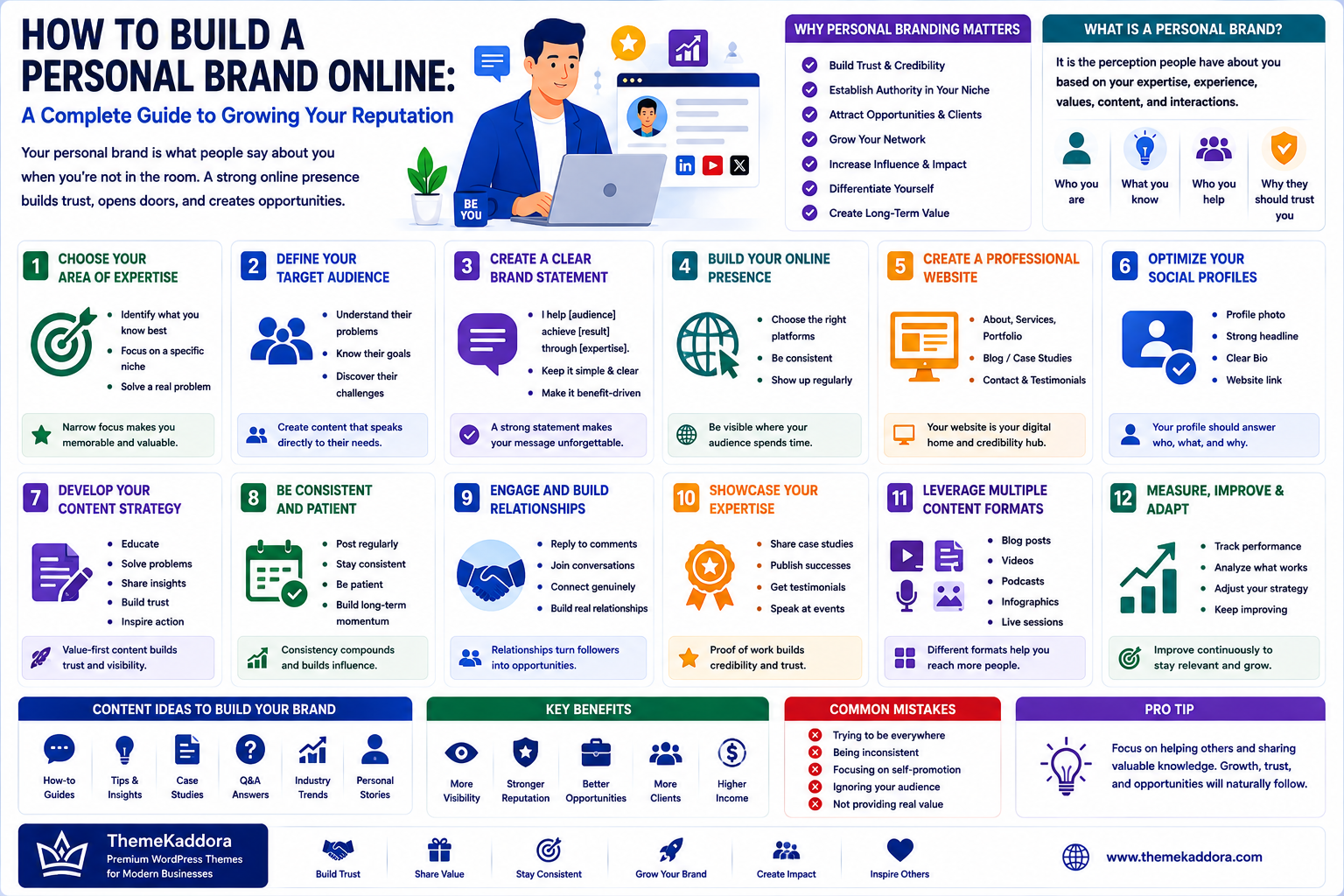
How to Build a Personal Brand Online: A Complete Guide to Growing Your Reputation
Introduction
People no longer discover businesses, professionals, and experts only through traditional advertising.
Today, they search online.
Before buying a product, hiring a consultant, working with an agency, or following an expert, people often look at their online presence.
They may search for:
Your name
Your expertise
Your social media profiles
Your website
Your content
Your opinions
Your previous work
Customer reviews
This creates an important opportunity.
You can build a recognizable reputation around your knowledge, experience, personality, and expertise.
This is known as personal branding.
A strong personal brand can help professionals attract customers, build trust, create partnerships, generate leads, and establish authority in their industry.
However, personal branding is not simply posting frequently on social media.
It requires a clear strategy.
In this guide, you'll learn how to build a personal brand online, create useful content, develop credibility, grow an audience, and turn attention into meaningful opportunities.
What Is a Personal Brand?
A personal brand is the perception people develop about you based on your expertise, communication, experiences, values, content, and interactions.
In simple terms:
Your personal brand is what people remember about you when you're not present.
For example, someone might become known as:
A marketing expert
A technology consultant
A finance educator
A productivity specialist
A business strategist
A design expert
A software developer
Your personal brand should make it easy for people to understand:
Who you are → What you know → Who you help → Why they should trust you
Why Personal Branding Matters
A strong personal brand can provide several benefits.
Build Trust
People often prefer buying from individuals they recognize and trust.
Establish Authority
Consistently sharing useful knowledge can demonstrate expertise.
Generate Opportunities
A strong online reputation can attract:
Customers
Employers
Partnerships
Speaking opportunities
Consulting projects
Media opportunities
Differentiate Yourself
Your skills may be similar to those of competitors.
Your perspective, experience, communication style, and story can make you different.
1. Choose Your Area of Expertise
Do not try to become known for everything.
Start with a specific area.
For example:
Technology
can become:
Technology for small business automation
Specific positioning makes it easier for people to understand what you offer.
Ask yourself:
What do I know well?
What problems can I solve?
What experience do I have?
What topics can I discuss consistently?
Who can benefit from my knowledge?
2. Define Your Target Audience
A personal brand becomes stronger when it speaks to a specific audience.
Your audience might be:
Entrepreneurs
Small business owners
Developers
Marketing professionals
Students
Freelancers
Creators
Executives
Understand their:
Problems
Goals
Questions
Interests
Challenges
Then create content around those needs.
3. Create a Clear Personal Brand Statement
Your personal brand statement should quickly explain your positioning.
A simple structure is:
I help [audience] achieve [result] through [expertise].
For example:
I help small businesses improve productivity through automation and practical technology.
This gives your audience an immediate reason to follow you.
4. Build Your Online Presence
Your personal brand should have a consistent digital presence.
Important platforms may include:
Personal website
YouTube
X
Professional communities
You do not need to be everywhere.
Choose platforms where your target audience is actually active.
5. Create a Professional Website
A personal website gives you ownership over your online presence.
It can include:
About page
Services
Portfolio
Case studies
Blog
Contact information
Testimonials
Media appearances
Your website should clearly communicate who you are and what you offer.
6. Optimize Your Social Profiles
Your profile should answer three questions quickly:
Who are you?
What do you do?
Why should someone follow you?
Optimize:
Profile photo or professional visual identity
Bio
Headline
Website link
Contact information
Featured content
Keep your messaging consistent across platforms.
7. Develop Your Content Strategy
Content is one of the strongest tools for personal branding.
Create content that:
Educates
Solves problems
Shares experiences
Explains complex topics
Provides practical advice
Starts meaningful discussions
Avoid making every post promotional.
People follow personal brands because they receive value.
8. Use the Content Pillar Strategy
Choose three to five major topics you can consistently discuss.
For example:
Pillar 1: Expertise
Share professional knowledge.
Pillar 2: Education
Explain concepts and provide tutorials.
Pillar 3: Experience
Share lessons learned from real situations.
Pillar 4: Opinions
Discuss industry trends and ideas.
Pillar 5: Results
Share case studies and outcomes.
Content pillars make content planning easier.
9. Tell Stories
Facts can educate people.
Stories can make people remember you.
Share stories about:
Mistakes
Lessons
Challenges
Failures
Successes
Customer experiences
Career experiences
A good story should have a useful takeaway.
10. Share Your Expertise for Free
One of the most effective ways to establish authority is to teach.
Share:
Tutorials
Checklists
Guides
Templates
Frameworks
Examples
Industry insights
Giving useful information does not necessarily reduce the value of your paid services.
It can demonstrate why people should trust you.
11. Be Consistent
Personal branding is a long-term process.
You do not need to publish content every day.
Instead, create a schedule you can maintain.
For example:
3 social posts per week
1 long-form article per week
2 short videos per week
1 newsletter per week
Consistency matters more than short-term bursts of activity.
12. Build a Recognizable Style
Your content should gradually become recognizable.
This can come from:
Writing style
Visual design
Topics
Presentation format
Humor
Storytelling
Opinions
You do not need to copy another creator.
Your individuality is part of your brand.
13. Build Credibility With Proof
Claims are stronger when supported by evidence.
Build credibility through:
Case studies
Client results
Testimonials
Certifications
Projects
Publications
Research
Portfolio examples
Instead of saying:
"I'm an expert."
Show evidence that demonstrates your experience.
14. Network With Other Professionals
Personal branding is not only about publishing content.
Build relationships with people in your industry.
You can:
Comment thoughtfully on posts
Participate in communities
Attend events
Collaborate on content
Conduct interviews
Join podcasts
Partner on projects
Networking can expand your reach while building genuine relationships.
15. Engage With Your Audience
Do not treat social media like a broadcasting channel.
Respond to:
Questions
Comments
Messages
Feedback
Ask your audience what they want to learn.
Audience interaction can reveal useful content ideas.
16. Develop a Content Distribution Strategy
Creating excellent content is only half the job.
You also need distribution.
A single long-form article can become:
Article → LinkedIn post → Instagram carousel → Short video → Newsletter → Quote graphic
Repurposing allows you to reach people across different platforms without creating everything from scratch.
17. Build an Email Audience
Social platforms can change their algorithms or policies.
An email list gives you a more direct communication channel.
Offer valuable resources such as:
Guides
Templates
Checklists
Reports
Newsletters
Always collect and use email addresses responsibly and comply with applicable privacy requirements.
18. Avoid Chasing Every Trend
Trends can provide visibility.
But following every trend can make your brand inconsistent.
Ask:
Does this trend help communicate my expertise?
If not, you may be better off focusing on useful evergreen content.
19. Share Opinions Carefully
Opinions can help differentiate a personal brand.
However, opinions should be supported by:
Experience
Evidence
Reasoning
Relevant examples
Avoid creating controversy simply for attention.
Reputation takes time to build and can be damaged quickly.
20. Use Analytics
Track how your audience responds to your content.
Useful metrics include:
Profile visits
Website traffic
Engagement
Follower growth
Email subscribers
Leads
Conversions
Content shares
Do not focus only on follower count.
A smaller audience that trusts you can be more valuable than a large audience that never engages.
21. Turn Attention Into Business Opportunities
A personal brand should not necessarily remain a popularity project.
Depending on your goals, it can support:
Consulting
Freelancing
Courses
Digital products
Software
Speaking
Coaching
Services
Partnerships
The key is to create a natural connection between your expertise and your offer.
22. Build a Personal Brand Funnel
A simple funnel can look like:
Content → Attention → Trust → Relationship → Offer → Customer
For example:
Helpful article → Newsletter → Educational emails → Consultation → Client
This creates a system instead of relying on random social media posts.
23. Protect Your Online Reputation
Your online presence can remain searchable for years.
Before publishing something, consider:
Is it accurate?
Is it respectful?
Could it damage professional relationships?
Does it represent the reputation I want?
Also monitor search results for your name and business.
Common Personal Branding Mistakes
Trying to Appeal to Everyone
A broad message often becomes forgettable.
Posting Without a Strategy
Publishing random content makes it difficult to build a recognizable position.
Being Too Promotional
Constant selling reduces trust.
Copying Other Creators
Learn from others, but develop your own voice.
Focusing Only on Followers
Followers do not automatically become customers.
Ignoring Your Website
Social profiles are useful, but a personal website provides greater control over your online identity.
Inconsistent Publishing
Long periods of inactivity make it harder to build momentum.
Personal Branding Strategy
A practical strategy can follow this process:
Expertise → Audience → Positioning → Content → Distribution → Engagement → Trust → Opportunity
Start by defining what you want to be known for.
Then consistently demonstrate that expertise through useful content.
90-Day Personal Branding Plan
Month 1: Foundation
Define your niche
Identify your audience
Create your positioning statement
Build or improve your website
Optimize social profiles
Create content pillars
Month 2: Content
Publish consistently
Experiment with different formats
Engage with your audience
Network with professionals
Start building an email list
Month 3: Growth
Analyze content performance
Double down on successful topics
Create collaborations
Publish case studies
Develop an offer
Build a simple conversion funnel
Personal Branding Checklist
Positioning
Define expertise
Choose target audience
Create a clear message
Presence
Build a website
Optimize social profiles
Maintain consistent branding
Content
Define content pillars
Share useful knowledge
Tell stories
Publish consistently
Growth
Engage with followers
Network
Repurpose content
Build an email audience
Business
Create relevant offers
Build trust
Track leads
Measure conversions
Why Choose ThemeKaddora?
At ThemeKaddora, we believe a strong digital presence is built through valuable information, consistent communication, and technology that supports long-term growth.
A personal brand can become a powerful asset when it combines:
Expertise
Content
Digital presence
Audience relationships
Trust
Business strategy
Technology can support this process through websites, analytics, automation, content systems, and digital marketing tools.
Conclusion
Building a personal brand online is not about becoming famous.
It is about becoming recognizable and trusted for something valuable.
Start by identifying your expertise and understanding the audience you want to serve.
Then build a consistent online presence, create useful content, share your experiences, demonstrate your results, and develop genuine relationships.
Do not expect immediate results.
Personal branding compounds over time.
A useful article published today may bring opportunities months or even years later. A helpful video can introduce someone to your work long after it was created.
The goal is to build a digital reputation that continues working for you.
When your expertise, content, audience, and business offer align, your personal brand can become one of your most valuable long-term professional assets.
Frequently Asked Questions
1. What is personal branding?
Personal branding is the process of intentionally developing how people perceive your expertise, experience, values, and professional identity.
2. Why is personal branding important?
It can help professionals build trust, establish authority, attract opportunities, differentiate themselves, and develop stronger professional relationships.
3. How long does it take to build a personal brand?
There is no fixed timeline. Consistent publishing, networking, and demonstrating expertise can gradually build recognition and credibility.
4. Do I need to be active on every social media platform?
No. Focus on platforms where your target audience is most active.
5. What should I post about?
Focus on your expertise, customer problems, lessons learned, practical advice, industry insights, and useful educational content.
6. Can personal branding help generate customers?
Yes. A strong personal brand can attract potential customers who already trust your knowledge and approach.
7. Should I share personal information online?
Only share information you are comfortable making public. Personal stories can strengthen connection, but boundaries are important.
8. How often should I publish content?
Choose a schedule you can maintain consistently. Quality and relevance are more important than publishing simply to increase volume.
9. What metrics should I track?
Monitor meaningful metrics such as engagement, profile visits, website traffic, email subscribers, leads, and conversions.
10. What is the biggest personal branding mistake?
Trying to become everything to everyone. A clear area of expertise and consistent positioning usually creates a stronger brand.
Comments (0)