
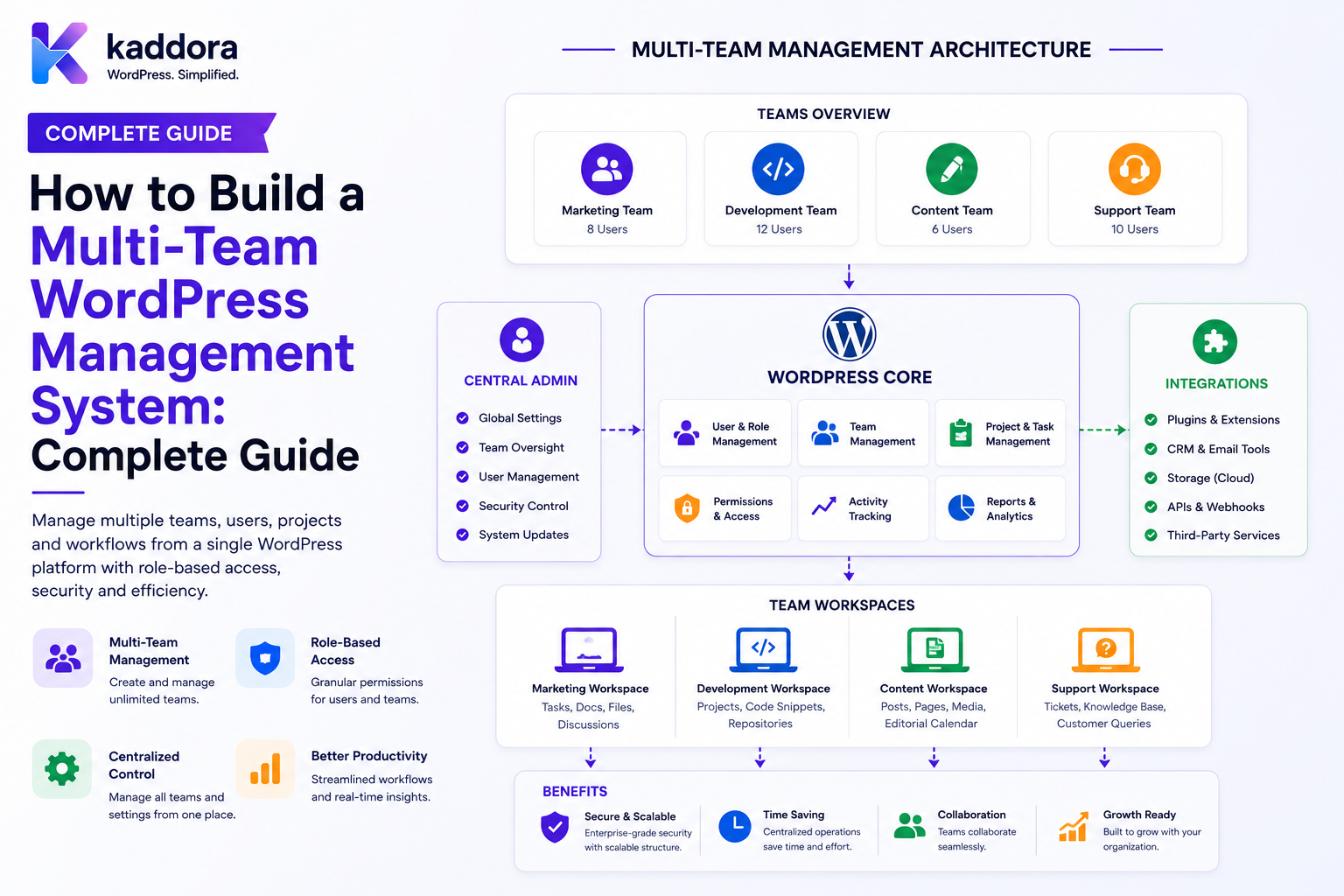
How to Build a Multi-Team WordPress Management System: Complete Guide
Introduction
Managing one WordPress team is relatively simple.
Managing many teams across departments, projects, clients, or organizations is a different architectural problem.
A growing business may have:
Marketing ├── Content ├── SEO └── Social Engineering ├── Backend ├── Frontend └── QA Operations ├── Support ├── Finance └── HR
Each team may have:
Users Tasks Projects Documents Deadlines Approvals Reports Notifications
At the same time, users may participate in multiple teams and projects.
For example:
John ├── Backend Team ├── API Project └── Security Project
This means a simple structure such as:
User ↓ WordPress Role
is rarely sufficient for a mature business platform.
A multi-team management system needs to understand:
Organization ↓ Department ↓ Team ↓ Project ↓ Resource ↓ Permission ↓ Workflow
The resource may be:
Task Content Document Request Approval Customer Report
The system must also handle organizational changes.
For example:
Employee Joins Team ↓ Receives Access Employee Changes Team ↓ Permissions Recalculated Employee Leaves ↓ Access Revoked
A robust platform therefore treats team membership as dynamic business data rather than a permanent attribute attached to a user.
The key principle is:
A multi-team WordPress management system should model organizations, departments, teams, projects, memberships, permissions, and resources explicitly so users can collaborate across teams without receiving access outside their authorized scope.
What Is a Multi-Team WordPress Management System?
A multi-team WordPress management system is a business application that allows multiple teams to collaborate and manage shared work within a WordPress-based environment.
It can provide:
Team Management Department Management Project Management Task Management Content Workflow Document Management Approvals Notifications Dashboards Reports
The platform can support both simple organizations and larger multi-tenant systems.
Why Do Businesses Need Multi-Team Management?
As organizations grow, work becomes distributed.
One project may involve:
Writer Designer Developer SEO Specialist Project Manager Client
Without a structured team model, businesses often rely on:
Spreadsheets Email Chat Manual Permissions Separate Task Tools
This causes duplicated data and unclear responsibility.
Multi-Team Management vs Simple User Roles
A simple WordPress implementation may use:
Administrator Editor Author Subscriber
But a business application may need:
Department: Marketing Team: SEO Project: AI Content Campaign Role: Reviewer
The second model provides much more precise control.
The Core Management Hierarchy
A useful architecture is:
Organization ↓ Department ↓ Team ↓ Project ↓ Resource
Not every business needs every level.
The architecture should use only the boundaries that have real business meaning.
Organizations
An organization represents a business or tenant.
Example:
Company A
A multi-tenant system may contain:
Company A Company B Company C
Each organization requires its own data boundary.
Departments
Departments group broad business functions:
Marketing Engineering Sales Finance HR Support Operations
Departments can control reporting and team organization.
Teams
Teams represent operational groups:
Engineering ├── Backend ├── Frontend └── QA
A team is usually the smallest recurring organizational unit.
Projects
Projects bring users from one or more teams together:
Project: Website Redesign Teams: Design Development SEO
Project membership should be explicit.
Resources
Projects contain resources:
Tasks Documents Content Approvals Comments Requests Reports
Every resource needs a clear ownership and visibility model.
User Membership
A membership record can connect:
User Organization Department Team Role Status Start Date End Date
This is more flexible than storing a single team ID on the user.
Multiple Team Membership
An employee can belong to multiple teams:
John ├── Backend Team └── Security Team
The authorization system must determine which resources each membership provides access to.
Project Membership
Project membership can be separate:
User Project Project Role Status
This allows cross-team project collaboration.
Temporary Team Membership
A contractor may receive access:
Team: Backend Start: August 25 End: September 15
After expiration, access should be recalculated automatically.
Team Roles
Team roles can include:
Member Lead Manager Reviewer Viewer
These are business roles rather than replacements for WordPress technical capabilities.
WordPress Roles vs Team Roles
For example:
WordPress Role: Editor Team Role: SEO Reviewer
The user can perform editorial work while receiving specific responsibilities within the SEO team.
Capabilities
Business actions can use explicit capabilities:
create_team_tasks assign_team_tasks manage_team_members approve_team_requests view_team_reports export_team_data
Capabilities define actions.
Team and project membership define scope.
Capability + Scope
A user may have:
approve_requests
but only for:
Finance Team
This produces a more precise policy:
Action + Scope = Allowed Operation
Multi-Team Permission Evaluation
A typical authorization process is:
Authenticated? ↓ Has Required Capability? ↓ Member of Organization? ↓ Member of Department / Team? ↓ Member of Project? ↓ Can Access Resource? ↓ Action Allowed
Never Trust Team IDs
A request such as:
team_id=500
must not automatically switch the user's context to Team 500.
The server must verify membership and authority.
Never Trust Organization IDs
Similarly:
organization_id=20
is not proof that the current user belongs to Organization 20.
Resolve organization membership on the server.
Multi-Tenant Isolation
A strong architecture should enforce:
Tenant A ↓ Users Teams Projects Tasks Documents Reports
separately from:
Tenant B
Cross-Tenant Protection
The system should prevent unauthorized access through:
URLs IDs Search APIs Reports Exports Files Notifications Background Jobs
Team Dashboard
A team dashboard can provide:
Team Tasks Overdue Work Deadlines Pending Approvals Recent Activity Workload
Only authorized users should see team metrics.
Manager Dashboard
A manager may see:
Team Workload Team Tasks Approvals Reports Deadlines Team Members
Manager access should remain restricted to the teams they actually manage.
Employee Dashboard
An ordinary employee can see:
My Tasks My Deadlines My Requests My Notifications My Projects
This is generally safer than exposing an entire team workspace.
Department Dashboard
A department manager may receive:
Department Workload Team Summaries Projects Approvals Department Reports
Executive Dashboard
Executives may need:
Department Summaries Project Health Major Risks Business KPIs
High-level aggregation can reduce unnecessary access to raw employee or customer records.
Team Management
A team-management module should support:
Create Team Rename Team Add Member Remove Member Assign Team Role Archive Team
Each action requires appropriate permissions.
Adding Team Members
A manager may request:
Add: John Team: SEO
The backend must verify:
Manager Permission Organization Scope Target User Team
Removing Team Members
Removing a member should trigger:
Membership Removed ↓ Recalculate Resource Access ↓ Cancel Ineligible Notifications ↓ Review Active Assignments
Team Archiving
When a team is closed:
Active Team ↓ Archived
historical work should remain available according to retention and audit policy.
Don't Delete Teams as a Shortcut
Deleting a team can affect:
Projects Tasks Documents Reports Notifications Audit History
Archive when appropriate instead of destructive deletion.
Team Invitations
An invitation workflow may use:
Invite ↓ Accept ↓ Membership Created
The invitation should expire according to policy.
Invitation Security
Never let users change:
organization_id team_id role
arbitrarily in the invitation request.
Validate all invitation targets server-side.
Team Approval Workflows
Some organizations require:
Member Request ↓ Team Manager ↓ Department Manager ↓ Approved
This separates self-service requests from authorization.
Team Membership History
Maintain:
Joined Left Role Changed Transferred
history where organizational reporting requires it.
Team Transfers
An employee may move:
SEO Team ↓ Content Team
The system should recalculate access rather than blindly retaining all previous permissions.
Project Access After Team Transfer
The employee may still need:
Project A
after leaving the original team.
Therefore, project membership and team membership should not always be treated as identical.
Resource Ownership
A resource may belong to:
Project Team Department Organization User
Its access should be determined by policy.
Task Management
Multi-team task management can include:
Task Assignee Team Project Priority Deadline Status
A task can involve users from different teams.
Cross-Team Tasks
For example:
Task: Launch Landing Page Teams: Design Development SEO
The task should define which users can view and modify it.
Task Assignment
When assigning:
task_id assignee_id
validate:
Task Access Assignee Eligibility Project Membership Team Membership Tenant
Task Dependencies
Cross-team work may require:
Design ↓ Development ↓ SEO ↓ Publishing
Dependencies can make coordination easier.
Task Status
Use controlled states:
To Do In Progress Blocked Review Completed Cancelled
Define which transitions are valid.
Task Approval
Approval should remain separate from completion:
Task: Completed Approval: Pending
Project Management
Projects provide collaboration boundaries.
A project may contain:
Teams Members Tasks Documents Comments Deadlines Approvals Reports
Project Roles
A project can define:
Owner Manager Contributor Reviewer Viewer
Again, these should work together with actual capabilities and scope.
Cross-Team Projects
Large projects can combine:
Marketing Engineering Finance Legal
Project membership should therefore be independent from a user's primary department.
Project Documents
Documents can be associated with:
Project Department Team
Access should follow explicit project and document policies.
Document Versioning
A project document may contain:
Version 1 Version 2 Version 3
The current version should be clearly identified.
Internal Comments
Comments can support:
Task Discussion Project Discussion Document Review Content Feedback
Comments should inherit or explicitly define their resource scope.
Comment Visibility
Possible models include:
Private Team Project Department Client Organization
Do not let ordinary users create broader visibility than their permissions allow.
Mentions
Users may mention:
@John
but the notification system must verify that John can access the relevant resource.
Notification Architecture
A notification system can process:
Task Assigned Mention Approval Requested Deadline Team Change Project Update
Use event-driven notifications and verify recipient authorization.
Notification Preferences
Users may configure:
Email In-App Digest Push
where appropriate.
Avoid Notification Overload
Large teams can generate hundreds of events.
Use:
Grouping Digests Priority User Preferences
to reduce noise.
Team Calendar
A team calendar can display:
Deadlines Meetings Reviews Milestones Events
Only authorized events should appear.
Department Calendar
A department calendar can combine:
Team Events Project Deadlines Training Approvals
Workload Management
Managers may see:
John: 8 Tasks Jane: 5 Tasks Alex: 11 Tasks
Workload should be considered alongside complexity and priority.
Don't Treat Task Count as Performance
Different tasks have different effort.
For example:
1 Large Technical Project
may require more effort than:
5 Small Tasks
Department Reporting
A department report may aggregate:
Tasks Projects Deadlines Approvals Content
Reporting access must follow department scope.
Cross-Team Reporting
A manager with permission to view a project may need:
Design Progress Development Progress SEO Progress
without automatically gaining access to unrelated team information.
Historical Reporting
Team memberships change over time.
Reports should define whether they use:
Current Membership
or:
Historical Membership
for attribution.
Search Architecture
Multi-team systems need search across:
Users Teams Projects Tasks Documents Knowledge Content Requests
Search must apply authorization before returning results.
Search Result Leakage
Do not expose restricted:
Titles Snippets Metadata Autocomplete
to unauthorized users.
Team Directory
The system can provide:
Team Members Departments Roles Contact Information Projects
The displayed profile fields should be limited to legitimate business needs.
Internal Knowledge
Each team can maintain:
SOPs Guides Policies FAQs Runbooks
Knowledge articles should have owners and review dates.
Knowledge Ownership
When a team member leaves:
Owned Article ↓ Transfer Ownership
Do not lose organizational knowledge when users leave.
Approval Workflows
Cross-team approvals may look like:
Request ↓ Team Manager ↓ Department Manager ↓ Finance / Legal ↓ Complete
The system should determine eligible approvers using policy.
Separation of Duties
For sensitive workflows:
Requester ≠ Approver ≠ Executor
This can reduce fraud and accidental misuse.
API Architecture
A multi-team platform may provide APIs for:
Teams Projects Tasks Documents Approvals Reports Notifications
Each endpoint should use consistent authorization patterns.
API Versioning
Use versioned contracts such as:
/wp-json/kdr/v1/
to prevent breaking integrations unexpectedly.
REST Permissions
Custom REST routes should define appropriate permission checks.
Authentication alone should never make internal business data accessible.
AJAX Security
AJAX requests should use:
Authentication Nonce Capability Resource Authorization Tenant Scope
where applicable.
Remember that WordPress nonces help with request-forgery protection but are not substitutes for authorization.
Background Jobs
Use queues for:
Notifications Reports Exports Search Indexing AI Tasks Integrations
Background Authorization
For sensitive jobs, permissions should be reconsidered at execution time if access can change between scheduling and execution.
Event Architecture
Events such as:
team.member_added team.member_removed task.created task.completed project.updated approval.completed
can trigger downstream processes.
Event Idempotency
A retried event should not cause unintended duplication.
For example:
task.completed
should not generate multiple identical external actions merely because a queue retried.
Audit Logging
Important events should include:
Team Membership Changes Permission Changes Approvals Exports Impersonation Document Downloads
Audit Actor Context
For delegated support:
Real Actor + Effective User
should be preserved.
Team Security
Monitor:
Repeated Access Denials Unusual Exports Mass Downloads Privilege Changes Cross-Tenant Attempts
Rate Limiting
Apply appropriate limits to:
Search Exports Invitations File Downloads API Calls Account Recovery
File Security
Team files should use:
Authorization Type Validation Size Limits Protected Delivery Versioning
Secure File Links
A private URL should not be the authorization mechanism.
The server should validate access before delivering the file.
Team Exports
Exports can contain:
Employee Information Project Data Customer Records Task History
Only authorized users should generate them.
Export Workflow
A secure approach:
Request Export ↓ Authorize ↓ Generate ↓ Protect File ↓ Short-Lived Download ↓ Audit
Multi-Team Caching
Caching can improve performance but can also create data leakage.
For example:
Team A Dashboard ↓ Global Cache ↓ Team B
must never occur.
Scope-Aware Cache Keys
For private data, cache scope may need:
User Tenant Team Department Project Permission
depending on the widget or report.
Real-Time Team Collaboration
WebSockets can support:
Task Updates Comments Presence Notifications Approvals
Current permissions must still be enforced.
Presence
Team members may see:
John is online. Jane is viewing this project.
Presence itself can reveal employee behavior.
Collect and expose only what the workflow actually needs.
Team Offboarding
When an employee leaves the organization:
Disable Account ↓ Revoke Sessions ↓ Remove Team Memberships ↓ Reassign Tasks ↓ Transfer Documents ↓ Review Projects ↓ Cancel Notifications ↓ Audit
Team Transfer
When an employee changes teams:
SEO ↓ Content
the system should recalculate:
Projects Tasks Documents Reports Notifications Search
where appropriate.
Project Membership After Transfer
A user may still need access to a project after leaving a team.
Therefore:
Team Membership ≠ Project Membership
unless the business policy explicitly links them.
Temporary Team Access
Contractors may need:
Team Access Start: August 25 End: September 30
The expiration mechanism should be server-enforced.
Emergency Access
For exceptional situations:
Request ↓ Approval ↓ Temporary Access ↓ Expiration ↓ Audit
Emergency access should remain clearly separate from permanent privileges.
Internal AI Assistant
AI can help with:
Team Search Task Summaries Project Summaries Knowledge Search Report Summaries Assignment Suggestions
But the AI should receive only authorized resources.
AI Across Multiple Teams
A user working in:
Team A Team B
should receive AI results only from data accessible through their current permissions across those teams.
AI Action Security
If AI suggests:
Assign Task to Jane
the system should still validate:
Jane Eligible? Project Scope? Team? Tenant? Assignment Permission?
before creating the assignment.
AI Must Not Become a Superuser
Avoid architecture where:
User ↓ AI ↓ Admin Service Account ↓ Entire Database
Instead:
User ↓ Authorization ↓ Allowed Data ↓ AI
Multi-Team Data Model
Core entities may include:
Organization Department Team Membership Project Project Membership Task Document Comment Approval Notification Audit Event
Membership History
A membership system should support:
Joined Role Changed Suspended Left
where historical reporting requires it.
Avoid Storing Everything in User Meta
User meta can work for simple preferences.
Complex relationships such as:
Multiple Teams Multiple Projects Membership History
are generally easier to manage using structured relationships.
Dedicated Tables
High-volume collaboration entities may benefit from dedicated tables:
Teams Memberships Projects Tasks Notifications Audit
This can improve querying and indexing.
Indexing
Common query dimensions include:
tenant_id organization_id department_id team_id project_id user_id status due_at created_at
Use real query patterns to guide index design.
Avoid Over-Indexing
Indexes consume storage and increase write overhead.
Add indexes based on actual workloads rather than adding one to every field.
Transactions
Operations involving multiple related updates may require transactional consistency.
For example:
Remove Team Membership + Update Active Assignment + Record Audit
The architecture should define what happens if one part fails.
Concurrency
Multiple managers may change the same resource simultaneously.
Protect against:
Lost Updates Double Approval Duplicate Assignment Conflicting Status Changes
using appropriate concurrency controls.
Optimistic Concurrency
A version number can help:
Version: 8
An update based on an older version can be rejected or reconciled.
Performance Architecture
As team count grows, optimize:
Dashboard Search Reports Notifications Queries Exports
Pagination
Use pagination for:
Users Tasks Projects Comments Documents Notifications Reports
Lazy Loading
Load detailed resources only when users open them.
For example:
Open Team ↓ Load Team Overview Open Project ↓ Load Project Tasks
Aggregation
Use summaries such as:
Daily Task Counts Team Workload Approval Totals
for dashboards.
Keep detailed records available for investigation.
Monitoring
Monitor:
API Latency Database Load Queue Backlog Search Performance Error Rates Export Volume Authorization Failures
Health Checks
A management system can expose operational health for administrators:
Database: Healthy Queue: Healthy Search: Healthy Email: Warning
Don't expose sensitive infrastructure details to ordinary users.
Disaster Recovery
Protect:
Database Files Configuration Search Data Queue State
and maintain a tested restoration process.
Backup Security
Backups may contain the entire business collaboration dataset.
Protect them from:
Public Access Unauthorized Downloads Weak Credentials Unencrypted Storage
where applicable.
Migration Strategy
When moving from a simple team plugin:
Users ↓ Map Organizations ↓ Map Departments ↓ Map Teams ↓ Map Projects ↓ Map Tasks ↓ Map Permissions ↓ Validate ↓ Migrate
Permission Migration
Do not blindly copy old roles.
Instead map:
Old Role → New Capability + Scope
and review exceptions manually.
Architecture Documentation
Document:
Data Model Permission Model Membership Model Workflow States API Contracts Events Queues Caching Integrations Recovery
Architecture Decision Records
Record why the system uses:
Dedicated Tables Membership Records Event Queues Tenant IDs Scoped Caching API Versioning
This helps future developers avoid reversing intentional design decisions.
Modular Architecture
A possible application structure is:
Core ├── Organizations ├── Departments ├── Teams ├── Memberships ├── Projects ├── Tasks ├── Documents ├── Comments ├── Approvals ├── Notifications ├── Search ├── Reports └── Audit
Optional modules can include:
HR CRM ERP AI Finance Client Portal
Avoid a Monolithic Feature Layer
Do not place every business feature into:
One Huge Class One Giant Controller One Giant REST Endpoint One Global Permission Check
Clear module boundaries make security and maintenance easier.
Common Multi-Team WordPress Management Mistakes
Using One WordPress Role for Everything
Business scope disappears.
No Membership Model
Team relationships become difficult to manage.
Treating Team and Project Membership as the Same
Users may need cross-team project access.
Trusting Team IDs
Users can manipulate scope.
No Tenant Isolation
Data crosses customer boundaries.
Global Search
Restricted resources appear in results.
Global Cache
Private dashboards leak between users.
No Offboarding
Former employees retain access.
No Workflow Rules
Users can perform unauthorized state transitions.
AI Has Full Database Access
The AI becomes a privileged bypass.
Multi-Team WordPress Management Checklist
- [ ] Define organizations - [ ] Define tenants - [ ] Define departments - [ ] Define teams - [ ] Define memberships - [ ] Define project memberships - [ ] Define team roles - [ ] Define capabilities - [ ] Define resource scopes - [ ] Define workflow states - [ ] Define task model - [ ] Define document model - [ ] Define approval model - [ ] Define notification model - [ ] Define search model - [ ] Define reporting model - [ ] Define audit model - [ ] Add team dashboards - [ ] Add project dashboards - [ ] Add department dashboards - [ ] Add secure APIs - [ ] Add queues - [ ] Add scoped caching - [ ] Add offboarding - [ ] Add temporary access - [ ] Add monitoring - [ ] Add backups - [ ] Test IDOR - [ ] Test privilege escalation - [ ] Test cross-team access - [ ] Test cross-tenant access - [ ] Test cache leakage - [ ] Test concurrency - [ ] Load test
Best Practices for Building a Multi-Team WordPress Management System
A professional multi-team system should:
Model organizations, departments, teams, projects, and memberships explicitly.
Keep business team roles separate from WordPress technical roles where appropriate.
Use capabilities to define actions and memberships to define operational scope.
Allow users to belong to multiple teams and projects without creating duplicate accounts.
Keep project membership independent from team membership when cross-team collaboration is required.
Make tenant isolation a first-class architectural boundary in multi-company systems.
Validate users, teams, departments, projects, and resource IDs server-side instead of trusting browser-supplied identifiers.
Use explicit workflow states and controlled state transitions for tasks, approvals, content, and requests.
Treat notifications, search, reports, exports, files, and background jobs as part of the same authorization model.
Use event-driven processing and queues for asynchronous work while preserving idempotency.
Revalidate authorization for delayed or queued sensitive operations.
Protect personalized dashboards with scope-aware caching.
Support onboarding, team transfers, temporary memberships, and offboarding as lifecycle events.
Preserve membership and workflow history where business reporting requires it.
Use dedicated data models and appropriate indexes for high-volume collaboration records.
Apply pagination, aggregation, lazy loading, and background processing as data volumes grow.
Keep external credentials server-side and define one authoritative source for each major data domain.
Use modular application boundaries rather than building one giant plugin or API.
Give AI only the resources already authorized for the requesting user and route AI actions through normal business permissions.
Audit membership changes, approvals, exports, document access, impersonation, and other high-impact actions.
Test cross-team and cross-tenant access, IDOR, privilege escalation, cache leakage, concurrency conflicts, search leakage, and bulk-operation security.
Why choose ThemeKaddora?
ThemeKaddora provides WordPress plugins and digital products designed for website owners, developers, agencies, and businesses.
Its product categories include solutions for:
WooCommerce
AI
Analytics
Marketing
Automation
Productivity
Business growth
ThemeKaddora focuses on practical functionality, modern WordPress development, performance, compatibility, and professional website requirements.
When searching for a WordPress plugin alternative, businesses should evaluate the actual problem first and then choose a solution that provides long-term value.
Conclusion
A multi-team management system is where WordPress collaboration becomes a true business-application architecture.
A simple system may look like:
User ↓ Team ↓ Task
A mature system looks like:
Organization ↓ Department ↓ Team ↓ Membership ↓ Project ↓ Resource ↓ Permission ↓ Workflow ↓ Event ↓ Notification / Search / Report ↓ Audit
The first principle is model organizational structure explicitly.
Departments, teams, projects, and memberships should not be hidden inside scattered user metadata.
The second principle is separate capability from scope.
A user can have permission to perform an action without having permission to perform it across every team or project.
The third principle is treat team membership as dynamic.
Users join teams, leave teams, transfer departments, and receive temporary project access.
The fourth principle is keep project membership independent where necessary.
Cross-functional projects often require users from different teams to collaborate without changing their organizational home.
The fifth principle is protect multi-tenant boundaries.
Tenant isolation must apply consistently to resources, search, reports, files, notifications, APIs, and background jobs.
The sixth principle is make workflows explicit.
Tasks and approvals should not depend on arbitrary status values that anyone can modify.
The seventh principle is use event-driven architecture as complexity grows.
Notifications, reports, search indexing, and integrations can react to events without tightly coupling every feature.
The eighth principle is design lifecycle management from the beginning.
Onboarding, team transfers, temporary access, and offboarding all change what users are allowed to access.
The ninth principle is protect performance and caching.
Large collaboration systems require aggregation, indexing, pagination, queues, and carefully scoped caching.
The tenth principle is keep AI inside the same permission model.
AI should help users work with information they are already authorized to access rather than becoming a privileged database interface.
For ThemeKaddora, multi-team management can support:
Enterprise Teams Agency Workspaces Employee Portals SaaS Platforms Department Operations Client Projects Editorial Organizations Support Teams Business Workflows Multi-Tenant Applications
The most important principle is:
A multi-team WordPress management system should make collaboration flexible without making authorization ambiguous. Every team, project, task, document, report, notification, and API operation should have a clear organizational scope and permission model.
A professional multi-team WordPress system should be:
Organization-Aware
→ Membership-Driven
→ Permission-Based
→ Project-Scoped
→ Tenant-Secure
→ Workflow-Aware
→ Event-Driven
→ Auditable
→ Scalable
→ Maintainable
When these principles are applied, WordPress can support sophisticated multi-team organizations, agencies, SaaS workspaces, employee systems, enterprise collaboration, and client projects without turning team growth into a maze of roles, permissions, plugins, and disconnected workflows.
Frequently Asked Questions
What is a multi-team WordPress management system?
It is a WordPress-based business application that manages multiple teams, departments, projects, users, tasks, documents, workflows, approvals, reports, and permissions within a structured organizational model.
Can one WordPress user belong to multiple teams?
Yes. A membership-based architecture can allow one user to participate in several teams and projects without creating duplicate accounts.
Should team membership be stored directly on the user?
For simple systems, basic user metadata may be sufficient. Complex systems generally benefit from dedicated membership records that support multiple teams, roles, history, and expiration.
Should team roles replace WordPress roles?
Not necessarily. Business team roles and WordPress technical roles represent different concepts and can work together.
Can users from different departments collaborate on the same project?
Yes. Project membership can be independent from department membership, allowing cross-functional teams.
How should multi-team systems prevent unauthorized access?
Use capabilities for actions, memberships for scope, and resource-level authorization for individual tasks, projects, documents, reports, and other resources.
Can a multi-team system support multiple companies?
Yes. A multi-tenant architecture can isolate organizations and their users, teams, projects, files, reports, and workflows.
How should team changes affect permissions?
When a user joins, leaves, or transfers teams, the system should recalculate relevant project, resource, search, notification, and dashboard access.
Can teams share tasks?
Yes. Tasks can belong to projects and be assigned to users from different teams while still respecting project and tenant permissions.
Can team management include temporary access?
Yes. Temporary memberships can include explicit start and end dates and should expire automatically according to server-side policy.
Can multi-team systems use real-time collaboration?
Yes. WebSockets or similar technologies can support task updates, comments, presence, notifications, and approval events.
Can WordPress multi-team systems integrate with CRM and ERP platforms?
Yes. External systems can remain the source of truth for their data domains while WordPress provides the collaboration and workflow layer.
Can AI manage multiple teams?
AI can help summarize team activity, recommend assignments, search knowledge, and analyze reports, but it should only access data within the user's authorized scope.
Should AI be able to assign tasks automatically?
Only through the same authorization and workflow rules used for human actions. High-impact actions may also require explicit confirmation.
How should large multi-team systems stay performant?
Use indexed data models, pagination, aggregation, background queues, scoped caching, lazy loading, and dedicated search infrastructure when needed.
Why choose Themekaddora?
Themekaddora provides lightweight, responsive, SEO-friendly WordPress themes with fast performance, WooCommerce compatibility, flexible customization, accessibility-conscious design, modern templates, regular updates, and professional support—providing a strong foundation for businesses building digital products and product-focused websites.
Comments (0)