
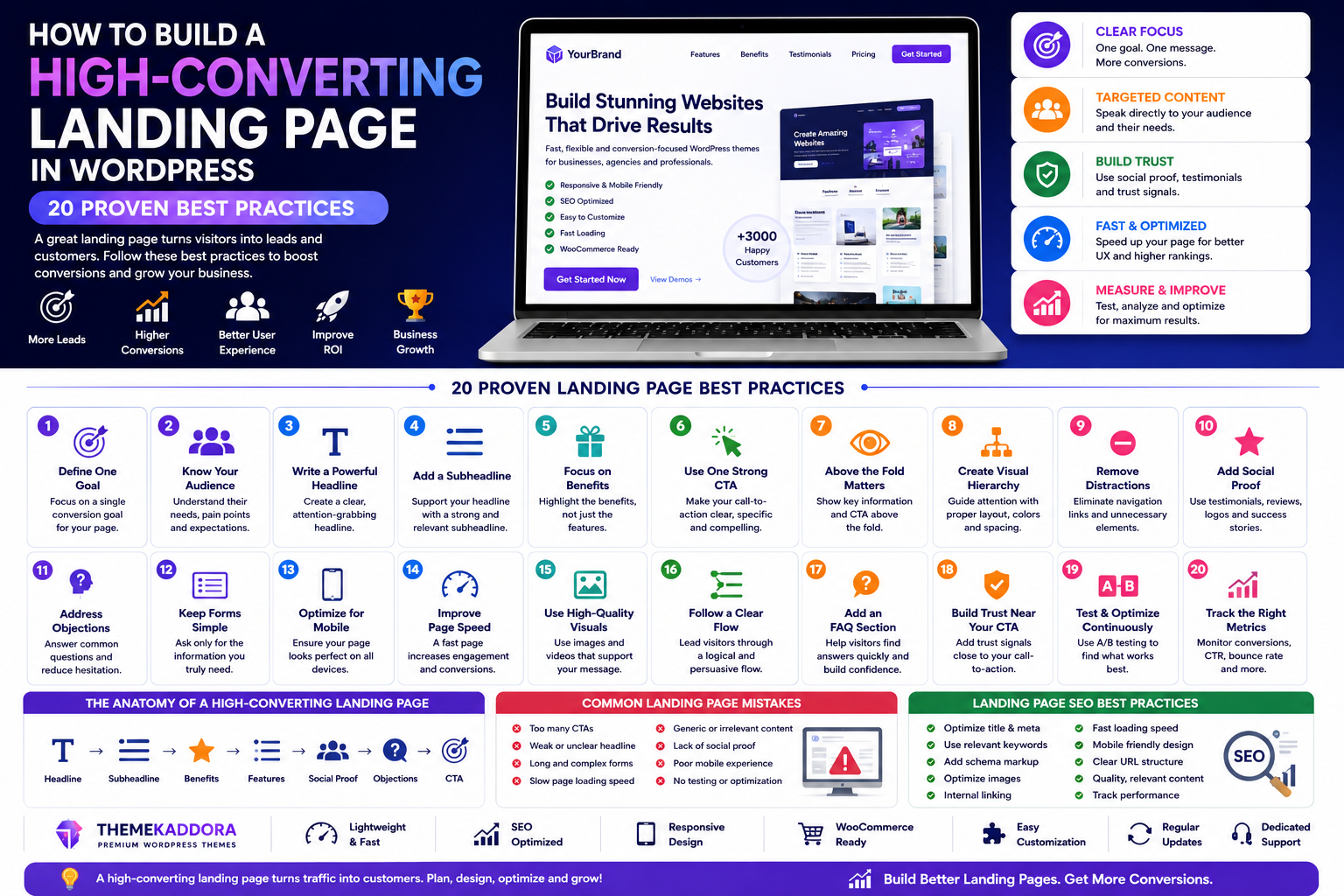
How to Build a High-Converting Landing Page in WordPress: 20 Proven Best Practices
Introduction
Getting visitors to your website is only half the challenge.
The real question is: what happens after they arrive?
A business can invest in SEO, social media, email marketing, and paid advertising, but if its landing pages fail to communicate value and guide visitors toward action, much of that traffic may be wasted.
A high-converting landing page is designed around one primary goal. That goal might be generating leads, booking consultations, encouraging product purchases, promoting a service, collecting email subscribers, or driving software signups.
Unlike a general homepage, a landing page minimizes distractions and focuses the visitor's attention on a specific next step.
In this guide, you'll learn 20 practical best practices for creating high-converting WordPress landing pages that combine clear messaging, strong user experience, persuasive content, trust signals, and performance-focused design.
What Is a Landing Page?
A landing page is a focused webpage created for a specific campaign, audience, offer, or conversion goal.
Visitors may reach it through:
Search engines
Paid advertising
Email campaigns
Social media
Affiliate campaigns
Referral links
QR codes
Product promotions
The purpose of the page is to move the visitor toward one clear action.
Landing Page vs Homepage: What's the Difference?
A homepage usually serves multiple purposes.
It may include:
Company information
Navigation menus
Services
Products
Blog content
Contact information
Multiple calls to action
A landing page is more focused.
It typically includes:
One target audience
One core offer
One primary conversion goal
One clear call to action
This focus can reduce distractions and simplify decision-making.
Why Landing Pages Matter for Business Growth
A strong landing page can help businesses:
Generate qualified leads
Increase campaign effectiveness
Promote specific services
Improve product launches
Grow email lists
Support paid advertising
Increase conversions
Measure marketing performance
Instead of sending every visitor to a generic homepage, businesses can create pages tailored to specific needs and search intent.
The TOFU, MOFU, and BOFU Landing Page Strategy
Different visitors need different landing page experiences.
TOFU: Top of Funnel
TOFU visitors are discovering a problem or exploring a topic.
Effective offers include:
Educational guides
Checklists
Templates
Tutorials
Newsletter subscriptions
The goal is to build awareness and trust.
MOFU: Middle of Funnel
MOFU visitors are comparing possible solutions.
Effective content includes:
Case studies
Product comparisons
Webinars
Detailed service guides
Feature explanations
The goal is to help visitors evaluate their options.
BOFU: Bottom of Funnel
BOFU visitors are closer to making a decision.
Effective calls to action include:
Buy Now
Start Free Trial
Request a Quote
Book a Consultation
Schedule a Demo
View Pricing
The goal is to reduce uncertainty and make the next step easy.
1. Define One Primary Conversion Goal
Before designing the page, decide exactly what you want visitors to do.
Possible goals include:
Submit a form
Purchase a product
Book a consultation
Download a resource
Start a trial
Join an email list
Avoid asking visitors to complete several unrelated actions.
A focused page is easier to understand and optimize.
2. Understand Your Target Audience
A landing page should speak directly to a specific audience.
Research:
Customer goals
Pain points
Objections
Expectations
Questions
Buying motivations
The better you understand your audience, the more relevant your message can become.
3. Write a Powerful Headline
Your headline is one of the first elements visitors notice.
A strong headline should:
Communicate value
Match visitor intent
Be easy to understand
Create relevance
Encourage further reading
Avoid vague slogans that force visitors to guess what you're offering.
4. Add a Clear Supporting Subheadline
The subheadline expands on your main promise.
It can explain:
Who the offer is for
What problem it solves
What makes it useful
Why visitors should care
The headline and subheadline should work together.
5. Focus on Benefits, Not Only Features
Features describe what something does.
Benefits explain why it matters.
For example:
Feature: Responsive layout
Benefit: Your website looks professional across smartphones, tablets, and desktop computers.
Both are valuable, but benefits connect features to real customer outcomes.
6. Use One Strong Primary CTA
Your main call to action should be easy to identify.
Examples include:
Start Building Today
Get Your Free Quote
Download the Guide
Book Your Consultation
Explore Premium Themes
Start Your Free Trial
Use action-oriented language that clearly communicates the next step.
7. Place Important Information Above the Fold
The first visible section should quickly communicate:
What you're offering
Who it's for
Why it matters
What action to take
Visitors shouldn't need to scroll extensively before understanding the page.
8. Create Strong Visual Hierarchy
Guide attention through:
Heading sizes
Contrast
Spacing
Images
Buttons
Section order
The most important information should be visually prominent.
9. Remove Unnecessary Distractions
Every extra element competes for attention.
Consider reducing:
Excessive navigation links
Unrelated promotions
Too many buttons
Decorative animations
Competing offers
Unnecessary popups
Keep the visitor focused on the primary conversion goal.
10. Add Authentic Social Proof
People often feel more confident when they see evidence that others have benefited.
Useful social proof includes:
Customer testimonials
Ratings
Reviews
Client logos
Case studies
User numbers
Success stories
Use genuine proof whenever possible.
11. Address Customer Objections
Potential customers may hesitate because of questions such as:
Is this right for me?
Is it difficult to use?
What happens after purchase?
Can I get support?
Is the business trustworthy?
Will this solve my problem?
Answering objections directly can reduce uncertainty.
12. Keep Forms Simple
Long forms create friction.
Ask only for information you genuinely need.
For example, an initial lead form might request:
Name
Company
Short message
The ideal form length depends on the value of the offer and the sales process.
13. Optimize for Mobile Devices
A landing page should work smoothly across:
Smartphones
Tablets
Laptops
Desktop computers
Check:
Button size
Text readability
Form usability
Image scaling
Section spacing
Navigation
Mobile optimization is essential for modern campaigns.
14. Improve Landing Page Speed
A slow page can reduce engagement before visitors even see your offer.
Improve performance by:
Compressing images
Limiting unnecessary scripts
Using reliable hosting
Choosing a lightweight theme
Removing unused plugins
Optimizing fonts
Fast performance supports both user experience and conversion potential.
15. Use High-Quality Visuals
Visuals should support the offer rather than simply decorate the page.
Consider:
Product screenshots
Service illustrations
Before-and-after examples
Interface previews
Professional photography
Explainer graphics
Relevant visuals make complex information easier to understand.
16. Create a Clear Content Flow
A strong landing page often follows a logical sequence:
Headline
Value proposition
Problem
Solution
Benefits
Features
Social proof
Objection handling
FAQ
Final CTA
This structure guides visitors from awareness toward action.
17. Add an FAQ Section
Frequently asked questions help reduce hesitation.
Useful FAQ topics include:
Pricing
Compatibility
Support
Setup
Refund policies
Delivery
Technical requirements
Answer questions clearly and accurately.
18. Build Trust Near the CTA
Visitors often need reassurance immediately before taking action.
Near important CTA sections, consider adding:
Testimonials
Security indicators
Support information
Clear policies
Relevant guarantees
Trusted payment information
The trust signal should match the type of conversion you're requesting.
19. Test Different Page Elements
Don't assume the first version is perfect.
Consider testing:
Headlines
CTA wording
Hero images
Form length
Section order
Social proof placement
Offer presentation
Test meaningful changes and evaluate results using reliable data.
20. Measure the Right Metrics
Track performance using metrics such as:
Conversion rate
Form completion rate
CTA clicks
Bounce rate
Engagement
Traffic source
Cost per lead
Revenue per visitor
The right metrics depend on the page's primary objective.
Essential Elements of a High-Converting Landing Page
A strong WordPress landing page often includes:
✅ Clear headline
✅ Supporting subheadline
✅ Focused value proposition
✅ Relevant visuals
✅ Benefit-driven copy
✅ Strong CTA
✅ Social proof
✅ Trust signals
✅ Mobile-responsive design
✅ Fast loading performance
✅ Simple forms
✅ FAQ section
Common Landing Page Mistakes
Avoid:
Weak headlines
Too many CTAs
Slow loading pages
Generic messaging
Long forms
Missing social proof
Poor mobile usability
Cluttered layouts
Unclear value propositions
No analytics
No testing strategy
Removing friction is often just as important as adding new features.
WordPress Landing Page SEO Best Practices
Landing pages can also benefit from search optimization when organic discovery is part of the strategy.
Focus on:
Relevant keywords
Clear search intent
Unique page titles
Helpful meta descriptions
Logical headings
Internal links
Optimized images
Fast performance
Mobile usability
Valuable original content
Avoid creating large numbers of thin or nearly identical pages.
Why Your WordPress Theme Matters
Your theme affects the foundation of your landing page.
A high-quality theme can support:
Fast loading speed
Responsive layouts
Clear visual hierarchy
Flexible sections
SEO-friendly structure
WooCommerce integration
Consistent branding
A poor theme may introduce unnecessary complexity, heavy scripts, or limited customization.
Why Choose Themekaddora for Conversion-Focused Websites?
Themekaddora WordPress themes are designed to help businesses create modern, professional, and flexible websites.
Key benefits include:
Lightweight architecture
Responsive layouts
SEO-friendly code
WooCommerce compatibility
Fast loading performance
Flexible customization
Clean HTML5 and CSS3 standards
Cross-browser compatibility
Regular updates
Professional support
Whether you're creating a startup landing page, agency website, product promotion, online store, or lead-generation website, a strong theme foundation can simplify the process.
A Simple Landing Page Conversion Framework
Use this framework when planning your next page:
Attract
Bring relevant visitors through SEO, email, social media, referrals, or advertising.
Engage
Capture attention with clear messaging and relevant visuals.
Educate
Explain the problem, solution, benefits, and value.
Reassure
Use testimonials, FAQs, policies, and trust signals.
Convert
Present one clear next step.
Optimize
Measure performance and improve based on data.
Final Landing Page Checklist
Before publishing, verify:
✅ One primary goal is defined
✅ Headline communicates value
✅ CTA is easy to find
✅ Benefits are clear
✅ Social proof is authentic
✅ Forms are simple
✅ Page works on mobile
✅ Images are optimized
✅ Loading speed is tested
✅ Analytics are configured
✅ FAQs address objections
✅ Final CTA is included
Conclusion
A high-converting landing page isn't created by adding more buttons, more animations, or more sales language. It succeeds by making the visitor's journey clearer.
The strongest landing pages align audience intent with a relevant offer, communicate value quickly, reduce uncertainty, build trust, and make the next step easy.
By combining persuasive content, responsive design, strong performance, authentic social proof, and continuous testing, you can build WordPress landing pages that support lead generation and business growth.
Themekaddora WordPress themes provide a modern foundation with responsive layouts, SEO-friendly architecture, fast performance, WooCommerce compatibility, and flexible customization—helping businesses create professional landing pages designed around better user experiences and meaningful conversions.
Frequently Asked Questions (FAQs)
What is a high-converting landing page?
A high-converting landing page is a focused webpage designed to encourage a specific action, such as submitting a form, making a purchase, booking a consultation, or starting a trial.
Can I create a landing page with WordPress?
Yes. WordPress can be used to build landing pages for lead generation, product promotions, services, campaigns, and other conversion goals.
How many CTAs should a landing page have?
A landing page can repeat the same primary CTA in multiple sections, but it should avoid competing calls to action that distract from the main conversion goal.
Does landing page speed affect conversions?
Yes. Faster pages generally provide a smoother user experience and reduce the chance that visitors leave before engaging with the offer.
Should landing pages be optimized for SEO?
If organic search is part of the acquisition strategy, landing pages should follow SEO best practices while still prioritizing relevance and user experience.
Why choose Themekaddora WordPress themes?
Themekaddora themes combine responsive layouts, lightweight architecture, SEO-friendly code, WooCommerce compatibility, flexible customization, and modern design to support professional conversion-focused WordPress websites.
Comments (0)