
Introduction
WordPress AI plugins increasingly handle tasks that require different levels of accuracy, reasoning, and automation. A simple content classification request may need only a lightweight AI model, while generating structured business recommendations, processing customer requests, or executing administrative operations may require more advanced reasoning and additional verification.
Using the same processing method for every AI task can create unnecessary costs, slow responses, and unreliable results. Some tasks are straightforward and can be completed automatically. Others contain ambiguous information, incomplete context, or potentially sensitive operations that require additional checks.
Confidence-based routing provides a structured way to handle these differences.
Instead of sending every request through an identical workflow, a confidence-aware system evaluates the available evidence, task requirements, model output, and risk level before selecting the next processing path. Depending on the result, it can choose a standard AI workflow, request additional information, use another model, perform verification, or send the task for human review.
For WordPress developers, this approach makes AI-powered plugins more adaptable and easier to control. It also helps separate routine automation from decisions that require additional attention.
This guide explains how confidence-based routing works, how to design it for WordPress AI tasks, and how to implement a practical routing architecture using WordPress development practices.
What Is Confidence-Based Routing?
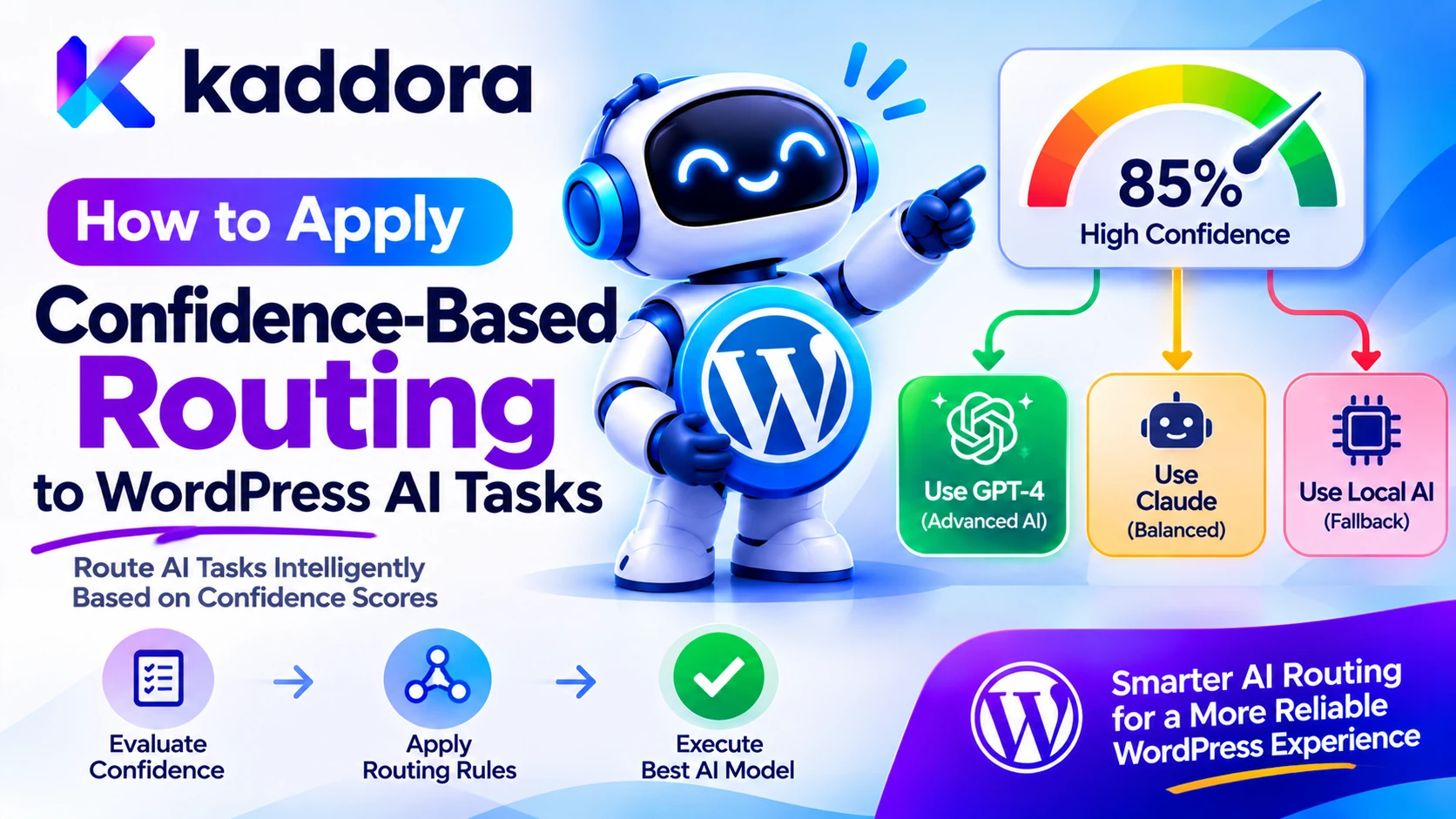
Confidence-based routing is a decision-making approach that selects an appropriate processing path according to the estimated reliability of an AI result or the available evidence.
In a traditional AI workflow, a request generally follows a predefined sequence:
Receive an AI task.
Send the request to an AI model.
Receive the response.
Return or execute the result.
This workflow may be sufficient for simple applications, but it does not account for differences in uncertainty between tasks.
A confidence-based workflow introduces an evaluation stage before deciding what happens next.
For example:
High-confidence results may continue through a standard processing workflow.
Medium-confidence results may receive additional context or verification.
Low-confidence results may be processed using another model or sent for human review.
High-risk operations may require approval regardless of the confidence score.
The objective is not to make AI perfectly accurate. It is to create a controlled system that responds differently when the reliability of a result changes.
An important distinction: Model-reported confidence is not automatically a calibrated probability of correctness. A model stating that it is highly confident does not prove that its answer is correct. Confidence-based routing should use measurable evidence, task-specific evaluation, and verification wherever possible.
Why WordPress AI Plugins Need Confidence-Based Routing
WordPress plugins serve different types of users and operate across a wide range of websites. An AI feature that works well for a personal blog may also be installed on an online store, membership platform, business website, or booking system.
These environments introduce different requirements.
Different Tasks Have Different Accuracy Requirements
Consider a WordPress AI plugin that supports several operations:
Generating blog summaries.
Categorizing articles.
Creating SEO descriptions.
Answering customer questions.
Analyzing WooCommerce orders.
Updating business records.
These tasks do not have identical consequences when an AI response is incorrect.
An inaccurate blog summary may require a simple correction. An incorrect customer refund recommendation or unauthorized record modification can create a much more serious problem.
Confidence-based routing allows developers to assign different processing requirements to each task.
Avoid Unnecessary Model Escalation
Advanced AI models can be more expensive and slower than lightweight models.
If every request is sent to the most capable model, the plugin may consume more resources than necessary.
A routing system can process straightforward requests through a suitable lightweight workflow and escalate difficult requests only when additional reasoning is justified.
Improve Uncertain AI Responses
Some requests are incomplete, ambiguous, or outside the available knowledge base.
Instead of treating every generated answer as reliable, the plugin can detect weak supporting evidence and choose an alternative workflow.
This may include:
Retrieving additional information.
Asking the user to clarify the request.
Running a second evaluation.
Selecting a different model.
Requesting human verification.
Support More Controlled Automation
AI agents can recommend actions, interact with plugin services, and coordinate multiple operations.
However, confidence must never become an authorization mechanism.
Even a highly confident AI response must pass capability checks, permission validation, and any required approval process before a sensitive WordPress operation is executed.
Core Components of a Confidence-Based Routing Architecture
A reliable implementation requires more than a single confidence threshold. Developers should separate task classification, confidence evaluation, routing decisions, and execution controls.
Task Classification
The first step is identifying what the AI system has been asked to do.
A plugin may define task categories such as:
Content generation.
Content analysis.
Customer support.
Data extraction.
Product recommendations.
Business reporting.
Administrative operations.
Each category can have its own routing policy.
For example, a content-generation task may tolerate a broader range of acceptable outputs than a task that extracts order information or recommends a financial adjustment.
Task classification should use trusted application context wherever possible. Do not rely exclusively on an AI model to determine the security category of an operation.
Confidence Evaluation
The evaluation stage estimates whether the available information is sufficient for the requested task.
Depending on the workflow, useful signals can include:
Whether the response follows the required output schema.
Whether retrieved documents support the response.
Whether required information is missing.
Whether independent verification succeeds.
Whether the model output passes task-specific validation.
Whether multiple evaluation methods produce consistent results.
A model-reported confidence value may be one signal, but it should not be treated as definitive evidence.
For example, a product classification system can evaluate whether the generated category exists in an approved list and whether the input contains enough information to support that classification.
Routing Policy
The routing policy converts evaluation results into a processing decision.
Common routing destinations include:
Standard processing: Continue with the normal workflow when the result satisfies the task's reliability requirements.
Additional verification: Validate the output against trusted records, schemas, or business rules.
Model escalation: Send the task to another suitable model when the current processing path cannot produce a sufficiently reliable result.
Context enrichment: Retrieve additional documents or ask for missing information.
Human review: Pause automated processing and request an authorized person's decision.
Safe fallback: Return a controlled response when the system cannot establish sufficient reliability.
Execution and Permission Controls
After selecting a route, the system must still enforce the permissions required by the operation.
For example, an AI model may confidently recommend changing a WooCommerce order status. The plugin must independently verify that the current user has permission to perform that operation and that the order is eligible for the requested transition.
Routing determines how a task should be processed. It does not grant permission to execute it.
Designing Confidence Thresholds for Different WordPress AI Tasks
Confidence thresholds determine when a task moves from one processing path to another.
A common mistake is applying one universal threshold to every AI feature. Different tasks require different evidence and different levels of reliability.
Use Task-Specific Thresholds
A content summarization feature and an administrative automation feature should not necessarily use the same routing rules.
For example:
Task
Suggested routing approach
Blog topic classification
Validate category and output structure
SEO description generation
Check relevance, length, and content quality
Customer support response
Verify supporting knowledge-base information
Product data extraction
Validate extracted fields against product records
Order modification
Require permission and operation-specific validation
Sensitive administrative action
Require explicit approval and independent checks
These are routing design examples, not universal numerical confidence requirements.
Separate Confidence From Risk
Confidence and risk answer different questions.
Confidence asks: How well does the available evidence support this result?
Risk asks: What could happen if the result is incorrect?
A high-confidence result can still involve a high-risk operation. Similarly, a low-risk task may be acceptable with less verification.
A useful policy considers both dimensions:
Confidence assessment
Risk level
Appropriate handling
Strong supporting evidence
Low
Standard processing
Incomplete evidence
Low
Additional validation
Strong supporting evidence
High
Permission checks and approval where required
Weak supporting evidence
High
Stop automated execution and request review
This approach prevents a confidence score from overriding important safety requirements.
Evaluate Confidence Against Real Results
Thresholds should be developed using representative test data.
For example, a plugin developer can collect reviewed examples of customer-support questions and compare the system's routing decisions against verified answers.
The evaluation should identify:
Correctly accepted responses.
Incorrectly accepted responses.
Correctly escalated responses.
Unnecessarily escalated responses.
This helps developers understand whether their routing policy is too permissive or too restrictive.
A numerical threshold should be selected based on observed performance, not simply because a value appears reasonable.
Implementing Confidence-Based Routing in WordPress
A practical implementation can use a small routing service, task-specific evaluation methods, and a controlled set of processing destinations.
The following example demonstrates the basic structure.
Define a Routing Service
Create a dedicated PHP class responsible for selecting a route.
<?php if ( ! defined( 'ABSPATH' ) ) { exit; } class Kaddora_AI_Task_Router { /** * Select an appropriate task route. * * @param float $confidence Evaluated confidence score. * @param string $risk Task risk category. * @return string */ public function get_route( $confidence, $risk ) { $confidence = max( 0, min( 1, (float) $confidence ) ); $allowed_risks = array( 'low', 'medium', 'high', ); if ( ! in_array( $risk, $allowed_risks, true ) ) { return 'human_review'; } if ( 'high' === $risk ) { return 'verification_required'; } if ( $confidence >= 0.90 ) { return 'standard_processing'; } if ( $confidence >= 0.65 ) { return 'additional_verification'; } return 'human_review'; } }
This example uses illustrative thresholds. A production plugin should establish thresholds through task-specific evaluation and should not assume that a model-generated score is calibrated.
The high-risk rule is intentionally separate from the confidence threshold. High-risk tasks require additional controls even when the confidence score is high.
Validate the Evaluation Input
The routing service should receive an evaluation result produced by a trusted application component.
For example, a content classification workflow might evaluate:
Whether the selected category exists.
Whether the output matches the expected format.
Whether the input contains sufficient information.
Whether the classification is supported by the available content.
The evaluation component should not accept arbitrary values from an unauthenticated frontend request and treat them as verified confidence.
Execute the Selected Route
After the router returns a route, the plugin can dispatch the task to the appropriate handler.
public function process_ai_task( $task, $evaluation ) { $router = new Kaddora_AI_Task_Router(); $route = $router->get_route( $evaluation['confidence'], $task['risk'] ); switch ( $route ) { case 'standard_processing': return $this->complete_task( $task ); case 'additional_verification': return $this->verify_task( $task ); case 'verification_required': return $this->verify_sensitive_task( $task ); case 'human_review': default: return $this->request_human_review( $task ); } }
The example assumes that the surrounding class defines the task handlers and validates the task structure. A production implementation should validate every required array key and value before accessing it.
Add Capability Checks Before Sensitive Operations
A routing decision must never replace WordPress authorization.
Before an operation changes important records, the plugin should check the current user's capabilities and verify that the requested object is accessible.
For example:
public function can_update_plugin_record( $record_id ) { $record_id = absint( $record_id ); if ( ! $record_id ) { return false; } if ( ! current_user_can( 'manage_options' ) ) { return false; } return true; }
The capability shown here is only an example. Production plugins should define capabilities appropriate to their features and verify object-level permissions where necessary.
For frontend requests, use suitable nonces to protect against CSRF. Remember that a nonce does not replace authorization.
Applying Confidence-Based Routing to Common WordPress AI Workflows
The routing architecture becomes more useful when applied to real plugin features.
AI Content Generation
A content-generation plugin can route generated drafts according to output quality and validation results.
A straightforward article introduction may pass through a standard review workflow. A response containing unsupported claims, missing information, or invalid formatting can be sent for further processing.
Possible validation signals include:
Required sections are present.
Output follows the requested format.
The content does not contain prohibited markup.
Important factual claims have supporting sources where required.
The result does not violate the site's publishing rules.
For automatic publishing, additional editorial permissions and publication policies should apply.
AI Customer Support
Customer-support plugins can use confidence-aware routing to distinguish supported answers from uncertain responses.
A question with a clear answer in an approved knowledge base may follow the normal response workflow.
A question with missing documentation or conflicting retrieved information may require further retrieval or human assistance.
The system should avoid presenting unsupported answers as verified facts.
WooCommerce Product Recommendations
A WooCommerce AI feature may recommend products based on customer preferences, product attributes, and available inventory.
The routing process can check whether:
Recommended product IDs exist.
Products are available for the relevant sales channel.
Recommendations match the requested attributes.
Product information comes from current, trusted records.
When evidence is incomplete, the plugin can broaden the search or return fewer verified recommendations instead of inventing product details.
AI Data Extraction
Data extraction features often convert unstructured text into structured WordPress records.
For example, an AI plugin might extract contact details, booking information, or product attributes.
A confidence-aware workflow can validate extracted values against expected formats and existing records.
If an important field cannot be verified, the system should request correction rather than silently saving an uncertain value.
AI Agent Task Execution
AI agents may break a request into multiple operations.
For example, an agent could analyze a support request, retrieve a customer record, prepare a response, and recommend a follow-up action.
Each step should have its own validation requirements.
A reliable architecture should:
Track confidence and evidence for individual steps.
Validate dependencies before proceeding.
Recheck permissions before tool execution.
Stop when a required step cannot be verified.
Request approval for sensitive operations.
Record the final execution outcome.
A strong result from an earlier step must not automatically make every later step trustworthy.
Model Routing and Confidence-Based Escalation
Confidence-based routing can also help WordPress plugins choose between different AI models.
A plugin may support a lightweight model for routine requests and a more capable model for complex tasks.
However, model selection should consider more than a confidence value.
Relevant factors include:
Task complexity.
Required output format.
Supported model capabilities.
Processing cost.
Response time.
Privacy requirements.
Availability and rate limits.
Previous evaluation performance.
Start With a Suitable Model
The system should select an appropriate initial model based on the task type.
For example, a short classification task may not need the same model used for complex reasoning or document analysis.
Escalate When Evidence Is Insufficient
If the first model produces an incomplete or invalid result, the plugin can send the task to a different model.
The second model should receive the necessary task context, validation requirements, and relevant evidence.
Simply repeating the same prompt with a more expensive model does not guarantee a better result.
Avoid Endless Escalation
Define a maximum number of attempts and a clear fallback route.
For example:
Run the initial model.
Validate the response.
Attempt one suitable escalation if needed.
Revalidate the new response.
Request human review or return a controlled fallback if validation still fails.
This prevents repeated requests from creating unnecessary costs and delays.
Logging and Monitoring Routing Decisions
Confidence-based routing should be observable. Without useful monitoring, developers cannot determine whether their routing policies are working correctly.
A WordPress plugin can record structured events such as:
Task identifier.
Task category.
Selected processing route.
Validation outcome.
Model identifier.
Retry count.
Processing duration.
Human-review status.
Final task outcome.
Avoid storing full private prompts, sensitive customer records, authentication credentials, or unnecessary personal data.
Monitor Routing Accuracy
Useful performance indicators include:
Escalation rate: The percentage of tasks sent to a more advanced workflow.
Human-review rate: The percentage of tasks that require manual attention.
False acceptance rate: The percentage of incorrectly accepted results.
False escalation rate: The percentage of acceptable results unnecessarily escalated.
Task completion rate: The percentage of tasks successfully completed under the routing policy.
Average processing time: The time required to complete a task across all selected routes.
These metrics help developers understand the balance between reliability, cost, and user experience.
Reassess Thresholds Regularly
AI models, prompts, content sources, and user behavior can change over time.
A threshold that works well for one dataset may perform poorly on another.
Developers should periodically evaluate their routing policies against reviewed examples and adjust them when evidence indicates a problem.
Common Mistakes When Applying Confidence-Based Routing
Using One Threshold for Every Task
Different tasks have different reliability requirements. A universal threshold can produce unnecessary escalations or allow uncertain results through sensitive workflows.
Define task-specific evaluation policies.
Treating Model Confidence as Guaranteed Accuracy
A model can produce a confident but incorrect answer.
Use independent validation, trusted evidence, and measured performance rather than relying exclusively on self-reported confidence.
Ignoring the Consequences of Errors
Confidence alone does not describe the impact of a mistake.
Use risk classification and separate authorization controls for sensitive operations.
Repeatedly Switching Models Without Clear Rules
Unrestricted model escalation increases costs and processing time.
Define supported models, retry limits, and clear stopping conditions.
Failing to Record Routing Outcomes
Without structured monitoring, developers cannot identify unreliable routes or unnecessary escalations.
Record appropriate metadata and review performance over time.
Automatically Executing High-Impact Actions
A high confidence score should never authorize a sensitive action.
Use WordPress capabilities, object-level checks, operation allowlists, and human approval where required.
Best Practices for Confidence-Based Routing in WordPress
Classify AI tasks before selecting a processing route.
Define evaluation criteria for each task category.
Use confidence thresholds supported by test results.
Separate model-reported confidence from verified evidence.
Evaluate operational risk independently from confidence.
Use additional retrieval when supporting information is incomplete.
Set clear model escalation and retry limits.
Validate AI responses against expected schemas and trusted records.
Enforce WordPress capabilities before sensitive operations.
Apply object-level permission checks where required.
Require human approval for designated high-impact actions.
Keep API credentials and sensitive information server-side.
Record routing decisions without exposing private data.
Monitor false acceptance and unnecessary escalation rates.
Reevaluate routing policies when models or workflows change.
Provide a safe fallback when no route can establish sufficient reliability.
Why Choose Kaddora?
Kaddora focuses on practical digital products and development solutions across WordPress plugins, themes, AI integrations, business applications, and workflow automation.
Building dependable AI-powered WordPress products requires more than connecting a plugin to an AI API. Developers need structured workflows, clear permission boundaries, maintainable code, and reliable validation processes.
A well-designed confidence-based routing architecture supports these goals by helping applications choose appropriate processing paths without treating every AI response as automatically reliable.
ThemeKaddora supports developers and businesses looking for WordPress and digital solutions that can be adapted to different website requirements and application workflows.
Whether developing an AI content tool, customer-support system, WooCommerce integration, or intelligent business application, a focus on maintainability, security, and practical implementation helps create more dependable digital products.
Conclusion
Confidence-based routing gives WordPress AI plugins a structured way to handle tasks according to their reliability, complexity, and operational risk.
Instead of processing every request through the same workflow, developers can use evaluation results to select standard processing, additional verification, model escalation, context enrichment, or human review.
The most important principle is to separate confidence from authorization. A strong confidence assessment can help determine how a task should proceed, but it cannot replace evidence verification, WordPress permissions, or approval requirements.
By combining task-specific thresholds, independent validation, controlled model selection, secure execution, and continuous monitoring, developers can build AI-powered WordPress systems that are more efficient, maintainable, and dependable.
Frequently Asked Questions
What is confidence-based routing?
Confidence-based routing is a method of selecting an AI processing workflow according to the estimated reliability of a result and the requirements of the task.
Why is confidence-based routing important for WordPress AI plugins?
It helps WordPress AI plugins handle straightforward, uncertain, and sensitive tasks differently instead of using the same processing workflow for every request.
How can Kaddora help with confidence-based AI workflows?
Kaddora focuses on WordPress development, AI integrations, digital products, and workflow automation that support structured and maintainable application development.
What is an AI confidence threshold?
An AI confidence threshold is a decision boundary used by a system to determine whether a result needs additional validation, escalation, or review. Its reliability depends on how well it has been evaluated.
Can confidence-based routing reduce AI API costs?
Yes. It can reduce unnecessary use of advanced models by directing suitable routine tasks through less expensive processing workflows.
Should every WordPress AI task use the same confidence threshold?
No. Different tasks have different accuracy requirements and consequences. Thresholds should be designed and evaluated according to individual task categories.
What happens when an AI task has low confidence?
The plugin can retrieve additional information, request clarification, use another model, perform further validation, or send the task for human review.
Is model-reported confidence always accurate?
No. A model's self-reported confidence is not automatically a calibrated probability of correctness. Developers should evaluate confidence against reviewed examples and supporting evidence.
Can confidence-based routing improve AI agent security?
It can improve decision control by identifying uncertain tasks and directing them toward verification or review. However, security still requires independent permissions, capability checks, operation allowlists, and approval controls.
Why choose ThemeKaddora?
ThemeKaddora provides digital products and development solutions for WordPress websites, themes, plugins, AI integrations, and business applications, with an emphasis on practical development requirements.
Comments (0)