
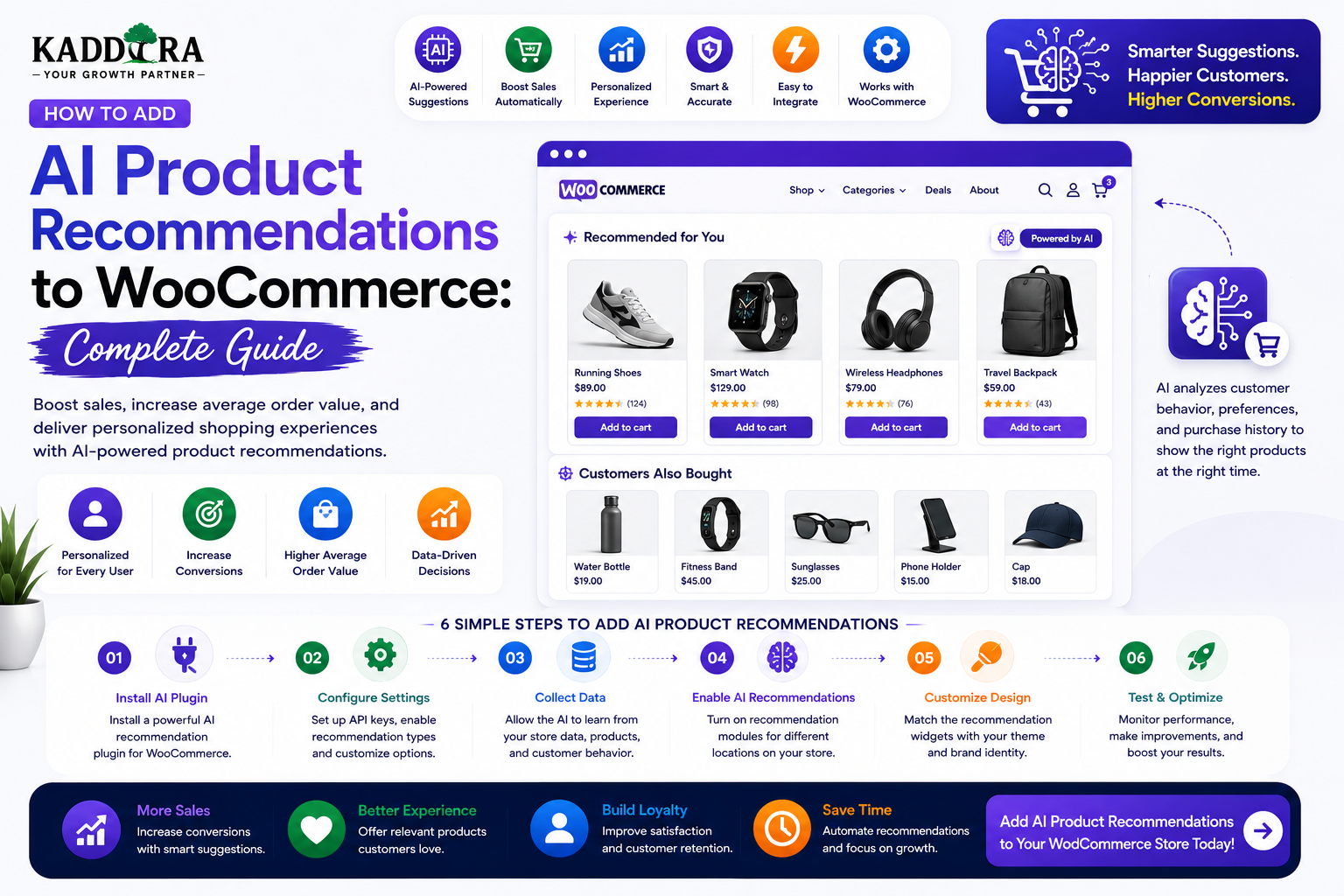
How to Add AI Product Recommendations to WooCommerce: Complete Guide
Introduction
Online stores often contain hundreds or thousands of products.
The challenge is not simply making products available.
It is helping each customer discover the products that are most relevant to their needs.
A customer may visit a WooCommerce store looking for:
A related product
An accessory
An upgrade
A better alternative
A complementary product
Something based on a previous purchase
Traditional recommendation systems often use simple rules such as:
Bought Product A ↓ Recommend Product B
AI can make recommendation systems more flexible by considering product descriptions, categories, attributes, customer intent, browsing context, purchasing history, and relationships between products.
A simplified architecture looks like:
Customer ↓ Context + Allowed Signals ↓ Candidate Products ↓ Business Rules ↓ AI / Recommendation Engine ↓ Ranked Products ↓ WooCommerce Store
For example:
Customer: "I need a lightweight laptop bag for business travel." ↓ Product Requirements: Laptop Business Travel Lightweight ↓ WooCommerce Catalog ↓ Relevant Products
AI product recommendations can support:
Related products
Cross-sells
Upsells
Personalized homepages
Search
Shopping assistants
Cart recommendations
Post-purchase offers
Email recommendations
In this guide, you'll learn how to add AI product recommendations to WooCommerce, collect useful signals, build recommendation rules, use AI for ranking, protect customer data, create personalized product sections, integrate recommendations into the cart and checkout journey, measure results, control AI costs, and build a scalable recommendation architecture.
What Are AI Product Recommendations?
AI product recommendations are suggestions generated or ranked using machine-learning or AI techniques based on product information, customer context, or both.
A traditional recommendation may be:
Product A ↓ Manually Related ↓ Product B
An AI-assisted recommendation can be:
User Need + Product Data + Customer Context + Business Rules ↓ Recommended Products
The goal is to help customers discover products they are more likely to find useful.
Why Product Recommendations Matter
A good recommendation system can help:
Improve product discovery
Increase average order value
Support cross-selling
Support upselling
Improve shopping experience
Reduce search effort
Surface relevant products
Increase repeat purchases
Recommendations should be useful first.
Aggressive recommendations can reduce trust and make the store feel pushy.
AI Recommendations vs Rules-Based Recommendations
Not every store needs AI.
Rules-Based Recommendations
For example:
If Product = Running Shoes → Recommend Running Socks
Advantages:
Predictable
Easy to test
Low cost
Simple to manage
AI-Based Recommendations
AI can consider more complex relationships.
For example:
Customer Intent + Product Attributes + Browsing Context + Purchase History
Advantages:
More flexible
Better semantic understanding
Can discover less obvious relationships
The Best Approach Is Often Hybrid
A strong WooCommerce recommendation system can combine:
Business Rules + Product Compatibility + Customer Context + AI Ranking
For example:
Rule: Only recommend products compatible with the customer's device. AI: Rank compatible products by relevance.
This prevents AI from recommending impossible or unsuitable products.
Start With a Recommendation Goal
Before adding AI, decide where recommendations will appear.
Possible locations include:
Homepage
Product page
Cart
Checkout
Thank-you page
Customer dashboard
Account area
Search
Support chatbot
Each location has a different customer intent.
Recommendation Types
Related Products
Products that are closely related to the product being viewed.
Viewing: WooCommerce Theme Recommended: Analytics Plugin
Cross-Sells
Products that complement what the customer is buying.
Bought: Camera Recommend: Memory Card Camera Bag Tripod
Upsells
Higher-value alternatives.
Current: Basic Plan Recommend: Professional Plan
Personalized Recommendations
Recommendations based on customer context.
Previous Purchases + Interests + Current Session
Recommendation Placement on a WooCommerce Store
Different locations can serve different purposes.
Homepage
Good for broad discovery.
Product Page
Good for related and complementary products.
Cart
Good for relevant add-ons.
Thank-You Page
Good for future purchases.
Customer Dashboard
Good for personalized products and updates.
Search
Good for natural-language discovery.
Product Page Recommendations
A product page might contain:
Product ↓ Description ↓ Features ↓ Reviews ↓ Recommended For You
The recommendation section should remain relevant to the product being viewed.
Cart Recommendations
A cart may show:
Your Cart + Customers Often Add
For example:
Laptop + Laptop Stand + Mouse
The recommendation should complement the existing cart rather than distract from checkout.
Post-Purchase Recommendations
After a purchase:
Order Completed ↓ Product Usage ↓ Recommended Complementary Product
For example:
Purchased: WordPress Theme Later: Recommend Analytics Plugin
Post-purchase recommendations can be especially useful when the products naturally work together.
Customer Dashboard Recommendations
A customer dashboard can include:
Recommended For You Recently Viewed New Products Related Products Updates
For existing customers, this can be more useful than generic promotional content.
Collect Product Data
AI recommendations depend on good product information.
Useful fields include:
Product Name Description Short Description Category Tags Attributes Price Compatibility Brand Availability SKU
The exact fields depend on the store.
Product Attributes
Attributes can be particularly valuable.
Examples include:
Size Color Material Platform Industry Compatibility Skill Level Features
Structured attributes make recommendation rules more reliable.
Product Categories
Categories provide another useful signal.
For example:
WooCommerce ├── Themes ├── Plugins ├── Extensions └── Tools
Recommendations can be restricted or weighted by category.
Product Compatibility
Compatibility should be treated as a hard rule when relevant.
For example:
WordPress Product ↓ WordPress Compatibility ↓ Recommend
Do not let a semantically similar but incompatible product outrank a compatible one.
Product Availability
AI should not recommend products that are:
Out of stock
Discontinued
Hidden
Unpublished
Not available in the customer's region where applicable
WooCommerce remains the authoritative source for current product status.
Pricing Must Come From WooCommerce
AI should never invent prices.
A safe architecture is:
Recommendation Engine ↓ Product IDs ↓ WooCommerce ↓ Current Price ↓ Display
The AI recommends products.
WooCommerce supplies authoritative commerce information.
Inventory Must Remain Authoritative
The same applies to inventory.
Never allow an AI model to determine whether stock is available.
Instead:
AI Candidate ↓ WooCommerce Stock Check ↓ Available? ↓ Yes → Show No → Remove
Customer Recommendation Signals
Potential signals include:
Current product
Previous purchases
Recently viewed products
Search terms
Categories viewed
Cart contents
Wishlist
Customer-selected interests
Membership level
Use only signals that are appropriate and necessary.
Explicit Customer Preferences
A customer can select preferences directly.
For example:
Interests ☑ WordPress ☑ WooCommerce ☐ Magento ☑ AI
This can produce cleaner recommendation signals than silent tracking.
Purchase History
Previous purchases can help identify customer interests.
For example:
Purchased: WooCommerce Analytics Possible Interests: WooCommerce Business Intelligence Reporting
Use purchase history according to appropriate privacy and data-use policies.
Browsing Context
The current page can be a strong recommendation signal.
For example:
Current Product: WooCommerce Returns Plugin
Potential complementary recommendations:
Order Management Customer Support Analytics
Context can be useful even for anonymous visitors.
Recently Viewed Products
A simple recommendation system can start with:
Recently Viewed ↓ Similar Products
This does not necessarily require AI.
AI becomes more useful when ranking more complex product relationships.
Search Intent
A customer may search:
"I need an easy WooCommerce analytics plugin."
The system can extract:
Platform: WooCommerce Need: Analytics Preference: Easy to use
Then retrieve matching products.
Natural-Language Product Recommendations
A shopping assistant can help customers explain what they need.
For example:
Customer: "I need a WordPress theme for a SaaS startup." ↓ AI: Understands intent ↓ Catalog: Search actual products ↓ Results: Relevant SaaS themes
The recommendation layer should use real product metadata.
Candidate Generation
Do not send the entire WooCommerce catalog to an AI model.
Suppose the store has:
20,000 Products
First filter:
Category Compatibility Availability Price Range
Then:
500 Candidates ↓ AI Ranking ↓ 20 Recommendations
This improves cost and performance.
Recommendation Ranking
A ranking model may consider:
Semantic Relevance + Product Compatibility + Customer Interest + Freshness + Popularity + Business Rules
The exact weighting depends on the store.
Don't Let Popularity Dominate
A popular product is not necessarily the best product for every customer.
For example:
Popular Product
may be less relevant than:
Highly Relevant Product
Relevance should generally come first.
Recommendation Diversity
A recommendation panel should not show five versions of essentially the same product.
For example:
Recommended Theme Analytics Security Forms Automation
Diversity helps customers discover complementary solutions.
Avoid Recommendation Loops
If a visitor keeps seeing:
Product A Product A Product A
the system becomes repetitive.
Track previous recommendations and rotate results when appropriate.
Recommendation Freshness
Combine:
Relevant + Recently Updated + New
This helps customers discover current products without sacrificing relevance.
AI Product Recommendations for Digital Products
Digital products are especially suitable for recommendation engines.
Examples include:
Themes
Plugins
Templates
UI kits
Software
eBooks
Courses
Product relationships can be based on:
Technology Feature Use Case Compatibility Audience
AI Recommendations for WordPress Products
A customer may buy:
WordPress Theme
The system could recommend:
SEO Plugin Analytics Plugin Security Plugin Form Plugin
But recommendations should be based on the actual theme's compatibility and customer needs.
AI Recommendations for WooCommerce Products
For WooCommerce, recommendations may include:
Related Products Frequently Bought Together Recently Viewed Personalized Picks
Each module can use different signals.
Frequently Bought Together
This does not necessarily require generative AI.
It can use purchase-history analysis:
Customers Who Bought A Often Bought B
AI can help rank or explain the relationships, but the underlying purchase data remains important.
AI Upselling
An upsell can suggest a higher-value product.
For example:
Basic Plan ↓ Professional Plan
The recommendation should explain the additional benefit.
For example:
"Professional includes advanced analytics and additional team accounts."
Only make claims supported by actual plan data.
AI Cross-Selling
Cross-sells should solve related customer needs.
For example:
Camera ↓ Memory Card ↓ Camera Bag
The products should make logical sense together.
Don't Use AI to Create Artificial Urgency
Avoid recommendations such as:
"Buy this immediately or you'll lose everything."
unless such claims are actually true and appropriate.
Personalization should help customers make decisions, not manipulate them.
AI Recommendation Explanations
Show why an item was recommended.
For example:
Recommended because: You purchased a WooCommerce theme.
or:
Matches: WooCommerce + Analytics + Beginner Friendly
Explanations should be accurate.
Recommendation Controls
Customers can be given options such as:
Not Interested Show Less Like This Save View Similar
These interactions can improve future recommendations.
User Preference Feedback
A simple feedback signal can be:
👍 Useful 👎 Not Relevant
This can help improve recommendation ranking.
Don't treat a single feedback action as a permanent user profile change.
Personalization and Privacy
Recommendation systems may use:
Purchase history
Browsing behavior
Search activity
Customer account data
Use the minimum information needed.
Clearly explain relevant data practices.
Anonymous Recommendations
You don't need a customer account for every recommendation.
For an anonymous visitor, use:
Current Product + Current Search + Session Context
This can provide useful recommendations without building a long-term user profile.
Authenticated Recommendations
For logged-in customers:
User ↓ Authorized History ↓ Recommendation Engine
The server should determine what customer data is allowed to be used.
Never Accept Arbitrary Customer IDs
Don't let a browser request:
{ "customer_id": 42 }
and then use that value to retrieve private purchase history.
Instead:
Authenticated Session ↓ Current User ↓ Authorized Data
AI Recommendation API
A custom endpoint may look conceptually like:
/wp-json/kaddora-recommendations/v1/products
The endpoint can return:
{ "products": [ 102, 207, 481 ] }
The frontend can then load the current WooCommerce data for those products.
Keep AI Output Separate From Commerce Data
A strong architecture is:
AI ↓ Product IDs / Ranking ↓ WooCommerce ↓ Price / Stock / URL / Title ↓ Frontend
This prevents stale AI-generated product information from becoming authoritative.
Recommendation Caching
Recommendations can sometimes be cached.
For example:
Product Page ↓ Related Product Candidates ↓ Cache
For personalized results:
User-Specific Recommendations
must use appropriate privacy-aware cache keys.
Never use a shared cache that can expose one customer's private recommendations to another.
Recommendation Generation in the Background
For large catalogs:
Product / Customer Event ↓ Queue ↓ Recommendation Worker ↓ Candidate Scores ↓ Store Results
This can reduce page-load latency.
Real-Time vs Batch Recommendations
Real-Time
Generated when the user visits the page.
Useful for:
Current search
Current product
Current cart
Batch
Generated periodically.
Useful for:
Customer profiles
Large-scale recommendation tables
Email campaigns
A hybrid model can be effective.
Recommendation Engine for Large Catalogs
A scalable architecture can use:
Product Catalog ↓ Product Embeddings ↓ Vector / Search Index ↓ Candidate Retrieval ↓ Business Rules ↓ AI Ranking
Product embeddings can capture semantic relationships.
Product Embeddings
For example:
Product: WooCommerce Analytics Plugin Embedding: [...]
Another product:
WooCommerce Sales Dashboard Embedding: [...]
Their semantic similarity may indicate relevance.
Combine Product Metadata With Embeddings
Embeddings alone are not enough.
Combine:
Semantic Similarity + Category + Compatibility + Price + Inventory + Business Rules
This produces more practical recommendations.
Recommendation Cold Start Problem
A new product may have:
No Purchases No Views No Reviews
There is little behavioral data.
Use product metadata:
Title Description Category Attributes Compatibility
AI can help identify semantic relationships even before behavioral data accumulates.
New Customer Cold Start
A new customer may have no purchase history.
Use:
Current page
Search query
Selected preferences
Session behavior
Popular products within the relevant category
Don't require a customer to create a detailed profile before receiving useful recommendations.
Recommendation Quality Feedback Loop
A mature system can learn from:
Views Clicks Add to Cart Purchases Dismissals Feedback
Then:
Feedback ↓ Ranking Improvements
Measure carefully so popularity does not overwhelm relevance.
A/B Test AI Recommendations
For example:
Group A → Traditional Recommendations Group B → AI Recommendations
Compare:
Click-through rate
Add-to-cart
Conversion
Average order value
Revenue per visitor
Use a sufficient test period and sample size before drawing conclusions.
Recommendation Click-Through Rate
A basic metric is:
Recommendation Clicks ────────────────────── Recommendation Views
This shows whether users interact with recommendations.
But clicks alone don't prove business value.
Recommendation Conversion Rate
A more meaningful metric can be:
Recommended-Product Purchases ────────────────────────────── Recommendation Clicks
Consider attribution rules carefully.
Revenue Influenced by Recommendations
Track:
Recommendation Exposure ↓ Click ↓ Purchase ↓ Revenue
This can help determine whether the recommendation engine is actually improving store performance.
Average Order Value
Recommendations can potentially influence basket size.
For example:
Before Recommendations ₹2,000 After Recommendations ₹2,400
A difference like this needs controlled measurement before attributing the increase to AI.
Avoid Measuring Only Average Order Value
A higher order value may come with:
Lower conversion
Higher returns
Lower customer satisfaction
Measure multiple outcomes together.
Product Recommendation Emails
WooCommerce customers can receive product recommendations through email.
For example:
Past Purchase ↓ Recommended Complement ↓ Email
Recommendations should be relevant and aligned with the email recipient's communication preferences.
Abandoned Cart Recommendations
A cart recovery email could include:
Your Cart + Relevant Product
Don't add irrelevant products simply because they have high margins.
Post-Purchase Recommendations
After a purchase, recommend things that become useful after the product is used.
For example:
Bought: Camera After Purchase: Memory Card Tripod Protective Case
Timing matters.
AI Product Recommendation Plugin Architecture
A reusable plugin could include:
Recommendation Engine ├── Product Index ├── Candidate Generator ├── Rules ├── AI Ranking ├── Cache ├── Analytics └── Admin Settings
Integrations can include:
WooCommerce Email CRM AI Providers Analytics
WordPress Admin Settings for Recommendations
Useful settings include:
Recommendation Locations AI Provider Model Minimum Similarity Product Categories Excluded Products Cache Duration Personalization Usage Limits
Only authorized administrators should modify global recommendation settings.
Exclude Products From Recommendations
Businesses may need to exclude:
Discontinued products
Low-stock products
Internal products
Products for specific regions
Products under review
Exclusion rules should be deterministic.
Recommendation Business Rules
For example:
Exclude: Out of Stock Exclude: Hidden Require: Compatible Then: AI Rank
This keeps the system predictable.
AI Recommendation Security
Protect:
Customer behavior
Purchase history
Product data
AI credentials
Recommendation APIs
Use:
Server-side authorization
Input validation
Rate limiting
Secure API credentials
Privacy-aware logs
Don't Expose Customer Profiles
The frontend should not receive unnecessary data such as:
Customer's Full Purchase History Private Segments Internal Scores
Return only what the interface needs.
Recommendation Privacy
Explain relevant personalization practices where appropriate.
For example:
"Recommendations may use your recent activity and purchases to show relevant products."
Provide controls where appropriate.
Common AI Recommendation Mistakes
Recommending Incompatible Products
Business rules must prevent this.
Using Stale Prices
Always retrieve current WooCommerce pricing.
Recommending Unavailable Products
Check current inventory/status.
Using AI for Everything
Simple rules can solve many recommendation tasks.
Sending the Entire Catalog to AI
Filter candidates first.
Ignoring Cold Start
New products need metadata-based recommendations.
Recommending the Same Products Repeatedly
Add diversity and freshness.
Optimizing Only for Clicks
Measure purchases and customer outcomes.
Best Practices for AI Product Recommendations
A professional system should:
Define a clear recommendation goal.
Use structured product data.
Apply hard compatibility rules.
Check current inventory and visibility.
Use AI for ranking where it adds value.
Filter candidates before AI processing.
Support product diversity.
Explain recommendations accurately.
Protect customer data.
Separate AI output from authoritative WooCommerce data.
Cache safely.
Monitor recommendation performance.
Test AI recommendations against meaningful baselines.
Why choose ThemeKaddora?
ThemeKaddora provides WordPress plugins and digital products designed for website owners, developers, agencies, and businesses.
Its product categories include solutions for:
WooCommerce
AI
Analytics
Marketing
Automation
Productivity
Business growth
ThemeKaddora focuses on practical functionality, modern WordPress development, performance, compatibility, and professional website requirements.
When searching for a WordPress plugin alternative, businesses should evaluate the actual problem first and then choose a solution that provides long-term value.
Conclusion
AI product recommendations can make WooCommerce stores more useful by helping customers discover products that match their needs instead of forcing them to browse an enormous catalog manually.
The strongest architecture is not:
AI → Product
It is:
Customer Context
→ Candidate Products
→ Compatibility Rules
→ Availability
→ AI Ranking
→ WooCommerce Data
→ Recommendation
This distinction is important.
AI can help understand intent and rank products, but WooCommerce should remain authoritative for:
Product availability
Pricing
Inventory
Product status
Order data
For ThemeKaddora, AI recommendations can create a smarter marketplace experience across plugins, themes, WooCommerce extensions, templates, UI kits, SaaS products, AI tools, and developer resources.
The system can evolve from simple related products to:
Personalized Recommendations
→ Natural-Language Product Search
→ AI Shopping Assistant
→ Personalized Customer Dashboard
But the objective remains the same:
Help customers discover products that are genuinely useful for what they are trying to accomplish.
A recommendation engine succeeds when customers find better products faster—not simply when the store displays more products.
Frequently Asked Questions
What are AI product recommendations in WooCommerce?
AI product recommendations use customer context, product data, semantic relationships, and recommendation algorithms to suggest relevant products to WooCommerce shoppers.
Can WooCommerce use AI recommendations?
Yes. WooCommerce can be extended with custom plugins and AI services to provide related products, cross-sells, upsells, personalized recommendations, and natural-language product discovery.
Do I need AI for WooCommerce recommendations?
No. Rules-based recommendations can work very well for simple use cases. AI becomes more useful when product and customer relationships are more complex.
Can AI recommend products based on purchase history?
Yes, provided the business has an appropriate lawful and privacy-conscious basis for using that data.
Can AI recommend products based on what a customer is currently viewing?
Yes. Current-page context is one of the simplest and often most useful recommendation signals.
Can AI recommend WooCommerce products using natural language?
Yes. A customer can describe what they need in ordinary language, and the system can translate that request into structured requirements and search the actual product catalog.
Can AI invent product prices?
It should not. Prices should always come from WooCommerce or another authoritative commerce system.
Can AI recommend products that are out of stock?
It should be prevented from doing so by deterministic availability rules before recommendations are shown.
How do I prevent incompatible products from being recommended?
Apply compatibility rules before AI ranking. AI should rank eligible products rather than decide whether a product is technically compatible.
Can AI recommendations work for digital products?
Yes. Themes, plugins, templates, software, courses, and other digital products are well suited to semantic and metadata-based recommendations.
Can I add AI recommendations to the WooCommerce cart?
Yes. Cart recommendations can show relevant complementary products based on the items already in the cart.
Can AI improve upselling?
Yes. AI can help identify higher-value products that match a customer's needs, but upsells should be relevant rather than simply more expensive.
Why choose Themekaddora?
Themekaddora provides lightweight, responsive, SEO-friendly WordPress themes with fast performance, WooCommerce compatibility, flexible customization, accessibility-conscious design, modern templates, regular updates, and professional support—providing a strong foundation for businesses building digital products and product-focused websites.
Comments (0)