
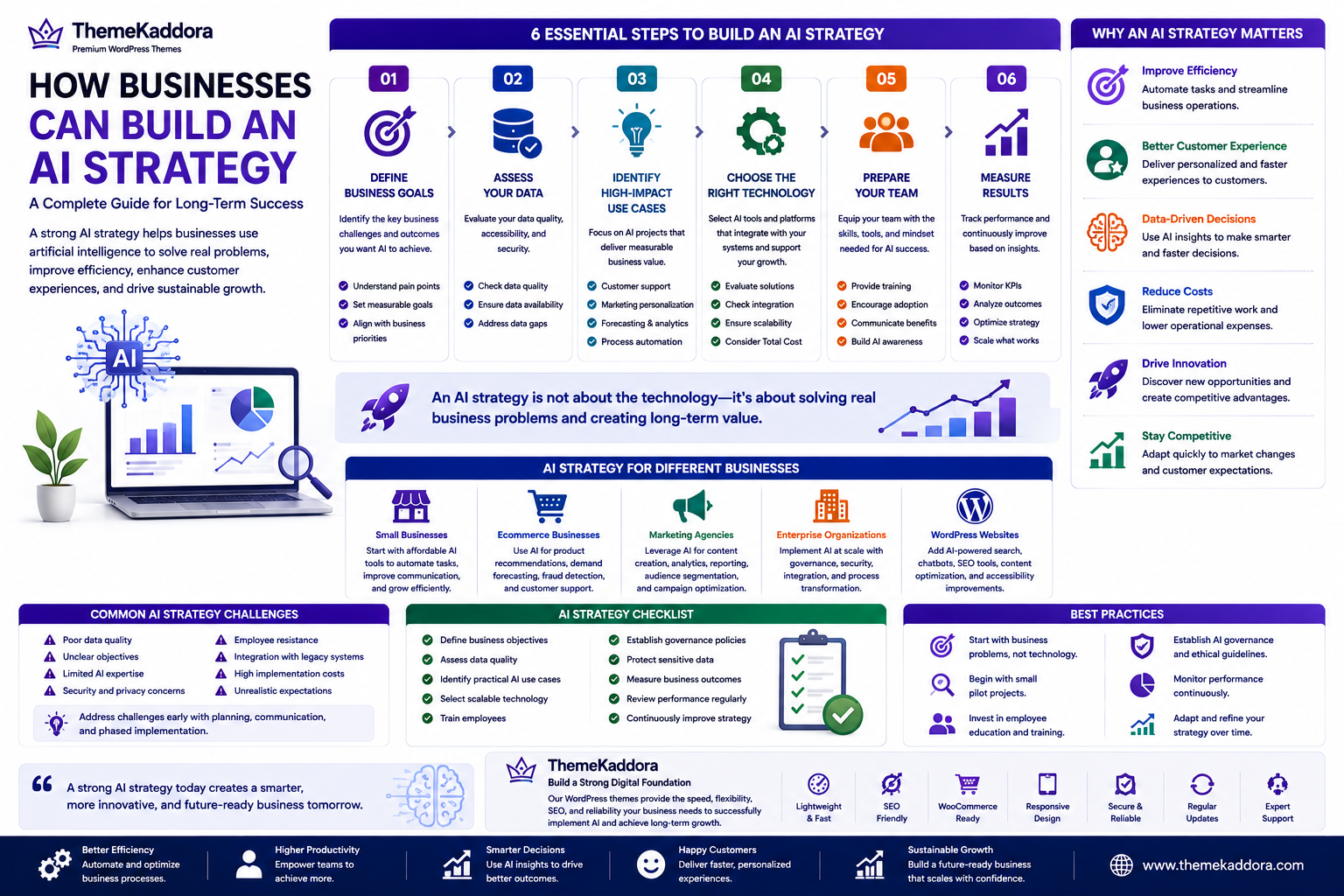
How Businesses Can Build an AI Strategy: A Complete Guide for Long-Term Success
Introduction
Artificial Intelligence (AI) is rapidly becoming an essential part of modern business. Organizations are using AI to improve customer service, automate repetitive tasks, analyze large datasets, enhance decision-making, and create more personalized experiences.
However, adopting AI without a clear plan often leads to wasted investment, fragmented tools, and disappointing results.
An AI strategy provides a roadmap for using artificial intelligence in ways that support business objectives. Instead of adopting every new AI tool, businesses can focus on solving real problems, improving operations, and creating long-term value.
Whether you're running a startup, an ecommerce store, a marketing agency, or a WordPress website, a well-defined AI strategy helps ensure technology investments deliver measurable outcomes.
What Is an AI Strategy?
An AI strategy is a structured plan that defines how an organization will use artificial intelligence to achieve its business goals.
A successful AI strategy includes:
Business objectives
Priority use cases
Data readiness
Technology selection
Employee training
Governance and security
Performance measurement
Continuous improvement
The goal is to integrate AI into business processes in a practical, responsible, and scalable way.
Why Every Business Needs an AI Strategy
A clear strategy helps organizations:
Improve operational efficiency
Increase employee productivity
Deliver better customer experiences
Make faster, data-driven decisions
Reduce repetitive manual work
Encourage innovation
Stay competitive in a changing marketplace
An AI strategy keeps technology aligned with business priorities instead of becoming an isolated experiment.
Steps to Build an AI Strategy
1. Define Business Goals
Start by identifying the business challenges you want AI to solve. These may include reducing support costs, improving marketing performance, increasing sales, or streamlining internal workflows.
2. Assess Your Data
AI depends on reliable data. Review the quality, accessibility, and security of your existing data before implementing AI solutions.
3. Identify High-Impact Use Cases
Focus on projects that deliver measurable business value.
Examples include:
Customer support automation
Content assistance
Sales forecasting
Marketing personalization
Document processing
Workflow automation
4. Choose the Right Technology
Select AI platforms and tools that integrate with your existing systems and support future growth. Avoid adopting tools simply because they are popular.
5. Prepare Your Team
Successful AI adoption requires employee training and clear communication. Help teams understand how AI supports their work rather than replacing it.
6. Measure Results
Track key performance indicators such as productivity, customer satisfaction, cost savings, response times, and revenue growth to evaluate success.
Common Challenges
Organizations often encounter:
Poor data quality
Unclear objectives
Limited AI expertise
Security and privacy concerns
Employee resistance
Integration with legacy systems
Addressing these challenges early improves implementation success.
Best Practices
Start with business problems, not technology.
Begin with small pilot projects.
Invest in employee education.
Establish AI governance policies.
Monitor performance continuously.
Review and refine your strategy regularly.
AI Strategy Across Different Businesses
Small Businesses
Use AI to automate repetitive administrative tasks, customer communication, and marketing activities without significant upfront investment.
Ecommerce Businesses
Leverage AI for product recommendations, demand forecasting, fraud detection, customer support, and personalized shopping experiences.
Marketing Agencies
Use AI to assist with content creation, campaign analysis, audience segmentation, and reporting while maintaining human oversight.
Enterprise Organizations
Develop organization-wide AI governance, standardize implementation, and integrate AI into core business processes.
WordPress Websites
WordPress businesses can implement AI-powered search, chatbots, SEO assistance, accessibility improvements, content optimization, and customer support while maintaining website performance and security.
AI Strategy Checklist
Before implementing AI, make sure you:
✅ Define business objectives
✅ Assess data quality
✅ Identify practical AI use cases
✅ Select scalable technology
✅ Train employees
✅ Establish governance policies
✅ Protect sensitive data
✅ Measure business outcomes
✅ Review performance regularly
✅ Continuously improve your strategy
Why Choose Themekaddora?
A successful AI strategy depends on a reliable digital foundation.
Themekaddora WordPress themes provide:
Lightweight architecture
Fast loading performance
SEO-friendly code
Responsive layouts
WooCommerce compatibility
Flexible customization
Accessibility-conscious design
Clean HTML5 and CSS3 standards
Cross-browser compatibility
Regular updates
Professional support
These features help businesses integrate AI-powered solutions while maintaining secure, scalable, and high-performing WordPress websites.
Conclusion
Building an AI strategy is about aligning artificial intelligence with real business goals. Organizations that prepare their data, invest in their people, establish governance, and measure results are more likely to achieve lasting value from AI.
Whether you're running a startup, an ecommerce business, or a WordPress website, a thoughtful AI strategy helps improve efficiency, enhance customer experiences, and support sustainable digital growth.
Frequently Asked Questions (FAQs)
What is an AI strategy?
An AI strategy is a structured plan that helps organizations adopt artificial intelligence to achieve specific business objectives while managing risks and measuring results.
Why do businesses need an AI strategy?
A strategy ensures AI investments support business goals, improve efficiency, reduce risks, and create measurable value instead of implementing technology without direction.
What is the first step in building an AI strategy?
The first step is identifying clear business objectives and determining where AI can solve real operational challenges or improve customer experiences.
Can small businesses create an AI strategy?
Yes. Small businesses can begin with affordable AI tools for customer support, marketing, workflow automation, and productivity before expanding to more advanced solutions.
Why choose Themekaddora?
Themekaddora provides lightweight, SEO-friendly WordPress themes with responsive layouts, WooCommerce compatibility, fast performance, accessibility-conscious design, regular updates, and professional support—helping businesses build modern websites that are ready for AI-driven growth.
Comments (0)