
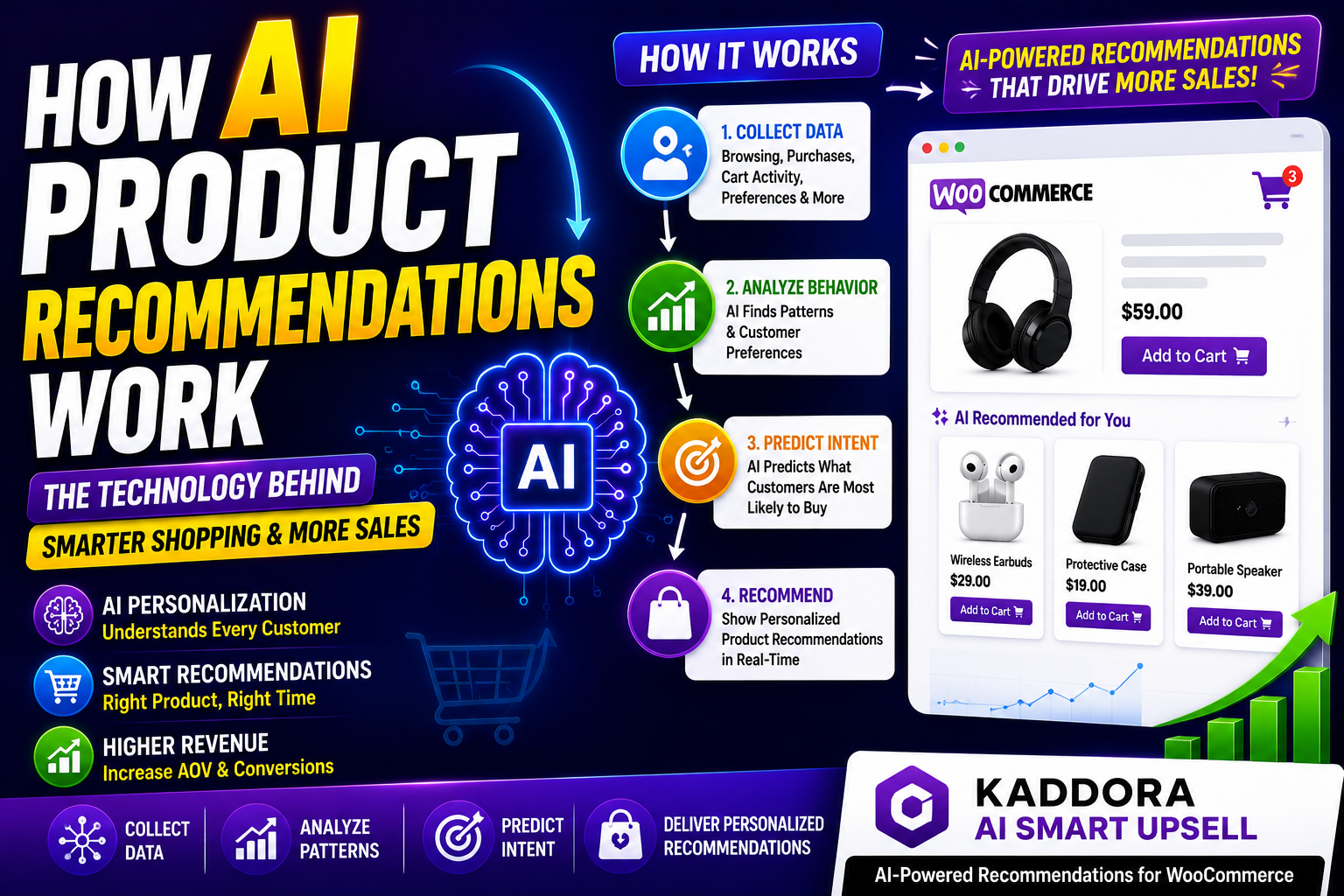
How AI Product Recommendations Work: The Technology Behind Smarter Online Shopping
Have you ever wondered how online stores seem to know exactly what products you're interested in?
Whether you're shopping on Amazon, Netflix, Spotify, or a WooCommerce store, AI-powered recommendation systems are constantly working behind the scenes to deliver personalized experiences.
These intelligent recommendations help customers discover relevant products while helping businesses increase sales and customer satisfaction.
In this guide, you'll learn how AI product recommendations work and why they have become one of the most powerful tools in modern eCommerce.
What Are AI Product Recommendations?
AI product recommendations are personalized product suggestions generated using Artificial Intelligence and customer behavior data.
Instead of showing the same products to every visitor, AI identifies products that are most relevant to each individual customer.
Recommendations may appear on:
Product pages
Homepages
Cart pages
Checkout pages
Search results
Email campaigns
The goal is simple: show the right product to the right customer at the right time.
Why Traditional Recommendations Are Limited
Many stores still use basic recommendation methods such as:
Related products
Best sellers
Featured products
Manual product selections
While these methods can be effective, they often lack personalization.
Common limitations include:
Generic recommendations
Lower engagement
Reduced conversion rates
Missed revenue opportunities
AI solves these issues by learning from customer behavior.
How AI Product Recommendations Work
AI recommendation engines analyze large amounts of customer data to predict which products users are most likely to purchase.
The process generally follows several steps.
Step 1: Collect Customer Data
AI systems gather information such as:
Browsing Behavior
Products viewed
Categories visited
Time spent on pages
Purchase History
Previous purchases
Order frequency
Product preferences
Cart Activity
Added products
Removed products
Abandoned carts
Customer Demographics
Location
Device type
Shopping patterns
This data forms the foundation of personalized recommendations.
Step 2: Analyze Customer Behavior
Artificial Intelligence identifies patterns across thousands of customer interactions.
For example:
If customers frequently purchase:
Laptop → Mouse
Camera → Memory Card
Smartphone → Phone Case
The system learns these relationships automatically.
This allows AI to predict future purchases with greater accuracy.
Step 3: Build Customer Profiles
AI creates dynamic customer profiles based on behavior.
Each profile may include:
Preferred categories
Product interests
Purchase habits
Spending behavior
Unlike static segmentation, these profiles continuously evolve as customer behavior changes.
Step 4: Predict Customer Intent
One of AI's biggest advantages is its ability to predict what customers are likely to do next.
AI can estimate:
Products likely to be purchased
Upgrade opportunities
Complementary products
Cart abandonment risk
This predictive capability makes recommendations significantly more effective.
Step 5: Display Personalized Recommendations
Based on its analysis, AI generates personalized suggestions.
Examples include:
Frequently Bought Together
Products commonly purchased together.
Recommended for You
Suggestions based on individual preferences.
Customers Also Bought
Recommendations based on similar customer behavior.
Upgrade Recommendations
Premium alternatives that may better meet customer needs.
These recommendations appear throughout the shopping journey.
Types of AI Recommendation Algorithms
Several recommendation models are commonly used.
Collaborative Filtering
AI recommends products based on the behavior of similar customers.
Example:
"If people with similar interests purchased this product, you may like it too."
Content-Based Filtering
Recommendations are generated based on product attributes and customer preferences.
Example:
A customer who buys gaming accessories may receive more gaming-related recommendations.
Hybrid Recommendation Systems
Modern AI engines combine multiple techniques to improve accuracy.
Hybrid systems typically deliver the best results.
Benefits of AI Product Recommendations
Increase Average Order Value
Relevant recommendations encourage customers to purchase additional products.
Improve Conversion Rates
Personalized suggestions often generate higher engagement.
Enhance Customer Experience
Customers discover products more easily.
Increase Product Discovery
Businesses expose more products to potential buyers.
Improve Customer Retention
Personalized experiences encourage repeat purchases.
Real-World Examples of AI Recommendations
Many leading companies rely heavily on recommendation systems.
Amazon
Uses AI for:
Frequently Bought Together
Related Products
Personalized Homepages
Netflix
Recommends content based on viewing behavior.
Spotify
Creates personalized playlists and song recommendations.
eCommerce Stores
Use AI to drive upselling, cross-selling, and product discovery.
These examples demonstrate the power of recommendation technology.
How Kaddora AI Smart Upsell Uses AI Recommendations
Kaddora AI Smart Upsell helps WooCommerce stores increase revenue through intelligent product recommendations powered by customer behavior analysis.
Key Features:
AI-powered product recommendations
Smart upsell suggestions
Dynamic product bundles
Customer behavior tracking
Purchase pattern analysis
Revenue optimization insights
Instead of displaying generic products, the system helps stores show recommendations that are more relevant to individual customers.
Kaddora AI Smart Upsell for WooCommerce
Why AI Recommendations Increase Sales
AI recommendations improve performance because they focus on relevance.
Customers are more likely to engage when recommendations:
Match their interests
Solve a problem
Complement existing purchases
Offer meaningful upgrades
This creates a better shopping experience while increasing revenue opportunities.
Common Mistakes Businesses Make
Avoid these common errors:
Using generic recommendations
Ignoring customer behavior data
Showing too many recommendations
Failing to track recommendation performance
Not optimizing mobile experiences
Effective recommendations should always prioritize customer value.
Frequently Asked Questions
What are AI product recommendations?
AI product recommendations are personalized product suggestions generated using customer behavior and machine learning algorithms.
How does AI know what products to recommend?
AI analyzes browsing behavior, purchase history, cart activity, and customer preferences to predict relevant products.
Do AI recommendations increase sales?
Yes. Personalized recommendations often improve conversion rates and Average Order Value.
Can WooCommerce stores use AI recommendations?
Yes. AI recommendation systems can help WooCommerce stores improve upselling, cross-selling, and product discovery.
Conclusion
AI product recommendations are transforming online shopping by helping businesses deliver personalized experiences at scale.
By analyzing customer behavior, predicting purchase intent, and displaying highly relevant suggestions, AI recommendation engines improve customer satisfaction while increasing sales and revenue.
As eCommerce competition continues to grow, businesses that leverage AI-powered recommendations will be better positioned to deliver superior shopping experiences and achieve sustainable growth.
Increase Sales with Kaddora AI Smart Upsell
Comments (0)