
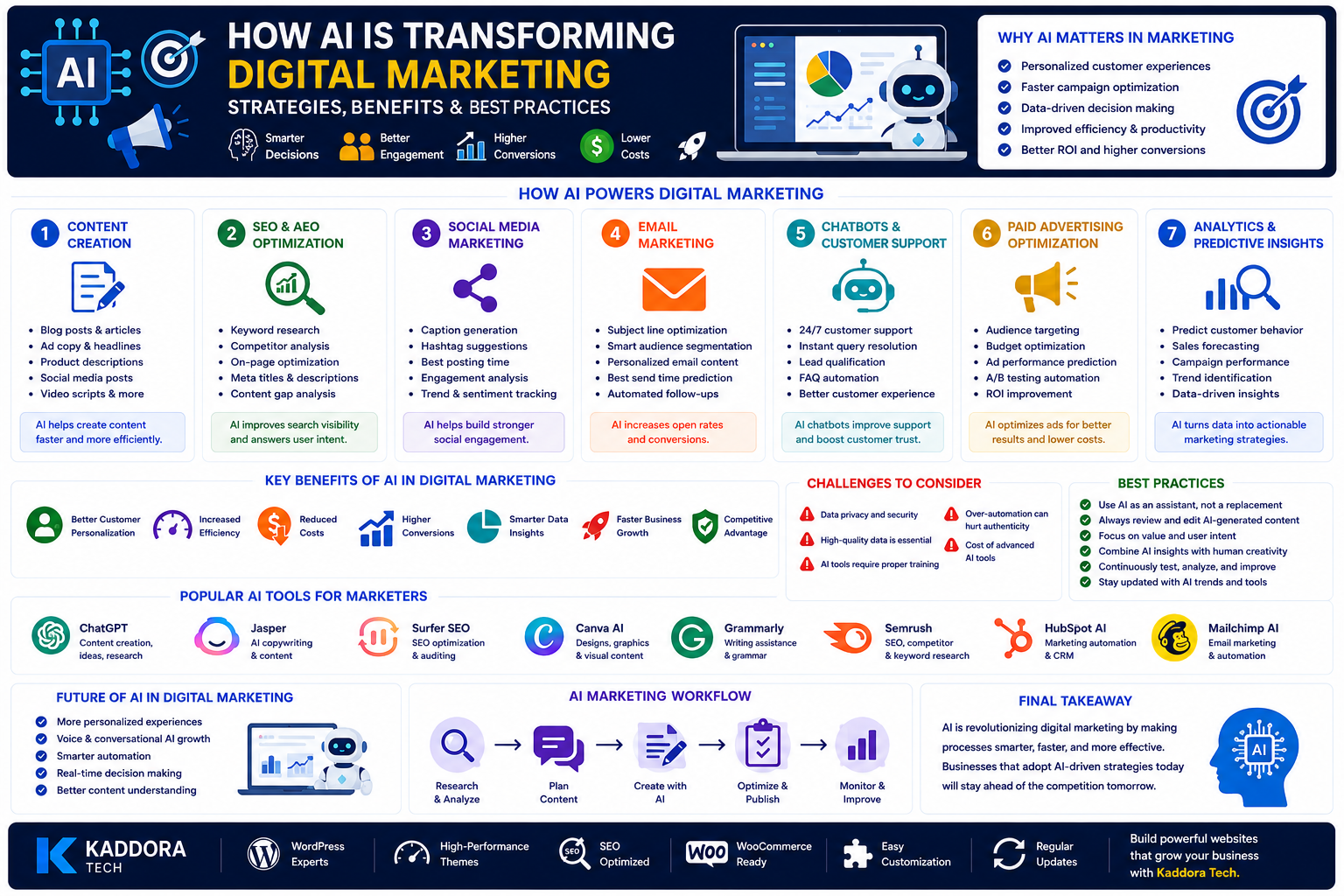
How AI Is Transforming Digital Marketing: Strategies, Benefits & Best Practices
Introduction
Artificial Intelligence (AI) has become one of the biggest driving forces behind modern digital marketing. Businesses are no longer relying solely on traditional marketing strategies. Instead, they are using AI-powered tools to automate repetitive tasks, understand customer behavior, create personalized experiences, and make smarter marketing decisions.
From generating high-quality content to optimizing advertising campaigns and predicting customer preferences, AI is helping businesses of every size improve efficiency and achieve better results.
Whether you're a business owner, digital marketer, freelancer, or entrepreneur, understanding how AI is transforming digital marketing can help you stay competitive and build more effective marketing strategies.
In this comprehensive guide, we'll explore how AI works in digital marketing, its benefits, real-world applications, challenges, and best practices for using AI successfully.
What Is AI in Digital Marketing?
AI in digital marketing refers to the use of Artificial Intelligence technologies to automate, optimize, and improve marketing activities.
Instead of relying only on manual work, AI can analyze massive amounts of customer data, recognize patterns, predict future behavior, and recommend the best marketing actions.
Modern AI marketing combines several technologies, including:
Machine Learning
Natural Language Processing (NLP)
Predictive Analytics
Computer Vision
Generative AI
These technologies help marketers make data-driven decisions while delivering better customer experiences.
Why AI Matters in Digital Marketing
Consumer expectations continue to grow. People expect brands to deliver personalized, relevant, and timely experiences across websites, email, social media, and mobile apps.
AI makes this possible by processing vast amounts of information much faster than humans.
Some major benefits include:
Better customer engagement
Personalized marketing
Faster campaign optimization
Higher conversion rates
Reduced operational costs
Smarter audience targeting
Improved productivity
Better return on investment (ROI)
Businesses that effectively use AI often gain a competitive advantage by responding more quickly to customer needs and market trends.
AI-Powered Content Creation
Creating valuable content consistently can be time-consuming. AI-powered writing tools help marketers produce blogs, product descriptions, email campaigns, social media posts, and advertising copy more efficiently.
AI can assist with:
Blog article generation
Product descriptions
Website copy
Email campaigns
Video scripts
Ad copy
Social media captions
Content ideas
While AI speeds up content production, human review is still essential to ensure originality, factual accuracy, and brand consistency.
AI for Search Engine Optimization (SEO)
Search engine optimization requires continuous research, analysis, and optimization. AI simplifies many of these tasks by providing intelligent recommendations based on data.
AI can help marketers:
Discover keyword opportunities
Analyze competitors
Optimize page structure
Generate SEO-friendly meta titles and descriptions
Improve internal linking
Identify content gaps
Understand user search intent
By combining AI insights with proven SEO techniques, businesses can improve their search visibility and attract more organic traffic.
AI and Answer Engine Optimization (AEO)
As AI-powered search assistants become increasingly popular, Answer Engine Optimization (AEO) is becoming just as important as traditional SEO.
AI helps marketers create content that directly answers user questions, increasing the chances of appearing in featured snippets and AI-generated search responses.
To optimize for AEO:
Write clear, direct answers
Use descriptive headings
Include FAQ sections
Organize content logically
Use conversational language
This approach helps improve visibility across both traditional search engines and AI-driven search experiences.
AI in Social Media Marketing
Managing multiple social media platforms requires creativity and consistency. AI makes this easier by helping businesses create content, schedule posts, analyze engagement, and identify trends.
AI-powered social media tools can:
Generate captions
Recommend hashtags
Suggest posting schedules
Analyze audience behavior
Monitor brand mentions
Measure campaign performance
These insights help marketers build stronger relationships with their audiences while saving valuable time.
AI Email Marketing
Email marketing continues to deliver one of the highest returns on investment in digital marketing. AI enhances email campaigns by analyzing subscriber behavior and delivering highly personalized messages.
AI helps marketers:
Optimize subject lines
Segment audiences
Personalize email content
Recommend products
Predict the best sending times
Automate follow-up sequences
Personalized emails often result in higher open rates, click-through rates, and conversions.
AI Chatbots and Customer Support
AI-powered chatbots provide instant customer support around the clock. They can answer common questions, recommend products, collect leads, and assist customers throughout the buying journey.
Common chatbot capabilities include:
Answering FAQs
Booking appointments
Product recommendations
Order tracking
Lead generation
Customer support
When combined with human support teams, AI chatbots improve customer satisfaction while reducing operational costs.
AI-Powered Advertising
Digital advertising platforms increasingly rely on AI to optimize campaigns and maximize advertising performance.
AI helps advertisers:
Target the right audience
Optimize bidding strategies
Personalize advertisements
Predict campaign success
Reduce advertising costs
Increase conversion rates
These capabilities enable businesses to achieve better results from their advertising budgets.
AI Analytics and Customer Insights
Successful marketing depends on understanding customer behavior. AI analyzes data from websites, social media, email campaigns, and online stores to identify valuable insights.
Businesses use AI analytics to:
Identify customer preferences
Predict purchasing behavior
Measure campaign effectiveness
Discover emerging trends
Improve marketing strategies
Data-driven decisions help marketers allocate resources more effectively and improve campaign performance.
AI Personalization
Today's customers expect personalized experiences. AI enables businesses to deliver relevant content based on each user's interests, behavior, and preferences.
Examples include:
Personalized product recommendations
Dynamic website content
Customized email campaigns
Personalized search results
Targeted advertising
Personalization improves customer satisfaction, increases engagement, and encourages repeat purchases.
AI for Lead Generation
Finding qualified leads is one of the biggest challenges for businesses. AI improves lead generation by identifying potential customers based on their online behavior and likelihood to convert.
AI can:
Score leads
Identify buying intent
Automate follow-up emails
Recommend communication channels
Prioritize high-value prospects
These capabilities allow sales teams to focus on the most promising opportunities.
AI in eCommerce Marketing
Online retailers increasingly rely on AI to improve shopping experiences and increase sales.
Popular applications include:
Product recommendations
Dynamic pricing
Inventory forecasting
Customer segmentation
Personalized promotions
Automated customer support
These features help businesses create more engaging shopping experiences while improving operational efficiency.
Popular AI Marketing Tools
Businesses use various AI-powered tools to improve marketing productivity.
Popular categories include:
AI writing assistants
SEO optimization tools
Email marketing platforms
Marketing automation software
CRM systems
Analytics platforms
Chatbot solutions
Choosing the right tools depends on your business objectives, budget, and marketing strategy.
Challenges of AI in Digital Marketing
Despite its many advantages, AI also presents several challenges.
These include:
Data privacy concerns
Algorithm bias
Dependence on quality data
Initial implementation costs
Need for human oversight
Ethical considerations
Using AI responsibly helps businesses maximize benefits while minimizing potential risks.
Best Practices for Using AI in Digital Marketing
To get the most value from AI, businesses should:
Use AI to support—not replace—human creativity.
Regularly review AI-generated content for accuracy.
Protect customer data and privacy.
Monitor campaign performance continuously.
Combine AI insights with strategic decision-making.
Stay updated on new AI technologies and trends.
A balanced approach ensures AI enhances marketing efforts while maintaining authenticity and trust.
The Future of AI in Digital Marketing
Artificial Intelligence will continue to reshape digital marketing through smarter automation, predictive analytics, and increasingly personalized customer experiences.
Future developments are expected to include:
More conversational AI assistants
Advanced predictive marketing
Smarter recommendation systems
Voice and visual search optimization
Hyper-personalized customer journeys
Greater integration across marketing platforms
Businesses that adopt AI thoughtfully and strategically will be better positioned for long-term success.
Conclusion
Artificial Intelligence has transformed digital marketing from a manual process into a smarter, data-driven discipline. Whether it's creating content, improving SEO, managing advertising campaigns, analyzing customer behavior, or delivering personalized experiences, AI helps businesses work more efficiently while achieving better results.
Rather than replacing marketers, AI acts as a powerful assistant that enhances creativity, automates repetitive tasks, and supports informed decision-making. By embracing AI responsibly, businesses can strengthen their marketing strategies, improve customer engagement, and drive sustainable growth.
Frequently Asked Questions
What is AI in digital marketing?
AI in digital marketing refers to using Artificial Intelligence technologies to automate, optimize, and improve marketing activities such as SEO, content creation, email marketing, advertising, and customer support.
How does AI improve SEO?
AI helps identify keyword opportunities, optimize content, analyze competitors, improve internal linking, and better understand user search intent.
Can AI replace digital marketers?
No. AI automates repetitive tasks and provides valuable insights, but human creativity, strategic thinking, and relationship-building remain essential.
Is AI useful for small businesses?
Yes. AI tools help small businesses improve productivity, automate routine marketing tasks, enhance customer support, and make better business decisions.
What are the biggest benefits of AI in digital marketing?
The biggest benefits include improved efficiency, personalized customer experiences, smarter audience targeting, better analytics, higher conversion rates, and marketing automation.
Comments (0)