
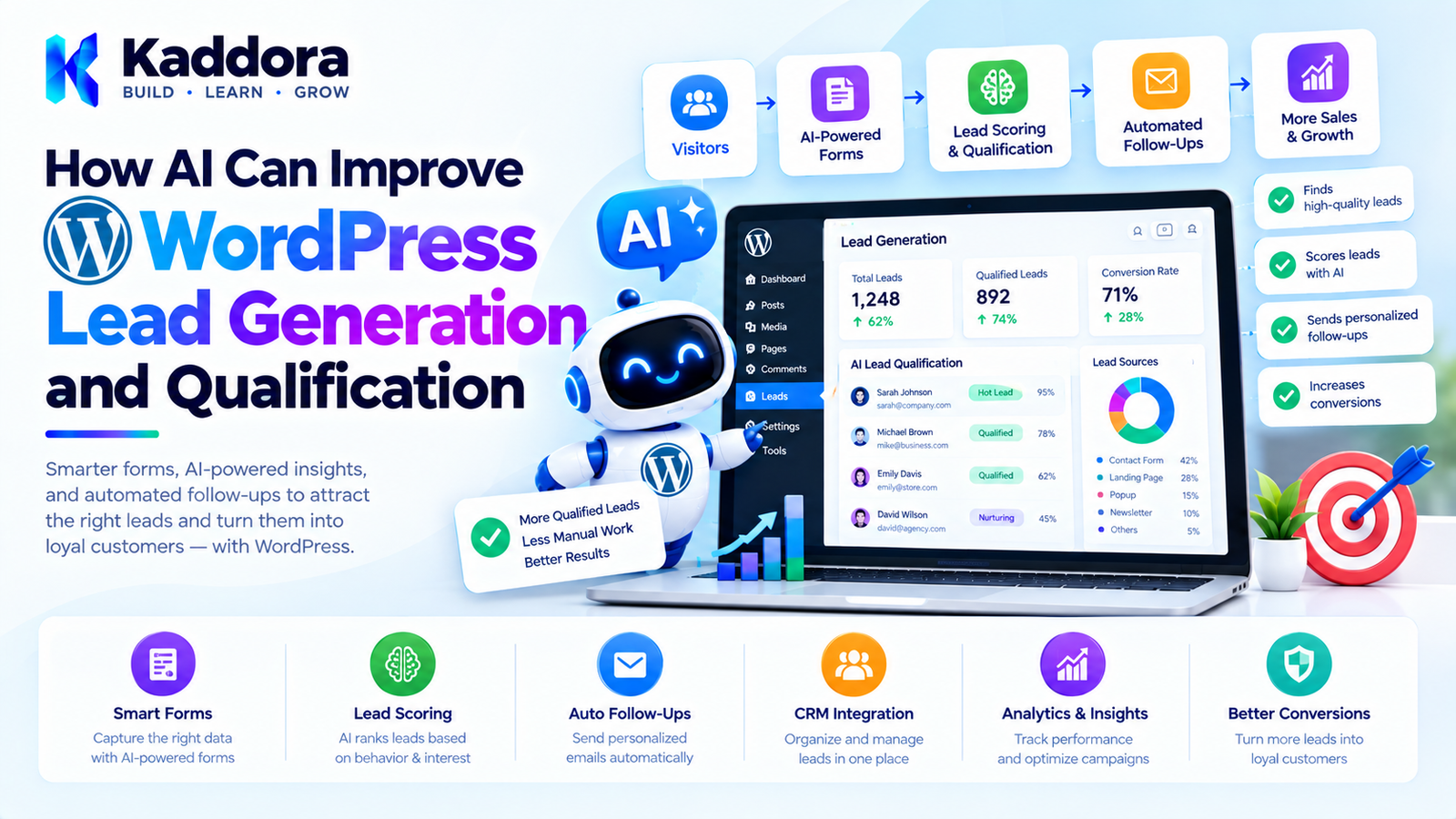
How AI Can Improve WordPress Lead Generation and Qualification
Introduction
Generating leads is one of the most important goals for many WordPress websites.
Whether you operate:
A SaaS business
Digital agency
Consulting company
WooCommerce store
Real estate website
Education platform
Service business
Membership website
B2B company
your website needs a reliable way to turn visitors into potential customers.
Traditional lead generation usually depends on:
Visitor ↓ Landing Page ↓ Form ↓ Lead ↓ Sales Team
Artificial intelligence can make this process more intelligent.
AI can help understand visitor intent, answer questions, personalize interactions, qualify leads, score prospects, summarize submissions, and route leads to the appropriate sales workflow.
A modern architecture can look like:
Visitor ↓ WordPress Website ↓ AI Interaction ↓ Lead Capture ↓ AI Qualification ↓ Lead Score ↓ CRM / Sales Team ↓ Follow-Up
The objective is not simply to collect more form submissions.
The objective is to identify relevant prospects and help move them through the sales process efficiently.
What Is AI Lead Generation?
AI lead generation uses artificial intelligence to help identify, attract, capture, and qualify potential customers.
AI can assist with:
Website chatbots
Lead-generation forms
Conversational forms
Visitor intent detection
Lead scoring
Lead qualification
Personalized recommendations
Content personalization
Follow-up generation
CRM data enrichment
Sales summaries
Conversion analysis
For example:
Visitor ↓ AI Chatbot ↓ "What service are you looking for?" ↓ Visitor Response ↓ AI Qualification ↓ Lead Created
Why Lead Generation Matters for WordPress Websites
Traffic alone does not necessarily produce business results.
A website may receive:
10,000 Visitors
but only a small percentage may become:
Leads
and an even smaller percentage may become:
Customers
A lead-generation system helps businesses understand the path:
Traffic ↓ Engagement ↓ Lead ↓ Qualified Lead ↓ Opportunity ↓ Customer
AI can assist at several stages of this funnel.
AI Lead Generation vs Traditional Lead Generation
Traditional lead generation often looks like:
Visitor ↓ Contact Form ↓ Email Notification ↓ Sales Team
AI-assisted lead generation can look like:
Visitor ↓ AI Conversation ↓ Intent Detection ↓ Relevant Questions ↓ Lead Qualification ↓ Lead Score ↓ CRM ↓ Sales Follow-Up
The AI system can collect additional context before the lead reaches the sales team.
AI Lead Generation With WordPress Forms
WordPress forms are one of the easiest places to introduce AI-assisted lead generation.
A traditional form might ask:
Name Email Phone Message
An AI-assisted form can dynamically ask relevant questions.
For example:
AI: What service are you interested in? Visitor: WordPress development. AI: What type of website are you building? Visitor: WooCommerce store. AI: Do you already have an existing website? Visitor: Yes.
The system can then create a structured lead.
AI Conversational Forms
Conversational forms replace long forms with a question-by-question experience.
Instead of:
Name Email Company Budget Service Message
the visitor sees:
What can we help you with? ↓ What type of business do you operate? ↓ What service do you need? ↓ What is your estimated budget? ↓ How can we contact you?
This can make lead capture feel more interactive.
AI Form Qualification
Not every form submission has the same business value.
AI can analyze submitted information and classify leads.
For example:
Lead ↓ AI Analysis ↓ Qualification ├── High Intent ├── Medium Intent ├── Low Intent └── Needs Review
The actual qualification criteria should be defined by the business.
What Is AI Lead Qualification?
Lead qualification determines whether a lead matches the business's target customer criteria.
Possible criteria include:
Service requirement
Budget
Company size
Industry
Location
Project timeline
Existing solution
Purchase intent
Business need
AI can organize these responses into structured lead information.
AI Lead Scoring
Lead scoring assigns a numerical or categorical value to prospects based on predefined criteria.
For example:
Budget matches target +20 Requested service +25 Timeline under 30 days +20 Company size matches ICP +15 High engagement +10
The resulting score can be used for workflow routing.
For example:
80–100 → Priority 50–79 → Follow-Up 0–49 → Nurture
These thresholds should be configured according to the business's actual sales process.
AI and Ideal Customer Profiles
An Ideal Customer Profile, or ICP, describes the type of customer a business is trying to serve.
For example:
Industry: SaaS Company Size: 10–100 employees Budget: $5,000+ Need: Custom WordPress development Timeline: Under 60 days
AI can compare lead information against these criteria.
The result could be:
ICP Match: High Reasons: - Industry matches - Budget matches - Required service matches - Timeline matches
The criteria should remain transparent and configurable.
AI Lead Intent Detection
AI can analyze the language used by visitors.
Compare:
"I'm researching WordPress plugins."
with:
"I need a WordPress plugin developed for my company."
The second statement may indicate a different stage of purchase intent.
AI can classify such language into predefined intent categories.
Lead Intent Categories
A business might use:
Research Comparison Evaluation Purchase Intent Existing Customer Support
This can help route visitors to the appropriate experience.
AI Chatbots for Lead Generation
An AI chatbot can combine support and lead generation.
For example:
Visitor: Can you build a WooCommerce marketplace? AI: Yes. We provide custom WooCommerce development. Would you like to tell me about your project?
The chatbot can then collect:
Name
Project type
Requirements
Budget
Timeline
The information can become a lead record.
AI Chatbot Lead Qualification
A lead-generation chatbot can ask different questions depending on previous answers.
For example:
Visitor wants SEO ↓ AI asks about website size ↓ Visitor says WooCommerce ↓ AI asks about product count ↓ Visitor says 10,000 products ↓ AI routes to WooCommerce SEO workflow
This creates a more contextual lead-capture process.
AI Lead Generation Landing Pages
AI can assist with landing-page personalization.
For example:
Visitor Interest ↓ AI / Rules ↓ Relevant Content ↓ Relevant CTA ↓ Lead Capture
A visitor interested in WooCommerce could see WooCommerce-focused messaging rather than generic agency content.
Personalization should respect privacy and applicable consent requirements.
AI Personalized Calls to Action
Different visitors may respond to different calls to action.
Examples:
Book a Demo Get a Quote Start Free Trial Request Consultation Download Guide Talk to an Expert
AI can help select or generate relevant messaging based on the visitor's stated intent.
AI Lead Magnets
AI can help businesses create lead magnets such as:
Checklists
Guides
Templates
Reports
Calculators
Assessments
Quizzes
Industry resources
A WordPress website can use these resources to capture leads.
For example:
Free SEO Audit ↓ Email Capture ↓ AI Analysis ↓ Personalized Report ↓ Lead
AI-Powered Quizzes for Lead Generation
Interactive quizzes can collect useful qualification information.
For example:
What type of website do you operate? ↓ How much traffic do you receive? ↓ What is your main challenge? ↓ What solution are you considering?
AI can summarize the responses and create a structured lead profile.
AI Lead Qualification Reports
After a visitor completes a quiz or form, AI can generate an internal summary.
For example:
Lead Summary Business: Example Company Requirement: WooCommerce development Budget: $5,000–$10,000 Timeline: 30 days Primary Need: Custom checkout Qualification: High relevance
The sales team receives useful context instead of only a raw form submission.
AI CRM Integration
A WordPress website can send qualified leads to a CRM.
The workflow can be:
WordPress ↓ Lead Capture ↓ AI Qualification ↓ Lead Scoring ↓ CRM ↓ Sales Pipeline
The CRM could contain:
Lead name
Contact information
Company
Source
Requirements
Lead score
Intent
AI summary
Assigned sales representative
AI Lead Enrichment
Lead enrichment means adding useful information to a lead record.
Depending on the legitimate data sources and applicable privacy requirements, enrichment may include:
Company information
Industry
Website
Lead source
Product interest
Form responses
Do not collect or infer sensitive personal information unnecessarily.
AI Lead Routing
AI can help determine which sales team should receive a lead.
For example:
Lead ↓ AI Classification ├── WooCommerce → E-commerce Team ├── SEO → SEO Team ├── SaaS → SaaS Team └── Enterprise → Enterprise Team
Routing rules should be explicit and reviewable.
AI Lead Assignment
A larger business can route leads according to:
Product
Geography
Industry
Company size
Lead score
Sales territory
Service type
AI can classify the lead, while deterministic business rules can handle final assignment.
AI Lead Follow-Up
AI can generate personalized follow-up drafts.
For example:
Lead Requirement: WooCommerce migration AI Draft: Thanks for sharing your WooCommerce migration requirements. Based on the information provided, our team can help...
The sales representative can review the message before sending it.
Automated Email Follow-Up
A lead-generation system can trigger workflows such as:
Lead Submitted ↓ Confirmation Email ↓ AI Lead Summary ↓ Sales Assignment ↓ Follow-Up
Automation should respect email consent, applicable marketing rules, and the user's communication preferences.
AI Lead Nurturing
Not every lead is ready to buy immediately.
A nurturing workflow can provide useful content over time:
New Lead ↓ Educational Content ↓ Case Study ↓ Product Information ↓ Demo / Consultation
AI can help personalize content recommendations.
AI Lead Segmentation
Leads can be segmented based on structured business criteria.
For example:
Leads ├── Enterprise ├── SMB ├── Startup ├── Agency └── Individual
Additional segmentation can include:
High Intent Medium Intent Low Intent
AI can help classify leads into these predefined groups.
AI Lead Generation for WooCommerce
WooCommerce stores can use AI for lead generation through:
Product recommendation quizzes
Personalized product finders
Back-in-stock notifications
Product comparison tools
Shopping assistants
Quote requests
Wholesale forms
For example:
Customer ↓ Product Finder ↓ AI Recommendation ↓ Email Capture ↓ Lead / Customer
AI Lead Generation for Real Estate
Real estate websites can use AI to qualify property inquiries.
For example:
Visitor ↓ Property Interest ↓ Budget ↓ Location ↓ Property Type ↓ Timeline ↓ Qualified Lead
The AI can summarize the requirements for an agent.
AI Lead Generation for Agencies
Digital agencies can use AI to qualify project inquiries.
For example:
Service Budget Timeline Business Type Current Website Project Requirements
The system can create an internal project summary.
AI Lead Generation for SaaS
SaaS websites can use AI assistants to:
Explain features
Compare plans
Answer questions
Qualify prospects
Schedule demos
Capture contact information
A workflow could be:
Visitor ↓ AI Product Assistant ↓ Feature Questions ↓ Plan Recommendation ↓ Demo Request
AI Lead Generation for B2B Websites
B2B lead generation often requires more qualification than a simple contact form.
Useful fields can include:
Company size
Industry
Use case
Budget
Timeline
Number of users
Current technology
AI can summarize these responses for sales teams.
AI Lead Generation for Service Businesses
Service businesses can use AI to qualify:
Legal inquiries
Consulting requests
Marketing projects
Development projects
Design requests
Financial services inquiries
Professional services
The AI workflow should be adapted to the specific business.
AI Lead Qualification and Forms
A WordPress form can collect structured data:
$lead = array( 'name' => $name, 'email' => $email, 'service' => $service, 'budget' => $budget, );
The application can then pass the relevant fields to an AI service for classification.
AI output should be validated before storing it as a lead attribute.
AI Lead Scoring Architecture
A practical architecture is:
Form / Chat ↓ Input Validation ↓ Lead Record ↓ Rule-Based Scoring ↓ AI Classification ↓ Final Lead Status ↓ CRM
Using deterministic business rules alongside AI can make the workflow easier to audit.
AI vs Rule-Based Lead Scoring
AI is not always necessary.
For example:
Budget > $10,000 +30 Timeline < 30 days +20 Target Service +20
A simple rule engine may be more transparent.
AI becomes more useful when analyzing:
Free-text answers
Customer intent
Conversation context
Complex descriptions
Unstructured requirements
The strongest system may combine both.
AI Lead Qualification From Free-Text Messages
Suppose a visitor writes:
"We operate a WooCommerce store with around 15,000 products and need help improving product filtering and search before our next sales campaign."
AI can extract structured information:
Platform: WooCommerce Product Count: 15,000 Requirement: Search + Filtering Timeline: Before campaign Potential Service: WooCommerce optimization
The extracted information can be reviewed or stored in structured fields.
AI Lead Summarization
Sales teams often receive long messages.
AI can convert:
Long Customer Message
into:
Need: WooCommerce optimization Main Problem: Poor product discovery Scale: 15,000 products Goal: Improve search before campaign
This can reduce manual reading time.
AI Lead Intent and Sentiment
AI can classify customer language into categories such as:
Interested Researching Urgent Existing Customer Support Request
Sentiment analysis can also be used as a support signal, but it should not be treated as a definitive assessment of a person's emotional state.
AI Lead Source Analysis
A WordPress lead system should track where leads originate.
Possible sources:
Google Organic Search Paid Ads Social Media Email Referral Landing Page AI Chatbot
AI can summarize patterns across these sources.
AI Conversion Funnel Analysis
A useful funnel is:
Visitors ↓ Engaged Visitors ↓ Leads ↓ Qualified Leads ↓ Opportunities ↓ Customers
AI can help summarize where users appear to drop out.
The underlying analytics should remain the source of truth.
AI Lead Generation Dashboard
A WordPress admin dashboard could display:
Total Leads Qualified Leads Lead Score Lead Sources Conversion Rate Top Services Pending Follow-Ups
AI can provide a natural-language summary of the dashboard.
AI Lead Generation Reports
For example:
Weekly Lead Report New Leads: 124 Qualified: 48 Pending Follow-Up: 17 Top Service Interest: WooCommerce Top Lead Source: Organic Search
The values should come from actual stored analytics.
AI Appointment Scheduling for Leads
Once a lead is qualified, AI can guide the visitor toward scheduling.
For example:
Qualified Lead ↓ Book Consultation ↓ Availability ↓ Select Time ↓ Appointment
The booking system should confirm actual availability.
AI should not claim that a meeting has been booked until the booking system confirms it.
AI Lead Generation and CRM Automation
A complete workflow can be:
WordPress ↓ AI Lead Capture ↓ Qualification ↓ Lead Score ↓ CRM ↓ Assignment ↓ Follow-Up ↓ Appointment
This can connect marketing and sales operations.
AI Lead Generation and Privacy
Lead-generation systems can collect personal information.
Possible data includes:
Name
Phone
Company
Requirements
Form responses
Conversation history
Only collect information that is necessary for the stated purpose.
Businesses should consider applicable privacy and data-protection requirements before sending lead information to external AI services.
Do Not Send Unnecessary Personal Data to AI
For lead qualification, the AI may only need:
Service Budget Timeline Requirements
It may not need:
Password Payment Information Authentication Token Private Account Data
Data minimization reduces unnecessary exposure.
AI Lead Generation Security
A WordPress AI lead-generation system should include:
Input validation
Sanitization
Authentication where necessary
Capability checks for admin functions
Nonces where appropriate
Rate limiting
Secure API credentials
Output escaping
Access controls
AI should never bypass application security.
Protect Lead Data
Lead information should be protected using appropriate WordPress and infrastructure security practices.
Avoid exposing private lead information through:
Public REST APIs
Frontend JavaScript
Unprotected AJAX endpoints
Public logs
Debug output
AI Lead Generation Rate Limiting
Public AI lead-generation chatbots can be abused.
Implement controls such as:
Requests per IP Requests per Session Requests per User Daily AI Quota
The exact limits should match the application's traffic and cost profile.
AI Lead Generation Cost Management
AI requests can increase operating costs.
Control costs through:
Input limits
Output limits
Caching
Appropriate model selection
Rule-based scoring for simple cases
Conversation summarization
Request quotas
Background processing where appropriate
AI Lead Generation With Existing WordPress Plugins
AI can complement existing WordPress tools for:
Forms
CRM
Email marketing
Analytics
WooCommerce
Booking
Chat
The AI layer can act as an intelligence component rather than replacing every existing system.
Build an AI Lead Generation Plugin
A dedicated WordPress plugin could contain:
AI Lead Generation Plugin │ ├── Lead Capture ├── Conversational Forms ├── AI Qualification ├── Lead Scoring ├── Lead Segmentation ├── CRM Integration ├── Email Automation ├── Analytics ├── AI Reports └── Settings
The architecture should remain proportional to the business requirements.
AI Lead Generation Plugin Architecture
A scalable architecture might look like:
Frontend ↓ WordPress REST / AJAX ↓ Lead Controller ↓ Lead Service ├── Lead Validator ├── Qualification Engine ├── AI Service └── CRM Service ↓ Database
This keeps WordPress integration, business logic, and external AI communication separated.
AI Service Layer
A dedicated AI service can isolate the external provider.
For example:
final class Kaddora_AI_Service { public function classify_lead( array $lead_data ) { // Send approved data to AI service. } }
The lead-management system does not need to know provider-specific API details.
Lead Qualification Service
A service can coordinate:
final class Lead_Qualification_Service { public function qualify( array $lead ) { // Apply business rules. // Use AI where appropriate. // Return structured qualification. } }
This keeps the workflow reusable across:
Forms
Chatbots
Landing pages
REST APIs
CRM imports
AI Lead Generation Workflow
A complete workflow can be:
1. Visitor Arrives ↓ 2. Visitor Engages ↓ 3. AI / Form Captures Information ↓ 4. Input Is Validated ↓ 5. Lead Is Created ↓ 6. Lead Is Qualified ↓ 7. Lead Is Scored ↓ 8. Lead Is Routed ↓ 9. CRM Is Updated ↓ 10. Follow-Up Begins
Common AI Lead Generation Mistakes
1. Collecting Too Much Data
Only ask for information that serves a legitimate purpose.
2. Letting AI Decide Everything
Use explicit business rules for important decisions.
3. No CRM Integration
A lead-generation system should fit into the sales workflow.
4. No Lead Validation
Validate email addresses and other important fields.
5. No Human Review
High-value or complex leads may need human verification.
6. Exposing Lead Data
Protect private customer information.
7. No Rate Limiting
Public AI forms and chatbots can be abused.
8. Sending Sensitive Data to AI
Minimize external data transmission.
9. Overusing AI
Simple rules may solve some problems more efficiently.
10. Measuring Only Lead Volume
A large number of low-quality leads may not be useful.
Best Practices for AI Lead Generation in WordPress
1. Define Your Ideal Customer
Create clear qualification criteria.
2. Use Conversational Forms
Ask relevant questions progressively.
3. Combine AI With Rules
Use AI for unstructured information and deterministic rules for important business logic.
4. Centralize Lead Data
Maintain a consistent lead record.
5. Integrate With Your CRM
Make qualified leads available to the sales team.
6. Provide Useful Follow-Up
Do not collect leads without a plan for what happens next.
7. Protect Customer Data
Use appropriate security and privacy controls.
8. Monitor Lead Quality
Track qualified leads and downstream outcomes.
9. Control AI Costs
Use appropriate models, limits, caching, and rules.
10. Keep Humans in the Loop
Allow sales teams to review important leads and AI-generated information.
AI Lead Generation Checklist
Lead Capture
Lead forms configured
Conversational forms considered
Required fields defined
Input validation implemented
Spam protection enabled
AI
Intent detection
Lead qualification
Lead scoring
Lead summarization
Product/service matching
AI response validation
Sales
CRM integration
Lead routing
Sales assignment
Follow-up workflow
Appointment scheduling
Security
API credentials protected
Lead data access controlled
REST/AJAX endpoints secured
Rate limiting implemented
Sensitive information minimized
Analytics
Lead sources tracked
Qualified leads tracked
Conversion funnel measured
Follow-up performance monitored
AI recommendations reviewed
The Future of AI Lead Generation in WordPress
The future of WordPress lead generation is likely to become more conversational and context-aware.
Instead of:
Visitor ↓ Static Form
businesses can build:
Visitor ↓ AI Conversation ↓ Intent ↓ Requirements ↓ Qualification ↓ Personalized Experience ↓ CRM ↓ Sales
A more advanced system could connect:
WordPress + AI + Forms + CRM + Analytics + Email + Appointments
The most effective architecture will not rely on AI alone.
It will combine AI's ability to understand unstructured information with reliable application rules and authoritative business systems.
Why Choose Kaddora?
Kaddora focuses on practical WordPress and WooCommerce solutions involving AI, automation, analytics, customer engagement, and business workflows.
For businesses interested in AI-powered lead generation, these technologies can support:
AI lead-generation forms
Conversational forms
AI chatbots
Lead qualification
Lead scoring
CRM integration
Automated follow-ups
Appointment scheduling
AI sales summaries
Conversion analytics
Kaddora's approach is to use AI where it provides practical value while keeping important business rules, customer data, permissions, and CRM workflows under application control.
AI can help understand a visitor's requirements and organize unstructured responses, while deterministic systems can handle lead storage, routing, permissions, appointments, and other critical operations.
Conclusion
AI can make WordPress lead generation more intelligent by helping businesses understand visitor intent, capture useful information, qualify prospects, summarize requirements, and connect leads with sales workflows.
A practical architecture is:
Visitor ↓ WordPress ↓ AI / Form ↓ Lead Capture ↓ Qualification ↓ Lead Scoring ↓ CRM ↓ Sales Follow-Up
For WooCommerce, SaaS, agencies, service businesses, real estate websites, and B2B companies, AI can support different lead-generation workflows.
The most important principle is that AI should assist the sales process rather than become the sole decision-maker.
Lead information should be validated.
Customer data should be protected.
Important qualification rules should be explicit.
CRM records should remain authoritative.
Appointments should be confirmed by the actual booking system.
And high-value or sensitive decisions should have appropriate human oversight.
When WordPress, AI, forms, CRM systems, analytics, and sales workflows are connected properly, businesses can create a more useful lead-generation experience while reducing repetitive manual work.
The goal is not simply to generate more leads.
It is to capture better information, identify relevant prospects, and help sales teams respond more effectively.
Frequently Asked Questions
What is AI lead generation in WordPress?
AI lead generation uses artificial intelligence to help capture visitors, understand their requirements, identify intent, qualify prospects, and connect leads with sales workflows.
Can AI generate leads from a WordPress website?
Yes. AI can support lead generation through chatbots, conversational forms, personalized experiences, quizzes, product finders, and other interactive website features.
What is AI lead qualification?
AI lead qualification analyzes lead information to determine how closely a prospect matches predefined business criteria.
Can AI score WordPress leads?
Yes. AI can help classify and score leads, although important scoring rules can also be implemented using deterministic business logic.
Should AI make the final decision about a lead?
Not necessarily. For important sales or business decisions, explicit rules and human review can provide additional control.
Can I add an AI chatbot for lead generation?
Yes. A WordPress AI chatbot can answer questions, collect requirements, qualify prospects, and create lead records.
Can AI qualify leads from contact forms?
Yes. AI can analyze structured form fields and free-text responses to produce a qualification summary.
What is a conversational lead form?
A conversational form asks questions progressively rather than displaying a large form with many fields at once.
Can AI personalize lead-generation forms?
Yes. AI can help determine which questions or messages are relevant based on a visitor's previous responses.
Can AI process customer passwords or payment information?
No. Sensitive credentials and payment information should not be unnecessarily exposed to AI systems.
How can I control AI lead-generation costs?
Use request limits, appropriate models, input and output limits, caching where appropriate, deterministic rules for simple decisions, and efficient workflows.
Can AI lead-generation systems be abused?
Yes. Public chatbots and forms can receive spam or automated requests. Rate limiting, validation, anti-spam controls, and usage monitoring can reduce abuse.
Why choose Themekaddora?
Themekaddora provides lightweight, responsive, SEO-friendly WordPress themes with fast performance, WooCommerce compatibility, flexible customization, accessibility-conscious design, modern templates, regular updates, and professional support—providing a strong foundation for businesses building digital products and product-focused websites.
Comments (0)