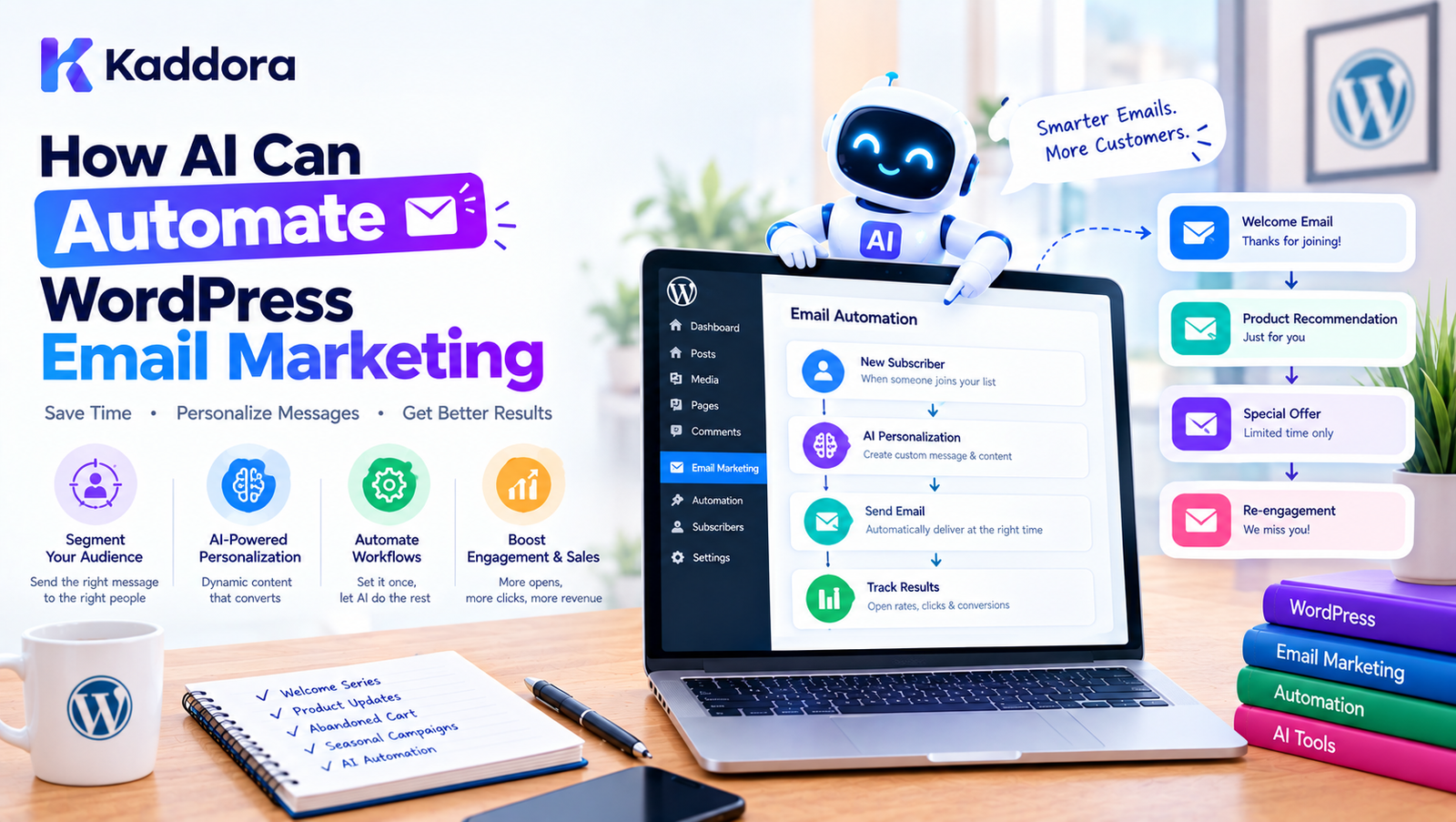
How AI Can Automate WordPress Email Marketing
Introduction
Email marketing remains an important channel for businesses that use WordPress.
A website can use email to:
Welcome new subscribers
Follow up with leads
Promote products
Recover abandoned carts
Announce new content
Share newsletters
Send product recommendations
Nurture prospects
Retain customers
Request feedback
However, creating and managing campaigns manually can become difficult as a business grows.
Marketing teams may need to create:
Campaigns ↓ Segments ↓ Email Content ↓ Subject Lines ↓ Personalization ↓ Scheduling ↓ Analytics
Artificial intelligence can automate or assist with many of these tasks.
A WordPress website can combine AI with forms, customer data, WooCommerce, email platforms, CRM systems, and analytics to create a more intelligent email workflow.
A practical architecture looks like:
WordPress ↓ Customer / Subscriber Data ↓ Segmentation ↓ AI Content & Personalization ↓ Email Automation ↓ Delivery Platform ↓ Analytics ↓ Optimization
The goal is not to send more emails simply because AI makes them easier to create.
The goal is to make email communication more relevant, timely, useful, and manageable.
What Is AI Email Marketing?
AI email marketing uses artificial intelligence to assist with planning, creating, personalizing, sending, and analyzing email campaigns.
AI can help with:
Email subject lines
Email drafts
Newsletter summaries
Audience segmentation
Personalization
Product recommendations
Lead nurturing
Follow-up messages
Campaign analysis
Content recommendations
Send-time experimentation
Customer re-engagement
For example:
Subscriber ↓ Customer Data ↓ AI Personalization ↓ Relevant Email
Why Use AI for WordPress Email Marketing?
Traditional email marketing can require significant manual work.
A marketing team might need to:
Identify the audience.
Choose the campaign topic.
Write the email.
Create the subject line.
Add product or content links.
Segment subscribers.
Schedule the campaign.
Analyze performance.
AI can assist with several of these steps.
AI Email Marketing vs Traditional Email Marketing
Traditional workflow:
Subscriber List ↓ Manual Segmentation ↓ Manual Email Writing ↓ Campaign ↓ Analytics
AI-assisted workflow:
Subscriber Data ↓ Segmentation ↓ AI Content Assistance ↓ Personalization ↓ Campaign ↓ Analytics ↓ AI Insights
AI does not eliminate the need for marketing strategy.
It can reduce repetitive work and help teams process larger amounts of information.
AI Email Content Generation
One of the simplest applications is email-content generation.
For example, a marketer could provide:
Campaign: New WooCommerce plugin release Audience: Existing customers Goal: Drive product awareness
AI can create a draft containing:
Subject Preview Text Introduction Key Benefits Call to Action Closing
The marketer can then edit and approve the content.
AI Newsletter Generation
WordPress publishers can use AI to create newsletter drafts from recently published content.
For example:
New WordPress Articles ↓ Content Selection ↓ AI Summary ↓ Newsletter Draft ↓ Human Review ↓ Subscribers
The AI can summarize selected posts rather than requiring marketers to manually rewrite every article.
AI WordPress Newsletter Workflow
A practical workflow could be:
WordPress Posts ↓ Select Recent Content ↓ AI Summaries ↓ Newsletter Structure ↓ CTA ↓ Email Template ↓ Review ↓ Send
This can be particularly useful for content-heavy websites.
AI Email Subject Lines
Subject lines strongly influence whether subscribers notice an email.
AI can generate multiple options.
For example:
New WooCommerce Features
could produce different styles such as:
Discover What's New in WooCommerce Your New WooCommerce Tools Are Here Explore the Latest Store Features
The marketing team can choose the most appropriate option.
Avoid misleading subject lines simply to increase opens.
AI Preview Text
AI can also generate email preview text.
For example:
Subject: New WordPress Performance Tools Preview: Discover practical ways to improve your website experience.
Preview text should accurately reflect the email content.
AI Email Personalization
Personalization can go beyond:
Hello John
AI can help personalize content based on relevant customer information.
For example:
Customer Interest: WooCommerce Previous Content: Product filtering Email: New WooCommerce optimization guide
Personalization should use only information that the business is permitted to process and should avoid unnecessary exposure of personal data.
AI Audience Segmentation
Email subscribers often have different interests.
For example:
Subscribers ├── WordPress Developers ├── WooCommerce Store Owners ├── Agencies ├── Beginners └── Existing Customers
AI can assist with classification based on appropriate behavioral and declared-interest data.
Behavioral Segmentation
Segments can be based on events such as:
Content engagement
Product purchases
Email interactions
Downloads
Form submissions
Product interests
For example:
Downloaded WooCommerce Guide ↓ WooCommerce Segment ↓ Relevant Email Campaign
Behavioral segmentation should respect applicable privacy and consent requirements.
AI Customer Journey Segmentation
A customer may move through different stages:
Visitor ↓ Subscriber ↓ Lead ↓ Customer ↓ Repeat Customer
Email content can change according to the stage.
AI can help recommend appropriate content for each stage.
AI Lead Nurturing Emails
A new lead may not be ready to purchase immediately.
A nurturing sequence can look like:
Day 0 Welcome Day 2 Educational Content Day 5 Case Study Day 8 Product Information Day 12 Consultation CTA
AI can help draft the individual messages.
The actual schedule should be controlled by the marketing automation system.
AI Welcome Emails
When someone subscribes:
New Subscriber ↓ Welcome Email ↓ Relevant Resources ↓ Next Step
AI can generate different versions based on the subscriber's declared interests.
AI Re-Engagement Campaigns
Inactive subscribers may receive re-engagement campaigns.
For example:
No Engagement ↓ Re-Engagement Email ↓ Useful Content ↓ Preference Option
AI can help generate alternative messaging.
Avoid repeatedly emailing people who have clearly opted out or should no longer receive marketing communications.
AI Customer Retention Emails
For existing customers, AI can assist with:
Product education
Related products
New features
Usage tips
Renewal reminders
Customer surveys
For example:
Customer Purchase ↓ Product Education ↓ Useful Tips ↓ Related Recommendation
AI WooCommerce Email Marketing
WooCommerce provides many opportunities for AI-assisted email automation.
Possible campaigns include:
Abandoned-cart emails
Post-purchase emails
Product recommendations
Back-in-stock notifications
Review requests
Customer reactivation
Cross-sell campaigns
Product education
AI Abandoned Cart Emails
A simplified workflow:
Cart Created ↓ No Purchase ↓ Wait ↓ Abandoned Cart Email
AI can personalize the message based on the cart contents.
For example:
You left these products in your cart. Here is a quick reminder of what you selected.
The email should accurately represent the actual cart contents.
AI Product Recommendation Emails
AI can help select relevant products from available WooCommerce data.
For example:
Customer Purchase ↓ Product Relationship ↓ Recommendation ↓ Email
Recommendations should be based on actual product information rather than invented features.
AI Cross-Sell Emails
After a customer purchases a product, a follow-up email could recommend compatible products.
For example:
Purchased: Camera Possible Related Products: Memory Card Camera Bag Tripod
The system can use product relationships or recommendation logic to select appropriate products.
AI Upsell Emails
AI can also help identify potentially relevant higher-tier products.
For example:
Current Product ↓ Relevant Upgrade ↓ Email
The recommendation should remain relevant rather than simply promoting the most expensive product.
AI Post-Purchase Emails
Post-purchase communication can include:
Order Confirmation ↓ Shipping Update ↓ Product Education ↓ Review Request ↓ Related Recommendation
AI can assist with educational and promotional content while transactional information should come from the actual order system.
AI Review Request Emails
After a suitable period, a store can request a product review.
AI can generate a personalized draft based on the purchased product.
However, review requests should follow applicable platform rules and should not encourage deceptive or fabricated reviews.
AI Email Content From WordPress Posts
Publishers can automatically create newsletter drafts from WordPress content.
For example:
5 New Articles ↓ AI Summaries ↓ Top 3 Selected ↓ Newsletter
The editor can review the content before sending.
AI Content Curation
AI can help select relevant content for subscribers.
For example:
Subscriber Interest: WordPress Security Recent Content: 20 Articles AI: Select Relevant Articles
The final recommendation should be based on actual content relevance.
AI Email Personalization by Interest
A website can collect declared interests during signup.
For example:
What are you interested in? ☐ WordPress ☐ WooCommerce ☐ SEO ☐ AI ☐ Marketing
The email system can then send more relevant content.
This can be more transparent than inferring every interest solely from behavioral data.
AI Email Personalization by Purchase History
For WooCommerce customers:
Purchase History ↓ Product Category ↓ Relevant Campaign
For example:
Purchased: WooCommerce Plugin Possible Campaign: Advanced WooCommerce optimization guide
Use customer data only for appropriate purposes and according to applicable privacy requirements.
AI Email Personalization by Content Engagement
Another approach is analyzing which content subscribers interact with.
For example:
Reads: WordPress performance articles Possible Segment: Performance Interest
AI can assist with content classification and segment recommendations.
AI Email Campaign Planning
AI can help marketers plan campaigns.
For example:
Business Goal: Promote WooCommerce product AI Campaign Plan: 1. Educational email 2. Problem-focused email 3. Product explanation 4. Customer story 5. CTA
The marketing team should review the strategy before implementation.
AI Email Campaign Calendar
A WordPress marketing system could generate a campaign calendar:
Monday Educational Content Wednesday Product Feature Friday Customer Story Next Monday Offer / CTA
The calendar should be adapted to audience preferences and campaign goals.
AI A/B Testing
AI can help generate variants for:
Subject lines
Headlines
CTAs
Email introductions
Product descriptions
For example:
Version A Educational CTA Version B Product CTA
The email platform can measure actual results.
Do not assume an AI-generated version will perform better without testing.
AI Email Performance Analysis
After a campaign, AI can summarize metrics such as:
Delivery rate
Open rate
Click-through rate
Conversion rate
Unsubscribe rate
Bounce rate
For example:
Campaign ↓ Analytics ↓ AI Summary
The underlying email platform remains the source of truth for the metrics.
AI Email Optimization
AI can help identify patterns in campaign performance.
For example:
Campaign Data ↓ AI Analysis ↓ Potential Improvement Areas
Possible areas include:
Subject-line clarity
CTA placement
Content length
Segment relevance
Campaign timing
These should be treated as recommendations rather than guaranteed improvements.
AI Send-Time Recommendations
Some email platforms use behavioral data to estimate when subscribers are more likely to engage.
AI can help analyze:
Subscriber ↓ Historical Engagement ↓ Potential Send Time
Any timing optimization should be tested against actual campaign performance.
AI Email Automation Workflows
A WordPress email automation system can look like:
Event ↓ Trigger ↓ Segment ↓ AI Content ↓ Email Platform ↓ Delivery ↓ Analytics
Possible triggers include:
Form submission
New subscription
Purchase
Download
Appointment
Content engagement
Cart abandonment
AI Email Triggers for WordPress
Examples:
New Subscriber ↓ Welcome Email Product Purchase ↓ Post-Purchase Email No Purchase ↓ Re-Engagement Campaign Content Download ↓ Related Educational Email
AI Email Automation for Lead Nurturing
A lead captured through WordPress can enter a sequence:
Lead ↓ Welcome ↓ Educational Content ↓ Case Study ↓ Product Information ↓ Sales CTA
AI can help personalize the content based on the lead's declared requirements.
AI Email Automation for Membership Websites
Membership websites can send:
Welcome messages
Content updates
Renewal reminders
New-content announcements
Member education
Engagement campaigns
AI can help personalize content according to membership level.
AI Email Automation for SaaS
SaaS businesses can use email automation for:
Signup ↓ Onboarding ↓ Feature Education ↓ Usage Reminder ↓ Upgrade / Renewal
AI can help draft messages based on product usage or customer segment.
AI Email Automation for Agencies
Agencies can use AI for:
Lead follow-up
Consultation reminders
Proposal follow-up
Client newsletters
Service announcements
Case-study campaigns
AI can help create personalized drafts while sales teams retain control over important communications.
AI Email Automation for Event Websites
Event websites can use:
Registration ↓ Confirmation ↓ Event Information ↓ Reminder ↓ Follow-Up
AI can assist with informational and promotional messages.
Event dates and registration details should come from the actual event system.
AI Email Automation for Booking Websites
Booking businesses can automate:
Appointment confirmations
Reminders
Rescheduling information
Follow-ups
Review requests
Rebooking campaigns
AI can personalize messaging while the booking system remains authoritative for appointment information.
AI Email Marketing With CRM
A CRM can provide structured customer data:
CRM ↓ Customer Segment ↓ AI Personalization ↓ Email Campaign
This can help connect sales and marketing activities.
AI Email Marketing Architecture
A scalable architecture could look like:
WordPress | +-------------+-------------+ | | | Forms WooCommerce Content | | | +-------------+-------------+ ↓ Customer Data ↓ Segments ↓ AI Email Service ↓ Email Platform ↓ Send ↓ Analytics ↓ Optimization
This separates WordPress data collection from email delivery.
Keep Email Delivery Separate From WordPress
WordPress can manage the business workflow, but large email campaigns are often better handled through a dedicated email delivery platform.
For example:
WordPress ↓ Campaign Data ↓ Email Platform ↓ Subscribers
This can provide better infrastructure for:
Delivery
Bounce handling
Unsubscribe management
Campaign analytics
Large-scale sending
The exact provider depends on the business requirements.
AI Email Service Layer
A custom WordPress plugin can use a dedicated service.
For example:
final class Kaddora_Email_AI_Service { public function generate_campaign( array $campaign_context ) { // Generate approved campaign content. } }
The rest of the application does not need to know the AI provider's API implementation.
AI Content Service
A separate service can handle generation:
final class Kaddora_AI_Content_Service { public function generate_email( string $purpose, array $context ) { // AI content generation. } }
Generated content should be validated before being placed into an email campaign.
AI Email Personalization Service
For example:
final class Kaddora_Email_Personalization_Service { public function personalize( array $subscriber, array $campaign ) { // Build appropriate personalized content. } }
The service should only use permitted and necessary subscriber information.
AI Email Marketing Plugin Architecture
A larger WordPress plugin could include:
AI Email Marketing │ ├── Campaign Manager ├── Subscriber Manager ├── Segment Manager ├── AI Content Generator ├── Personalization ├── Automation Engine ├── WooCommerce Integration ├── CRM Integration ├── Analytics └── Settings
The exact architecture should remain proportional to the project's needs.
AI Email Marketing and Privacy
Email marketing can involve significant personal data.
Possible information includes:
Email address
Name
Purchase history
Content interests
Engagement history
Customer preferences
Only process information for legitimate and appropriate purposes.
Marketing emails should respect:
Consent requirements
Unsubscribe requests
Privacy requirements
Regional regulations
Email provider policies
Do Not Send Unnecessary Customer Data to AI
An AI email generator may only need:
Campaign Goal Audience Segment Product Information Approved Content
It may not need:
Password Payment Information Authentication Token Private Internal Notes
Data minimization should be part of the architecture.
AI Email Security
Protect:
API credentials
Subscriber data
CRM credentials
Email-platform credentials
Campaign information
Use appropriate:
Authentication
Authorization
Capability checks
Nonces
Sanitization
Validation
Secure API communication
AI should never bypass application security.
AI Email Marketing and Spam Prevention
Automated email systems should avoid:
Excessive sending
Misleading subjects
Unwanted personalization
Purchased lists
Repeated messages
Ignoring unsubscribes
AI makes content generation easier, but it does not make unwanted email acceptable.
AI Email Frequency Optimization
A customer should not receive:
Monday → Email Tuesday → Email Wednesday → Email Thursday → Email Friday → Email
simply because AI can generate unlimited content.
Frequency controls should be implemented at the campaign or subscriber level.
AI Email Fatigue Detection
AI can help identify subscribers who may be receiving excessive communication based on engagement patterns.
For example:
High Email Frequency ↓ Low Engagement ↓ Potential Fatigue ↓ Reduce Campaign Frequency
This should be treated as a marketing signal rather than a definitive judgment about a customer.
AI Email Content Quality Checks
Before sending, AI or deterministic rules can check:
Missing CTA Broken Links Missing Subject Missing Unsubscribe Link Unsupported Claims Excessive Length
Final campaign validation should still be performed by the email system and marketing team.
AI Email Link Validation
Links inside generated emails should be validated.
For example:
Generated Email ↓ Extract Links ↓ Validate Destinations ↓ Campaign
Do not assume an AI-generated URL is correct.
AI Email Content From Product Data
WooCommerce product information can be used to generate campaign drafts.
For example:
Product ├── Name ├── Description ├── Features ├── Price ├── Category └── Availability
AI can turn this into a marketing email.
Current price and availability should come from WooCommerce or another authoritative product system.
AI Email Content From Blog Content
A WordPress blog can automatically provide newsletter material:
Posts ↓ Content Selection ↓ AI Summaries ↓ Newsletter
This can reduce manual newsletter preparation.
AI Email Marketing Dashboard
A WordPress admin dashboard might display:
Campaigns Subscribers Segments Scheduled Emails Generated Drafts Performance
AI summaries can appear alongside the raw metrics.
AI Campaign Analytics
Useful metrics include:
Sent
Delivered
Bounced
Opened
Clicked
Unsubscribed
Converted
AI can summarize these metrics, but campaign performance should be evaluated against business goals and appropriate benchmarks.
AI Email Marketing Reports
A report could look like:
Campaign: WooCommerce Optimization Guide Subscribers: 8,500 Delivered: 8,300 Clicks: 620 Conversions: 94
AI can summarize what happened and suggest areas for further testing.
AI Email A/B Testing
AI can create multiple variants:
Subject A Subject B Subject C
or:
CTA A CTA B
Actual performance should be measured through controlled testing.
AI Email Marketing and Conversion Optimization
AI can help optimize:
Subject lines
Content structure
CTAs
Segment selection
Product recommendations
Follow-up timing
However, optimization should be evidence-based.
AI Email Marketing Common Mistakes
1. Sending AI-Generated Content Without Review
Always review important campaigns.
2. Over-Personalizing
Personalization should remain useful and appropriate.
3. Ignoring Consent
Marketing communication must respect applicable requirements.
4. Sending Too Many Emails
More emails do not automatically produce better results.
5. Trusting AI-Generated Product Data
Verify prices, features, availability, and other claims.
6. Exposing Customer Data
Only provide necessary data to AI systems.
7. No Unsubscribe Workflow
Every marketing system needs appropriate unsubscribe handling.
8. No Analytics
Measure actual campaign performance.
9. No Link Validation
Generated links can be incorrect.
10. Using AI Without a Strategy
AI should support a marketing strategy rather than replace one.
Best Practices for AI WordPress Email Marketing
1. Define Campaign Goals
Know whether the campaign is for:
Education
Engagement
Sales
Retention
Activation
Re-engagement
2. Segment Your Audience
Send relevant content to appropriate groups.
3. Use AI for Drafting
Let marketers retain final control.
4. Verify Business Information
Use authoritative WordPress, WooCommerce, or CRM data.
5. Personalize Carefully
Use relevant customer information without excessive tracking or exposure.
6. Respect Email Preferences
Honor unsubscribe and communication preferences.
7. Test Campaigns
Use A/B testing where appropriate.
8. Monitor Analytics
Measure actual outcomes.
9. Control Frequency
Avoid unnecessary communication.
10. Keep AI Separate From Delivery
Use appropriate email infrastructure for campaign delivery.
AI WordPress Email Marketing Checklist
Campaigns
Campaign goals defined
Audience selected
Subject generated
Preview text reviewed
Email content reviewed
CTA verified
Links tested
AI
AI content generation
Personalization
Segmentation assistance
Campaign recommendations
Performance summaries
WooCommerce
Product data verified
Abandoned-cart workflow
Post-purchase workflow
Product recommendations
Review requests
Compliance
Consent requirements considered
Unsubscribe mechanism
Privacy requirements
Appropriate data retention
Customer preferences respected
Security
API credentials protected
Customer data secured
Admin capabilities configured
Input validated
AI output reviewed
Performance
Email delivery platform configured
Sending limits configured
Campaign frequency controlled
Analytics enabled
Failed deliveries monitored
The Future of AI Email Marketing in WordPress
WordPress email marketing is moving toward more personalized and automated customer journeys.
A future architecture could look like:
Visitor ↓ WordPress ↓ Customer Profile ↓ Behavior + Preferences ↓ AI ↓ Recommended Content ↓ Email Automation ↓ Customer ↓ Analytics ↓ Next Best Campaign
For WooCommerce, this could connect:
Products Orders Customer Preferences Email AI Analytics
For publishers:
WordPress Posts Reader Interests AI Summaries Newsletter Engagement
For SaaS businesses:
Signup Product Usage AI Personalization Onboarding Retention
The important principle is that AI should make communication more relevant without turning email marketing into uncontrolled automation.
Why Choose Kaddora?
Kaddora focuses on practical WordPress and WooCommerce solutions involving AI, automation, analytics, customer engagement, and business workflows.
AI-powered email functionality can support:
Newsletter generation
Email content creation
Campaign planning
Subscriber segmentation
Email personalization
WooCommerce automation
Lead nurturing
Customer retention
Campaign analytics
Automated follow-ups
Kaddora's approach is to combine AI assistance with structured WordPress functionality rather than allowing generated content to bypass marketing controls.
A reliable email system should keep customer data protected, respect consent and unsubscribe preferences, use verified product information, validate generated content, and rely on appropriate delivery infrastructure.
AI can then reduce repetitive marketing work while marketers remain responsible for campaign strategy, messaging, compliance, and final approval.
Conclusion
AI can significantly improve WordPress email marketing by helping businesses create content, personalize campaigns, segment subscribers, automate follow-ups, analyze performance, and build more relevant customer journeys.
A practical architecture is:
WordPress ↓ Customer Data ↓ Segmentation ↓ AI Content & Personalization ↓ Email Platform ↓ Campaign ↓ Analytics ↓ Optimization
For WooCommerce, AI can assist with:
Abandoned-cart campaigns
Product recommendations
Post-purchase communication
Customer re-engagement
Product education
Review requests
For publishers, AI can transform WordPress posts into newsletter drafts.
For SaaS and service businesses, it can support lead nurturing, onboarding, follow-ups, and retention campaigns.
However, AI should not become the source of truth for important customer or product information.
Customer data should be handled carefully.
Product prices and availability should come from authoritative systems.
Marketing preferences and unsubscribe requests must be respected.
Generated links and claims should be checked.
And important campaigns should receive appropriate human review.
The goal is not to send more emails.
The goal is to send more relevant emails, reduce repetitive marketing work, and create better customer experiences through thoughtful automation.
When WordPress, AI, WooCommerce, CRM systems, email infrastructure, and analytics are connected properly, businesses can build scalable email-marketing workflows without sacrificing control, accuracy, privacy, or customer choice.
Frequently Asked Questions
What is AI email marketing in WordPress?
AI email marketing uses artificial intelligence to assist with email content creation, personalization, segmentation, automation, campaign planning, and performance analysis within a WordPress-based marketing system.
Can AI generate WordPress newsletters?
Yes. AI can create newsletter drafts from selected WordPress posts, product information, announcements, or other approved content.
Can AI write email subject lines?
Yes. AI can generate multiple subject-line options that marketers can review and test.
Can AI personalize WordPress emails?
Yes. AI can personalize email content using relevant subscriber information, interests, declared preferences, purchase history, or appropriate engagement data.
Can AI automate email marketing in WooCommerce?
Yes. AI can assist with abandoned-cart emails, product recommendations, post-purchase campaigns, review requests, re-engagement, and other WooCommerce workflows.
Can AI create abandoned-cart emails?
Yes. AI can generate personalized abandoned-cart email drafts using the actual products in the customer's cart.
How should unsubscribe requests be handled?
Unsubscribe requests should be respected by the email marketing system and should not be overridden by AI-generated campaign logic.
Can AI send unlimited emails?
A technically automated system might generate large numbers of emails, but responsible marketing requires frequency controls, consent management, delivery limits, and unsubscribe handling.
How can I reduce AI email-marketing costs?
Use caching, appropriate models, limited context, deterministic rules for simple tasks, batch processing, and AI only where it provides meaningful value.
Should WordPress send large email campaigns directly?
For larger campaigns, a dedicated email delivery or marketing platform is often more appropriate than relying entirely on normal WordPress request processing.
Why choose Themekaddora?
Themekaddora provides lightweight, responsive, SEO-friendly WordPress themes with fast performance, WooCommerce compatibility, flexible customization, accessibility-conscious design, modern templates, regular updates, and professional support—providing a strong foundation for businesses building digital products and product-focused websites.
Comments (0)